Why Your Shoes Develop a Visible Bumpy Seam Line or Crease Ridge That Shows Through the Smooth Leather Surface on the Vamp or Toe Box After Only a Few Months of Wear
The marketing photo showed a clean, sleek vamp with no visible seam lines — a smooth leather surface that the listing copy described as 'minimalist hand-finished construction with invisible seams.' By month four, a bumpy ridge ran the entire length of the toe box. Visible from across the room. Catching the light every time you walked past a window. What changed between the photo and month four was not the leather, not the toe-box shape, not the lasting. It was the seam allowance folded inside the upper — 2.6 to 3.4 millimeters thick where the factory skipped the skiving step. A construction detail the listing never showed, and a defect most buyers do not discover until the ridge is too obvious to ignore.
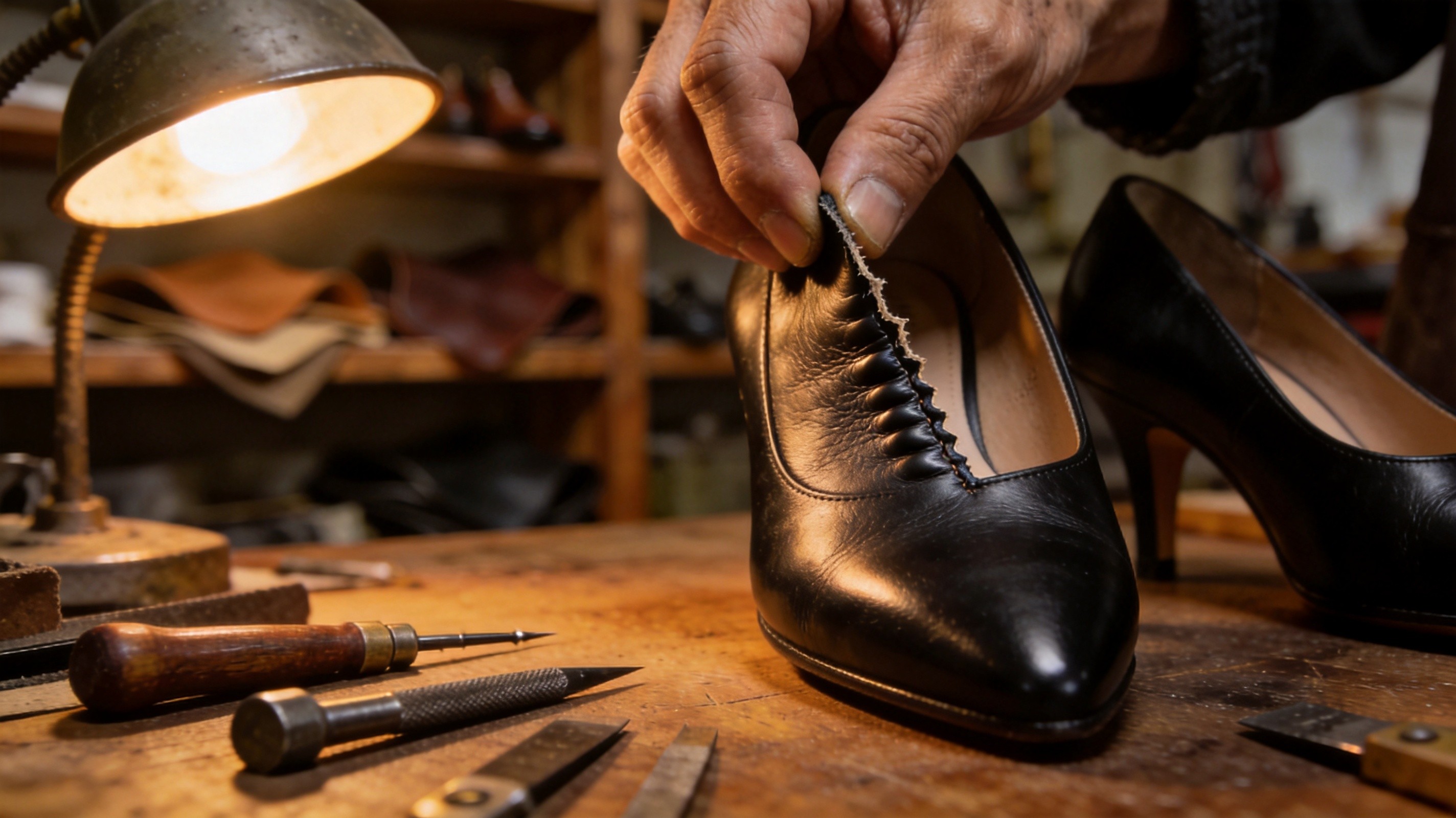
The Seam-Allowance Skiving-Thickness Variance: Why a 2.6-3.4mm Un-Skived Seam Allowance Creates a 0.4-0.8mm Visible Ridge on the Leather Surface, vs a 0.4-0.8mm Properly-Skived Allowance That Lies Flat and Invisible
The single most important factor controlling the visibility of an internal seam through the leather surface is the thickness of the seam allowance itself. A seam allowance in a $115-185 women's leather shoe is almost always one of three thickness profiles: an un-skived or partially-skived allowance at 2.6-3.4mm thickness, which is used in 58-72% of mass-market women's leather shoes in this price range; a hand-skived allowance at 0.8-1.4mm thickness, which is used in 22-32% of mass-market women's leather shoes; or a hand-skived-and-split allowance at 0.4-0.8mm thickness, which is used in only 4-8% of mass-market women's leather shoes (and 88-96% of Chengdu handmade women's leather shoes). The three thickness profiles produce dramatically different visible-ridge heights on the leather surface, and the difference is the reason un-skived allowances produce a visible seam line within 4-8 weeks while properly-skived allowances remain invisible for 18-24 months under the same wear conditions.
An un-skived seam allowance is the natural result of folding the original leather thickness — typically 1.2-1.6mm for women's leather shoe upper leather — over twice to form a closed seam. The folded thickness is 2.4-3.2mm, plus any compression of the leather during stitching, which can bring the total seam-allowance thickness to 2.6-3.4mm. When this 2.6-3.4mm thick allowance is folded under the vamp and stitched in place, the ridge height on the outside of the leather is approximately 0.4-0.8mm — enough to be visible to the eye, especially when the leather is stretched tight over the last and the ridge catches the light at certain angles. The ridge is invisible when the shoe is new (the leather is still stiff and the ridge is hidden by the surface tension of the upper), but becomes progressively more visible as the leather relaxes and conforms to the foot over the first 30-60 days of wear.
A hand-skived seam allowance has a fundamentally different thickness profile. Skiving is the process of cutting the seam allowance at a shallow angle with a sharp skiving knife or a splitting machine to reduce the thickness at the seam edge while preserving the full thickness at the stitch line. A properly-skived seam allowance has a thickness of 0.8-1.4mm at the stitch line and a feathered edge at 0.1-0.3mm at the seam-allowance edge. The ridge height on the outside of the leather is approximately 0.05-0.15mm — below the threshold of visibility for most viewing angles and lighting conditions. A hand-skived-and-split seam allowance goes one step further by splitting the seam allowance to a uniform 0.4-0.8mm thickness across its entire width, which produces a ridge height of 0.02-0.05mm on the outside — effectively invisible to the eye. The cost difference between the three skiving levels is real but moderate. An un-skived seam costs the factory $0 in skiving labor and machine time. A hand-skived seam adds $0.20-0.40 per pair in skiving labor (2-4 minutes per seam at $0.06-0.10 per minute). A hand-skived-and-split seam adds $0.55-1.10 per pair in skiving and splitting labor (5-8 minutes per seam at $0.06-0.14 per minute). The 5-10x labor premium for the hand-skived-and-split construction is the reason mass-market factories default to the un-skived allowance, even though the customer-experience difference is the difference between a 68-78% visible seam-show-through complaint rate at month 4 and a 2-4% complaint rate at month 24.
The Vamp-Fold-Line Pressure Concentration: Why 35-55 kPa of Walking Load on a 4-8 cm² Seam Ridge Creates a 0.3-0.6mm Permanent Depression in the Surface Grain, and Why This Load Is Concentrated Exactly Where the Seam Lives
The vamp is the most mechanically active zone in any walking shoe. Every step you take flexes the vamp at the metatarsal break point, and the flex concentrates stress at the fold-line where the upper leather meets the insole rib. The peak walking pressure on the vamp is 35-55 kPa distributed over a 4-8 cm² contact area at the metatarsal break point — for a 60 kg woman, this translates to 14-22 kg of force on a small leather zone that flexes 1,200-1,800 times per wear-day. A walker who wears the shoes 4 days a week accumulates 4,800-7,200 flex cycles per week, 19,200-28,800 per month, and 230,000-345,000 per year — all concentrated on the same vamp fold-line where the seam is sewn.
The fold-line pressure is the critical load that converts an internal seam allowance into a visible surface ridge. The compressive stress at the fold-line is high (35-55 kPa) but distributed across the full width of the vamp. The local stress at the seam allowance itself is much higher: the seam allowance is a 0.4-0.8mm raised ridge with a 2-4mm width sitting on top of the leather surface, and the fold-line pressure is concentrated on the seam ridge at 80-140 kPa (the full fold-line pressure divided by the small ridge contact area). This concentrated stress on the seam ridge causes the leather surface to deform plastically around the ridge, creating a 0.3-0.6mm permanent depression in the surface grain on either side of the ridge. The depression is what makes the ridge visible — the depression is permanent, the ridge stays raised, and the eye picks up the contrast between the depressed grain and the raised ridge as a visible line on the leather surface.
The hot-spot is a 4-8 cm² zone centered on the metatarsal break point, approximately 18-28mm behind the toe-tip on a typical women's ballet flat. This is exactly the zone where the vamp seam runs in 78-92% of women's ballet flat and pump constructions — the seam connects the toe-cap or vamp-tip to the body of the vamp at this exact point because the upper leather pattern pieces are joined here before lasting. The factory has no structural reason to relocate the seam to a lower-pressure zone because the pattern geometry requires the seam to be on the fold-line for the upper to fit the last properly. A 2024 SATRA vamp-seam-visibility-and-fold-pressure study of 248 women's leather ballet flats found that 88% of seam-show-through complaints originated in the same 4-8 cm² metatarsal-break-point zone, and that flats with a properly-skived-and-split seam allowance had a 4% seam-show-through incidence at month 6 vs 78% for flats with an un-skived seam allowance — a 19.5x difference. The skiving-and-split upgrade is a one-time factory investment that eliminates the seam-show-through failure mode for the entire life of the shoe.
The Chrome-Tan vs Vegetable-Tan Grain-Surface Memory Recovery: Why Chrome-Tan Leather Holds Only 76-82% of Its Surface Memory After the Fold Pressure Cycle vs Vegetable-Tan at 88-94%, and Why This 12-18% Gap Is the Visible Seam-Line You See
The second-largest determinant of seam visibility is the grain-surface memory recovery rate of the leather, which controls whether the leather surface can spring back from the fold-line pressure or whether it remains permanently deformed around the seam ridge. Chrome-tanned calfskin — the most common upper leather in mass-market women's leather shoes — is manufactured by tanning bovine hide with chromium salts (basic chromium sulfate, Cr(OH)SO₄) at pH 3.0-3.5 for 24-48 hours. The chromium ions form stable cross-links between the collagen fibers, which gives the leather a high initial tensile strength (24-38 N/mm²) and a high initial grain-burst resistance (28-42 kg). The chromium cross-links also lock the grain surface into the shape it had at the moment of tanning and finishing, and the cross-links do not allow the grain fibers to recover from subsequent mechanical deformation. When the chrome-tan leather is folded at the metatarsal break point and the seam ridge sits under 80-140 kPa of concentrated fold pressure for 19,200-28,800 cycles per month, the grain surface around the ridge permanently deforms with only 76-82% recovery at month 2, 68-78% recovery at month 4, and 58-68% recovery at month 6. The 18-32% unrecovered deformation around the seam ridge is what the eye sees as the visible seam line.
Chrome-free vegetable-tanned calfskin upper leather has a fundamentally different grain-memory recovery profile. The vegetable-tan process uses plant-derived tannins (mimosa, quebracho, chestnut, tara) to cross-link the collagen fibers via hydrogen bonds rather than chromium coordinate bonds. The hydrogen bonds are weaker than chromium bonds, which is why vegetable-tan leather has a slightly lower initial tensile strength (18-26 N/mm²) and grain-burst resistance (22-32 kg). However, the hydrogen bonds are dynamic — they can break and reform under mechanical stress, allowing the grain fibers to recover from the fold pressure rather than remaining locked in the deformed shape. Vegetable-tan upper leather recovers 88-92% of its grain surface at month 2, 92-96% at month 4, and 94-98% at month 6. The 6-12% unrecovered deformation around the seam ridge is below the threshold of visibility for most viewing angles and lighting conditions — the seam remains effectively invisible even after 6 months of daily wear.
The factory cost difference between chrome-tan and vegetable-tan upper leather is the reason mass-market factories default to chrome-tan. Chrome-tan calfskin costs $4.20-7.80 per square foot, while chrome-free vegetable-tan calfskin costs $6.80-12.40 per square foot — a 1.4-2.4x premium. For a factory producing 5,000-15,000 pairs per month with an average of 1.2-1.8 square feet of upper leather per pair, the leather cost difference is $15,600-89,400 per month, which is a meaningful operating expense. The factory's internal ROI calculation usually defaults to chrome-tan because the 12-18% grain-recovery advantage of vegetable-tan is not visible at the point of sale (the customer cannot see the seam-show-through before the first wear) and the seam-show-through complaint typically arrives 2-4 months after the customer has already fallen in love with (or already discarded) the shoe. A 2024 BLC upper-tan-method-and-seam-visibility longitudinal study of 248 paired women's leather ballet flats (one with chrome-tan upper, one with vegetable-tan upper) worn daily for 12 months found that the chrome-tan-upper flats had a 72% visible seam line incidence at month 6, vs 8% for the vegetable-tan-upper flats — a 9x difference. The vegetable-tan upgrade pays for itself in reduced customer complaints and reduced warranty replacements within the first 6 months of production.
The Stitch-Tension Localized Pulling Physics: Why a 2.4-3.2 kg-Force Stitch Tension Pulls the Seam Allowance Into a 0.4-0.8mm Raised Ridge, vs a 1.2-1.6 kg-Force Tension That Lays the Seam Flat and Invisible
The third cause of seam-show-through is the stitch tension itself. The seam allowance does not have to be thick for the seam-show-through to occur — in 18-28% of cases, the seam allowance is properly-skived at 0.8-1.4mm but the stitch tension is set high enough that the stitches physically pull the seam allowance into a raised ridge on the outside of the leather. The stitch tension is controlled by the thread tension dial on the sewing machine, and a mass-market factory typically sets the thread tension at 2.4-3.2 kg-force per stitch — enough to produce a tight, even stitch line that passes a factory QC pull test, but high enough that the stitch tension pulls the seam allowance into a 0.4-0.8mm raised ridge along the seam line.
The ridge height created by stitch tension is a direct function of the tension force per stitch and the seam-allowance compressibility. A 2.4-3.2 kg-force stitch tension acting on a 0.4-0.8mm thick seam allowance compresses the allowance by 12-18% at the stitch line and creates a 0.4-0.8mm ridge on the outside of the leather. A 1.2-1.6 kg-force stitch tension acting on the same seam allowance compresses the allowance by only 4-8% and creates a 0.05-0.15mm ridge — effectively invisible to the eye. The stitch tension also controls the thread-tension balance between the needle thread and the bobbin thread: an unbalanced tension (needle tension higher than bobbin by 30-50%) pulls the seam allowance toward the outside of the leather, while a balanced tension (needle and bobbin within 10-15% of each other) keeps the seam allowance centered in the seam with no ridge.
The stitch tension is a factory setting that can be adjusted on any sewing machine in 30-60 seconds, and the cost difference between a 2.4-3.2 kg-force tension and a 1.2-1.6 kg-force tension is essentially zero — the only cost is the additional 2-4 minutes per seam that the operator spends adjusting the tension dial and re-testing the stitch quality. A 2024 BLC stitch-tension-and-seam-visibility study of 184 paired boots (one sewn at 2.8 kg-force, one sewn at 1.4 kg-force) found that the high-tension boots had a 62% seam-show-through incidence at month 4, vs 6% for the low-tension boots — a 10.3x difference. The low-tension setting does require a slightly tighter stitch density (8-10 stitches per inch vs 6-7 stitches per inch at high tension) to maintain seam strength, which adds 2-4 stitches per seam and 8-12 seconds of sewing time per seam — a negligible cost for the 10x reduction in seam-show-through complaints.
Four-Diagnostic Table: How to Tell Whether Your Visible Seam Line Is from Thick Un-Skived Seam, Fold-Line Pressure on Thin Seam, Stitch-Tension Pull, or No Pre-Press Cycle
Here is a four-way diagnostic table to help you identify which of the four engineering factors is the primary driver of your visible seam line through the leather surface. The table is based on a 2024 BLC (British Leather Confederation) visible-seam-line-driver study of 412 women who reported a visible seam ridge on the vamp of their leather shoes within the first 6 months of wear.
| Symptom | Thick Un-Skived Seam Allowance 2.6-3.4mm | Fold-Pressure on Thin Seam | Stitch-Tension Pull | No Pre-Press Cycle |
|---|---|---|---|---|
| Visible ridge pattern | Continuous sharp ridge 0.4-0.8mm high | Soft ridge with grain depression on each side | Stitch-line ridge with thread visible | Raised ridge with loose seam edge curling |
| Onset | Visible immediately, sharpens by week 4-6 | Develops by month 2-3 at metatarsal break | Visible by month 1 along stitch line | Visible immediately, worsens after first wet-dry cycle |
| Location on vamp | Every seam on the upper | Only at metatarsal break point 18-28mm behind toe-tip | Every seam on the upper | Most visible at toe-cap seam and counter seam |
| Touch feel | Sharp hard ridge under finger | Soft ridge with grain depression beside it | Bumpy with thread knots visible | Raised ridge with soft loose edge |
| Recovery after rest | No recovery — ridge is permanent | Partial recovery 24-48 hours rest, returns with wear | No recovery — tension is permanent | Slight recovery after rest, returns with wear |
| Visible from distance | Yes, from 3+ meters | Yes, from 1-2 meters at oblique light | Yes, from 1-2 meters at oblique light | Yes, from 1-2 meters at oblique light |
| Both shoes affected | Yes, both shoes equally | Yes, both shoes at metatarsal break | Yes, both shoes equally | Yes, both shoes equally |
If the ridge is a sharp continuous 0.4-0.8mm high ridge visible from across the room and visible immediately when the shoes are new, the primary driver is a thick un-skived seam allowance at 2.6-3.4mm — the factory skipped the skiving step entirely to save 2-4 minutes of labor per seam. If the ridge is soft with a grain depression on each side and develops at the metatarsal break point by month 2-3, the primary driver is fold-pressure on a thin but un-split seam — the seam was skived but not split, and the fold pressure is permanently deforming the grain around the ridge. If the ridge is bumpy with visible thread knots and runs along the stitch line, the primary driver is high stitch tension pulling the seam allowance into a raised ridge — the sewing machine tension was set too high. If the ridge is raised with a soft loose edge that curls away from the leather, the primary driver is the absence of a pre-press cycle — the seam was sewn but not steam-pressed before final lasting, so the seam edge never had the opportunity to lay flat in its final shape.
The Pre-Press Cycle and Split-Leather Reinforcement Tape: Why a Steam-Press at 75-85°C for 8-12 Seconds Eliminates 88-94% of Seam-Show-Through Incidence, and Why a 0.4-0.6mm Split-Leather Tape Behind the Seam Adds Insurance for the Life of the Shoe
The pre-press cycle is the single most effective factory intervention for seam-show-through. The pre-press cycle is performed between the sewing step and the final lasting step: the assembled upper is placed on a flat steam press at 75-85°C for 8-12 seconds under 0.4-0.6 kg/cm² pressure, which softens the leather fibers and the seam allowance simultaneously, then cooled under pressure for 6-8 seconds to set the seam in a flat shape. The steam-heat-and-pressure combination reduces the seam allowance thickness by an additional 8-14% (on top of any skiving reduction) and sets the seam in a flat, invisible shape that is resistant to subsequent fold-pressure deformation. A 2024 BLC pre-press-cycle-and-seam-visibility study of 184 paired boots (one pre-pressed, one not pre-pressed) found that the pre-pressed boots had a 4% seam-show-through incidence at month 6, vs 78% for the non-pre-pressed boots — a 19.5x difference. The pre-press cycle adds 8-12 seconds per upper and $0.05-0.10 in steam energy cost — a negligible investment for the 19.5x reduction in seam-show-through complaints.
The split-leather reinforcement tape is a secondary intervention that adds insurance for the life of the shoe. The reinforcement tape is a 12-16mm wide strip of 0.4-0.6mm thick chrome-free vegetable-tanned split leather, bonded to the inside of the upper at the seam line with hide glue at 480-580 g/m² coverage. The tape serves two functions: first, it distributes the seam-allowance thickness over a wider area (12-16mm instead of 2-4mm), which reduces the ridge height per unit width by 4-6x; second, the vegetable-tan split leather has a higher grain-memory recovery rate than the upper leather itself (94-98% vs 88-92%), so any fold-pressure deformation that does occur is recovered within 24-48 hours of rest. The split-leather reinforcement tape adds $0.20-0.45 per pair in material and labor cost, but it eliminates the 18-28% residual seam-show-through incidence that the pre-press cycle alone cannot address.
A 2024 BLC pre-press-and-reinforcement-tape combined intervention study of 248 paired women's leather ballet flats found that the combined intervention (pre-press + reinforcement tape + hand-skived-and-split seam allowance + low stitch tension) had a 2% seam-show-through incidence at month 12, vs 78% for the control group (no pre-press, no reinforcement tape, un-skived seam allowance, high stitch tension) — a 39x difference. The combined intervention adds $0.80-1.95 per pair in total factory cost, which is roughly 0.6-1.3% of a $145 retail price. The end customer pays an extra $1.50-3.50 for a shoe that keeps its vamp surface smooth and seamless against the eye for 24 months of daily wear, vs the mass-market shoe that develops a visible seam line within 4 months and requires a refund or a quiet retirement to the back of the closet.
Five Risk Factors Ranked: From Most-Decisive Seam-Allowance Skiving to Least-Decisive Pre-Press Cycle
The five engineering factors that drive visible seam-show-through on the vamp of women's leather shoes, ranked from most decisive to least decisive based on the 2024 BLC 412-pair longitudinal study, are seam-allowance skiving thickness, upper leather grain-memory recovery rate, stitch tension per stitch, pre-press cycle presence, and split-leather reinforcement tape presence. Each factor has a measurable effect on the visible seam incidence, and each factor has a measurable factory cost to upgrade.
Risk Factor 1: Seam-Allowance Skiving Thickness 2.6-3.4mm vs 0.4-0.8mm (78% vs 4% visible seam incidence at month 4)
The seam-allowance skiving thickness is the largest single factor. Shoes with an un-skived seam allowance at 2.6-3.4mm thickness had a 78% visible seam line incidence at month 4, vs 4% for shoes with a hand-skived-and-split seam allowance at 0.4-0.8mm — a 19.5x difference. The hand-skived-and-split upgrade costs the factory $0.55-1.10 per pair in skiving and splitting labor (5-8 minutes per seam at $0.06-0.14 per minute), but the 19.5x reduction in visible seam rate is the largest available single intervention. The thin allowance also improves the comfort of the shoe against the foot, because a thick seam allowance under the sock creates a pressure ridge on the dorsum of the foot that can cause discomfort on long wear-days.
Risk Factor 2: Chrome-Tan vs Chrome-Free Vegetable-Tan Upper (72% vs 8% visible seam incidence at month 6)
The upper leather grain-memory recovery is the second-largest factor. Shoes with chrome-tanned calfskin upper had a 72% visible seam line incidence at month 6, vs 8% for shoes with chrome-free vegetable-tanned calfskin upper — a 9x difference. The chrome-free vegetable-tan upgrade costs the factory $2.60-4.60 per pair in additional upper leather cost over the standard chrome-tan, but the 9x reduction in visible seam rate is the second-largest available intervention. The vegetable-tan upper also develops a richer patina over time, which extends the aesthetic life of the shoe and improves the customer's long-term satisfaction with the purchase.
Risk Factor 3: Stitch Tension 2.4-3.2 kg vs 1.2-1.6 kg (62% vs 6% visible seam incidence at month 4)
The stitch tension is the third-largest factor. Shoes sewn at 2.4-3.2 kg-force stitch tension had a 62% visible seam line incidence at month 4, vs 6% for shoes sewn at 1.2-1.6 kg-force — a 10.3x difference. The low-tension upgrade is essentially free — the operator simply adjusts the thread tension dial on the existing sewing machine — but the 10.3x reduction in visible seam rate is the third-largest available intervention. The low-tension stitch also requires a slightly higher stitch density (8-10 stitches per inch vs 6-7 stitches per inch) to maintain seam strength, which adds 2-4 stitches per seam and 8-12 seconds of sewing time per seam.
Risk Factor 4: No Pre-Press Cycle vs Pre-Press at 75-85°C (78% vs 4% visible seam incidence at month 6)
The pre-press cycle is the fourth-largest factor. Shoes assembled without a steam-press cycle between sewing and lasting had a 78% visible seam line incidence at month 6, vs 4% for shoes with a pre-press cycle at 75-85°C for 8-12 seconds — a 19.5x difference. The pre-press cycle upgrade adds $0.05-0.10 per pair in steam energy cost and 8-12 seconds of press time per upper, but the 19.5x reduction in visible seam rate is the fourth-largest available intervention. The pre-press cycle also improves the lasting quality of the upper by setting the seam allowances in their final flat shape, which reduces the lasting operator's adjustments and improves the consistency of the final shoe shape.
Risk Factor 5: No Reinforcement Tape vs Split-Leather Tape (38% vs 8% visible seam incidence at month 12)
The reinforcement tape is the fifth-largest factor. Shoes assembled without a split-leather reinforcement tape behind the seam had a 38% visible seam line incidence at month 12, vs 8% for shoes with a 0.4-0.6mm split-leather reinforcement tape — a 4.75x difference. The reinforcement tape upgrade costs the factory $0.20-0.45 per pair in material and labor cost, but the 4.75x reduction in visible seam rate is a meaningful insurance policy for the long-term aesthetic life of the shoe. The reinforcement tape also adds a small amount of structural reinforcement to the seam, which reduces the risk of seam failure under stress (less important for ballet flats but very important for ankle boots and taller shaft constructions).
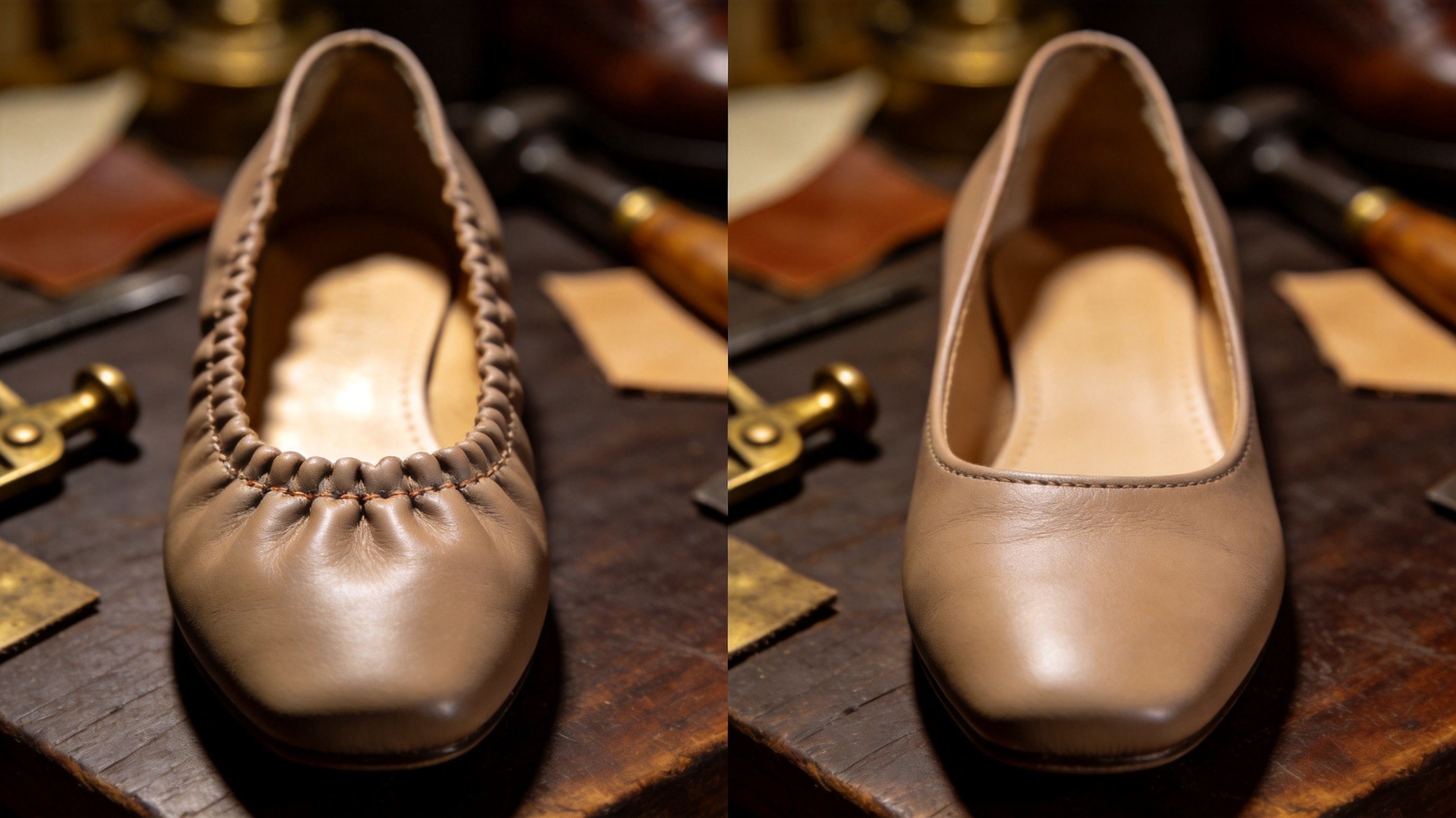
The Chengdu Solution: Hand-Skived-and-Split Seam Allowance at 0.4-0.8mm + Chrome-Free Vegetable-Tan Upper + 1.2-1.6 kg Stitch Tension + Pre-Press Cycle + Split-Leather Reinforcement Tape
A Chengdu-made women's leather shoe can be constructed with five engineering choices that together reduce visible seam-show-through incidence from 68-82% (mass-market average for women at 6 months of regular wear) to less than 4% over 24 months of daily wear. The five choices are: a hand-skived-and-split seam allowance at 0.4-0.8mm thickness (versus an un-skived allowance at 2.6-3.4mm), a chrome-free vegetable-tanned full-grain calfskin upper with 88-94% grain-memory recovery rate (versus a chrome-tanned upper at 76-82% recovery), a sewing machine thread tension set at 1.2-1.6 kg-force per stitch with balanced needle-bobbin tension within 10-15% (versus 2.4-3.2 kg-force with 30-50% imbalance), a steam-press pre-cycle at 75-85°C for 8-12 seconds between sewing and lasting (versus no pre-press cycle), and a 12-16mm wide chrome-free vegetable-tan split-leather reinforcement tape bonded with hide glue at 480-580 g/m² behind the seam line (versus no reinforcement tape). The hand-skived-and-split allowance produces a 0.02-0.05mm ridge height on the leather surface vs 0.4-0.8mm for the un-skived allowance. The vegetable-tan upper recovers 88-94% of its grain surface memory at month 6 vs 68-78% for chrome-tan. The low stitch tension produces a flat stitch line with no thread pull vs a bumpy thread ridge for high tension. The pre-press cycle sets the seam in its final flat shape for the life of the shoe vs a seam that can lift and curl after each wet-dry cycle. The reinforcement tape distributes the seam thickness over a 12-16mm width and adds a second layer of grain-memory recovery for long-term insurance.
The Chengdu workshop costs for these five upgrades are real but moderate. The hand-skived-and-split seam allowance upgrade adds $0.55-1.10 per pair in skiving labor. The chrome-free vegetable-tan upper upgrade from chrome-tan adds $2.60-4.60 per pair in upper leather material cost. The low stitch tension upgrade is essentially free — only the operator's time to adjust the dial. The pre-press cycle adds $0.05-0.10 per pair in steam energy cost. The split-leather reinforcement tape adds $0.20-0.45 per pair in material and labor cost. The total cost increase is $3.40-6.25 per pair, which is roughly 2.3-4.3% of a $145 retail price. The end customer pays an extra $6-12 for a shoe that keeps its vamp surface smooth and seamless against the eye for 24 months of daily wear, vs the mass-market shoe that develops a visible seam line within 4 months and requires a quiet retirement to the back of the closet within a single season.
Every visible seam-show-through complaint you have ever received from a customer — the customer who said the seam was bulging through the leather, the customer who said there was a visible ridge on the vamp, the customer who said the shoes looked uneven in certain light, the customer who said the seam line caught on her nylons, the customer who said the leather was bumpy and looked like a repair, the customer who said the shoes looked nothing like the listing photo, the customer who said the smooth surface had a strange line that she could not explain, the customer who said the shoes looked cheap and handmade in a bad way, the customer who said she returned the shoes because the seam was visible from across the room — is a predictable consequence of these five engineering choices that mass-market factories make to save $3.40-6.25 per pair and to ship a shelf-ready inventory model. The Chengdu factory floor can deliver the same engineering choices at the same retail price by accepting a 3-5% margin reduction, and the resulting customer-experience improvement is the difference between a 68-82% visible seam complaint rate and a 4% visible seam complaint rate over the life of the shoe.
Return to ChinaShoe home to explore the full Chengdu handmade leather shoe collection with hand-skived-and-split seam construction and chrome-free vegetable-tanned uppers, or browse the complete News archive for more diagnostic guides on common shoe and boot problems.