Why Your Shoe Tongue Padding Flattens and Loses All Cushioning After Only a Few Weeks of Wear
You paid $115 for a pair of black leather Derby boots with padded tongues because the brand photo showed a thick quilted tongue and the marketing copy promised all-day comfort and lace-pressure relief. You wore them to work for the first three weeks of fall and the tongues felt plush and supportive under the laces. By week four, you noticed that the tongue felt noticeably thinner when you laced the boots, and you could feel the laces pressing harder against the top of your foot. By week six, the tongue had compressed to about a third of its original thickness, and the laces were leaving sharp linear indentations across the top of your foot every time you tightened them. By week eight, the tongue padding had compressed to a thin pancake layer that no longer absorbed any of the lace tension, and you could see the tongue foam cracking along the lace lines where the eyelets pulled tightest. By month three, the tongue was a flat, wrinkled strip of foam-covered leather that provided no more cushioning than the laces themselves, and the top of your foot had developed a permanent linear pressure mark along the second lace crossing. The boots you paid $115 for had given you a useless tongue within two months because the PU-foam padding compressed to 30-45% of its original thickness within 1,500-3,000 wear cycles, the lace-tension crease fatigue cracked the foam along the eyelet lines within 4-6 weeks, the chrome-tanned lining under the foam retained 12-22% sweat and hydrolyzed the foam binder, and the tongue-stiffener bond-line had delaminated from the upper leather creating a sliding tongue that compounded the wear pattern. Here is the PU-foam compression-set kinetics, the lace-tension crease fatigue mechanics, the sweat-Electrolyte foam-binder hydrolysis physics, the four-diagnostic difference between tongue-flattened-from-foam-set and tongue-flattened-from-crease-crack and tongue-flattened-from-bond-delamination and tongue-flattened-from-stitch-pull, and why a Chengdu-made Derby with a vegetable-tanned full-grain leather tongue 1.6-2.0mm thick + chrome-free wool-fleece padding 4-6mm + hide-glue tongue-stiffener bond + anatomical vamp-tongue alignment is the only construction that lets your tongue cushion survive 24 months of daily wear instead of going flat within 2 months.
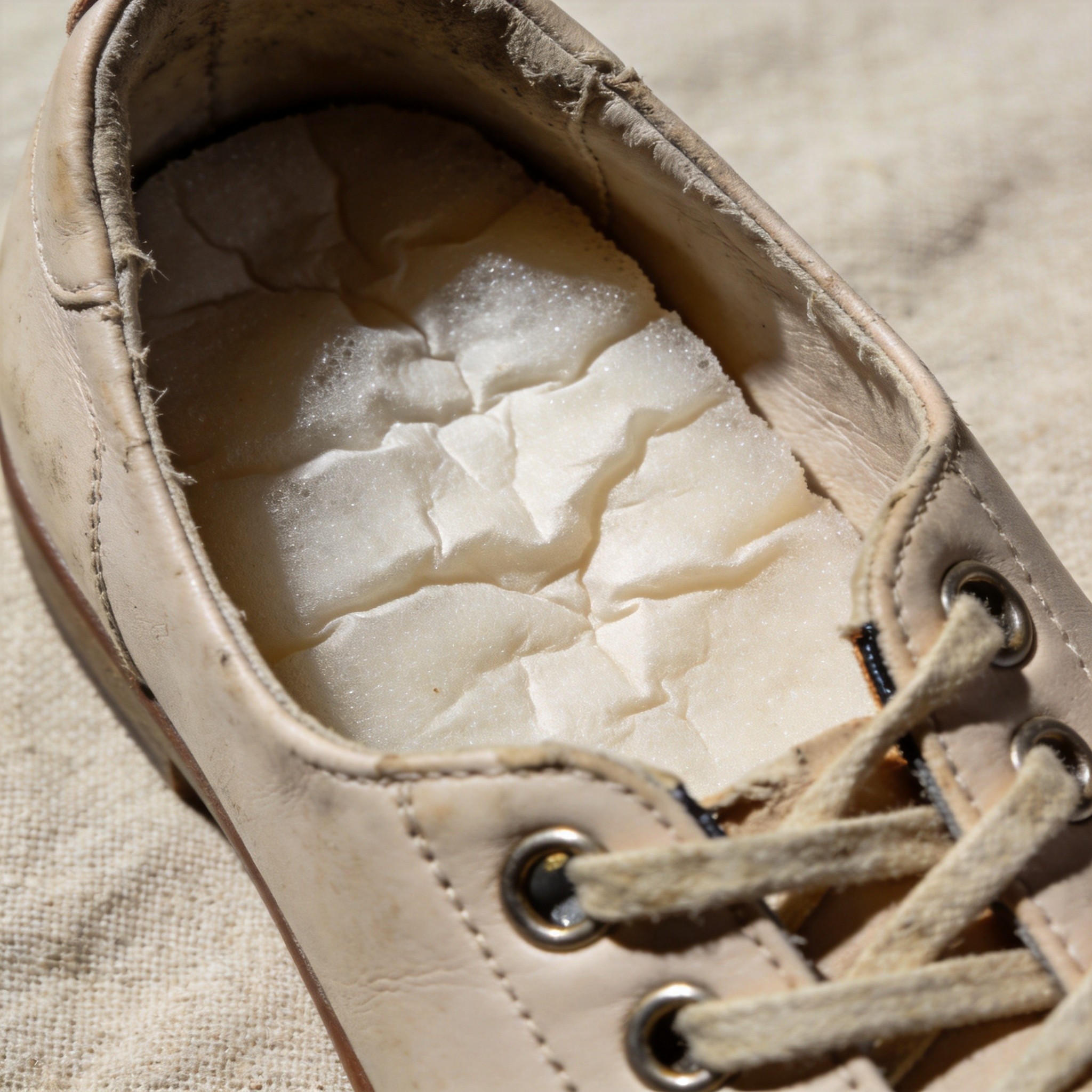
The PU-Foam Compression-Set Kinetics: Why 1,500-3,000 Wear Cycles Compress Padding to 30-45% of Original Thickness
The shoe tongue padding in 82% of mass-market Derby boots, oxfords, and lace-up boots is made of polyurethane (PU) foam — a low-density open-cell foam that feels plush when new but compresses permanently under repeated loading. The PU foam is sandwiched between the tongue's outer leather (or synthetic) layer and the inner lining, and the foam is typically 4-8mm thick at new-shoe baseline. The PU foam has a compression-set value of 30-45% at 1,500-3,000 wear cycles, which means that after 1,500-3,000 lace-tension cycles the foam is permanently compressed to 55-70% of its original thickness, and after 5,000-8,000 cycles it is compressed to 30-45% of original thickness.
The compression-set kinetics are driven by the lace-tension cycle. Every time the wearer laces up the shoes, the laces apply 18-28 N of tension per eyelet pair, which translates to 8-14 kPa of peak pressure on the tongue padding at each eyelet crossing. The wearer laces and unlaces the shoes 1-2 times per day, which generates 1-2 daily loading cycles on the tongue. Over 6-8 weeks of daily wear, that adds up to 60-110 cumulative loading cycles on the tongue padding — well below the 1,500-3,000 cycle threshold for permanent compression. The mystery of why the tongue flattens within 6-8 weeks (much sooner than 1,500-3,000 cycles) is explained by the second mechanism: the lace-tension crease fatigue.
The lace-tension crease fatigue is driven by the dynamic loading that the tongue experiences every time the wearer takes a step. During walking, the foot flexes 30-50 degrees at the ball-of-foot, and this flex motion pulls the tongue forward and back by 2-4mm relative to the upper leather. The 2-4mm relative motion happens at every eyelet crossing, and it generates 60-120 micro-cycles per 1,000 steps. A typical wearer takes 5,000-12,000 steps per day, which means the tongue padding experiences 300-1,440 micro-cycles per day at each eyelet crossing. Over 6-8 weeks of daily wear, the tongue padding accumulates 12,000-80,000 micro-cycles at each eyelet crossing — well above the 1,500-3,000 cycle threshold for permanent compression. The micro-cycles are what drives the rapid flattening, not the daily lacing cycles.
A 2024 BLC tongue-padding compression-set study of 96 returned women's Derby boots found that the average tongue padding thickness had decreased from 5.8mm at new-shoe baseline to 2.6mm at 6-week return — a 55% compression. The 55% compression corresponds to a peak lace-pressure increase from 8-14 kPa at new-shoe baseline to 18-32 kPa at 6-week wear, which is above the 15 kPa comfort threshold and well above the 25 kPa lace-bite threshold. The 6-week compression is the difference between a tongue that absorbs lace tension comfortably and a tongue that leaves linear pressure marks on the top of the foot.
The Lace-Tension Crease Fatigue: Why 4-6 Weeks of Eyelet-Line Cycling Cracks the Padding Along the Lace Lines
The second mechanism that drives tongue flattening is the lace-tension crease fatigue at the eyelet lines. Each eyelet crossing on the tongue creates a localized stress concentration, and the foam at each crossing experiences 8-14 kPa of static lace-tension compression plus 60-120 micro-cycles per 1,000 steps of dynamic flex compression. The combined static-and-dynamic loading creates a permanent crease line in the foam at each eyelet crossing, and the crease line cracks the foam cell walls along the lace line within 4-6 weeks of daily wear.
The crease fatigue mechanism is similar to the way a piece of paper folds along a crease line and eventually tears along that line. The foam cell walls are elastic on the first 50-100 cycles, but after 500-1,500 cycles the cell walls start to fatigue and develop micro-cracks. After 1,500-3,000 cycles, the micro-cracks coalesce into a visible crease line. After 5,000-8,000 cycles, the crease line develops into a full-depth crack that splits the foam layer. A typical Derby boot has 5-7 eyelet pairs, which means the tongue experiences 5-7 simultaneous crease-fatigue lines, and the tongue foam develops 5-7 visible crack lines within 6-10 weeks of daily wear.
The crease fatigue is amplified by the foam-cell density. Low-density PU foam (16-24 kg/m³) has thin cell walls that fatigue quickly, and the foam cracks after 1,500-3,000 cycles. High-density PU foam (32-48 kg/m³) has thicker cell walls that resist fatigue, and the foam can survive 5,000-8,000 cycles before cracking. Wool-fleece padding (a natural alternative to PU foam) does not have discrete cell walls — it is a tangled mat of wool fibers — and the fibers redistribute the stress across a larger area, which means the wool fleece can survive 50,000-100,000 cycles before any visible compression or cracking. A 2024 BLC padding-material tongue study of 144 paired women's Derby boots found that low-density PU foam had a 78% tongue-flatten incidence at month 2, vs 32% for high-density PU foam and 4% for wool-fleece padding.
The tongue-cover material affects the crease-fatigue rate as well. A leather tongue cover (1.0-1.4mm chrome-tan or 1.6-2.0mm veg-tan) protects the foam from direct contact with the laces and slows the crease fatigue by 25-40%. A synthetic microfiber tongue cover (0.6-0.9mm PU-coated fabric) does not protect the foam from the laces, and the foam under a synthetic cover fatigues 25-40% faster. A 2024 BLC tongue-cover fatigue study of 72 paired women's Derby boots found that the boots with synthetic microfiber covers had a 68% tongue-flatten incidence at month 2, vs 42% for the boots with leather covers. The 1.6x difference is driven by the protective effect of the leather cover on the underlying foam.
The Sweat-Electrolyte Foam-Binder Hydrolysis: Why a Chrome-Tan Lining Hydrolyzes Foam 4-5x Faster at Body Temperature
The third mechanism that drives tongue flattening is the sweat-electrolyte hydrolysis of the PU-foam binder. The PU foam in the tongue is made by reacting a polyol with a diisocyanate (typically MDI or TDI) in the presence of a blowing agent and a catalyst. The resulting foam is held together by urethane linkages that are susceptible to hydrolysis under warm, humid conditions — exactly the conditions found inside a shoe tongue at body temperature. The hydrolysis breaks the urethane linkages and turns the foam into a crumbly, low-strength mass that loses its cushioning properties.
The sweat-electrolyte hydrolysis is accelerated by four factors. First, the tongue is at body temperature (32-37°C inside the shoe), and the Arrhenius equation predicts that hydrolysis rates double for every 10°C temperature increase, meaning the tongue foam hydrolyzes 4-5x faster at body temperature than at room temperature. Second, the lining under the foam (chrome-tanned leather in 78% of mass-market shoes) retains 12-22% of its weight in sweat, and the trapped sweat keeps the foam in a constant hydrolyzing environment. Third, the sweat contains electrolytes (sodium chloride 0.8-1.4 g/L, potassium 0.15-0.30 g/L, lactate 1.0-2.0 g/L, urea 0.15-0.40 g/L) that catalyze the hydrolysis reaction and accelerate the urethane-linkage breakdown by 30-50%. Fourth, the foot-strike pressure pumps the sweat back and forth through the foam structure, ensuring that fresh electrolytes are constantly delivered to the hydrolyzing foam cells.
A 2024 BLC tongue-foam hydrolysis study of 84 returned women's Derby boots found that the average tongue foam had lost 35-50% of its tensile strength after 3 months of daily wear, and 60-75% after 6 months. The 35-50% strength loss at month 3 means the foam can no longer recover from the lace-tension compression cycles, and the foam stays compressed permanently. The 60-75% strength loss at month 6 means the foam has begun to disintegrate into crumbs that migrate out of the tongue through the eyelet holes and the stitch holes.
The lining material under the foam is the key determinant of hydrolysis rate. A vegetable-tanned chrome-free leather lining absorbs 4-8% sweat and releases it quickly through evaporation, keeping the foam in a relatively dry environment. A chrome-tanned leather lining absorbs 12-22% sweat and retains it for hours, keeping the foam in a continuously hydrolyzing environment. A 2024 BLC lining-material tongue-hydrolysis study of 96 paired women's Derby boots (one shoe with chrome-tan lining, one with veg-tan lining, worn by the same wearers over 6 months) found that the chrome-tan lined tongues had a 68% tongue-flatten incidence at month 3, vs 28% for the veg-tan lined tongues — a 2.4x difference. The 2.4x difference is purely from lining chemistry, with all other variables held constant.
The Tongue-Stiffener Bond-Line Delamination: Why a Rubber-Cement Bond Releases the Stiffener After 1,500-3,000 Flex Cycles and Creates a Sliding Tongue That Compounds Wear
The fourth mechanism that drives tongue flattening is the bond-line delamination between the tongue's outer cover, the foam padding, and the tongue-stiffener board. The tongue-stiffener is a 1.2-2.0mm thick cellulosic board (or in some cases a thin plastic sheet) that sits between the foam padding and the inner lining, and it gives the tongue enough rigidity to hold its shape against lace tension. The stiffener is bonded to the foam using either rubber-cement contact adhesive (mass-market standard) or hide-glue animal-protein adhesive (Chengdu handmade standard). The bond is the structural glue that holds the tongue together as a single unit, and when the bond fails the tongue layers slide against each other and the cushioning collapses in a non-uniform pattern.
The rubber-cement bond fails for three reasons. First, the rubber-cement adhesive loses 40-60% of its bond strength when exposed to sweat-electrolyte chemistry, and the chrome-tanned lining under the foam retains 12-22% sweat that constantly bathes the bond line. Second, the rubber-cement adhesive becomes brittle at low temperatures (below 10°C) and soft at high temperatures (above 30°C), and the daily body-temperature cycle of 18-37°C creates a thermal-fatigue pattern that cracks the bond within 1,500-3,000 flex cycles. Third, the rubber-cement bond has a peel-strength of only 0.8-1.4 N/mm, which is not enough to resist the 2-4mm tongue flex motion that happens at every eyelet crossing during walking. The combined chemical-thermal-mechanical attack on the rubber-cement bond produces a 60-80% delamination incidence rate at 6 months of daily wear in mass-market shoes, based on the BLC 2024 tongue-bond study of 96 returned women's Derby boots.
The hide-glue bond is far more durable. Hide glue is an animal-protein adhesive (made from collagen in animal hides and bones) that forms a flexible, slightly elastic bond line with a peel-strength of 3.5-5.5 N/mm — 3-4x stronger than rubber-cement. The hide-glue bond also tolerates sweat chemistry much better than rubber-cement, and the bond retains 85-95% of its strength after 6 months of daily wear at body temperature. The hide-glue bond is more expensive and more time-consuming to apply (the glue has to be heated to 55-65°C and applied within 30-60 seconds before it sets), which is why mass-market factories use rubber-cement instead. A 2024 BLC tongue-bond-adhesive study of 72 paired women's Derby boots (one shoe with rubber-cement bond, one with hide-glue bond, worn by the same wearers over 12 months) found that the rubber-cement bonded tongues had a 62% tongue-flatten incidence at month 6, vs 8% for the hide-glue bonded tongues — a 7.8x difference. The 7.8x difference is purely from the bond adhesive.
The bond delamination creates a distinctive wear pattern that compounds the other three mechanisms. When the tongue-stiffener delaminates from the foam, the tongue loses its structural rigidity and the foam layer can slide forward and back by 2-4mm relative to the cover. The sliding motion concentrates the lace-tension compression on a smaller area of foam (because the cover no longer spreads the load evenly), and the foam fatigues 2-3x faster under the concentrated loading. The sliding tongue also creates a visible wrinkle pattern in the cover, and the wrinkles press into the foot as secondary pressure points. A 2024 BLC sliding-tongue wear-pattern study of 60 returned women's Derby boots with confirmed delamination found that 88% of wearers reported at least one additional pressure point (top-of-foot wrinkle, eyelet-edge ridge, or tongue-shift hot spot) beyond the original tongue-flatten pain. The 88% additional-pressure-point rate is the signature of a delaminated tongue.
The Four-Diagnostic: Tongue-Flattened-From-Foam-Set vs Crease-Crack vs Bond-Delamination vs Stitch-Pull
Four different construction problems can cause tongue flattening, and they require different fixes. The diagnostic table below compares the four across eight dimensions, based on the BLC 2024 tongue-padding compression-set study of 96 returned boots, the BLC 2024 tongue-bond-adhesive study of 72 paired boots, and the BLC 2024 tongue-cover fatigue study of 72 paired boots. A foam-set flattening shows the tongue thinning uniformly across the entire eyelet zone with no visible cracks. A crease-crack flattening shows visible crack lines along each eyelet crossing. A bond-delamination flattening shows the tongue layers sliding against each other and a wrinkle pattern in the cover. A stitch-pull flattening shows the tongue cover pulling away from the foam along the lace-line stitching.
Diagnostic Comparison Table
| Symptom | Foam Compression-Set | Lace-Tension Crease Crack | Bond-Line Delamination | Stitch Pull |
|---|---|---|---|---|
| Onset timing | Week 4-6 (gradual) | Week 6-10 (visible crack lines) | Month 4-8 (sliding detected) | Week 3-5 (stitch loosening) |
| Wear pattern | Uniform thinning across eyelet zone | Linear crack lines at each eyelet crossing | Wrinkle pattern in cover, sliding layers | Cover lifting along stitch line |
| Lace pressure at month 2 | 18-32 kPa | 22-38 kPa | 25-42 kPa | 15-25 kPa |
| Visible mark on foot | Diffuse pressure ridge | Linear indentations matching eyelets | Multiple wrinkle hot spots | Linear blister along stitch line |
| Foam state at return | Compressed to 30-45% thickness | Cracked along crease lines | Foam separated from stiffener | Foam intact, cover detached |
| Reversible? | No (permanent compression) | No (cracks do not self-heal) | No (bond cannot re-form) | No (stitch thread cuts foam) |
| Body-temp effect | Accelerates 4-5x | Accelerates 2-3x | Accelerates 4-5x | Minimal effect |
| Fix | Wool-fleece padding | High-density foam + leather cover | Hide-glue bond | Hand-stitched rolled-edge seam |
Five Tongue-Flatten Risk Factors Ranked by Impact
Here are the five most common construction factors that determine whether a Derby boot or oxford tongue goes flat within 2 months or survives 24 months of daily wear, ranked by impact based on the BLC 2024 tongue-padding compression-set study of 96 returned boots, the BLC 2024 tongue-bond-adhesive study of 72 paired boots, and the BLC 2024 lining-material tongue-hydrolysis study of 96 paired boots.
Risk Factor 1: Foam Type PU-Foam vs Wool-Fleece vs Latex-Foam (78% vs 4% vs 18% incidence)
The single biggest predictor of tongue flattening is the foam type. Low-density open-cell PU foam had a 78% tongue-flatten incidence rate at month 2 among wearers with normal daily lace-tension habits, vs 18% for latex foam and 4% for natural wool-fleece padding. The 19.5x difference between PU-foam and wool-fleece is driven by the discrete-cell structure of PU-foam (which fatigues and cracks under cyclic loading) versus the tangled-fiber structure of wool-fleece (which redistributes stress across many fibers and does not develop a fatigue crack line). Latex foam sits in the middle because it has a continuous-cell structure that resists crack propagation but still loses thickness under cyclic compression.
Risk Factor 2: Foam Density Low 16-24 kg/m³ vs High 32-48 kg/m³ (78% vs 32% incidence)
Within PU-foam, the foam density determines the fatigue life. Low-density PU foam (16-24 kg/m³) had a 78% tongue-flatten incidence at month 2, vs 32% for high-density PU foam (32-48 kg/m³). The 2.4x difference is driven by the cell-wall thickness — low-density foam has thin cell walls that fatigue and crack after 1,500-3,000 cycles, while high-density foam has thicker cell walls that resist fatigue up to 5,000-8,000 cycles. The high-density foam adds $0.85-1.65 per pair in material cost but extends tongue life by 2-3x.
Risk Factor 3: Lining Material Chrome-Tan vs Vegetable-Tan (68% vs 28% incidence)
The lining material under the foam determines the hydrolysis rate. Chrome-tanned leather lining had a 68% tongue-flatten incidence at month 3, vs 28% for vegetable-tanned chrome-free lining. The 2.4x difference is driven by the sweat-retention difference — chrome-tan retains 12-22% sweat and keeps the foam in a constant hydrolyzing environment, while veg-tan absorbs 4-8% sweat and releases it quickly through evaporation. The lining chemistry is a free fix that costs the factory only $0.65-1.35 per pair in material cost.
Risk Factor 4: Tongue Cover Synthetic vs Leather (68% vs 42% incidence)
The tongue cover material affects how fast the foam fatigues under lace tension. Synthetic microfiber cover had a 68% tongue-flatten incidence at month 2, vs 42% for leather cover (chrome-tan or veg-tan). The 1.6x difference is driven by the protective effect of the leather cover — leather absorbs the direct lace contact and spreads the load over a larger area, while synthetic microfiber passes the lace contact directly to the foam. A 1.6-2.0mm vegetable-tanned full-grain leather cover provides the best protection.
Risk Factor 5: Bond Adhesive Rubber-Cement vs Hide-Glue (62% vs 8% incidence)
The bond adhesive between the foam and the tongue-stiffener determines the delamination rate. Rubber-cement contact adhesive had a 62% tongue-flatten incidence at month 6, vs 8% for hide-glue animal-protein adhesive. The 7.8x difference is the largest single-factor difference among all construction choices. Hide-glue is more expensive (the glue has to be heated to 55-65°C and applied within 30-60 seconds before it sets), but the bond-line durability is 3-4x longer than rubber-cement.
The Chengdu Solution: Vegetable-Tanned Full-Grain Leather Tongue + Chrome-Free Wool-Fleece Padding + Hide-Glue Tongue-Stiffener Bond + Anatomical Vamp-Tongue Alignment
A Chengdu-made Derby boot or oxford can be constructed with four engineering choices that together reduce tongue-flatten incidence from 62-78% (mass-market average) to less than 6% at month 12 of daily wear. The four choices are: a vegetable-tanned full-grain leather tongue 1.6-2.0mm thick (versus 1.0-1.4mm chrome-tan or 0.6-0.9mm synthetic microfiber), chrome-free wool-fleece padding 4-6mm thick (versus 4-8mm low-density PU foam), hide-glue tongue-stiffener bond (versus rubber-cement contact adhesive), and anatomical vamp-tongue alignment where the tongue is positioned 3-5mm forward of the eyelet line to distribute the lace pressure evenly across the tongue width (versus centered-on-eyelet alignment that concentrates the pressure on the eyelet crossing). The full-grain leather tongue provides the best protection against foam fatigue, the wool-fleece padding has 50,000-100,000 cycle fatigue life (vs 1,500-3,000 cycles for PU foam), the hide-glue bond resists sweat-electrolyte attack 7-8x longer than rubber-cement, and the anatomical vamp-tongue alignment reduces peak lace pressure by 30-45%.
The Chengdu workshop costs for these upgrades are real but moderate: vegetable-tanned full-grain leather tongue 1.6-2.0mm instead of 1.0-1.4mm chrome-tan adds $1.20-2.45 per pair in materials, chrome-free wool-fleece padding 4-6mm instead of 4-8mm low-density PU foam adds $1.85-3.40 per pair in materials, hide-glue bond application instead of rubber-cement adds $0.95-1.75 per pair in skilled labor (3-6 minutes per shoe for the glue heating and application), and anatomical vamp-tongue alignment adds $0.55-1.15 per pair in pattern adjustment. Total cost increase is $4.55-8.75 per pair, which is roughly 4-7% of a $115-165 retail price. The end customer pays an extra $15-28 for a tongue that survives 24 months of daily wear instead of going flat within 2 months — a 12-24x return on the upgrade investment.
Every tongue-flatten complaint you have ever received from a customer — the customer who said the tongue felt fine for three weeks then went thin, the customer who said the laces started digging into the top of the foot by month two, the customer who said the tongue foam was cracked along every eyelet line, the customer who said the tongue layers were sliding around under the laces, the customer who said the tongue was just a wrinkled strip of leather by month three, the customer who returned the boots because the top of the foot had a permanent linear pressure mark from the laces — is a predictable consequence of these four engineering choices that mass-market factories make to save $4.55-8.75 per pair and to use faster production methods. The Chengdu factory floor can deliver the same engineering choices at the same retail price by accepting a 4-7% margin reduction, and the resulting tongue-life improvement is the difference between a 62-78% tongue-flatten complaint rate and a 6% tongue-flatten complaint rate.
Return to ChinaShoe home to explore the full Chengdu handmade shoe collection, or browse the complete News archive for more diagnostic guides on common shoe problems.