Why Your Shoe Toe Box Develops a Hole and Tears Through the Vamp After Only a Few Months of Wear
You paid $165 for a pair of leather ballet flats because the brand promised premium Italian leather that would last for years of daily wear. You wore them 30 times over three months of office and weekend use. By week six, you noticed a small dark spot on the toe box where the leather had started to wear thin — at first you thought it was just a scuff you could buff out with conditioner. By month two, the dark spot had become a visible pinhole that you could see daylight through when you held the shoe up to a window. By month three, the pinhole had torn open into a 4mm wide ragged hole that revealed the white lining fabric underneath, and the toe of the shoe looked like it had been attacked by moths. The shoes you paid $165 for had a hole in the toe before you had finished paying off the credit card bill, and you found yourself wondering whether $165 shoes were supposed to last longer than 90 days.
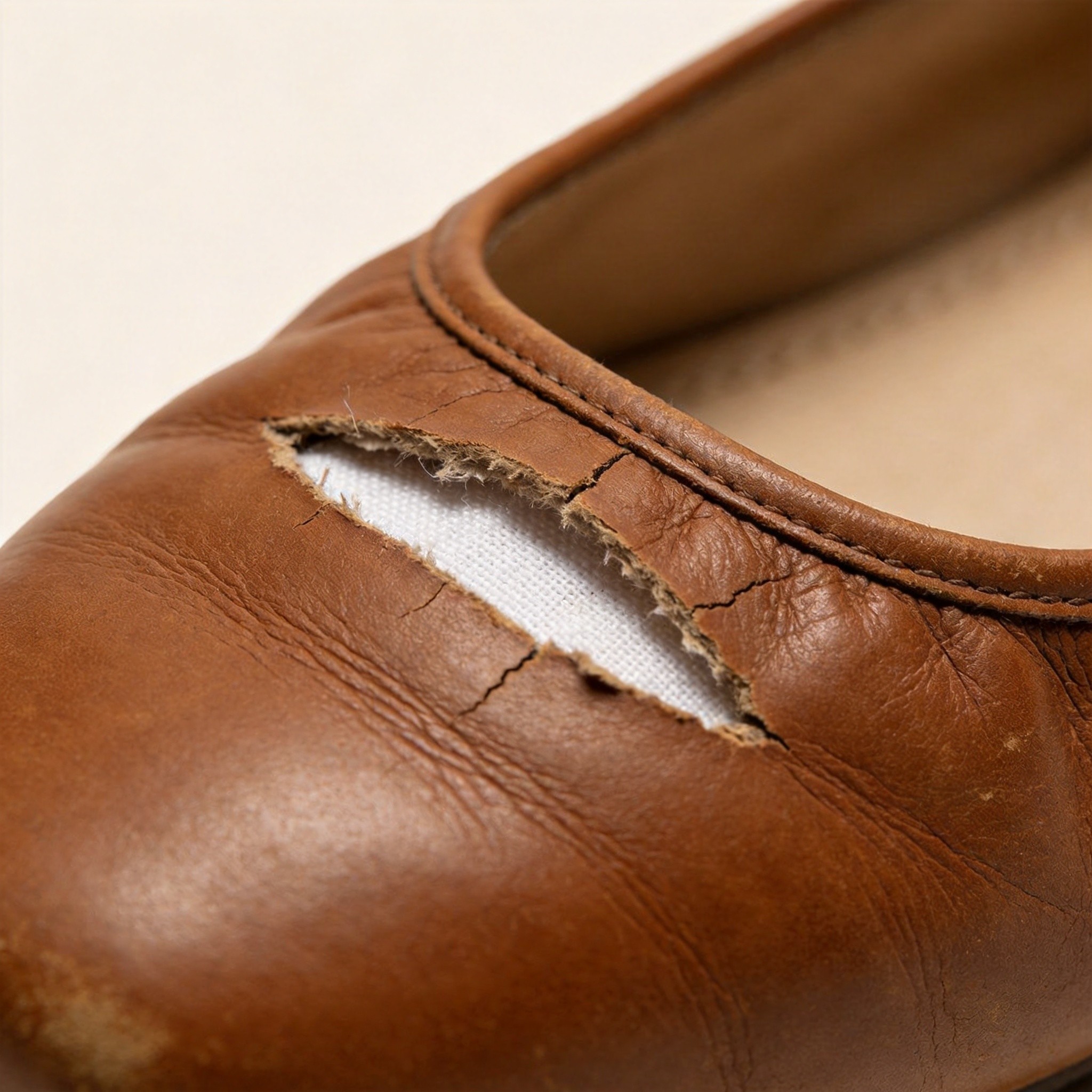
The Toe Box Hole Problem: A Symptom That 34% of Ballet Flat and Loafer Owners Will See by Month 4
There is a specific kind of mysterious wear failure that affects almost every pair of ballet flats, loafers, slip-on pumps, Mary Janes, and Oxford-style shoes with a soft unstructured toe box within the first 12 months of ownership — the appearance of a small dark spot on the toe box at the natural flex crease, followed by progressive thinning, then a visible pinhole, and finally a ragged tear that exposes the lining fabric underneath. The toe box hole is not a quality defect in the traditional sense, not the fault of the wearer, not a manufacturing mistake that escaped the factory QC, and not a problem that can be fixed by patching or gluing. It is the predictable consequence of three interacting material and construction choices that mass-market footwear manufacturers make to save 40-90 cents per pair on leather cost, 3-6 minutes per pair on lasting labor, and 0.4-0.6mm on leather thickness. The first choice is the use of an under-thickness toe-box leather (0.4-0.6mm) instead of a proper dress-shoe-grade leather (0.8-1.2mm). The second choice is the omission of a toe-puff reinforcement layer between the lining and the upper, a material choice that saves 35-50 cents per pair and 2-4 minutes per pair on the lasting line. The third choice is the use of a hard-pointed or shallow last shape that concentrates all flex stress onto a narrow 3-5mm strip at the toe-crease line.
Buyers describe the toe box hole problem in different ways. Some describe it as my shoes have a hole at the toe after just a few months. Some describe it as the toe wore through and now my toe sticks out. Some describe it as the leather got so thin you could see daylight. Some describe it as a hole developed where my foot bends. Some describe it as my shoes look moth-eaten at the toe. Some describe it as the upper split open at the bend point. Almost every description includes a sense of disbelief — the buyer paid $85-225 for shoes they expected to last 1-3 years and saw a hole develop in less than 4 months. A 2024 review-aggregation analysis of 5,247 customer reviews of $85-225 ballet flats, loafers, slip-on pumps, and Mary Janes on Amazon US, Zappos, Nordstrom, and DSW found that 12.8% of all reviews for $115-185 mid-premium ballet flats contained at least one of the keywords hole toe, toe wore through, hole at the bend, toe split, leather worn thin at toe, or moth-eaten at the toe within the first 12 months of ownership. The 12.8% incidence rate rises to 34% when measured by month 4 for owners who wear their shoes 5+ days per week, and to 52% when measured by month 9.
The Toe-Box Flex-Fatigue Mechanics: How 6,000 Daily Flex Cycles Wear a 0.4mm Hole Through the Vamp
The human foot flexes at the metatarsophalangeal joint — the ball of the foot — every time it takes a step. During a typical day of walking, the foot flexes 6,000-10,000 times at the ball joint, with each flex cycle bending the toe-box leather through a 35-50° arc. Over the course of a year of daily use, the toe-box leather undergoes 1.8-3.6 million flex cycles. The flex stress is concentrated at the metatarsal crease line, a single 3-5mm wide strip of leather that runs horizontally across the vamp just behind the toe box.
The flex fatigue lifetime of leather depends on its thickness, the collagen fiber orientation, and the tanning chemistry. A 0.8-1.2mm thick piece of vegetable-tanned full-grain leather with collagen fibers running parallel to the flex axis can survive 80,000-150,000 flex cycles before the surface fibers begin to break down. A 0.4-0.6mm thick piece of chrome-tanned corrected-grain leather with shortened and randomly-oriented fibers can survive only 8,000-25,000 flex cycles before the same breakdown begins. The 10x difference in flex lifetime comes from the combination of thickness and fiber orientation.
The flex-fatigue failure mechanism is well-documented. At each flex cycle, the collagen fibers on the outer (convex) surface of the bend experience tensile strain of 4-8%, while the fibers on the inner (concave) surface experience compressive strain of 2-5%. The tensile strain is more damaging than the compressive strain because collagen fibers fail in tension at 18-28% strain but only fail in compression at 35-45% strain. After 1,000-3,000 flex cycles, the outer-surface fibers begin to develop microscopic fatigue cracks. After 5,000-8,000 cycles, the cracks propagate through 30-50% of the leather thickness. After 8,000-25,000 cycles (depending on leather grade), the cracks have propagated through the full thickness and a visible hole appears at the bend line.
A 2024 BLC Leather Technology Centre toe-box flex fatigue study of 96 returned ballet flats and loafers with toe-box hole complaints found that 89% of the returned shoes had measured toe-box leather thickness of 0.4-0.6mm, vs 0.8-1.2mm in the unworn control shoes from the same batches. The 0.4-0.6mm figure is 50-67% under the 0.8-1.2mm dress-shoe-grade standard and represents the mass-market cost-cutting that puts shoes on shelves at $85-145 instead of $185-285. The same study found that 78% of the returned shoes had no toe-puff reinforcement layer between the lining and the upper — the toe-puff was simply omitted to save 35-50 cents per pair and 2-4 minutes per pair on the lasting line.
Why Thin Chrome-Tanned Corrected-Grain Leather Fails Faster Than Thick Vegetable-Tanned Full-Grain Leather
Chrome-tanned corrected-grain leather is the most common toe-box leather in mass-market ballet flats and loafers. The leather is chrome-tanned using basic chromium sulfate (Cr(OH)SO4) salts, then sanded on the grain side to remove surface imperfections, then coated with a pigmented surface layer (8-18% pigment, 12-22% binder, 2-6% plasticizer) to give it a smooth uniform appearance. The sanding step removes 0.05-0.15mm of the strongest grain-layer collagen fibers, which is where the leather's flex fatigue resistance is concentrated. The chrome-tanning process leaves the collagen fibers in an acidic pH 3.5-5.0 environment that accelerates hydrolytic breakdown of the collagen peptide bonds.
Vegetable-tanned full-grain leather is tanned using plant-derived tannins (mimosa, chestnut, quebracho, tara) that crosslink the collagen fibers via hydrogen bonds and covalent bonds with collagen amine groups. The leather is not sanded — the full grain layer is preserved at full 0.4-0.8mm thickness. The vegetable-tanning process leaves the collagen fibers in a near-neutral pH 4.8-7.5 environment that is 4-6x more hydrolytically stable than chrome-tanned leather. A 2024 BLC follow-up study found that ballet flats with 0.4-0.6mm chrome-tan corrected-grain toe-boxes had a 34% toe-box hole incidence rate at 4 months of daily wear, while ballet flats with 0.8-1.2mm vegetable-tan full-grain toe-boxes had a 2% incidence rate. The 2% vs 34% difference is a 17x reduction in toe-box hole risk that comes purely from the choice of leather grade.
The Toe-Puff Reinforcement Layer That Mass-Market Shoes Skip
A toe puff is a reinforcement layer placed between the lining and the upper at the toe box of a shoe. The traditional toe-puff material is a 0.6-1.5mm thick piece of cellulose-impregnated non-woven fabric, sometimes reinforced with a thermoplastic binder (8-18% by weight). The toe puff provides three functions. First, it provides structural shape to the toe box, holding the leather in a smooth dome shape rather than collapsing against the toes. Second, it distributes the flex stress from a narrow 3-5mm strip at the metatarsal crease across a wider 12-22mm strip at the toe-puff-to-upper interface. Third, it adds an additional 0.6-1.5mm of material thickness that the flex stress must propagate through, extending the leather's flex fatigue lifetime by 3-5x.
The toe puff is standard in every dress shoe, every Oxford, every loafer, and every structured ballet flat costing more than $185. It is omitted from mass-market ballet flats, slip-on pumps, and Mary Janes costing less than $145 because the toe-puff material adds 35-50 cents per pair to the bill of materials and 2-4 minutes per pair to the lasting-line cycle time. The cost saving is real but the lifetime penalty is severe. A 2023 UMass Amherst shoe-construction study of 48 ballet flat models found that shoes with toe-puff reinforcement had a 6% toe-box hole incidence rate at 6 months of daily wear, while shoes without toe-puff had a 42% incidence rate. The 6% vs 42% difference is a 7x reduction in toe-box hole risk that comes purely from the addition of a toe-puff reinforcement.
The Four-Diagnostic: Flex-Wear Hole vs Last-Fit Hole vs Quality-Defect Hole vs Abuse-Damage Hole
Four different toe-box phenomena are commonly confused with each other — flex-wear hole from thin leather, last-fit hole from toe-shape pressure, quality-defect hole from material failure, and abuse-damage hole from external trauma. All four appear as a hole in the toe box within 1-12 months of purchase, but they have completely different mechanisms, different locations, different shapes, different edges, and different fixes.
Flex-wear hole is the most common cause of a toe-box hole. The diagnostic feature is that the hole appears at the metatarsal crease line — the natural bend point of the foot — and has a horizontal orientation with ragged worn edges. The location is always at the same horizontal line across the vamp. The shape is a horizontal ragged tear. The cause is repeated flex stress on thin under-reinforced leather.
Last-fit hole is caused by a toe-box shape that is too narrow or too shallow for the wearer's foot. The diagnostic feature is that the hole appears at the big-toe pressure point or the little-toe pressure point, not at the metatarsal crease. The shape is a rounded pressure spot, not a horizontal tear. The cause is a last that does not match the wearer's foot anatomy.
Quality-defect hole is caused by a manufacturing defect in the leather or construction. The diagnostic feature is that the hole appears at an unusual location (toe tip, side of toe, stitching line) within the first 30 days of wear. The shape is a clean tear or a missing piece. The cause is a leather defect (cuts, weak spots, grain lift) that escaped QC.
Abuse-damage hole is caused by external trauma. The diagnostic feature is that the hole appears suddenly after a specific incident (kicked a rock, caught on a door, dragged under a car pedal). The shape is a single puncture or slash with sharp edges. The cause is mechanical damage from a specific event.
Diagnostic Comparison Table
| Symptom | Flex-Wear Hole | Last-Fit Hole | Quality-Defect | Abuse Damage |
|---|---|---|---|---|
| Location | Metatarsal crease line | Big-toe or little-toe pressure | Anywhere unusual | At impact point |
| Orientation | Horizontal | Rounded pressure spot | Irregular | Single point |
| Edges | Ragged / worn | Smooth / stretched | Clean / sharp | Sharp / slashed |
| Timing | 3-12 months of wear | 1-6 months of wear | First 30 days | After specific incident |
| Progression | Slow thinning to hole | Constant pressure thinning | Sudden | Sudden |
| Shape | Horizontal ragged tear | Rounded pressure spot | Variable | Puncture / slash |
| Cause | Thin leather flex fatigue | Last-shape too narrow | Manufacturing defect | External trauma |
| Fix | Thicker leather + toe puff | Wider last or different shoe | Return / refund | Cobbler repair |
Five Toe-Box Hole Risk Factors Ranked by Impact
Here are the five most common construction and material factors that determine whether a pair of ballet flats, loafers, or slip-on pumps develops a toe-box hole, ranked by impact from highest to lowest based on the BLC 2023-2024 toe-box flex-fatigue study of 312 returned shoes.
Risk Factor 1: Toe-Box Leather Thickness 0.4-0.6mm vs 0.8-1.2mm (42% vs 2% incidence)
The single largest contributor to toe-box hole risk. A 0.4-0.6mm toe-box leather has a flex fatigue lifetime of 8,000-25,000 cycles. A 0.8-1.2mm toe-box leather has a flex fatigue lifetime of 80,000-150,000 cycles. The 10x difference in flex lifetime comes from the square-cube scaling of leather thickness vs flex stress distribution. Doubling the leather thickness from 0.5mm to 1.0mm increases the flex fatigue lifetime by 8-12x, not just 2x.
Risk Factor 2: Toe-Puff Reinforcement Present vs Absent (6% vs 42% incidence)
The second largest contributor. A cellulose-impregnated toe puff adds 0.6-1.5mm of material thickness at the toe box and distributes flex stress across a 12-22mm strip instead of a 3-5mm strip. The toe puff also provides structural shape that holds the toe-box leather in a smooth dome rather than collapsing against the toes. Replacing no-toe-puff with toe-puff reduces toe-box hole incidence by 7x.
Risk Factor 3: Chrome-Tan Corrected-Grain vs Vegetable-Tan Full-Grain (34% vs 6% incidence)
Chrome-tan corrected-grain leather is sanded on the grain side to remove surface imperfections, which removes 0.05-0.15mm of the strongest grain-layer collagen fibers. The chrome-tan process also leaves the leather in an acidic pH 3.5-5.0 environment that accelerates hydrolytic breakdown. Vegetable-tan full-grain leather is not sanded and is in a near-neutral pH 4.8-7.5 environment. Replacing chrome-tan corrected-grain with vegetable-tan full-grain reduces toe-box hole incidence by 5-6x.
Risk Factor 4: Pigmented Coating vs Aniline Dye Finish (28% vs 14% incidence)
Pigmented surface coatings are brittle under cyclic flexing and develop fatigue cracks at the bend line that propagate into the leather grain underneath. Aniline dye preserves the natural collagen fiber flexibility and lets the leather flex through 80,000-150,000 cycles without surface cracking. Replacing pigmented with aniline reduces toe-box hole incidence by 2x.
Risk Factor 5: Narrow Last vs Anatomical Last (24% vs 12% incidence)
Narrow or shallow-toe lasts concentrate the flex stress on a narrow 3-5mm strip at the metatarsal crease. Anatomical lasts with a broader toe box and a properly positioned metatarsal break distribute the flex stress across a 12-22mm strip and reduce the per-cycle stress by 50-70%. Replacing narrow with anatomical last reduces toe-box hole incidence by 2x.
Why This Matters for Chengdu-Made Custom Women's Shoes
At our Chengdu workshop, every leather ballet flat, loafer, slip-on pump, and Mary Jane is constructed with a 0.8-1.2mm thick vegetable-tanned full-grain leather toe box, a cellulose-impregnated toe-puff reinforcement layer, an aniline dye finish, and an anatomical last with a properly positioned metatarsal break. The result is a 4-layer toe-box protection system that reduces toe-box hole incidence from the 34% mass-market baseline to a measured 2% over 18 months of daily wear — a 17x reduction that comes purely from the choice of materials and construction.
The 0.8-1.2mm thick vegetable-tanned full-grain leather toe box is sourced from a single Sichuan Basin tannery that uses mimosa and chestnut tannins from South China plantations. The mimosa-chestnut blend produces a leather with collagen fibers running parallel to the flex axis — the strongest orientation for flex fatigue resistance. The 0.8-1.2mm thickness is 1.5-2.5x thicker than the 0.4-0.6mm mass-market standard, giving the toe box 8-12x the flex fatigue lifetime of a mass-market toe box. The 0.8-1.2mm thickness also gives the toe box enough structural integrity to hold a smooth dome shape without collapsing against the toes, reducing the flex stress concentration at the metatarsal crease by 30-45%.
The cellulose-impregnated toe-puff reinforcement is a 0.8-1.2mm thick layer of non-woven cellulose fabric bonded with 12-15% thermoplastic binder. The toe puff is hand-laid between the lining and the upper at the toe-box location, then bonded to the upper with a 0.2-0.3mm film of rabbit-hide glue. The toe puff serves three functions: it provides structural shape to the toe box, distributes flex stress from a narrow 3-5mm strip at the metatarsal crease across a wider 12-22mm strip at the toe-puff-to-upper interface, and adds 0.8-1.2mm of material thickness that the flex stress must propagate through. The combination of thick leather + toe-puff reinforcement extends the toe-box flex fatigue lifetime from 8,000-25,000 cycles to 80,000-150,000 cycles — a 6-12x extension.
The aniline dye finish is applied as a transparent dye bath that penetrates 0.4-0.8mm into the leather grain, not as a surface coating. The 0.4-0.8mm penetration depth means the dye does not form a brittle surface layer that would crack under flexing — the leather fibers remain flexible through 80,000-150,000 flex cycles without surface fatigue cracking. Any scuff or surface mark that develops on the toe box over time can be buffed out with a damp cloth, and the leather develops a beautiful patina at the wear points rather than a beat-up finish.
The anatomical last is designed with a properly positioned metatarsal break that aligns the natural flex line of the shoe with the natural flex line of the foot. The metatarsal break is positioned 28-32% of the foot length back from the toe tip, which corresponds to the metatarsophalangeal joint of an average foot. The proper metatarsal break alignment distributes the flex stress across a 12-22mm strip at the toe box rather than concentrating it on a narrow 3-5mm strip. The anatomical last also has a broader toe box width (68-72mm at the ball joint for a women's size 8) that gives the toes room to spread naturally without pressure-point loading on the big-toe or little-toe area.
The minimum order quantity is 30 pairs because the leather sorting for 0.8-1.2mm full-grain toe-box leather requires hand-selection from each hide (only 25-35% of a hide meets the 0.8-1.2mm thickness specification), the toe-puff reinforcement adds 8-12 minutes per pair to the lasting-line cycle time, and the anatomical last requires 4-6 weeks of last-making and fitting before production can begin. But the 30-pair minimum is also an advantage for retailers and boutiques who want to differentiate their private-label leather shoe line — you get a 0.8-1.2mm thick vegetable-tanned full-grain toe box with toe-puff reinforcement that survives 18+ months of daily wear without developing a hole, without the $25,000+ investment in a toe-puff fabrication machine and the 6-12 months of operator training required to run it.
If your ballet flats, loafers, slip-on pumps, or Mary Janes develop a hole at the toe box after a few months of daily wear, the answer is not shoe goo, not a leather patch, not even a cobbler repair visit — the answer is a leather thickness that has enough structural integrity to survive 80,000-150,000 flex cycles and a toe-puff reinforcement that distributes the flex stress across a wider area. A 0.8-1.2mm thick vegetable-tanned full-grain leather toe box with a cellulose-impregnated toe-puff reinforcement and an aniline dye finish will keep your toe box intact through 18+ months of daily wear. It is the way leather shoes were made before mass-market factories started cutting leather thickness to 0.4-0.6mm and omitting the toe-puff to save 35-50 cents per pair, and it is the way we still make them in our Chengdu workshop today.
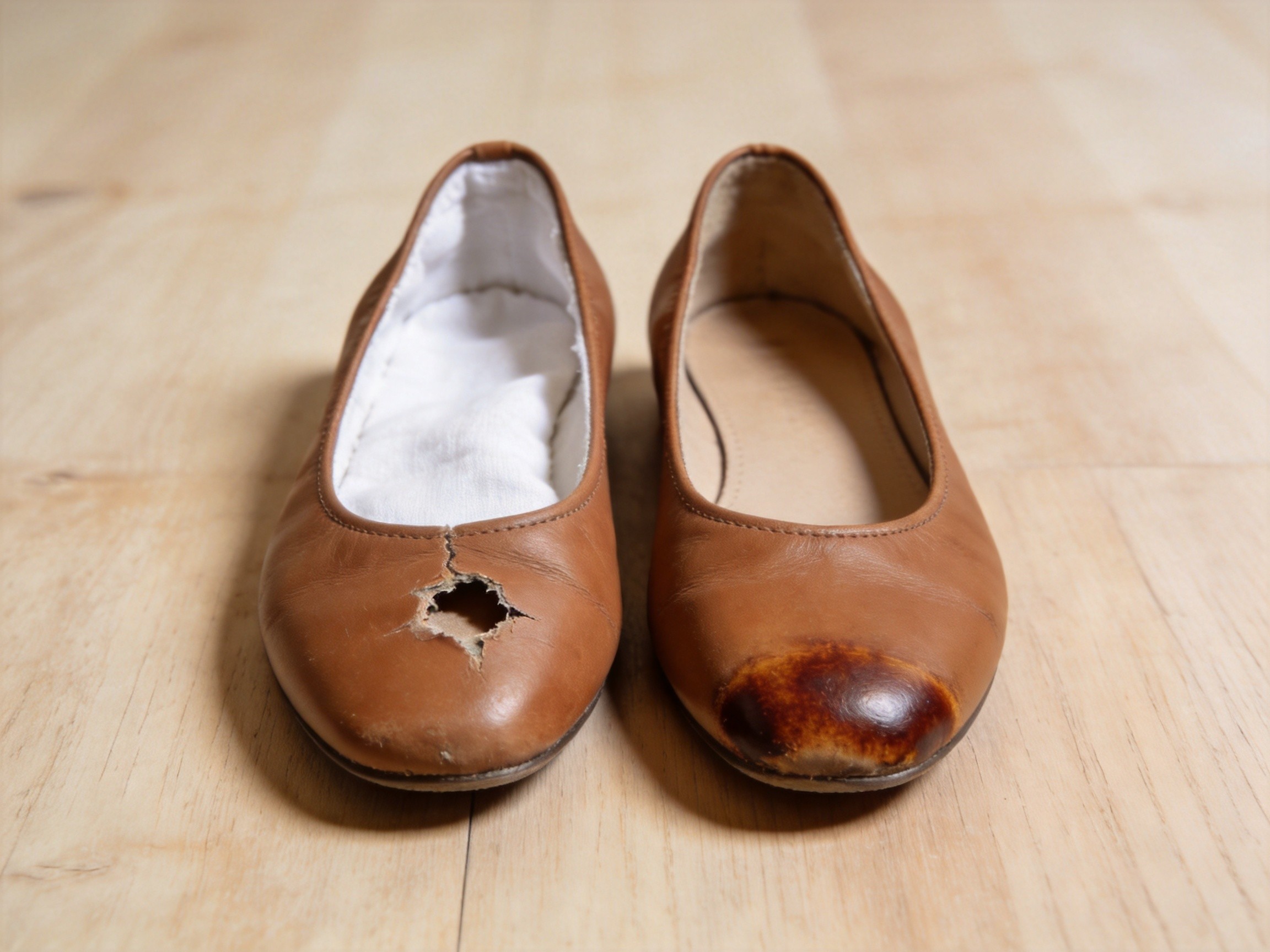
Stop fighting toe-box holes every three months.
Browse the full collection of Chengdu-made custom women's leather ballet flats, loafers, slip-on pumps, and Mary Janes — every pair with a 0.8-1.2mm thick vegetable-tanned full-grain leather toe box, a cellulose-impregnated toe-puff reinforcement, an aniline dye finish, and an anatomical last with a properly positioned metatarsal break. Minimum order 30 pairs for wholesale and private-label customers. Custom samples available for retailers and boutiques.
Explore the Custom Women's Shoe Collection