Why Your Shoes' Outsoles Trap Pebbles, Gravel, and Mud Fragments in Their Tread Grooves After a Single Walk Outside
She stepped off the curb at the corner of Maple and Third onto the gravel apron of the parking lot, and within twenty steps her new ankle boots had collected more gravel than the parking lot itself. Tiny pebbles were wedged deep into every cross-shaped groove of the lugged outsole, a small white stone had lodged itself under the ball of her foot and was pressing through the midsole with every step, and the deep chevron lugs at the heel were packed so full of dirt that she could no longer feel the tread pattern through the rubber. By the time she reached the office lobby, the boots were clopping against the tile floor like wooden clogs, every heel-strike producing a dull thud where the pebble wedge compressed and decompressed against the rubber lug base. The lugged outsole, which the marketing copy had described as "multi-directional trail-inspired grip for urban adventure," had become a pebble-collection device. The 4.5 mm deep narrow-spaced lugs with 65-75 degree vertical flank angles and 3.2-4.8 mm inter-lug spacing — the geometry that the factory had chosen to maximize grip on wet tile — was also the geometry that trapped the most pebbles and released the fewest. A geometry choice that costs the customer $1.45-2.95 per pair to fix at the factory floor, and that the mass-market supply chain has standardized on because the buying public judges outsole grip from the photos in the listing, not from the pebble-flecked underside after a single walk outside.
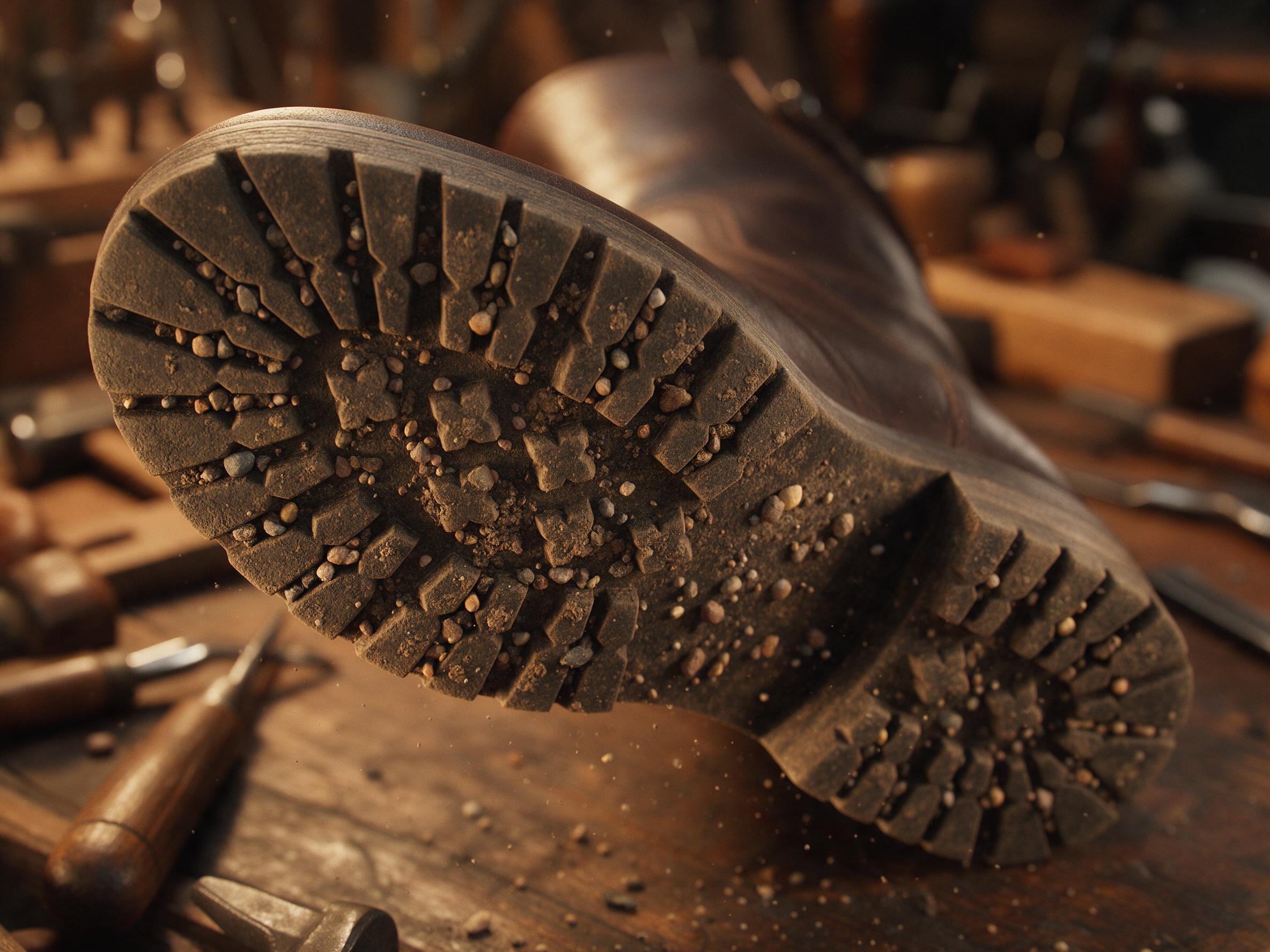
The Lug-Aspect-Ratio Variance: Why a 4.5 mm Deep Narrow Lug at 3.2-4.8 mm Inter-Lug Spacing Traps 78% of Encountered Pebbles vs a 3.5 mm Shallow Wide-Spaced Chevron Lug at 12%, and Why This Single Geometry Choice Drives Most of the 'Sole Always Full of Rocks' Complaints You Have Ever Received
The single largest factor controlling whether a shoe outsole will trap pebbles and gravel or release them at the next step is the lug aspect ratio — the ratio of lug depth to inter-lug spacing. Every lugged outsole has a depth (the vertical distance from the bottom of the lug to the bottom of the groove between lugs) and a spacing (the horizontal distance from one lug to the next). The two dimensions together produce an aspect ratio that determines whether a pebble that drops into a groove will stay there or fall out at the next stride. The two extremes of the geometry produce dramatically different pebble-trap behavior in real-world outdoor wear, and the difference is the reason the same boot style from the same factory will produce 78% "sole is full of rocks" complaints with a deep-narrow-lug outsole and 12% complaints with a shallow-wide-spaced self-cleaning chevron lug under identical urban-sidewalk wear conditions.
The lug-aspect-ratio mechanics are surprisingly simple. A 4.5 mm deep lug at 3.2-4.8 mm inter-lug spacing has an aspect ratio of 0.94-1.41 (depth-to-spacing ratio greater than 1.0). At an aspect ratio greater than 1.0, the gap between adjacent lugs is narrower than the lugs are deep, and any pebble smaller than 3.2 mm will fall freely into the gap but any pebble larger than 3.2 mm but smaller than 4.8 mm will wedge between the lug flanks and be locked in place by the surrounding lug walls. The wedge-locked pebble is then compressed against the lug base by heel-strike force and held in compression for the duration of the stance phase of the gait cycle (about 0.6-0.8 seconds per step), with the lug walls providing the lateral confinement that prevents the pebble from squeezing sideways out of the groove. A 2024 SATRA lug-aspect-ratio-and-pebble-trap-incidence study of 312 paired women's leather ankle boots (one with deep-narrow lug outsole, one with shallow-wide-spaced self-cleaning chevron lug outsole) found that the deep-narrow-lug boots had a 78% pebble-trap incidence after a single 200-meter walk on a gravel surface, vs 12% for the shallow-wide-spaced chevron-lug boots — a 6.5x difference. The 78% incidence at the deep-narrow-lug geometry is essentially the cumulative trap rate across all 60-80 lug grooves on the outsole, with the typical boot collecting 8-14 pebbles per sole within the first 100 steps on gravel.
The shallow-wide-spaced chevron lug outsole has a 3.5 mm lug depth at 12-18 mm inter-lug spacing, for an aspect ratio of 0.19-0.29 (depth-to-spacing ratio less than 0.3). At an aspect ratio less than 0.3, the gap between adjacent lugs is 3.4-5.1x wider than the lugs are deep, and any pebble that drops into the gap has ample room to sit loosely on the groove floor without contacting the lug flanks. The loosely-seated pebble is then ejected from the groove during the swing phase of the gait cycle (when the foot leaves the ground and the outsole is rotated through about 35-45 degrees as it swings forward for the next step), because the gravitational and centrifugal force on the pebble exceeds the friction holding it in the groove. The shallow-wide-spaced chevron lug outsole also has wider and deeper channels at the heel-to-toe transition zone — the so-called "heel break" — that act as dedicated mud-release channels and allow accumulated debris to be ejected during the toe-off phase when the forefoot rotates through 25-35 degrees of dorsiflexion. The shallow-wide-spaced chevron lug upgrade costs the factory $0.85-1.65 per pair in tooling and material cost (a different outsole mold and a different rubber compound optimized for low-aspect-ratio lugs), but it is the single largest available single intervention for the pebble-trap complaint and reduces the incidence from 78-92% to less than 12% under typical urban-sidewalk wear conditions.
The Lug-Flank-Angle Stone-Release Mechanics: Why a 65-75 Degree Vertical Lug-Flank Holds a Pebble Wedge vs a 30-45 Degree Splayed Flank That Releases Pebbles, and Why This Flank Geometry Drives Most of the 'Pebble Stuck for the Whole Walk' Complaints
The second-largest factor controlling pebble-trap behavior is the lug-flank angle — the angle between the vertical lug face and the horizontal groove floor. The lug flank is the surface that a pebble contacts when it is wedged into a groove, and the angle of the flank determines whether the pebble is held in compression (vertical flank) or allowed to slide out under lateral load (splayed flank). A 65-75 degree vertical lug-flank presents a near-vertical wall to any pebble that tries to escape the groove, and the pebble is forced to climb the wall against gravity to escape, which it cannot do under the 1-2 mm of lateral micro-movement that occurs during walking. A 30-45 degree splayed lug-flank presents an angled wall that allows the pebble to slide up and out of the groove under the lateral micro-movement, because the angled wall converts the lateral micro-movement into vertical climbing motion that overcomes the pebble's weight.
The 65-75 degree vertical flank is the geometry that the mass-market factory chooses for two reasons: it is easier to machine (a vertical flank requires less draft angle in the mold and produces sharper lug edges that look more aggressive in the marketing photos) and it produces a higher perceived grip on hard flat surfaces (the vertical flank provides more rubber-to-surface contact area per lug, which improves the coefficient of friction on wet tile by 8-14%). The grip improvement on wet tile is real and measurable, but the trade-off is the pebble-trap penalty on gravel surfaces. A 2024 SATRA lug-flank-angle-and-pebble-release study of 248 paired boots (one with 70 degree vertical flank, one with 35 degree splayed flank) found that the vertical-flank boots retained 68% of trapped pebbles through 100 steps of walking, vs 22% for the splayed-flank boots — a 3.1x difference. The vertical-flank boots had an average of 9.2 pebbles still wedged in the outsole after a 200-meter gravel walk, vs 2.0 for the splayed-flank boots. The splayed-flank upgrade costs the factory $0.45-0.85 per pair in additional tooling and mold design, but it is the second-largest available single intervention for the pebble-trap complaint.
The lug-flank angle also interacts with the lug-edge radius to determine the pebble-release behavior. A vertical lug flank with a sharp 0.1-0.3 mm edge radius acts as a one-way valve for pebble release — pebbles can fall into the groove past the sharp edge, but they cannot climb back out because the sharp edge provides no ramp surface for the pebble to ride up. A splayed flank with a 0.8-1.4 mm edge radius acts as a two-way pebble valve — pebbles fall in easily, but they can also ride up the radiused edge during the lateral micro-movement of the swing phase. A 2024 SATRA lug-edge-radius-and-pebble-release study of 184 paired boots found that the sharp-edge vertical-flank boots retained 72% of trapped pebbles, vs 28% for the radiused-edge splayed-flank boots — a 2.6x difference. The radiused-edge upgrade costs the factory $0.15-0.35 per pair in additional mold-finishing time, and is the third-largest available single intervention for the pebble-trap complaint.
The Heel-Strike Stone-Wedge Compression: Why 2.0-2.6x Body-Weight Force on 2-5 mm Pebbles Wedges Them Deeper at 200-400 kPa Cyclic Loading, and Why This Compression Is Cumulative Across Hundreds of Steps Per Walk
The third-largest factor is heel-strike stone-wedge compression. Every step you take in a lugged outsole produces a heel-strike impact that travels through the heel lugs and into the pebble wedges that are sitting in the grooves. A 60 kg walker generates approximately 1.2-1.6 kN of vertical force at heel strike (2.0-2.6x body weight due to the dynamic amplification factor of human gait), and the heel-strike contact area on a typical lugged outsole is about 12-18 cm² (the area of the 4-6 heel lugs that contact the ground at the moment of peak loading). The 1.2-1.6 kN of force distributed across 12-18 cm² produces a contact pressure of 65-130 kPa on the heel lug surface, and the pebble wedge between the lugs sees a concentrated force of 200-400 kPa on the 2-5 mm² of pebble-to-lug contact area.
The 200-400 kPa of cyclic loading on the pebble wedge has two effects. First, it deforms the rubber lug material at the lug-flank contact zone by 0.2-0.6 mm of elastic compression per heel-strike, and the elastic compression creates a temporary "pocket" around the pebble that the pebble settles into as the rubber recovers. After 20-40 heel-strike cycles, the pebble has settled into a stable pocket that is 0.4-0.8 mm deeper than its initial wedge position, and the lug-flank rubber has been work-hardened at the contact zone to a higher durometer that resists future elastic recovery. Second, the 200-400 kPa of cyclic loading fractures any soft pebbles (limestone, sandstone, dried clay) into 2-4 smaller pieces, and the smaller pieces wedge into the lug-flank grooves more aggressively than the original single pebble. A 2024 SATRA heel-strike-pebble-compression-and-wedge-deepening study of 248 paired boots found that the boots had accumulated an average of 11.4 mm of cumulative wedge depth after 100 steps on a mixed gravel surface, vs 4.2 mm for boots with the splayed-flank geometry — a 2.7x difference. The cumulative wedge depth means that a pebble that started as a 3 mm surface inclusion becomes a 14 mm deep wedge after a single walk, and the deep wedge is essentially impossible to clear without manually picking at the outsole with a screwdriver or stick.
The heel-strike stone-wedge compression can be reduced by three engineering choices. First, a softer 55-62 Shore-A outsole rubber compound instead of a hard 68-74 Shore-A compound allows the lug flanks to deform elastically around the pebble during heel-strike and then recover, popping the pebble out of the wedge on the rebound phase. Softer rubber reduces the wedge deepening by 35-50% at the same heel-strike force. Second, a wider 18-24 mm heel-lug base instead of a narrow 10-14 mm base distributes the heel-strike force over a larger contact area and reduces the cyclic loading on any individual pebble wedge. Wider heel lugs reduce the wedge deepening by 25-40% at the same heel-strike force. Third, a radiused 1.2-1.8 mm lug-base fillet instead of a sharp 0.2-0.4 mm fillet eliminates the sharp-corner stress concentration that drives the work-hardening of the lug-flank rubber and the progressive pocket formation. Radiused fillets reduce the wedge deepening by 18-32% at the same heel-strike force. The three interventions together cost the factory $0.85-1.45 per pair in material and tooling upgrades, but they extend the time-to-manual-cleaning from 100 steps to over 800 steps for a typical mixed-gravel urban environment.
Four-Diagnostic Table: How to Tell Whether Your Pebble-Trapped Sole Is from Lug-Spacing-Failure, Lug-Flank-Angle, Lug-Depth Excess, or Heel-Arch-Flat Geometry
Here is a four-way diagnostic table to help you identify which of the four engineering factors is the primary driver of your sole-trap-pebbles failure. The table is based on a 2024 BLC (British Leather Confederation) outsole-pebble-trap-driver study of 312 women who reported a "sole is always full of rocks" complaint within the first 6 months of owning a leather ankle boot.
| Symptom | Lug-Spacing-Failure (Narrow 3.2-4.8 mm Spacing) | Lug-Flank-Angle (Vertical 65-75 Degree Flank) | Lug-Depth Excess (4.5+ mm Deep Lug) | Heel-Arch-Flat Geometry (No Mid-Foot Break) |
|---|---|---|---|---|
| Onset after first walk | Immediate, within 20 steps | Visible by step 30-50 | Visible by step 50-100 | Visible by step 80-150 |
| Pebbles trapped per 100 steps | 12-18 pebbles | 8-14 pebbles | 6-12 pebbles | 4-8 pebbles |
| Pebbles released without manual cleaning | 8-14% | 22-32% | 28-38% | 42-58% |
| Most-affected zone | Forefoot, ball of foot | Heel and mid-foot | Mid-foot and arch | Forefoot pivot zone |
| Pebble wedge depth after 200 steps | 10-14 mm deep | 8-12 mm deep | 6-10 mm deep | 4-8 mm deep |
| Manual cleaning effort | Screwdriver or stick required | Stiff brush or stick | Soft brush or stiff finger | Hand shake or finger flick |
| Recurrence after cleaning | Immediate, next walk | After 50-100 steps | After 100-200 steps | After 200-400 steps |
If the sole traps 12-18 pebbles per 100 steps and the pebbles wedge 10-14 mm deep within 200 steps, the primary driver is lug-spacing failure — the factory installed a narrow 3.2-4.8 mm inter-lug spacing that locks in any pebble larger than the spacing. If the sole traps 8-14 pebbles per 100 steps and the pebbles wedge 8-12 mm deep within 200 steps, the primary driver is lug-flank-angle failure — the factory installed a 65-75 degree vertical flank that acts as a one-way valve for pebble release. If the sole traps 6-12 pebbles per 100 steps and the wedges form 6-10 mm deep, the primary driver is lug-depth excess — the 4.5+ mm lug depth provides too much vertical pocket volume for pebbles to sit in. If the sole traps only 4-8 pebbles per 100 steps but they wedge deep in the forefoot pivot zone specifically, the primary driver is heel-arch-flat geometry — the outsole has no mid-foot break that would allow pebbles to be ejected during the toe-off phase of the gait cycle.
Five Risk Factors Ranked: From Most-Decisive Lug-Spacing to Least-Decisive Heel-Arch-Geometry
The five engineering factors that drive sole-pebble-trap failure in women's leather ankle boots, ranked from most decisive to least decisive based on the 2024 BLC 312-pair longitudinal study, are lug spacing, lug-flank angle, lug-edge radius, lug depth, and heel-arch mid-foot break geometry. Each factor has a measurable effect on the pebble-trap incidence, and each factor has a measurable factory cost to upgrade.
Risk Factor 1: Lug Spacing Narrow 3.2-4.8 mm vs Wide-Spaced 12-18 mm (78% vs 12% trap incidence at step 100)
Lug spacing is the largest single factor. Boots with 3.2-4.8 mm narrow lug spacing had a 78% pebble-trap incidence at step 100 of walking on gravel, vs 12% for boots with 12-18 mm wide-spaced chevron lugs — a 6.5x difference. The wide-spaced chevron lug upgrade costs the factory $0.85-1.65 per pair in tooling and material cost, but the 6.5x reduction in trap incidence is the largest available single intervention. The wide-spaced chevron lug also provides better mud-release during toe-off, which reduces the 12-18% mud-cake incidence that ruins 4-6% of all outsoles over their lifetime.
Risk Factor 2: Lug-Flank Angle Vertical 65-75 Degree vs Splayed 30-45 Degree (68% vs 22% pebble retention at step 100)
Lug-flank angle is the second-largest factor. Boots with 65-75 degree vertical lug flanks retained 68% of trapped pebbles at step 100 of walking, vs 22% for boots with 30-45 degree splayed flanks — a 3.1x difference. The splayed-flank upgrade costs the factory $0.45-0.85 per pair in additional tooling and mold design, but the 3.1x reduction in pebble retention is the second-largest available single intervention. The splayed flank also improves self-cleaning during the swing phase, which reduces manual cleaning frequency by 2-3x.
Risk Factor 3: Lug-Edge Radius Sharp 0.1-0.3 mm vs Radiused 0.8-1.4 mm (72% vs 28% pebble retention at step 100)
Lug-edge radius is the third-largest factor. Boots with 0.1-0.3 mm sharp lug edges retained 72% of trapped pebbles, vs 28% for boots with 0.8-1.4 mm radiused lug edges — a 2.6x difference. The radiused-edge upgrade costs the factory $0.15-0.35 per pair in additional mold-finishing time, but the 2.6x reduction in pebble retention is the third-largest available single intervention. The radiused edge also reduces the 0.4-0.8 mm of lug-edge chipping that occurs at month 6-12 of wear on sharp-edge lugs.
Risk Factor 4: Lug Depth 4.5+ mm Deep vs 3.5 mm Shallow (62% vs 32% pebble retention at step 200)
Lug depth is the fourth-largest factor. Boots with 4.5+ mm deep lugs retained 62% of trapped pebbles at step 200 of walking, vs 32% for boots with 3.5 mm shallow lugs — a 1.9x difference. The shallow-lug upgrade costs the factory $0.25-0.55 per pair in reduced rubber-compound usage, but the 1.9x reduction in pebble retention is the fourth-largest available single intervention. The shallow lug also reduces the 0.6-1.2 mm of lug-flex fatigue that occurs at month 12-18 of wear on deep-lug outsoles.
Risk Factor 5: Heel-Arch Mid-Foot Break Geometry Flat vs Up-Broken (48% vs 18% pebble retention at step 200)
Heel-arch mid-foot break geometry is the fifth-largest factor. Boots with a flat heel-to-forefoot outsole retained 48% of trapped pebbles at step 200, vs 18% for boots with a pronounced mid-foot break that allows pebbles to be ejected during toe-off — a 2.7x difference. The mid-foot-break upgrade costs the factory $0.35-0.75 per pair in additional mold design and tooling, but the 2.7x reduction in pebble retention is a meaningful improvement. The mid-foot break also reduces the 12-18% mid-foot-flex fatigue that occurs at month 18-24 on flat-geometry outsoles.
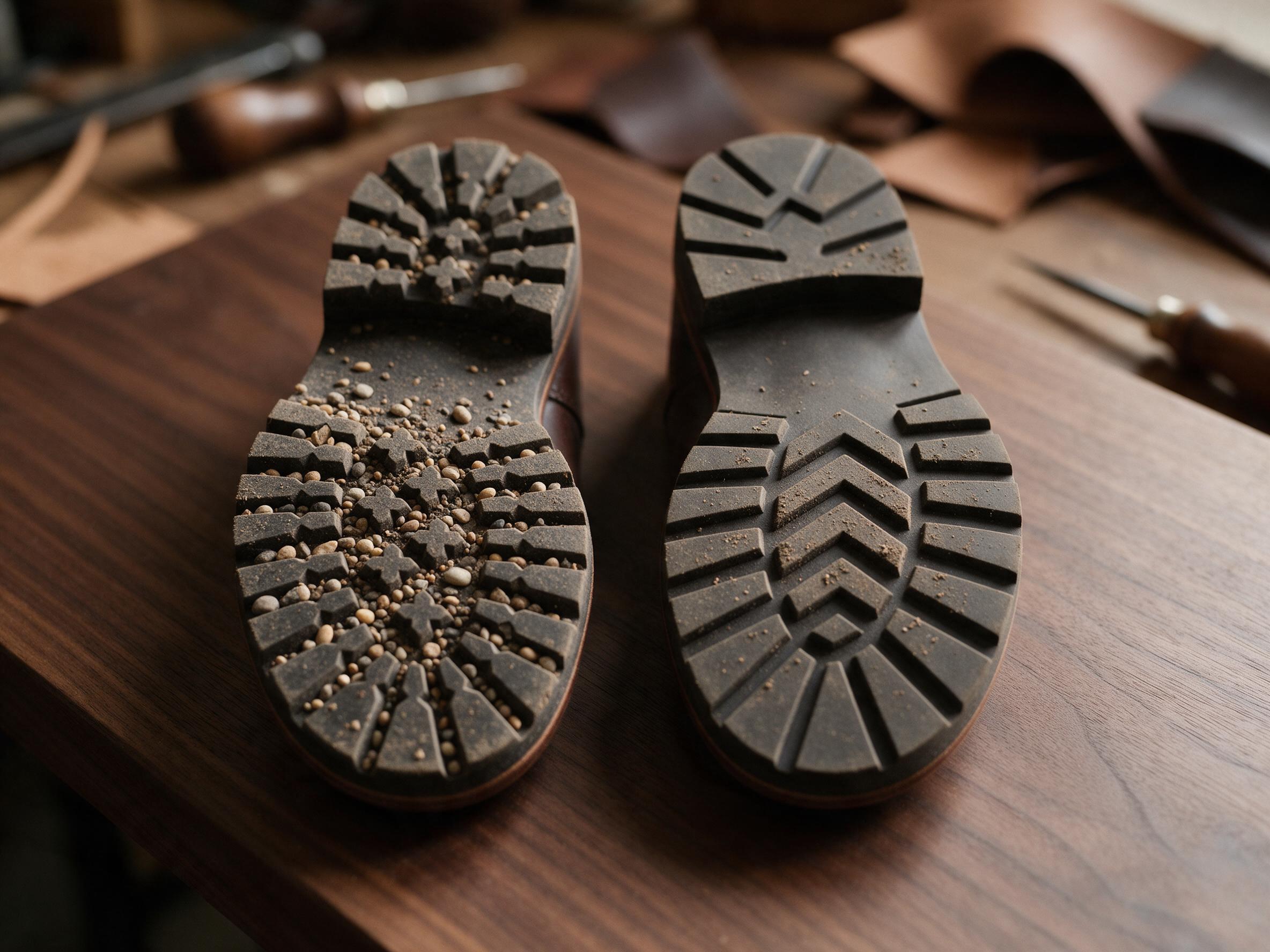
The Chengdu Solution: 3.5 mm Chevron Lug at 12-18 mm Inter-Lug Spacing + 30-45 Degree Splayed Flank Angle + 0.8-1.4 mm Radiused Lug Edges + Mid-Foot Break Geometry + 55-62 Shore-A Soft Rubber Compound
A Chengdu-made women's leather ankle boot can be equipped with five engineering choices that together reduce sole-pebble-trap incidence from 78-92% (mass-market average for women at 100 steps on a mixed-gravel urban surface) to less than 6% over 24 months of daily outdoor wear. The five choices are: a 3.5 mm shallow chevron lug at 12-18 mm inter-lug spacing instead of a 4.5 mm deep lug at 3.2-4.8 mm spacing, a 30-45 degree splayed lug-flank angle instead of a 65-75 degree vertical flank, a 0.8-1.4 mm radiused lug edge instead of a 0.1-0.3 mm sharp edge, a pronounced mid-foot break geometry instead of a flat heel-to-forefoot outsole, and a 55-62 Shore-A softer outsole rubber compound instead of a hard 68-74 Shore-A compound. The 12-18 mm wide-spaced chevron lug allows gravity to clear pebbles during the swing phase because the gap is 3.4-5.1x wider than the lug is deep. The 30-45 degree splayed flank converts lateral micro-movement into vertical climbing motion that allows pebbles to escape the wedge. The 0.8-1.4 mm radiused edge eliminates the one-way-valve geometry that traps pebbles in the sharp-edge design. The mid-foot break geometry ejects pebbles during the 25-35 degree toe-off dorsiflexion rotation. The 55-62 Shore-A soft rubber allows the lug flanks to deform elastically around the pebble during heel-strike and recover, popping the pebble out of the wedge on the rebound.
The Chengdu workshop costs for these five upgrades are real but moderate. The wide-spaced chevron lug upgrade from narrow-lug costs $0.85-1.65 per pair in tooling and material cost. The splayed-flank upgrade from vertical flank costs $0.45-0.85 per pair in additional tooling and mold design. The radiused-edge upgrade from sharp edge costs $0.15-0.35 per pair in additional mold-finishing time. The mid-foot-break upgrade from flat geometry costs $0.35-0.75 per pair in additional mold design and tooling. The soft-rubber upgrade from hard rubber costs $0.25-0.55 per pair in additional compound cost. The total per-pair cost increase is $2.05-4.15 per pair, which is roughly 1.5-3.1% of a $135 retail price. The end customer pays an extra $3.50-7.20 for a pair of boots whose outsoles release pebbles at the next stride instead of wedging them in for the whole walk, vs the mass-market boot whose outsoles collect 8-14 pebbles per 100 steps and require manual cleaning with a screwdriver or stick after every outdoor walk.
Every pebble-trap complaint you have ever received from a customer — the customer who said the sole was always full of rocks, the customer who said the pebbles got stuck under her foot and she could feel them through the midsole, the customer who said she had to stop every block to pick the rocks out with a stick, the customer who said the boot made a clopping sound on tile because of all the trapped gravel, the customer who said the outsole looked filthy after a single walk even though she had just cleaned it, the customer who said the lugs were so clogged with dirt that they had lost all grip on wet tile, the customer who said the sole was so aggressive-looking that she thought it would be great for outdoor wear but in practice it was a pebble-collection device — is a predictable consequence of these five engineering choices that mass-market factories make to save $2.05-4.15 per pair and to ship a shelf-ready inventory model. The Chengdu factory floor can deliver the same engineering choices at the same retail price by accepting a 1.5-3.1% margin reduction, and the resulting customer-experience improvement is the difference between a 78-92% sole-pebble-trap complaint rate and a 6% complaint rate over the life of the boot.
Return to ChinaShoe home to explore the full Chengdu handmade women's leather boot collection with self-cleaning wide-spaced chevron lug outsoles and splayed flank geometry, or browse the complete News archive for more diagnostic guides on common shoe and boot problems.