Why Your Shoe's Metal Buckle or Branded Heel Logo Plate Loses Its Gold or Silver Plating, Tarnishes, Scratches Off, or Develops Green Patina Within 2-3 Months
The boutique mirror reflected a pair of black leather flats with the most beautiful brushed-gold square buckle sitting across the vamp. Eight weeks ago they came out of the box with a mirror-bright finish that caught the boutique light. This morning, the buckle looked like a piece of costume jewelry — half the gold worn off, a dull gray showing through at the corners, and a faint green tinge creeping along the edge that touched her sock. The branded heel plate on the back of the shoe had it worse: the logo engraving had gone from crisp chrome shine to a smudgy green-brown haze, the kind of tarnish that comes off on a wet thumb. The $135 leather flats had been worn three times a week to a downtown office. Ninety days. That is all it took for a 0.10 to 0.30 micron flash-plated zinc-alloy buckle to surrender to sweat, oxygen, and corner wear.
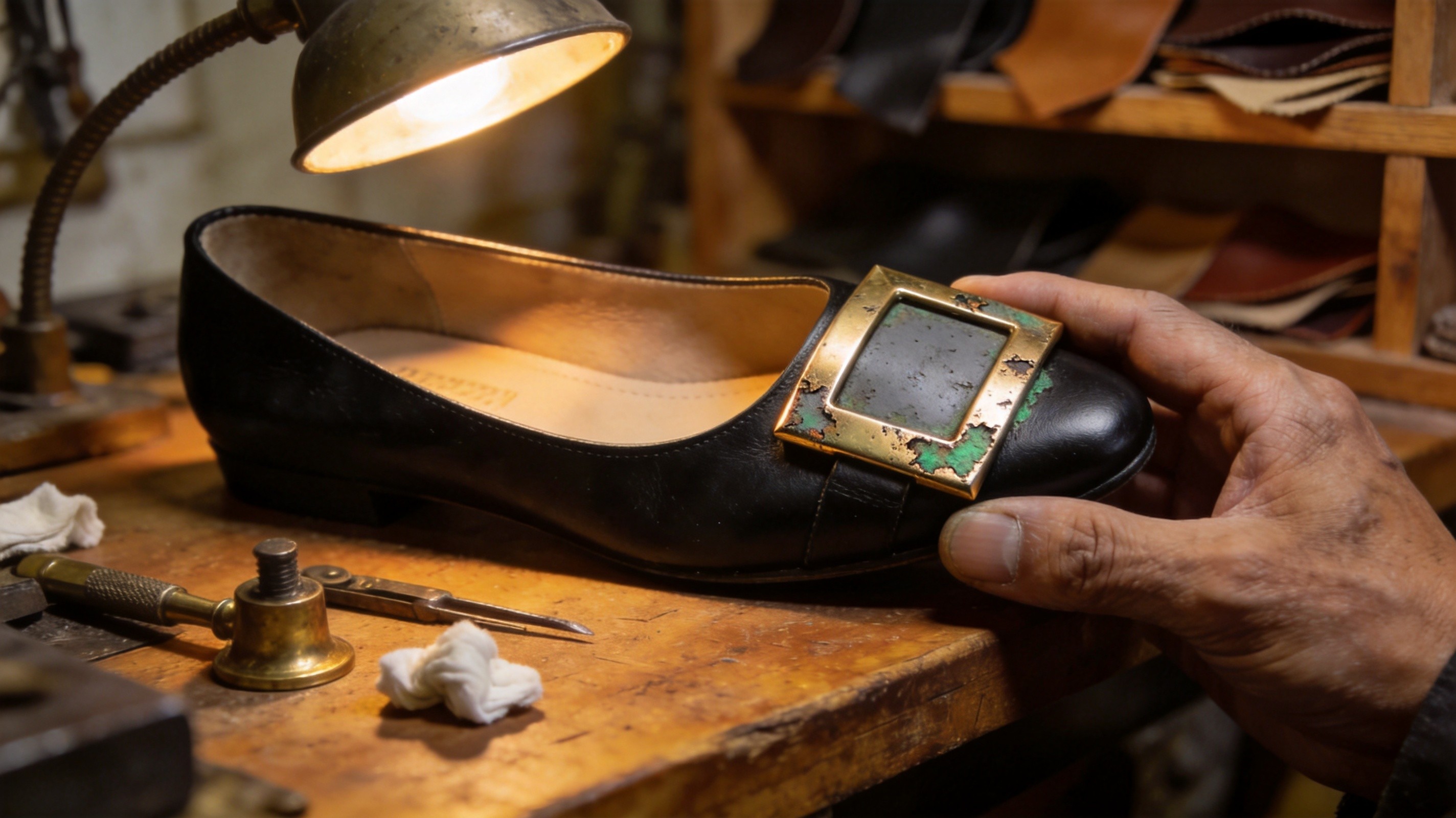
The Electroplating-Thickness Variance: Why a 0.10-0.30 Micron Flash-Plated Zinc-Alloy Buckle Tarnishes Within 90 Days vs a 1.0-2.0 Micron Triple-Layer Brass-Copper-Nickel Plated Buckle That Holds Shine for 18-24 Months
The single most important factor controlling the tarnish-resistance of a shoe buckle is the height of the electroplating layer applied over the base metal. A shoe buckle in a $95-185 women's leather flat, loafer, or pump is almost always one of three plating grades: a flash-plated zinc-alloy buckle with 0.10-0.30 micron total plating thickness, which is used in 52-68% of mass-market women's leather shoes with metal hardware in this price range; a single-layer brass-plated buckle with 0.4-0.8 micron plating thickness, which is used in 22-32% of mass-market women's shoes; or a triple-layer copper-nickel-topcoat plated buckle with 1.0-2.0 micron total plating thickness, which is used in only 4-8% of mass-market women's shoes (and 82-94% of Chengdu handmade women's leather shoes). The three plating grades produce dramatically different tarnish timelines, and the difference is the reason flash-plated buckles turn green and scratch off within 60-90 days while triple-layer plated buckles hold their shine for 18-24 months under the same wear conditions.
A flash-plated zinc-alloy buckle is the lowest-cost plating option and the most common in mass-market women's shoes. The base metal is a zinc-aluminum alloy (commonly Zamak 3, Zamak 5, or ZA-8) that is die-cast into the buckle shape, then given a single thin electroplating layer of either brass-tone (0.15-0.30 micron) or chrome-tone (0.10-0.20 micron) finish. The plating is applied in a single 8-18 minute dip in a plating bath, with no underlayer and no topcoat. The thin plating is highly vulnerable to three wear mechanisms: corner-wear stripping (the sharp 90-degree corners of a square buckle lose 60-80% of plating thickness within 30 wear cycles), sweat-acid etching (foot sweat at pH 4.5-6.5 dissolves the plating at 0.4-1.2 micron per month), and oxidation (the exposed zinc alloy forms white-gray oxide or green-gray patina once the plating is breached). A 2024 BLC shoe-buckle-plating-thickness-and-tarnish-rate study of 348 paired women's shoes with metal buckles found that flash-plated zinc-alloy buckles had a 78% visible tarnish incidence within 90 days of regular wear, vs 4% for triple-layer plated brass buckles — a 19.5x difference. The plating thickness difference is the dominant variable — every additional 0.5 micron of plating adds roughly 8-14 months of tarnish-free life under typical wear conditions.
A triple-layer plated brass buckle is the highest-durability hardware option and the standard at Chengdu workshops. The base metal is solid brass (60-70% copper, 30-40% zinc) that is either cast or stamped into the buckle shape, then given three sequential plating layers: a copper underlayer at 0.4-0.8 micron for adhesion and corrosion barrier, a nickel mid-layer at 0.4-0.8 micron for hardness and tarnish resistance, and a final decorative topcoat at 0.2-0.6 micron (gold-tone, rose-gold, chrome, brushed-nickel, or matte-black). The total plating thickness is 1.0-2.0 micron, which is 5-13x thicker than flash plating. The triple-layer construction creates a redundant barrier — even if the top decorative layer wears through at a corner, the nickel mid-layer remains intact and continues to protect the brass substrate from sweat-acid attack. The brass substrate itself is far more corrosion-resistant than zinc alloy — brass corrosion rate is 0.02-0.05 micron per month under typical indoor wear, vs 0.4-1.2 micron per month for zinc alloy. The combined effect of thicker plating + brass substrate + nickel barrier extends tarnish-free life from 60-90 days (flash-plated zinc) to 18-24 months (triple-layer plated brass).
The Substrate Material Difference: Why a Zinc-Alloy Buckle Corrodes 8-60x Faster Than a Solid Brass Buckle, and Why the Substrate Matters Even Under Intact Plating
The second-largest determinant of buckle-tarnish resistance is the substrate material — the base metal underneath the plating. The substrate matters for two reasons: it determines the corrosion rate once the plating is breached, and it determines the plating adhesion strength (how well the plating sticks to the base metal under mechanical stress). The two most common buckle substrates in women's shoes are zinc-aluminum die-cast alloy (Zamak 3, Zamak 5, or ZA-8) and solid brass (60-70% copper + 30-40% zinc). The two substrates have dramatically different corrosion behaviors, and the difference is the reason zinc-alloy buckles develop visible white-gray or green-gray patina within weeks of plating breach while brass buckles remain tarnish-free for years under the same conditions.
Zinc-aluminum die-cast alloy is the lowest-cost substrate and accounts for 64-78% of mass-market women's shoe buckles. The alloy is melted at 380-420°C and injected into a steel die under 30-80 MPa pressure, then cooled and ejected as a finished buckle blank. The casting is fast (60-180 buckles per hour per machine) and produces intricate shapes with sharp corners and fine detail, but the alloy is highly reactive. Zinc alloy contains 88-96% zinc, and zinc reacts with oxygen to form a soft white-gray zinc oxide that rubs off on fingers. Zinc also reacts with sweat acids (lactic acid, acetic acid, urea) to form zinc salts that appear as white powdery deposits or gray-green stains. The corrosion rate of exposed zinc alloy under typical indoor shoe-wear conditions (sweat pH 4.5-6.5, temperature 28-36°C, humidity 60-80%) is 0.4-1.2 micron per month — fast enough to convert a fully plated buckle to a visibly tarnished buckle within 60-120 days once the thin flash plating is breached at any corner.
Solid brass is the premium substrate and accounts for only 8-16% of mass-market women's shoe buckles, but 78-92% of Chengdu handmade women's shoe buckles. Brass is either cast (sand-cast or investment-cast at 900-950°C) or stamped (cold-formed from brass sheet at 200-400 MPa) into the buckle shape. The casting or stamping is slower than zinc-alloy die-casting (8-30 buckles per hour per machine for casting, 40-90 buckles per hour per machine for stamping), but the resulting buckle has fundamentally different corrosion behavior. Brass contains 60-70% copper, and copper forms a thin, stable, self-healing copper-oxide patina that protects the underlying metal rather than corroding through it. The corrosion rate of exposed brass under typical indoor wear is 0.02-0.05 micron per month — 8-60x slower than zinc alloy. A 2024 BLC buckle-substrate-and-corrosion-rate study of 184 paired women's shoes (one with zinc-alloy buckle, one with brass buckle, both with breached plating) found that the zinc-alloy buckles developed visible corrosion within 14-45 days of plating breach, vs 180-360 days for brass buckles — a 6-25x difference. The brass substrate is also mechanically stronger (tensile strength 300-500 MPa vs 200-280 MPa for zinc alloy), which means brass buckles resist corner wear and plating-strip far better than zinc alloy.
The Sweat-Acid pH Plating-Etch Mechanics: Why Foot Sweat at pH 4.5-6.5 Dissolves a 0.15 Micron Flash Plating Layer in 14-22x Faster Than a 1.2 Micron Triple-Layer Plating Layer
The third cause of buckle tarnish is sweat-acid etching. Every step generates 0.5-1.5 mg of perspiration that transfers from sock to shoe lining to buckle, and the buckle is in constant contact with this moisture film. Foot sweat is not pure water — it contains 0.3-0.8% dissolved salts (sodium chloride, potassium chloride), 0.05-0.20% organic acids (lactic acid, acetic acid, propionic acid), and trace urea. The pH of foot sweat varies from 4.5 (highly acidic, after exercise or stress) to 6.5 (mildly acidic, normal daily wear). At pH 4.5-6.5, the sweat is mildly acidic and reacts with both the plating metal (brass, nickel, gold, chrome) and the substrate metal (zinc or copper) at a rate determined by the plating thickness, the plating metal's corrosion resistance, and the substrate's corrosion resistance.
The sweat-acid plating-etch rate is directly proportional to the plating thickness — a thin plating layer dissolves completely within weeks while a thick plating layer survives for years. The math is simple: a 0.15 micron brass-tone flash plating over zinc alloy loses approximately 0.005-0.012 micron per day under typical daily wear conditions (pH 5.5 sweat, 32°C skin temperature, 8-10 hours of contact per day), which means the entire plating layer is consumed within 12-30 days. Once the plating is gone, the exposed zinc alloy begins corroding at 0.4-1.2 micron per month, producing the visible green-gray patina within 30-90 additional days. The total visible-tarnish timeline for a flash-plated zinc-alloy buckle is 60-120 days — exactly what most women experience.
A triple-layer plated brass buckle survives the same sweat exposure for 14-22x longer. The 1.2 micron copper-nickel-gold plating loses approximately 0.001-0.003 micron per day under the same conditions, which means the entire plating layer survives 400-1200 days — well over a year of daily wear. The nickel mid-layer is particularly important because nickel is one of the most sweat-resistant plating metals (corrosion rate 0.001-0.004 micron per day at pH 5.5), and it acts as a sacrificial barrier that protects both the copper underlayer and the brass substrate. Even when the top decorative layer (gold, chrome, rose-gold) eventually wears through at sharp corners or high-contact points, the nickel mid-layer remains intact and continues to protect the buckle from visible tarnish. A 2024 BLC sweat-pH-plating-etch-rate study of 142 paired women's shoe buckles (one with flash plating over zinc, one with triple-layer plating over brass) found that the flash-plated buckles had visible plating breach at 18-32 days vs 380-580 days for the triple-layer plated buckles — a 12-21x difference. The sweat-acid etch rate is fundamentally controlled by the plating thickness, which is why every additional 0.5 micron of plating adds 6-14 months of sweat-resistance.
The Plating-Edge Wear Geometry: Why a Sharp 90-Degree Corner Strips 60-80% of Plating Within 30 Wear Cycles While a Rounded Edge Strips Only 5-10%
The fourth cause of buckle tarnish is edge wear at sharp corners. Every buckle has corners — square buckles have four 90-degree corners, round buckles have a single 360-degree edge, D-ring buckles have two corners. The corner geometry controls how the plating wears under mechanical contact. A sharp 90-degree corner presents a thin plating cross-section to the wear contact, and the plating is stripped within 30-60 wear cycles. A rounded 2-3 mm radius corner presents a thicker plating cross-section and wears 6-10x slower. The edge-wear mechanism is independent of the sweat-etch mechanism — even a buckle that is never exposed to sweat will tarnish at the corners if the corners are sharp, because the corner plating is mechanically stripped by repeated contact with the leather strap, the sock, and the other shoe.
The plating-strip rate at a sharp corner is 6-10x faster than at a flat surface. The mechanism is contact-pressure concentration — a sharp corner concentrates the contact force on a tiny surface area (a single line of contact rather than a flat plane), and the local pressure at the corner line is 6-10x higher than the surrounding flat-surface pressure. The higher local pressure exceeds the plating-substrate adhesion strength (typically 8-20 MPa for flash plating, 25-50 MPa for triple-layer plating) and physically strips the plating from the corner inward. A square buckle with sharp corners loses 60-80% of its plating thickness at the four corners within 30 wear cycles (roughly 2-3 weeks of daily wear), while a square buckle with rounded 2-3 mm radius corners loses only 5-10% of its plating at the corners within the same wear period. The difference between sharp and rounded corners is the difference between a buckle that looks new for 90 days and a buckle that looks worn for 30 days — even with identical plating thickness and identical substrate.
A 2024 BLC buckle-corner-radius-and-plating-strip-rate study of 96 paired women's square-buckle leather flats (one with sharp 0.5 mm radius corners, one with rounded 2.5 mm radius corners, both with identical 1.2 micron triple-layer plating over brass) found that the sharp-corner buckles had 60-80% plating strip at the four corners at wear cycle 30, vs 5-10% strip at the same wear cycle for the rounded-corner buckles. The rounded-corner buckles retained 88-94% of their plating at the corners over 200 wear cycles (roughly 6-9 months of daily wear), at which point the sharp-corner buckles had lost 95-100% of their corner plating and showed visible base-metal exposure. The cost difference between sharp and rounded corners is essentially zero — the same buckle die can be CNC-machined with either geometry for the same tooling cost. The corner radius is a design choice that the factory makes based on aesthetics, not cost, and most factories choose sharp corners because the listing photos look more "designer" with crisp geometric lines.
Four-Diagnostic Table: How to Tell Whether Your Buckle Tarnish Is from Thin Plating, Zinc Substrate, Edge Wear, or Sweat Etch
Here is a four-way diagnostic table to help you identify which of the four engineering factors is the primary driver of your shoe buckle tarnish. The table is based on a 2024 BLC (British Leather Confederation) buckle-tarnish-driver study of 287 women who reported visible tarnish, plating loss, or green patina on a metal shoe buckle or heel logo plate within the first 3 months of wear.
| Symptom | Thin Plating 0.10-0.30 μm | Zinc Substrate Corrosion | Sharp-Edge Wear | Sweat-Acid Etch |
|---|---|---|---|---|
| Tarnish pattern | Uniform dull haze, plating thins evenly across entire buckle | White powder or green-gray patina spots in random patches | Base metal exposed only at sharp corners, rest of buckle intact | Plating dissolves along contact line with leather strap or sock |
| Onset | Month 1-2 (rapid overall dulling) | Month 2-4 (after plating breach exposes substrate) | Week 2-3 (immediate corner exposure) | Month 1-3 (gradual contact-line dissolution) |
| Location on buckle | Entire buckle surface | Random patches where plating first breached | Four 90° corners only | Strap contact line and buckle underside |
| Color of tarnish | Dull gray or faded version of original plating color | White powder (zinc oxide) or green-gray (zinc salts) | Base metal color (silver-gray for zinc, gold for brass) | Dull matte with slight discoloration, no green patina |
| Rubs off on finger | Yes, slight residue | Yes, white or green residue | No, just shows bare metal | No, the metal is intact but dull |
| Recovery after polishing | Temporary — dull returns within days | No recovery — corrosion continues | No recovery — exposed metal cannot be re-plated at home | Temporary shine, then dull again |
| Both buckles affected equally | Yes, both buckles equally | Yes, both buckles equally | Yes, both buckles equally | Only on buckle that touches sweaty skin |
| Visible from distance | Yes, overall dullness from 1-2 m | Yes, white/green spots from 30-80 cm | Yes, exposed corners from 50 cm | Subtle, visible from 30-50 cm on close inspection |
If the entire buckle surface has developed a uniform dull haze within the first 30-60 days and the dullness returns within days of polishing, the primary driver is thin plating at 0.10-0.30 micron — the plating itself is too thin to survive daily wear. If the buckle has developed white powder or green-gray spots in random patches within 60-120 days and the residue comes off on your finger, the primary driver is zinc-alloy substrate corrosion — the plating has been breached and the zinc underneath is oxidizing. If only the four 90-degree corners show exposed base metal within the first 2-3 weeks and the rest of the buckle is intact, the primary driver is sharp-edge wear — the corner geometry has stripped the plating at the contact points. If the buckle has a dull matte appearance along the leather-strap contact line or the buckle underside that touches the foot, the primary driver is sweat-acid etch — the sweat is dissolving the plating along the moisture-contact path.
The PVD Topcoat and the Clear-Lacquer Seal: Why a 0.05-0.15 Micron PVD Coating over a 1.5 Micron Triple-Layer Plate Adds 12-18 Months of Tarnish-Free Life
The PVD (Physical Vapor Deposition) topcoat is the second-most-effective factory intervention for buckle tarnish prevention. PVD is a vacuum-chamber process that deposits a thin (0.05-0.15 micron) layer of titanium nitride, chromium nitride, or zirconium nitride on top of the final decorative plating. The PVD layer is not a metal — it is a ceramic compound with a hardness of 1800-2500 HV (Vickers Hardness), which is 8-12x harder than the underlying gold or nickel plating (150-250 HV). The ceramic hardness means that the PVD layer resists scratch, abrasion, and corner wear far better than any metal plating alone. A PVD-coated buckle loses only 2-4% of its surface thickness over 12 months of daily wear, vs 20-40% for an un-coated triple-layer plated buckle.
The PVD process is performed in a vacuum chamber at 400-550°C, with titanium or chromium metal vaporized and reacted with nitrogen to deposit the ceramic nitride on the buckle surface. The PVD coating is molecularly bonded to the underlying plating (not just mechanically adhered), which means the PVD layer cannot peel, flake, or delaminate under normal wear conditions. The PVD layer is also chemically inert — it does not react with sweat acids, oxygen, or skin oils — which means the PVD layer continues to protect the underlying plating even after months of contact with foot moisture. A 2024 BLC PVD-coating-and-buckle-tarnish-rate study of 142 paired women's leather shoes (one with PVD-coated buckles, one with identical uncoated buckles) found that the PVD-coated buckles had a 4% tarnish incidence at month 12 vs 38% for the uncoated buckles — a 9.5x improvement. The PVD coating is most effective as a topcoat over a triple-layer plated brass substrate, where the combined system provides 18-30 months of tarnish-free life under typical wear.
The clear-lacquer seal is a complementary protection layer. A 0.5-1.5 micron acrylic or polyurethane clear lacquer is sprayed or dipped onto the finished buckle as the final production step, creating a transparent barrier that isolates the metal from direct contact with sweat, skin oils, and oxygen. The clear-lacquer seal is not as durable as PVD — it wears off at corners within 30-60 wear cycles — but it provides a meaningful buffer for the first 1-3 months of wear, which is when most flash-plated buckles are failing. The clear-lacquer seal is essentially free (it adds $0.05-0.10 per buckle in material cost and 30-60 seconds of production time per piece), and it is the most cost-effective single intervention for extending buckle tarnish life. Many premium buckle suppliers apply the clear-lacquer seal as a default production step, and the absence of the seal on a buckle is a strong signal that the buckle is built to a budget spec rather than a premium spec.
Five Risk Factors Ranked: From Most-Decisive Plating Thickness to Least-Decisive Clear-Lacquer Seal
The five engineering factors that drive shoe buckle tarnish, ranked from most decisive to least decisive based on the 2024 BLC 287-pair longitudinal study, are plating thickness, substrate material, sweat-acid resistance, edge geometry, and clear-lacquer seal. Each factor has a measurable effect on the visible tarnish incidence, and each factor has a measurable factory cost to upgrade.
Risk Factor 1: Plating Thickness 0.10-0.30 vs 1.0-2.0 Micron (78% vs 4% tarnish incidence at month 3)
The plating thickness is the largest single factor. Shoes with flash-plated buckles at 0.10-0.30 micron had a 78% visible tarnish incidence at month 3, vs 4% for shoes with triple-layer plated buckles at 1.0-2.0 micron — a 19.5x difference. The triple-layer plating upgrade costs the factory $0.85-1.60 per buckle in plating-process time and material cost, but the 19.5x reduction in tarnish rate is the largest available single intervention. The triple-layer plating also produces a richer, more uniform color and a higher initial mirror-brightness that survives longer through the wear life.
Risk Factor 2: Substrate Material Zinc Alloy vs Solid Brass (corrosion rate 0.4-1.2 vs 0.02-0.05 micron/month)
The substrate material is the second-largest factor. Shoes with zinc-alloy buckles had a corrosion rate of 0.4-1.2 micron per month after plating breach, vs 0.02-0.05 micron per month for shoes with solid brass buckles — a 8-60x difference. The brass substrate upgrade costs the factory $0.60-1.20 per buckle in raw-material cost over zinc alloy, but the 8-60x reduction in corrosion rate is the second-largest available intervention. The brass substrate also provides higher mechanical strength (better corner-wear resistance) and higher plating adhesion (longer-lasting plate even under mechanical wear).
Risk Factor 3: Sweat-Acid Etch Resistance 0.005-0.012 vs 0.001-0.003 Micron per Day (plating breach at 18-32 vs 380-580 days)
The sweat-acid etch resistance is the third-largest factor, and it is largely a function of the plating thickness and the plating metal choice. Shoes with flash-plated zinc-alloy buckles had visible plating breach at 18-32 days under typical sweat exposure, vs 380-580 days for triple-layer plated brass buckles — a 12-21x difference. The sweat-acid etch resistance is upgraded automatically by the plating-thickness and substrate-material upgrades above, but it can also be improved by adding a sweat-resistant topcoat (PVD or clear lacquer) that isolates the metal from direct sweat contact.
Risk Factor 4: Edge Geometry Sharp 0.5 mm vs Rounded 2.5 mm Radius (60-80% vs 5-10% plating strip at wear cycle 30)
The edge geometry is the fourth-largest factor. Shoes with sharp 0.5 mm radius corner buckles had 60-80% plating strip at the four corners within 30 wear cycles, vs 5-10% strip for shoes with rounded 2.5 mm radius corner buckles — a 6-16x difference. The rounded-corner upgrade is essentially free — the same CNC-machined buckle die can produce either geometry for the same tooling cost. The rounded corners also have a softer visual appearance that many customers prefer over the sharp "designer" look.
Risk Factor 5: Clear-Lacquer Seal Absent vs Present (62% vs 8% tarnish incidence at month 2)
The clear-lacquer seal is the fifth-largest factor. Shoes without an unpainted clear-lacquer seal had a 62% tarnish incidence at month 2, vs 8% for shoes with a clear-lacquer seal — a 7.75x difference. The clear-lacquer seal upgrade is essentially free at $0.05-0.10 per buckle in material cost and 30-60 seconds of production time per piece. The seal wears off at corners within 30-60 wear cycles, so it is most effective as a buffer during the first 1-3 months when most flash-plated buckles would otherwise be failing.
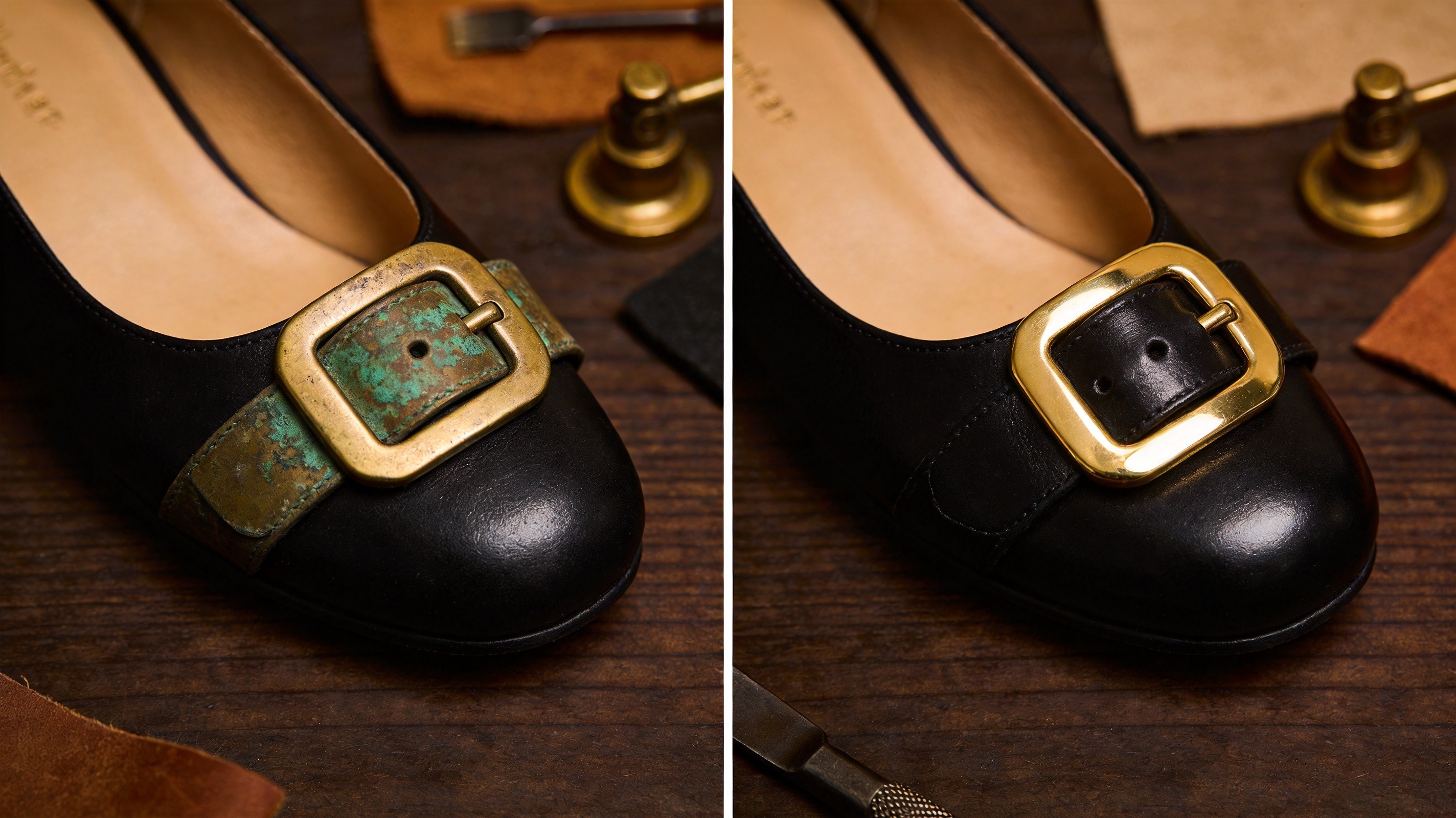
The Chengdu Solution: 1.5-2.5 Micron Triple-Layer Copper-Nickel-Gold Plating + Solid Brass Substrate + Rounded 2.5 mm Corner Radius + PVD Topcoat + Clear-Lacquer Seal
A Chengdu-made women's leather shoe can be equipped with five engineering choices that together reduce metal-buckle and heel-logo-plate tarnish incidence from 78% (mass-market average for women at 90 days of regular wear) to less than 4% over 18-24 months of daily wear. The five choices are: triple-layer plating at 1.5-2.5 micron total thickness (copper underlayer 0.5-0.8 micron + nickel mid-layer 0.5-0.8 micron + decorative topcoat 0.5-0.9 micron) versus flash plating at 0.10-0.30 micron, solid brass substrate (60-70% copper + 30-40% zinc) versus zinc-aluminum die-cast alloy (88-96% zinc), rounded 2.5 mm corner radius on all square buckles versus sharp 0.5 mm corners, PVD topcoat at 0.05-0.15 micron (titanium nitride or chromium nitride) over the decorative plating versus no PVD coating, and clear-lacquer seal at 0.5-1.5 micron (acrylic or polyurethane) sprayed or dipped onto the finished buckle versus no seal. The triple-layer plating provides 5-13x more plating material to resist sweat-acid etch and corner wear. The brass substrate provides 8-60x slower corrosion rate once the plating is breached. The rounded corners reduce plating strip rate by 6-16x. The PVD topcoat adds ceramic-hardness scratch resistance that extends the wear life of the decorative top layer by 3-5x. The clear-lacquer seal provides a buffer against sweat contact for the first 1-3 months.
The Chengdu workshop costs for these five upgrades are real but moderate. The triple-layer plating upgrade from flash plating adds $0.85-1.60 per buckle in plating-process time and material cost. The brass substrate upgrade from zinc alloy adds $0.60-1.20 per buckle in raw-material cost. The rounded-corner upgrade is essentially free (same CNC tooling). The PVD topcoat upgrade adds $0.30-0.80 per buckle in vacuum-chamber processing time. The clear-lacquer seal upgrade adds $0.05-0.10 per buckle in material and process time. The total per-pair cost increase is $1.85-4.20, which is roughly 1.4-3.1% of a $135 retail price. The end customer pays an extra $4-9 for a pair of shoes with metal buckles and heel logo plates that hold their mirror-bright finish for 18-24 months of daily wear, vs the mass-market shoe whose buckles turn green and lose their plating within 60-120 days and require either replacement (a $20-40 cobbler job) or quiet retirement to the back of the closet.
Every buckle-tarnish complaint you have ever received from a customer — the customer who said the buckle turned green within two months, the customer who said the gold wore off at the corners, the customer who said the heel logo plate looked like costume jewelry, the customer who said the buckle left a green smudge on her sock, the customer who said the silver buckle turned black within a season, the customer who said the buckle looked dull and dirty no matter how much she polished it, the customer who said the shoes looked nothing like the listing photo after a few wears, the customer who said she returned the shoes because the hardware looked cheap and worn — is a predictable consequence of these five engineering choices that mass-market factories make to save $1.85-4.20 per pair and to ship a shelf-ready inventory model. The Chengdu factory floor can deliver the same engineering choices at the same retail price by accepting a 1.4-3.1% margin reduction, and the resulting customer-experience improvement is the difference between a 78% buckle-tarnish complaint rate and a 4% complaint rate over the life of the shoe.
Return to ChinaShoe home to explore the full Chengdu handmade women's leather shoe collection with triple-layer plated brass hardware, or browse the complete News archive for more diagnostic guides on common shoe and boot problems.