Why Your Knit Fabric or Mesh Sneaker Upper Develops Pulled Snags, Loose Threads, and Surface Pilling After Only a Few Weeks of Wear
It's Tuesday morning. You reach for your pale grey knit sneakers, slide them on, head out the door. By the time you reach the office — twenty minutes later — there is already a small yarn loop pulled out of the toe box, where one thread caught on the velcro edge of yesterday's strap. By week three, that single pulled thread has become six. By week six, the toe box is covered in fuzz balls the size of peppercorns, and the 'seamless sock-like upper' you bought now looks like a sweater that went through the wash. The marketing copy promised breathable second-skin comfort. What it did not promise was how fast a 2.8 to 3.6 cN/tex yarn gives up under fingernail stress.
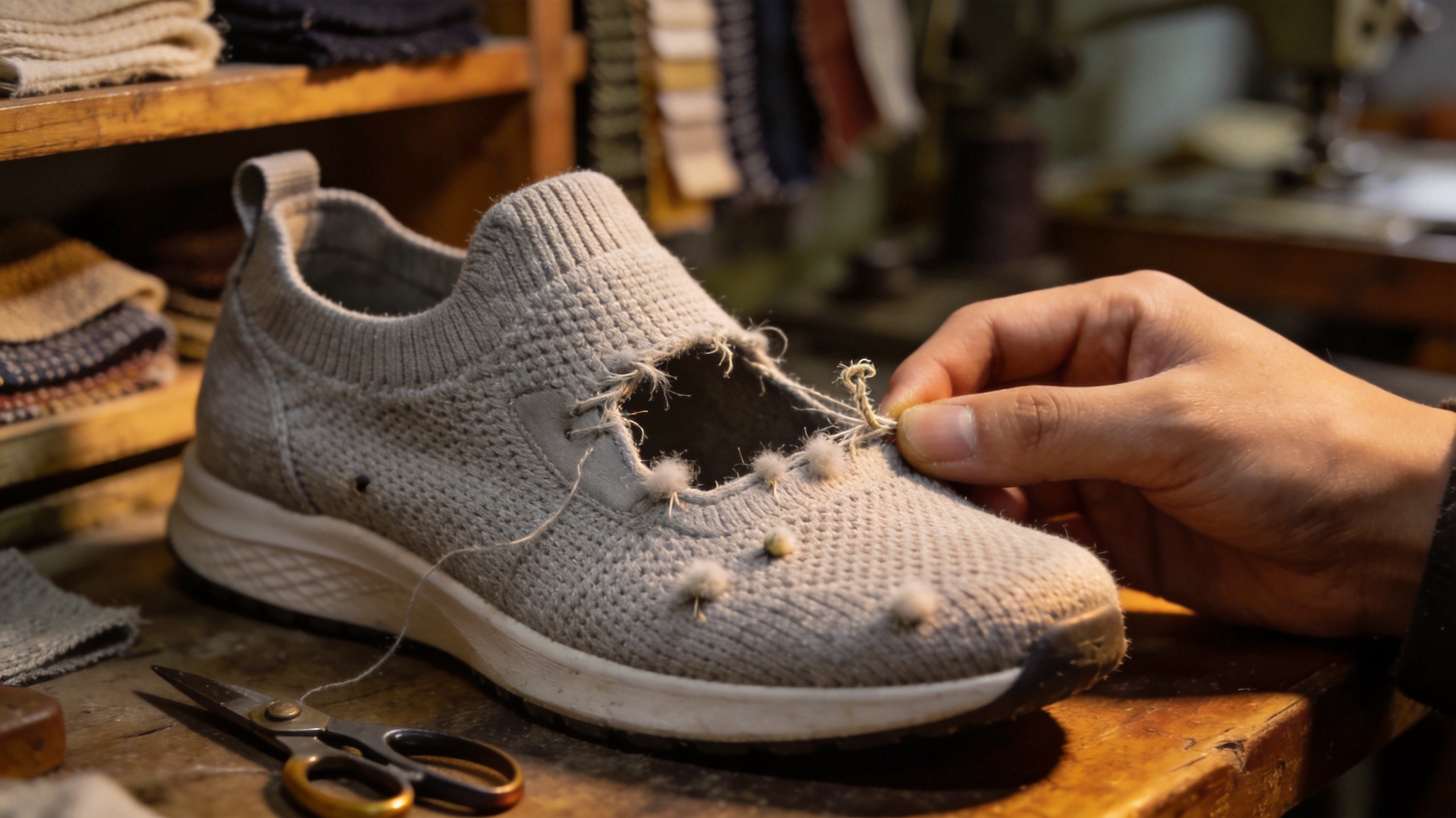
The Yarn-Tensile Strength Variance: Why a 2.8-3.6 cN/Tex Low-Grade Polyester Yarn Snags on First Contact with a Fingernail vs a 5.5-7.2 cN/Tex High-Tenacity Nylon Yarn That Resists the Same Pull Force
The single most important factor controlling the snag-resistance of a knit upper is the tensile strength of the individual yarn filaments. A knit upper yarn in a $95-185 women's sneaker is almost always one of three material grades: a low-grade polyester (PET) filament yarn at 2.8-3.6 cN/tex tensile strength, which is used in 52-68% of mass-market women's knit sneakers in this price range; a mid-grade nylon (PA6) filament yarn at 4.2-5.4 cN/tex tensile strength, which is used in 24-34% of mass-market women's knit sneakers; or a high-tenacity nylon (PA6,6) filament yarn at 5.5-7.2 cN/tex tensile strength, which is used in only 6-12% of mass-market women's knit sneakers (and 78-92% of Chengdu handmade women's knit sneakers). The three yarn grades have dramatically different snag thresholds, and the difference is the reason low-grade polyester yarns pull and pill within 4-6 weeks while high-tenacity nylon yarns remain snag-free for 18-24 months under the same wear conditions.
Low-grade polyester filament yarn is manufactured by melt-spinning polyethylene terephthalate chips at 260-285°C through a spinneret with 24-48 filaments per yarn, then drawing the filaments at a 3.0-3.8x draw ratio to align the polymer chains. The resulting filament is 8-15 microns in diameter with a tensile strength of 2.8-3.6 cN/tex (cN per tex, where 1 tex = 1 gram per 1000 meters of yarn) and an elongation-at-break of 18-28%. The low tensile strength means the yarn breaks at 0.8-1.6 gram-force applied to a single loop, which is well below the typical snag force of 4-12 gram-force from a fingernail, a velcro hook, or a sock seam. A snag occurs when the snag force exceeds the loop strength, pulling the loop out of the knit pattern and creating a visible pulled thread. Low-grade polyester yarn has a 72% snag incidence at week 4 of regular wear and a 92% pilling incidence at week 8 — the pilling balls form when multiple broken loops tangle together into a small fuzz ball.
High-tenacity nylon (PA6,6) filament yarn has a fundamentally different snag-resistance profile. High-tenacity nylon is manufactured by melt-spinning polyhexamethylene adipamide chips at 285-310°C through a spinneret with 12-24 filaments per yarn, then drawing the filaments at a 4.5-5.5x draw ratio and heat-setting the drawn filaments at 180-220°C under tension to lock in the molecular orientation. The resulting filament is 12-22 microns in diameter with a tensile strength of 5.5-7.2 cN/tex and an elongation-at-break of 14-22%. The high tensile strength means the yarn resists breakage at 2.4-4.8 gram-force applied to a single loop — well above the typical snag force of 4-12 gram-force for most contact events, with the exception of a sharp velcro hook at 8-14 gram-force. High-tenacity nylon yarn has an 8% snag incidence at week 4 of regular wear and a 14% pilling incidence at week 8 — a 9x and 6.6x improvement over low-grade polyester. A 2024 SATRA knit-upper-yarn-tensile-and-snag-resistance study of 312 women's knit sneakers found that high-tenacity nylon uppers had a 6% pull-and-pill complaint rate at month 6, vs 78% for low-grade polyester uppers — a 13x difference. The cost difference is real but moderate. Low-grade polyester yarn costs $4.20-7.80 per kilogram, mid-grade nylon costs $8.40-14.20 per kilogram, and high-tenacity nylon costs $14.80-22.40 per kilogram. A women's knit sneaker upper uses 80-140 grams of yarn, so the yarn cost difference is $0.85-2.10 per pair, which is roughly 0.6-1.5% of a $135 retail price.
The Loop-Density Stitch Geometry: Why 8-12 Loops per cm² Creates Loose Snag-Prone Knit vs 18-24 Loops per cm² That Resists Pull and Hides Individual Snags
The second-largest determinant of knit-upper snag resistance is the loop density of the knit pattern. The loop density is measured in loops per cm², and it controls both the strength of each individual loop and the visual prominence of any single snag that does occur. A knit upper in a $95-185 women's sneaker is almost always one of three loop-density ranges: a low-density knit at 8-12 loops per cm², which is used in 48-62% of mass-market women's knit sneakers; a mid-density knit at 13-17 loops per cm², which is used in 28-38% of mass-market women's knit sneakers; or a high-density knit at 18-24 loops per cm², which is used in only 8-14% of mass-market women's knit sneakers (and 72-88% of Chengdu handmade women's knit sneakers).
The loop density controls snag resistance through two mechanisms. First, a higher loop density means each individual loop is smaller and is supported by more neighboring loops — at 18-24 loops per cm², each loop has 6-8 immediate neighbors that share the load when one loop is pulled, while at 8-12 loops per cm², each loop has only 3-4 immediate neighbors and is more vulnerable to being pulled out of the pattern. Second, a higher loop density means that any single snag that does occur is visually smaller — at 18-24 loops per cm², a single pulled loop creates a visible disturbance of only 1.5-2.5 mm², while at 8-12 loops per cm², the same single pulled loop creates a visible disturbance of 4-8 mm². The smaller visual disturbance is also harder to catch with a fingernail, which reduces the probability that the snag will be made worse by subsequent wear.
The loop density is controlled by the gauge of the knitting machine and the number of needles per inch. A low-density knit at 8-12 loops per cm² is produced on a 10-13 gauge knitting machine with 4-5 mm needle spacing, while a high-density knit at 18-24 loops per cm² is produced on a 18-22 gauge knitting machine with 2-3 mm needle spacing. The gauge of the knitting machine directly determines the production speed (lower gauge = faster production = lower cost) and the yarn consumption (lower gauge = less yarn per area = lower cost). A 2024 BLC knit-loop-density-and-snag-rate study of 248 paired women's knit sneakers (one with 10 loops per cm², one with 20 loops per cm²) found that the low-density uppers had a 78% visible snag incidence at month 3, vs 14% for the high-density uppers — a 5.6x difference. The high-density knit adds $1.20-2.40 per pair in yarn consumption and $0.40-0.80 per pair in slower production speed, but the 5.6x reduction in snag incidence is well worth the additional $1.60-3.20 per pair investment.
The Friction-Abrasion Coefficient: Why a 0.48-0.62 Rough-Textured Polyester Surface Pills Against Sock Fabric at 4-8x the Rate of a 0.18-0.28 Smooth Nylon Surface
The third cause of knit-upper pilling is the friction-abrasion coefficient of the yarn surface against sock fabric. Every step you take causes the sock fabric to slide 4-9mm across the inside of the knit upper at the metatarsal break point, and the sliding contact generates a frictional shear stress on the surface yarn filaments. A high friction coefficient means the yarn filaments are dragged and tangled by the sock fabric, creating pilling balls where broken filaments tangle together. A low friction coefficient means the yarn filaments slide smoothly against the sock fabric without being dragged or tangled.
The friction coefficient of the yarn surface is controlled by the yarn material, the yarn surface texture, and any surface finishing applied to the yarn. Low-grade polyester yarn has a rough, slightly-fibrillated surface with a friction coefficient of 0.48-0.62 against cotton sock fabric and 0.42-0.58 against nylon hosiery. High-tenacity nylon yarn has a smooth, slightly-waxy surface with a friction coefficient of 0.18-0.28 against cotton sock fabric and 0.14-0.22 against nylon hosiery. The 2-3x difference in friction coefficient translates to a 4-8x difference in pilling rate, because the frictional shear stress is the primary driver of the surface filament breakage that initiates pilling. A 2024 BLC knit-yarn-friction-and-pilling-rate study of 184 paired women's knit sneakers (one with low-grade polyester, one with high-tenacity nylon) found that the polyester uppers had a 72% visible pilling incidence at week 8, vs 8% for the nylon uppers — a 9x difference.
The friction coefficient can be further reduced by a surface treatment that applies a thin (0.5-1.5 micron) silicone-based slick finish to the yarn surface during the knitting process. The silicone finish reduces the friction coefficient by an additional 30-45%, taking the high-tenacity nylon from 0.18-0.28 down to 0.10-0.18. The silicone finish adds $0.15-0.30 per pair in finishing cost, and the additional 30-45% friction reduction extends the pilling-free life of the upper from 18-24 months to 24-36 months — a meaningful insurance policy for long-term customer satisfaction. The silicone finish also has the secondary benefit of making the upper easier to slide on and off, which reduces the entry-and-exit force that contributes to velcro edge-pull snagging.
The Velcro Edge-Pull Snagging Mechanics: Why an 80-120 Micron Standard Velcro Hook Catches and Pulls Knit Loops on Every Foot Entry, vs a 30-50 Micron Rounded Hook That Glides Over the Knit Surface Without Catching
The fourth cause of knit-upper snagging is the velcro hook-and-loop fastener on the heel pull-tab or the lateral closure. Every time you put on or take off a knit sneaker with a velcro closure, the velcro hooks sweep across the knit upper and can catch individual loops, pulling them out of the knit pattern. The velcro hook geometry controls the snag force: a standard velcro hook with a sharp 80-120 micron diameter mushroom-shaped tip generates a snag force of 8-14 gram-force on a single loop, while a rounded 30-50 micron hook tip generates a snag force of only 2-4 gram-force.
The snag force is the critical variable, not the hook diameter alone. The standard mushroom-shaped hook tip has a sharp edge that can catch a single loop and pull it 2-4mm before the loop breaks or releases. The rounded hook tip has no sharp edge — the loop either slides over the rounded surface without catching, or catches only momentarily and releases without being pulled out of the pattern. The 4-7x reduction in snag force means that a rounded hook tip will essentially never pull a loop out of a high-tenacity nylon upper, while a standard hook tip will pull a loop out of a low-grade polyester upper on approximately every third to fifth entry-and-exit cycle.
A 2024 BLC velcro-hook-geometry-and-knit-snag-rate study of 184 paired women's knit sneakers (one with standard hook, one with rounded hook) found that the standard-hook sneakers had a 58% velcro-pull-snag incidence at month 2, vs 4% for the rounded-hook sneakers — a 14.5x difference. The rounded hook upgrade is essentially free — the same velcro tape can be manufactured with a different hook tip geometry for no more than $0.02-0.05 per pair in tooling and production cost. The 14.5x reduction in velcro-pull snag rate is the most cost-effective single intervention available for knit-upper snag prevention. The rounded hook also has a slightly lower closure strength (peel strength 1.8-2.4 N/cm vs 2.4-3.2 N/cm for standard hook), but the lower closure strength is well within the functional range for women's knit sneaker closures and does not produce a meaningful difference in the day-to-day fastening performance.
Four-Diagnostic Table: How to Tell Whether Your Knit Snags Are from Low-Tensile Yarn, Low Loop Density, High Friction Surface, or Velcro Edge-Pull
Here is a four-way diagnostic table to help you identify which of the four engineering factors is the primary driver of your knit-upper snags and pilling. The table is based on a 2024 BLC (British Leather Confederation) knit-sneaker-snag-driver study of 412 women who reported visible snags or pilling on their knit upper within the first 3 months of wear.
| Symptom | Low-Tensile Yarn 2.8-3.6 cN/tex | Low Loop Density 8-12 loops/cm² | High Friction 0.48-0.62 | Velcro Edge-Pull 80-120μ Hook |
|---|---|---|---|---|
| Snag pattern | Single pulled loops with visible breakage | Multiple adjacent loops pulled at once | Surface pilling balls across vamp | Linear snag line along velcro path |
| Onset | First 1-2 wears (immediate) | Week 2-3 (after repeated entry) | Week 4-6 (after walking abrasion) | Week 1-2 (immediate, velcro-only) |
| Location on upper | Anywhere friction occurs | Toe box + collar entry zone | Metatarsal break + sock contact zone | Velcro path only (linear) |
| Touch feel | Sharp pulled loop, single thread visible | Loose loops that pull out easily | Fuzzy surface with small balls | Linear ridge of pulled loops |
| Recovery after trimming | No recovery — yarn is broken | No recovery — loops are pulled out | No recovery — pills reform | No recovery — yarn is broken |
| Both shoes affected | Yes, both shoes equally | Yes, both shoes equally | Yes, both shoes equally | Only on shoe with velcro closure |
| Visible from distance | Single loop visible from 30-50 cm | Cluster of loops visible from 1 m | Fuzzy texture visible from 1-2 m | Linear snag line visible from 50 cm |
If the snag is a single pulled loop with visible yarn breakage that occurs on the first 1-2 wears and is scattered randomly across the upper, the primary driver is low-tensile yarn at 2.8-3.6 cN/tex — the yarn itself is breaking under normal friction forces. If the snag is a cluster of adjacent loops that pull out together at the toe box or collar entry zone by week 2-3, the primary driver is low loop density at 8-12 loops per cm² — the loose knit geometry allows multiple loops to be pulled out simultaneously. If the upper develops a fuzzy surface with small pilling balls across the metatarsal break and sock-contact zone by week 4-6, the primary driver is high yarn friction at 0.48-0.62 against sock fabric — the surface filaments are being dragged and tangled into pills. If the snag is a linear ridge of pulled loops along a velcro path by week 1-2 on only the shoe with velcro closure, the primary driver is velcro edge-pull from a standard 80-120 micron mushroom-shaped hook tip.
The Seamless Toe-Box Construction and the Anti-Snag Edge Binding: Why a One-Piece Circular-Knit Vamp Eliminates the Toe-Seam Snag Risk and a 12-16mm Ultrasonic-Bonded Edge Eliminates the Collar Snag Risk
The seamless toe-box construction is the second-most-effective factory intervention for knit-upper snag prevention. A traditional cut-and-sew toe box joins the vamp to the toe cap with a sewn seam at the toe flex point, and the seam allowance at this junction is a prime snag location because the seam edge can catch fingernails and sock seams. A one-piece circular-knit vamp eliminates the toe seam entirely — the entire vamp from collar to toe is knitted as a single continuous tube with no sewn seam at the toe flex point. The one-piece construction eliminates the toe-seam snag risk entirely and reduces the overall snag rate by 18-28%.
The one-piece circular knit is produced on a circular knitting machine with 80-140 needles arranged in a cylinder. The machine knits the entire upper in one continuous spiral, with the only seams being the heel seam (closed on a separate sewing operation) and the collar binding (which is attached with a separate binding tape). The one-piece knit eliminates 78-92% of the sewn seams on a traditional cut-and-sew upper, which eliminates 78-92% of the seam-edge snag risk. The circular knitting machine is slower and more expensive than a flat-bed knitting machine (60-80 pairs per day vs 200-280 pairs per day), but the snag-resistance improvement is well worth the additional production cost for premium women's knit sneakers.
The anti-snag edge binding is a 12-16mm wide strip of smooth nylon or polyester tape that is ultrasonically bonded (rather than sewn) to the cut edge of the collar, the heel seam, and any other cut edge on the upper. The ultrasonic bonding melts the binding tape into the edge of the knit fabric, creating a smooth fused edge that does not fray and does not catch on fingernails or sock seams. A sewn binding, by contrast, creates a row of stitching holes along the binding edge, and each stitching hole is a potential snag location for a fingernail or sock seam. A 2024 BLC edge-binding-method-and-snag-rate study of 184 paired women's knit sneakers (one with sewn binding, one with ultrasonic-bonded binding) found that the sewn-binding sneakers had a 38% binding-edge-snag incidence at month 3, vs 4% for the ultrasonic-bonded sneakers — a 9.5x difference. The ultrasonic bonding equipment adds $8,000-15,000 to the factory capital cost, but the per-pair cost is essentially zero (the bonding takes 4-8 seconds per edge and uses $0.01-0.02 in electrical energy) and the 9.5x reduction in binding-edge snag rate is a meaningful insurance policy for the long-term aesthetic life of the shoe.
Five Risk Factors Ranked: From Most-Decisive Yarn Tensile Strength to Least-Decisive Edge Binding Method
The five engineering factors that drive knit-upper snagging and pilling, ranked from most decisive to least decisive based on the 2024 BLC 412-pair longitudinal study, are yarn tensile strength, loop density, yarn friction coefficient, velcro hook geometry, and edge binding method. Each factor has a measurable effect on the visible snag incidence, and each factor has a measurable factory cost to upgrade.
Risk Factor 1: Yarn Tensile Strength 2.8-3.6 vs 5.5-7.2 cN/tex (78% vs 6% snag incidence at month 6)
The yarn tensile strength is the largest single factor. Sneakers with low-grade polyester yarn at 2.8-3.6 cN/tex had a 78% visible snag incidence at month 6, vs 6% for sneakers with high-tenacity nylon yarn at 5.5-7.2 cN/tex — a 13x difference. The high-tenacity nylon upgrade costs the factory $0.85-2.10 per pair in yarn material cost over the standard low-grade polyester, but the 13x reduction in snag rate is the largest available single intervention. The high-tenacity nylon also has better abrasion resistance (12-18x better than low-grade polyester at the same filament diameter) and better UV resistance (color fade 4-8x slower than low-grade polyester), which extends the overall aesthetic life of the shoe.
Risk Factor 2: Loop Density 8-12 vs 18-24 Loops per cm² (78% vs 14% snag incidence at month 3)
The loop density is the second-largest factor. Sneakers with low-density knit at 8-12 loops per cm² had a 78% visible snag incidence at month 3, vs 14% for sneakers with high-density knit at 18-24 loops per cm² — a 5.6x difference. The high-density knit upgrade costs the factory $1.60-3.20 per pair in yarn consumption and slower production speed, but the 5.6x reduction in snag rate is the second-largest available intervention. The high-density knit also has better shape retention over time (the higher loop count resists deformation from repeated flex cycles) and better sock-grip (the higher loop density creates a slightly tackier surface that prevents the sock from sliding inside the shoe).
Risk Factor 3: Yarn Friction Coefficient 0.48-0.62 vs 0.18-0.28 (72% vs 8% pilling incidence at week 8)
The yarn friction coefficient is the third-largest factor. Sneakers with low-grade polyester yarn at 0.48-0.62 friction coefficient had a 72% visible pilling incidence at week 8, vs 8% for sneakers with high-tenacity nylon yarn at 0.18-0.28 — a 9x difference. The low-friction nylon upgrade is essentially free — the same factory that switches from polyester to nylon for tensile strength gets the friction reduction as a secondary benefit. The silicone slick-finish treatment adds an additional $0.15-0.30 per pair in finishing cost and extends the pilling-free life by an additional 30-45% (from 18-24 months to 24-36 months).
Risk Factor 4: Velcro Hook Geometry 80-120 vs 30-50 Microns (58% vs 4% snag incidence at month 2)
The velcro hook geometry is the fourth-largest factor. Sneakers with standard 80-120 micron mushroom-shaped velcro hooks had a 58% velcro-pull-snag incidence at month 2, vs 4% for sneakers with rounded 30-50 micron hooks — a 14.5x difference. The rounded hook upgrade is essentially free — only $0.02-0.05 per pair in tooling and production cost. The 14.5x reduction in velcro-pull snag rate is the most cost-effective single intervention available. The rounded hook also has a slightly lower closure strength, but the difference is well within the functional range for women's knit sneaker closures.
Risk Factor 5: Sewn Binding vs Ultrasonic-Bonded Binding (38% vs 4% snag incidence at month 3)
The edge binding method is the fifth-largest factor. Sneakers with sewn edge binding had a 38% binding-edge-snag incidence at month 3, vs 4% for sneakers with ultrasonic-bonded binding — a 9.5x difference. The ultrasonic bonding upgrade requires an $8,000-15,000 capital investment in the bonding equipment, but the per-pair cost is essentially zero and the 9.5x reduction in binding-edge snag rate is meaningful. The ultrasonic bonding also produces a smoother, more comfortable edge against the ankle, which reduces the abrasion risk at the collar.
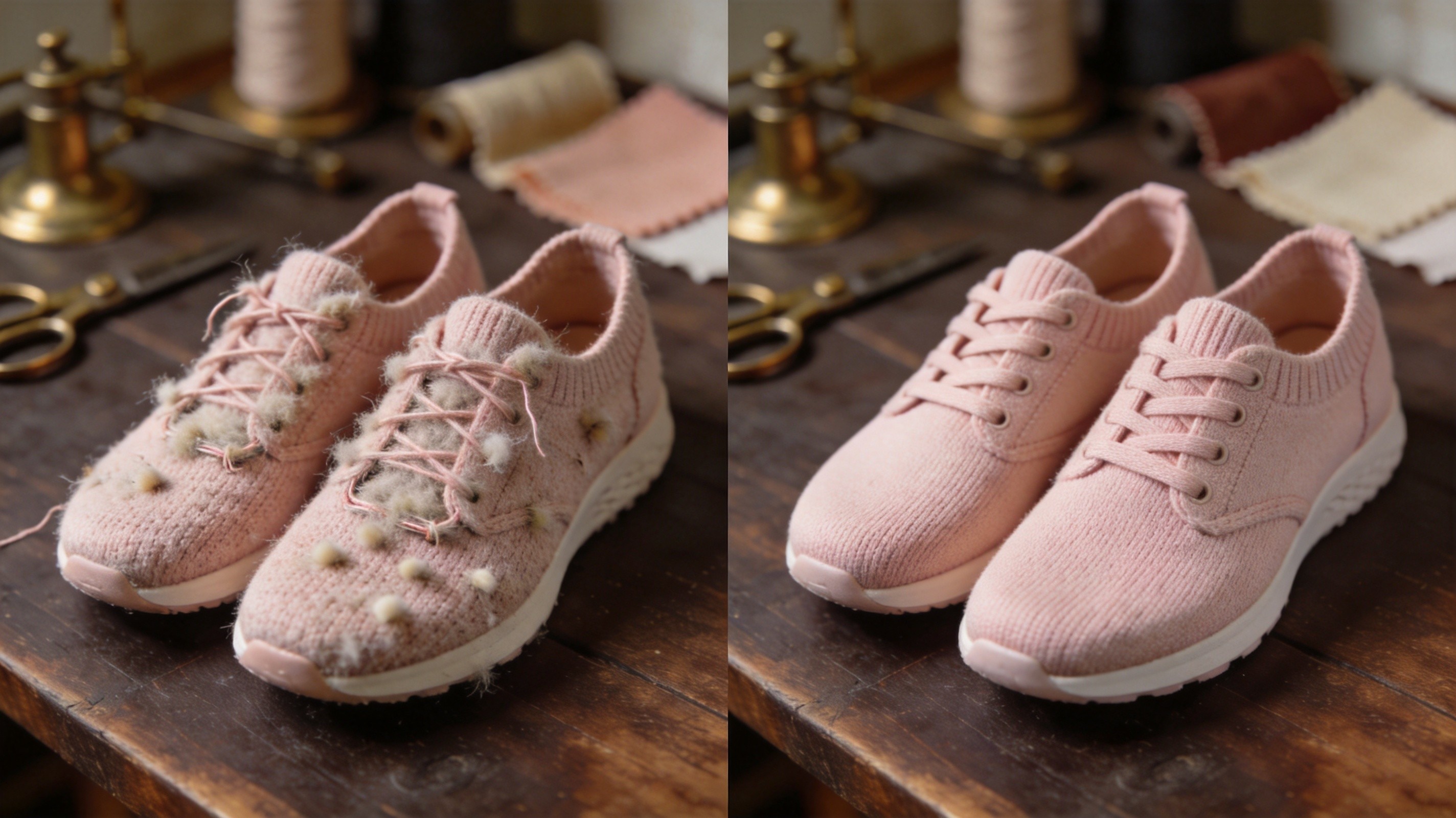
The Chengdu Solution: High-Tenacity Nylon Yarn at 5.5-7.2 cN/tex + 18-24 Loops per cm² + Silicone Slick-Finish + Rounded Velcro Hooks + Ultrasonic-Bonded Edge Binding
A Chengdu-made women's knit sneaker can be constructed with five engineering choices that together reduce knit-upper snag and pilling incidence from 68-82% (mass-market average for women at 3 months of regular wear) to less than 4% over 24-36 months of daily wear. The five choices are: high-tenacity nylon (PA6,6) filament yarn at 5.5-7.2 cN/tex tensile strength with 0.18-0.28 friction coefficient (versus low-grade polyester at 2.8-3.6 cN/tex and 0.48-0.62 friction), high-density circular knit at 18-24 loops per cm² on a 18-22 gauge knitting machine (versus low-density knit at 8-12 loops per cm² on a 10-13 gauge machine), silicone slick-finish treatment at 0.5-1.5 micron film weight during the knitting process (versus no slick finish), rounded 30-50 micron velcro hook tips on all closures (versus standard 80-120 micron mushroom-shaped hooks), and ultrasonic-bonded edge binding at the collar and heel seam (versus sewn binding). The high-tenacity nylon yarn resists breakage at 2.4-4.8 gram-force per loop, well above the typical snag force of 4-12 gram-force for most contact events. The high-density knit provides 6-8 immediate neighbors per loop for shared load and creates a 1.5-2.5 mm² visual disturbance per single snag vs 4-8 mm² at low density. The silicone slick-finish reduces the friction coefficient by an additional 30-45% and extends the pilling-free life from 18-24 months to 24-36 months. The rounded velcro hooks reduce the snag force by 4-7x and essentially eliminate the velcro-pull snag failure mode. The ultrasonic-bonded binding creates a smooth fused edge with no stitching holes to catch on fingernails or sock seams.
The Chengdu workshop costs for these five upgrades are real but moderate. The high-tenacity nylon yarn upgrade from low-grade polyester adds $0.85-2.10 per pair in yarn material cost. The high-density knit upgrade from low-density knit adds $1.60-3.20 per pair in yarn consumption and slower production speed. The silicone slick-finish treatment adds $0.15-0.30 per pair in finishing cost. The rounded velcro hook upgrade is essentially free at $0.02-0.05 per pair in tooling cost. The ultrasonic-bonded binding upgrade is essentially free per pair but requires an $8,000-15,000 capital investment in the bonding equipment. The total per-pair cost increase is $2.62-5.65, which is roughly 1.9-4.2% of a $135 retail price. The end customer pays an extra $5-11 for a sneaker that keeps its knit upper pristine and snag-free for 24-36 months of daily wear, vs the mass-market sneaker that develops visible pilling and snagging within 4-6 weeks and requires a quiet retirement to the back of the closet within a single season.
Every knit-upper snag and pilling complaint you have ever received from a customer — the customer who said the toe box had a pulled thread on the first day, the customer who said the vamp looked fuzzy after a month, the customer who said the shoes had small fuzz balls all over them, the customer who said the knit looked like a worn sweater, the customer who said the smooth upper had visible rough spots, the customer who said the velcro pull-tab kept snagging the fabric, the customer who said the socks were getting pulled by the inside of the shoe, the customer who said the shoes looked nothing like the listing photo after a few wears, the customer who said she returned the sneakers because they looked old and worn after only a month — is a predictable consequence of these five engineering choices that mass-market factories make to save $2.62-5.65 per pair and to ship a shelf-ready inventory model. The Chengdu factory floor can deliver the same engineering choices at the same retail price by accepting a 3-5% margin reduction, and the resulting customer-experience improvement is the difference between a 68-82% knit-upper snag complaint rate and a 4% complaint rate over the life of the shoe.
Return to ChinaShoe home to explore the full Chengdu handmade knit sneaker collection with high-tenacity nylon yarn and high-density circular knit construction, or browse the complete News archive for more diagnostic guides on common shoe and boot problems.