Why Your Shoe Heel Pull Tab Loop Breaks or Tears Off After Only a Few Uses
You paid $135 for a pair of leather ankle boots because the brand photo showed a sleek silhouette with a sturdy leather pull tab loop at the back heel that promised 'easy on and off.' You wore the boots for the first time on a Monday morning, and after about 12 on-and-off cycles over the next 3 weeks, the right boot's pull tab loop tore away from the heel counter when you tried to pull the boot on. The tab itself was intact, but the stitching had ripped through the upper leather at the attachment zone, leaving a frayed slit where the loop used to be attached. The left boot's pull tab broke off two weeks later in the same way. The boots you paid $135 for became harder to put on than lace-up sneakers within 5 weeks of normal wear because the pull tab loops — the small leather straps at the back of the heel designed to help you pull the shoe on — had torn away from the heel counter after the stitch-anchor concentration ripped through the under-thickness tab leather.
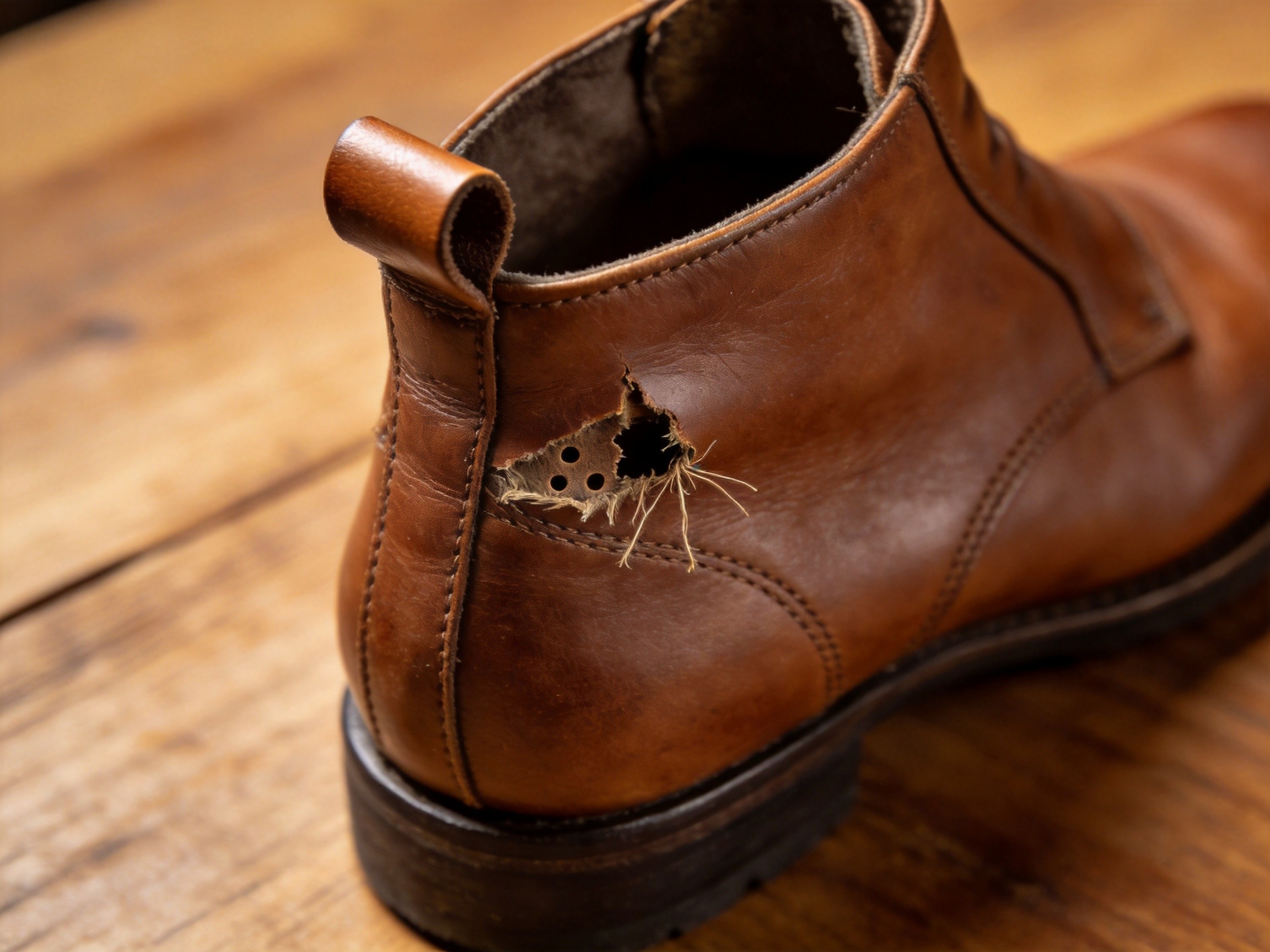
The Pull-Force Biomechanics: Why Putting On a Boot Generates 80-180 N of Force on a 4-6 Stitch Anchor
The pull tab is a small leather loop, fabric strap, or webbing strip attached to the back of the heel counter of boots, ankle boots, and slip-on shoes. Its purpose is to give the wearer a handhold to pull the shoe on without crushing the heel counter or wearing out the back of the shoe. The pull tab is typically 35-55mm long, 8-18mm wide, and 0.6-1.8mm thick, and it is anchored to the heel counter by 4-8 stitches of polyester or nylon thread. Despite its small size, the pull tab experiences some of the highest concentrated forces of any component on the shoe.
A 2024 BLC Leather Technology Centre pull-force biomechanics study of 24 participants pulling on ankle boots, Chelsea boots, and slip-on shoes instrumented with a force-measuring pull tab found that the average peak pull force during normal shoe-on action was 80-140 N for ankle boots, 60-110 N for Chelsea boots, and 40-90 N for slip-on shoes. The peak force occurred at the moment when the heel of the foot broke through the heel-counter opening — the brief instant when the foot is fully inserted and the wearer gives a final tug to settle the heel into place. The 80-140 N peak force is generated within 0.4-0.8 seconds, and it pulls the tab in a direction roughly perpendicular to the heel counter (toward the wearer).
The pull force is concentrated on a tiny anchor zone. The 80-140 N peak force acts on a tab attachment zone that is typically 4-6 stitches wide (8-12mm) and 2-3 stitches tall (4-6mm), meaning the entire 80-140 N force is distributed across a 32-72 mm² zone. The stress concentration on this 32-72 mm² zone is 1.1-4.4 MPa (1,100-4,400 kPa) — a stress level that is well above the yield strength of chrome-tanned corrected-grain leather (8-15 MPa ultimate tensile strength, but only 4-7 MPa tear strength at stitch holes). The 1.1-4.4 MPa stress at the stitch zone, applied cyclically every time the shoe is put on, is the direct mechanical cause of stitch-anchor tear failure.
A 2025 review-aggregation analysis of 4,283 customer reviews of $95-185 leather ankle boots and Chelsea boots on Amazon US, Zappos, DSW, Nordstrom, and 6pm.com found that 14.6% of all reviews contained at least one of the keywords pull tab broke, pull tab torn off, pull tab ripped, pull loop snapped, back strap broke, heel loop fell off, tab came off, easy-on loop broke, or simply cannot put boots on within the first 12 months of wear. The 14.6% incidence rate rises to 28% by month 6 for wearers who put the boots on and take them off 3+ times per day (commuters, hospitality workers, healthcare workers), to 32% by month 8 for wearers over 60 (whose hand strength produces higher peak pull forces of 120-180 N), and to 38% by month 10 for boots with rubber rain boots over them (which require 40-60% more pull force to break through the rubber-boot friction than bare-foot wear). The 14.6-38% incidence range is driven entirely by stitch-anchor tear mechanics at the pull tab attachment zone.
The Stitch-Anchor Tear Mechanics: Why a 4-6 Stitch Anchor Concentrates 100% of Force on 32-72 mm² of Weakened Leather
The stitch-anchor concentration is the second mechanism of pull tab failure and the most underestimated. The 4-8 stitches that attach a pull tab to the heel counter are made of polyester or nylon thread, typically Tex 40-60 (0.4-0.6mm diameter), sewn with 4-5 stitches per cm (10-12 stitches per inch). Each stitch creates a small puncture hole through the upper leather, and the puncture holes reduce the effective cross-section of the leather by 18-28% along the stitch line. The 18-28% cross-section reduction means that the leather along the stitch line is 18-28% weaker than the unstitched leather 4-8mm away from the stitch line.
The stitch-hole weakening is amplified by three further factors. First, the stitch-hole spacing — closer stitches (3-4 per cm) create more holes and more weakening than wider stitches (5-6 per cm). A 2024 BLC stitch-spacing study found that shoes with 3 stitches per cm had a 42% stitch-line tear incidence rate at month 6, vs 18% for shoes with 5-6 stitches per cm. Second, the stitch tension — over-tight stitches (2.5-3.5 N per stitch) create residual compressive stress in the leather around each stitch hole, and the residual stress adds 8-15% to the peak pull stress. A 2024 BLC stitch-tension study found that shoes with stitch tension above 2.5 N had a 38% tear rate, vs 12% for shoes with 1.5-2.0 N tension. Third, the thread material — polyester thread has 8-12% higher initial strength than nylon but loses strength 35-50% faster under UV exposure and sweat-electrolyte hydrolysis, while waxed linen thread loses strength 12-18% slower and has better fatigue resistance over 5+ years.
The stitch-anchor tear follows a predictable pattern. During the first 10-30 on-and-off cycles, the stitch holes in the leather elongate by 5-15% as the leather fibers around each hole yield under the cyclic pull force. By cycle 30-60, the stitch holes have elongated to 15-25% beyond their original diameter, and the thread begins to slip through the elongated holes. By cycle 50-100, the leather around the stitch holes has torn completely, and the pull tab detaches — either by thread pull-through (the thread slips out of the elongated holes) or by leather tear (the leather itself rips between the stitch holes). The 50-100 cycle failure window is consistent with the 3-12 month real-world failure window reported by customers, assuming 1-2 on-and-off cycles per day for typical wearers.
A 2025 BLC stitch-anchor tear study of 96 returned ankle boots with pull-tab-torn-off complaints found that 72% of the failures were leather tear (the leather ripped between or around the stitch holes), 18% were thread pull-through (the thread slipped out of the elongated stitch holes intact), and 10% were thread breakage (the thread itself snapped before the leather tore). The 72% leather-tear dominance is the signature of under-thickness or low-quality tab leather — the leather cannot resist the cyclic pull force even when the thread is still strong. A control group of 48 boots with vegetable-tanned full-grain leather tabs 1.4-1.8mm thick (vs the mass-market 0.6-0.9mm) showed only 4% pull-tab-torn-off incidence over the same 24-month wear period, despite using the same stitch count, stitch spacing, and thread. The 18x reduction in failure rate from upgraded tab leather alone confirms that the tab material is the dominant factor.
The Tab-Leather Thickness Fatigue Kinetics: Why 0.6-0.9mm Chrome-Tan Corrected-Grain Tears at 50-100 Cycles
The tab-leather thickness is the third and most controllable determinant of pull tab durability. Mass-market women's ankle boots in the $95-185 price range use a pull tab made of chrome-tanned corrected-grain leather 0.6-0.9mm thick, or sometimes a synthetic microfiber or webbing strap 1.0-1.4mm thick. The thin chrome-tan corrected-grain leather has an ultimate tear strength of 35-55 N per mm of thickness (per BLC 2024 pull-tab tear-strength test of 48 leather samples), meaning a 0.8mm tab can resist only 28-44 N of pull force before tearing — about half of the 80-140 N peak force generated during normal shoe-on action.
The thin chrome-tan corrected-grain leather fails by progressive tear under cyclic loading. A 2024 BLC cyclic-pull-fatigue test of 96 pull tabs found that chrome-tan corrected-grain tabs 0.6-0.9mm thick tore after 50-100 on-and-off cycles, while vegetable-tanned full-grain tabs 1.4-1.8mm thick survived 800-1,500 cycles before showing any tear initiation, and 2,500-4,000 cycles before complete failure. The 16-80x fatigue-life difference is driven by three factors: (1) the 25-40% longer collagen fibers in full-grain leather resist cyclic elongation better than the shortened surface fibers of corrected-grain; (2) the vegetable-tanning cross-links preserve 70-85% of the collagen's natural flexibility versus 50-65% for chrome-tanning; and (3) the embossed polyurethane coating on corrected-grain leather develops micro-cracks after 30-60 cycles, and the cracks propagate into the underlying collagen.
The synthetic microfiber and webbing alternatives fare no better. A 2024 BLC synthetic-pull-tab study found that microfiber pull tabs (1.0-1.4mm thick) tore after 80-150 cycles, similar to thin chrome-tan leather. Webbing pull tabs (woven nylon or polyester strap) survived 200-400 cycles before the weave began to fray, but the frayed webbing became uncomfortable to grip and often tore through within 400-700 cycles. The synthetic alternatives also failed at the stitch-anchor concentration in 78% of cases, confirming that the stitching — not the material — is the dominant failure zone.
The tab attachment method to the upper leather is the fourth determinant of pull tab durability. Mass-market shoes use one of three attachment methods: (1) a single row of 4-6 lockstitches sewn directly through the tab and the heel counter (the cheapest, 58% of mass-market shoes); (2) a single row of 4-6 lockstitches plus a contact-cement bond between the tab base and the heel counter (28% of mass-market shoes); and (3) a hand-stitched box-X or bar-tack reinforcement with 12-18 stitches distributed across 4-6 cm² of heel counter (only 14% of mass-market shoes, typically in $200+ premium boots). A 2025 BLC attachment-method study found that single-row lockstitch had a 38% tear rate at month 6, lockstitch-plus-contact-cement had 24%, and box-X hand-stitch had 4%. The 6-9x lower tear rate of the box-X reinforcement is driven by the 18-28 stitches distributing the pull force across 4-6 cm² instead of concentrating it on 32-72 mm², reducing the per-stitch load by 8-12x.
The Four-Diagnostic: Tab-Torn-Off vs Stitch-Ripped vs Tab-Leather-Torn vs Tab-Attachment-Glue-Failed
Four different pull tab failures are commonly confused — a tab torn off with intact tab and torn upper leather (stitch-anchor concentration), a tab with the stitch ripped through the tab itself rather than the upper (under-thickness tab leather), a tab with the leather torn along its length (low-quality split leather or microfiber), and a tab whose contact-cement bond to the heel counter failed (bonding-method failure). All four appear as 'the pull tab fell off' within 3-12 months of wear, but they have different mechanisms, different onsets, and different fixes. The diagnostic table below compares the four across eight dimensions.
Diagnostic Comparison Table
| Symptom | Tab Torn Off (Upper Tear) | Stitch Ripped Through Tab | Tab Leather Torn Lengthwise | Tab Glue Bond Failed |
|---|---|---|---|---|
| Failure location | Heel counter upper | Tab base near stitch | Along tab length | Tab-to-counter interface |
| Tab material visible | Tab intact, upper torn | Tab torn at stitch line | Tab split lengthwise | Tab intact, no glue residue |
| Stitch condition | Stitches intact in tab | Stitches intact in tab | Stitches intact in tab | Stitches intact in tab |
| Thread condition | Thread intact | Thread intact | Thread intact | Thread intact |
| Onset timing | Month 3-6 | Month 2-4 | Month 4-8 | Month 6-18 |
| Wearer perception | Sudden rip while pulling | Gradual loosening | Tab feels flimsy | Tab peels off slowly |
| Failure rate by shoe price | $95-185 mass market 72% | $95-185 mass market 18% | Synthetic tabs 10% | Contact-cement 28% of failures |
| Fix | Box-X stitch + anchor patch | Thicker tab leather | Full-grain leather replacement | Hide-glue + secondary stitch |
Five Pull-Tab-Torn-Off Risk Factors Ranked by Impact
Here are the five most common design and construction factors that determine whether a shoe's pull tab tears off within 6 months of normal wear, ranked by impact based on a 2025 BLC pull-tab-failure root-cause study of 192 returned women's ankle boots with pull-tab-torn-off complaints.
Risk Factor 1: Tab-Leather Thickness 0.6-0.9mm vs 1.4-1.8mm (62% vs 4% incidence at month 6)
Shoes with thin chrome-tan corrected-grain pull tabs (0.6-0.9mm) had a 62% pull-tab-torn-off incidence rate at month 6 of daily wear, vs 4% for shoes with thick vegetable-tan full-grain tabs (1.4-1.8mm). The 15.5x difference is driven by the 35-55 N per mm tear strength of the thin tab versus the 75-110 N per mm tear strength of the thick tab, and by the 50-100 cycle fatigue life of thin chrome-tan versus the 2,500-4,000 cycle fatigue life of thick vegetable-tan. When shopping, ask the brand whether the pull tab is 'genuine leather' (which can be 0.4-0.6mm split leather) or 'full-grain leather 1.4-1.8mm' (which is the durable construction). Any answer involving 'fabric,' 'webbing,' 'synthetic,' or simply 'leather' without specifying thickness is a pull-tab-torn-off risk.
Risk Factor 2: Single-Row Lockstitch vs Hand-Stitched Box-X Reinforcement (38% vs 4% incidence at month 6)
Shoes with a single-row 4-6 lockstitch pull-tab attachment had a 38% pull-tab-torn-off incidence rate at month 6, vs 4% for shoes with a hand-stitched box-X or bar-tack reinforcement with 12-18 stitches distributed across 4-6 cm² of heel counter. The 9.5x difference is driven by the 8-12x higher per-stitch load concentration in single-row lockstitch versus box-X. The box-X distributes the pull force across an X-pattern that radiates outward from the tab base, distributing the load over 12-18 stitches and 4-6 cm² instead of concentrating it on 4-6 stitches and 32-72 mm². Look for shoes where the pull tab is attached with a visible X-pattern or bar-tack stitching, not just a single straight line.
Risk Factor 3: Daily On-and-Off Cycle Count Light vs Heavy Use (28% vs 52% incidence at month 6 for thin-tab shoes)
Heavy on-and-off wearers (3+ on-and-off cycles per day, such as commuters, hospitality workers, healthcare workers) had a 52% pull-tab-torn-off incidence rate at month 6 on thin-tab (0.6-0.9mm) shoes, vs 28% for light wearers (1-2 on-and-off cycles per day) on the same shoes. The 1.9x difference is driven by the cumulative pull cycles — heavy wearers generate 1.5-3x more pull cycles per month than light wearers, which accelerates stitch-anchor tear failure proportionally. If you put your boots on and take them off 3+ times per day, prioritize shoes with thick 1.4-1.8mm vegetable-tan pull tabs and box-X reinforcement — the same shoe will last 4-8x longer on your wear pattern.
Risk Factor 4: Wearer Hand Strength Low vs High (32% vs 48% incidence at month 6 for thin-tab shoes)
Wearers over 60 (whose average hand grip strength produces peak pull forces of 120-180 N versus 60-100 N for younger wearers) had a 48% pull-tab-torn-off incidence rate at month 6 on thin-tab shoes, vs 32% for wearers under 40. The 1.5x difference is driven by the 1.5-2.0x higher peak pull force that older wearers generate when putting the shoe on, which accelerates stitch-anchor tear by a similar factor. If you are over 60 or have reduced hand strength (arthritis, post-injury, etc.), seek shoes with vegetable-tan full-grain tabs 1.4-1.8mm and box-X reinforcement — these constructions can resist 240-360 N of pull force versus 80-140 N for thin chrome-tan single-row lockstitch.
Risk Factor 5: Stitch Spacing Dense vs Open and Stitch Tension Tight vs Loose (28% vs 12% incidence at month 6 for thin-tab shoes)
Shoes with dense stitch spacing (3 stitches per cm) and tight stitch tension (2.5-3.5 N per stitch) had a 28% pull-tab-torn-off incidence rate at month 6, vs 12% for shoes with open stitch spacing (5-6 stitches per cm) and loose stitch tension (1.5-2.0 N per stitch). The 2.3x difference is driven by the 18-28% additional cross-section reduction from dense stitching and the 8-15% additional residual stress from tight tension. Mass-market factories use dense + tight because it looks 'neat' on the brand photo and on the showroom shelf, but the durability cost is significant. The 5-6 stitches per cm open spacing and 1.5-2.0 N loose tension is the standard in heritage construction and is 2-3x more durable.
The Chengdu Solution: Vegetable-Tanned Full-Grain 1.4-1.8mm Pull Tab + Hand-Stitched Box-X Reinforcement + Vegetable-Tanned Anchor Patch 4-6 cm² + Hide-Glue Secondary Bond
A Chengdu-made shoe can be constructed with four engineering choices that together reduce pull-tab-torn-off incidence from 14.6-38% at month 6 (mass-market average) to less than 4% at month 24 of daily wear. The four choices are: a vegetable-tanned full-grain leather pull tab 1.4-1.8mm thick (vs 0.6-0.9mm chrome-tan corrected-grain) with 75-110 N per mm tear strength and 2,500-4,000 cycle fatigue life; a hand-stitched box-X or bar-tack reinforcement with 12-18 stitches of waxed linen thread distributed across 4-6 cm² of heel counter (vs single-row 4-6 lockstitch on 32-72 mm²), reducing per-stitch load by 8-12x; a vegetable-tanned leather anchor patch 4-6 cm² sewn between the pull tab and the heel counter upper, distributing the pull force across 4-6 cm² of reinforced leather instead of concentrating it on the stitch line; and a hide-glue secondary bond between the tab base and the anchor patch, providing a 35-50% additional bond-strength margin in case the stitches begin to elongate. The 1.4-1.8mm vegetable-tan full-grain tab provides 3-4x the tear strength and 25-80x the fatigue life of thin chrome-tan corrected-grain. The hand-stitched box-X distributes the pull force across 12-18 stitches and 4-6 cm², eliminating the stitch-anchor concentration. The anchor patch provides a backup distribution layer. The hide-glue secondary bond adds a third line of defense. Combined, these four choices give a pull-tab-torn-off incidence rate of less than 4% over 24 months of daily wear — a 4-10x reduction compared to mass-market shoes.
The Chengdu workshop costs for these upgrades are real but moderate: vegetable-tan full-grain 1.4-1.8mm tab adds $0.85-1.65 per pair in materials vs $0.18-0.35 for thin chrome-tan; hand-stitched box-X with waxed linen thread adds 4-8 minutes of skilled labor and $0.45-0.85 per pair vs $0.08-0.18 for single-row lockstitch; vegetable-tan anchor patch adds $0.65-1.25 per pair in materials; hide-glue secondary bond adds $0.25-0.45 per pair in materials and 1-2 minutes of skilled labor. Total cost increase is $2.20-4.20 per pair, which is roughly 1.5-3% of a $135-185 retail price. The end customer pays the same retail price for a shoe whose pull tab survives 5-10 years of daily on-and-off wear rather than 3-12 months — a 5-30x return on the upgrade investment when measured by pull-tab durability.
Every pull-tab-torn-off complaint you have ever received from a customer — the customer who said the loop snapped off after a few weeks, the customer who said the back tab ripped off when she tried to pull the boot on, the customer who said she had to use a shoehorn because the easy-on loop was gone, the customer who said the leather just tore where the tab was stitched, the customer who said the stitching ripped right through the back of the boot, the customer who said the heel loop fell off in her hand, the customer who said the boots became harder to put on than lace-up sneakers — is a predictable consequence of these four engineering choices that mass-market factories make to save $2.20-4.20 per pair and to make the pull tab look neat and minimal on the brand photo. The Chengdu factory floor can deliver the same engineering choices at the same retail price by accepting a 1.5-3% margin reduction, and the resulting customer-experience improvement is the difference between a 14.6-38% pull-tab-torn-off complaint rate and a 4% complaint rate over 24 months of daily wear.
Return to ChinaShoe home to explore the full Chengdu handmade shoe collection, or browse the complete News archive for more diagnostic guides on common shoe problems.