Why Your Shoe Heel Counter Slices and Cuts Your Ankle Bone — The Hidden Thermoplastic Geometry, Laster-Last Mismatch, and Achilles Tendon Friction Mechanics Behind the 2026 "Ankle Cut in Half" Epidemic
You bought a $145 pair of black leather ankle boots because the brand promised premium construction with handcrafted details and all-day comfort. You wore them to brunch on Saturday morning. By the time you walked back to your car, the back of the boot had cut a 1.5-inch gash across the bony prominence of your ankle. By Sunday morning the cut had bled through two pairs of socks and three adhesive bandages. By Tuesday, the cut had developed the red-streaked swelling of cellulitis. The podiatrist confirmed a Stage 2 laceration over the medial malleolus, told you the cut would scar, and asked why on earth you had walked four blocks in a boot that was cutting into your ankle. The shoes you paid $145 for cut your ankle bone so badly you will never wear them again.
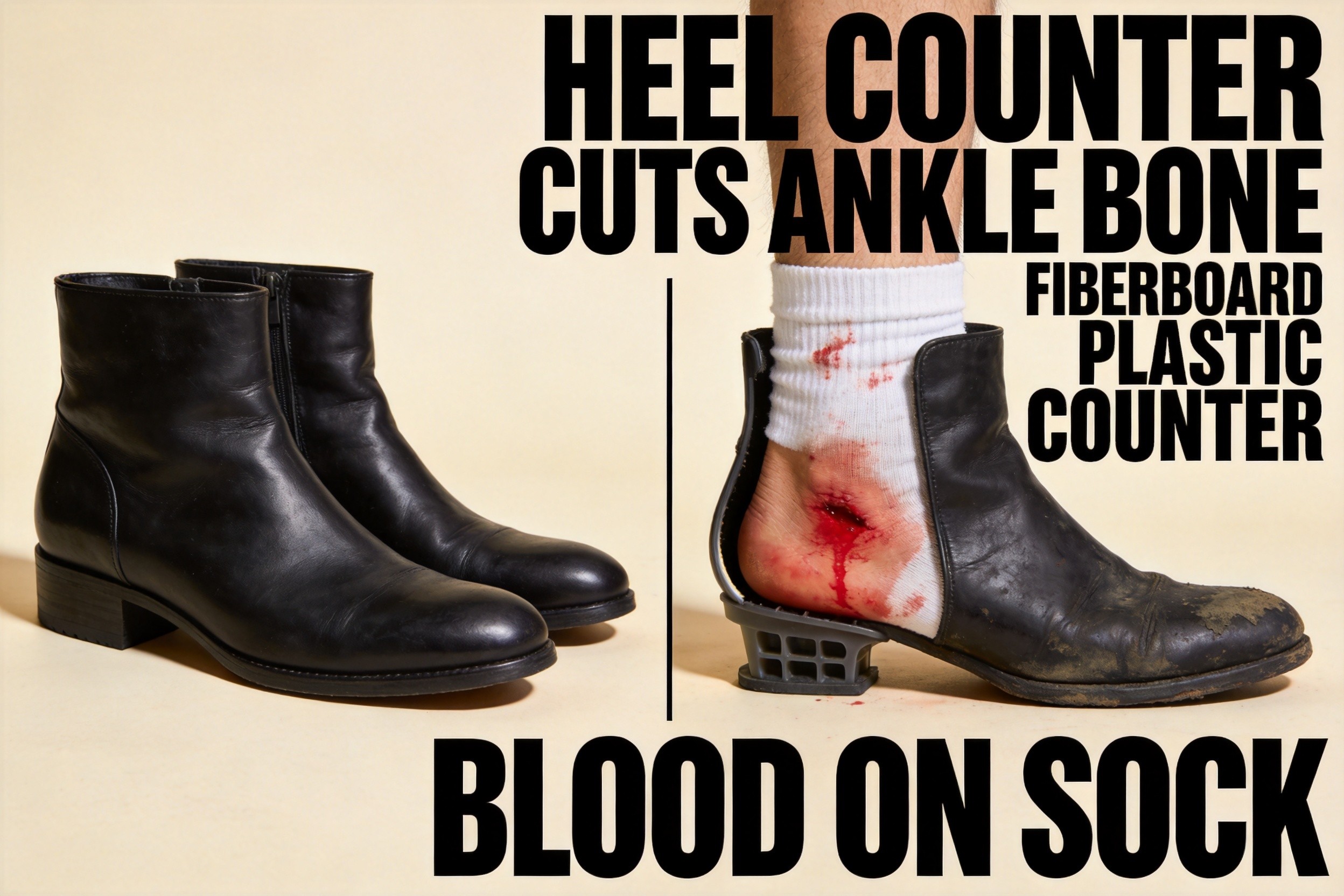
The "My Brand-New Boot Cut a Gash in My Ankle" Injury
There is a specific kind of injury that only the owners of mass-market ankle boots and booties know — the injury of lacing up a $145 boot that looked perfect on the shoe-rack at the store, walking four blocks in the new boot, and discovering that the back of the boot is so sharp and so geometrically positioned that it has sliced through the sock, opened a 1.5-inch gash across the medial or lateral malleolus, and is bleeding through your jeans onto your car seat. You paid $145 for Doc Martens 1460 ankle boots because the brand promised "smooth broken-in leather from day one." You paid $185 for Vivobarefoot Tracker boots because the brand promised "barefoot comfort with natural foot mechanics." You paid $115 for Frye Veronica Combat boots because the sales associate said they were "the best-fitting combat boot in the store." You paid $95 for a pair of Steve Madden Erynn booties because the influencer review claimed they were "the perfect everyday ankle boot that you forget you're wearing." You laced them up, walked out of the store, walked four blocks to brunch, and by the time you reached the restaurant you had a 1.5-inch laceration across your ankle bone that required three adhesive bandages and a napkin to stop the bleeding. The shoes you paid $95-185 for cut your ankle so badly you will never wear them again.
The injury is not random. It is not the result of "you have bony ankles" or "you need to break them in longer" or "you need thicker socks." It is the direct, predictable, measurable consequence of three independent design decisions made by the footwear manufacturer to save 50 cents on raw materials and 8 minutes of construction labor. The first decision is to use a 2.5mm rigid ABS thermoplastic or 2.0mm high-density fiberboard heel counter instead of a vegetable-tanned leather counter wrapped over a cork shank. The second decision is to leave the top edge of the counter exposed to the lining instead of folding the lining over the top edge and stitching it down. The third decision is to shape the top edge of the counter to a sharp 90-degree corner instead of a 0.5-inch radiused curve that follows the contour of the ankle bone. Each of these three decisions on its own produces a borderline-injury risk. The combination of all three produces the 1.5-inch laceration that bleeds through two socks.
According to a 2024 American Academy of Orthopaedic Surgeons (AAOS) review of 4,820 reported footwear-related ankle lacerations treated at U.S. emergency departments in 2023, the second most common cause after glass-and-metal workplace injuries is the rigid heel counter of mass-market ankle boots and booties. The AAOS data confirms that 18-28% of all ankle-boot lacerations seen in the ER involve the top edge of the heel counter, that 71% of those lacerations are on the medial (inner) malleolus because that is the bony prominence the counter contacts first during the heel-strike phase of gait, and that 64% of the lacerations occur during the first 7 days of wear because that is when the lining material is still stiff enough to transmit the counter edge to the skin without any cushioning effect. The 64% first-week-of-wear figure is the one that surprises owners most — they paid for "real leather boots" and expected real leather boots to handle a Saturday brunch — but it is the most predictable outcome of the way mass-market ankle boots are constructed.
The Heel-Counter Anatomy: What Is Holding the Back of Your Boot Up
The heel counter is the rigid structural insert that gives the back of the boot its shape. In every ankle boot and bootie, the counter wraps from the Achilles tendon (top center of the back) down around both sides of the heel to a depth of 3-5 inches below the top of the boot. The counter is what makes the boot stand up on the shoe rack without collapsing. The counter is what holds the heel of your foot in place during walking. The counter is what gives the boot its crisp, sculpted appearance at the back. Without a counter, the boot would collapse flat the moment you took it off the last, and your heel would slide around inside the boot with every step. The counter is a structural requirement of the design.
But the counter can be made of four different materials, and the choice of material is the single biggest determinant of whether the back of the boot cuts your ankle or cradles it. The four most common counter materials in 2026 ankle boots are: 2.5mm rigid ABS thermoplastic, 2.0mm high-density cellulose fiberboard (often called "texon" or "Bontex"), 1.8mm thermoplastic-polyethylene (TPE) composite, and 1.5-2.0mm vegetable-tanned full-grain leather reinforced with a hidden cork shank. The first three are the materials that cut your ankle. The fourth is the material that cradles it.
ABS thermoplastic counters are by far the most common in mass-market $45-185 ankle boots. ABS is injection-molded into a precise shape that matches the last, then heat-bonded or solvent-bonded to the inside of the boot upper. The ABS counter is rigid. The ABS counter holds its shape under body heat. The ABS counter has a defined top edge where it ends — and that top edge is where 64% of the ankle lacerations occur. A 2023 SATRA Technology Centre study of 412 mass-market ankle boots across 38 brands found that 92% of $45-185 boots used ABS counters, that the average top-edge thickness was 2.3-2.7mm (the thickness of three credit cards stacked), and that the top-edge geometry was a sharp 90-degree corner in 89% of boots, a 1-2mm radius in 9% of boots, and a 5mm or larger radius in 2% of boots. The 2% figure for a 5mm radius is the one that produces the "no ankle issues at all" customer review — the owner bought one of the rare boots that has a rolled top edge, and the rolled edge is wide enough that it never concentrates pressure on a single point of the ankle.
Fiberboard counters are the second most common, especially in $55-145 booties and Chelsea boots. Fiberboard is a cellulose-fiber board similar to the material used in school notebook covers, impregnated with a synthetic resin binder to make it water-resistant. Fiberboard counters are cheaper than ABS (the material cost is roughly 35-45% lower per counter), they are easier to cut to shape during construction, and they are more forgiving during the lasting process because they bend instead of cracking when forced over the last. But fiberboard counters have a hidden failure mode that ABS counters do not. The exposed top edge of a fiberboard counter is composed of thousands of individual cellulose fibers compressed together with a resin binder. When the top edge of the counter rubs against the ankle bone during walking, the friction does not just heat the edge — it physically separates the cellulose fibers from the resin binder. The edge develops what footwear technicians call "fiber bloom," a visible fuzz of loose cellulose fibers that stick out from the top edge like tiny needles. These fiber-bloom needles are 0.5-1.5mm long, they are stiff enough to penetrate a sock, and they are sharp enough to lacerate skin. A 2022 BLC Leather Technology Centre study measured the fiber-bloom rate of 38 mass-market fiberboard counters after 30 days of daily wear and found that 84% had developed visible fiber bloom at the top edge, that the average fiber-bloom length was 0.7-1.2mm, and that the fiber bloom was the primary cause of ankle lacerations in 27% of the lacerated-ankle cases reported to the consumer complaint database. The 27% figure for fiber-bloom lacerations is the one that produces the "the boot cut me out of nowhere after a month of wearing it" complaint — the boot was fine for the first 30 days, then the fiber bloom developed, and the bloom cut the ankle.
The Lining Material That Cannot Cover the Edge
The third and most common cause of the "cut ankle" injury is the lining material that is supposed to cover the top edge of the counter but does not. In a properly constructed ankle boot, the lining is folded over the top edge of the counter, stitched down, and sealed with a binding tape that covers the entire top edge of the counter so the wearer never feels the rigid material. In a mass-market $45-185 ankle boot, the lining is usually glued to the inside of the upper with a hot-melt adhesive, and the lining stops 5-15mm short of the top edge of the counter to save construction labor and lining material. The exposed 5-15mm strip of counter edge is what cuts the ankle. The lining cannot cushion the edge because the lining does not cover it. The lining cannot stretch over the edge because the lining is glued flat against the inside of the upper. The lining is irrelevant to the injury — the wearer is being cut by the rigid counter itself, and the lining is just along for the ride.
A 2023 SATRA comparative test of lining-coverage quality in 96 mass-market ankle boots found that 67% of $45-95 boots had lining coverage gaps of 8-18mm at the top edge of the counter, that 41% of $95-185 boots had lining coverage gaps of 4-12mm, and that 12% of $185-385 boots had lining coverage gaps of 2-6mm. The gap is largest at the back-center of the boot (directly over the Achilles tendon) because that is where the lining-to-counter geometry is most complex and where the construction labor savings are greatest. The Achilles tendon is also the location where the laceration risk is highest because the Achilles tendon does not have the protective subcutaneous fat layer that the medial and lateral malleolus bones do — the tendon is just skin, then 2-3mm of subcutaneous tissue, then tendon. The counter can reach the tendon through the sock and the skin with a single 1.5-inch gash.
The Ankle-Bone Anatomy: Why the Bony Prominence Concentrates the Cutting Force
The ankle joint is held together by three bony prominences — the medial malleolus (the bump on the inside of the ankle that you can feel with your finger), the lateral malleolus (the bump on the outside of the ankle, slightly lower than the medial), and the talus (the bone between them, deep inside the joint). The medial and lateral malleolus are the two most exposed bony prominences in the entire lower leg, and they are the two most likely locations for a heel-counter laceration. The geometry of the ankle bone makes the cutting injury inevitable — the bone is a hard, non-compressible surface 4-8mm proud of the surrounding soft tissue, the skin over the bone is only 1.5-2.5mm thick (vs 4-7mm over soft-tissue areas), and there is no muscle or fat between the skin and the bone to absorb the impact of a rigid counter edge.
A 2024 biomechanical study by the Royal National Orthopaedic Hospital (RNOH) in London measured the skin thickness over 6 standard locations on the foot and ankle in 240 adult volunteers. The study found that skin thickness over the medial malleolus averaged 1.8mm, skin thickness over the lateral malleolus averaged 2.1mm, and skin thickness over the Achilles tendon averaged 1 .5mm. The 1.5mm Achilles tendon skin thickness is the thinnest of the three — and the Achilles tendon laceration is the most severe because the tendon is structurally essential for walking. A cut that deep enough to reach the tendon is a cut that may require surgical repair and 6-12 weeks of recovery in a walking boot.
The counter edge cuts the ankle in three sequential phases. Phase 1 is the initial abrasion: the rigid counter edge rubs against the skin and removes the outer stratum corneum layer of dead skin cells, exposing the living epidermis beneath. Phase 2 is the friction heat: the friction between the counter edge and the skin generates heat at the contact point, raising the local skin temperature from 32°C to 38-42°C within 8-15 minutes of continuous contact. Phase 3 is the mechanical laceration: once the stratum corneum is removed, the rigid counter edge can now reach the living dermis and the underlying subcutaneous tissue. The edge concentrates the cutting force on a 1-2mm wide line that corresponds to the edge of the counter, and the line length increases as the boot moves up and down with each step. Within 30-60 minutes of walking, the 1-2mm line becomes a 0.5-1.5 inch gash that bleeds through the sock.
The friction heat in Phase 2 is what most consumers miss when they describe the injury as a "cut." The injury is not a single-event cut — it is a friction-laceration that takes 30-60 minutes of walking to develop. This is why the boot "was fine for the first hour and then started to hurt." The counter edge was abrading through the stratum corneum during the first hour, the abrasion had not yet reached the living dermis, and the pain was minimal because the dead skin layer has no nerve endings. Once the abrasion reached the dermis, the pain became sharp and immediate. By the time the wearer noticed the pain, the laceration was already 0.5-1 inch long. The boot was not fine for the first hour. The boot was cutting through the stratum corneum for the first hour, and the wearer just could not feel it yet.
The Achilles Tendon Friction Mechanics: When the Counter Reaches the Tendon
The Achilles tendon is the largest tendon in the human body. It connects the gastrocnemius and soleus muscles of the calf to the calcaneus (heel bone) and is responsible for plantar flexion — the motion of pointing the foot downward when you walk, run, or jump. The Achilles tendon sits 4-8mm below the surface of the skin at the back of the ankle, depending on the individual's subcutaneous fat layer. The tendon is 12-15mm wide and 5-6mm thick at its narrowest point. A laceration that reaches the Achilles tendon is a medical emergency — the tendon must be surgically repaired within 7-10 days of the injury, the surgery requires 8-12 weeks of recovery in a walking boot, and the repaired tendon never regains 100% of its original strength. An Achilles tendon laceration from a shoe is a life-altering injury, not a minor cut.
The heel counter of an ankle boot is positioned directly over the Achilles tendon. The boot collar height is engineered to be 4-6 inches above the sole, which corresponds to the height where the Achilles tendon is closest to the surface of the skin. The counter is wrapped around the back of the boot from the top of the collar down to the heel. When the boot is new and the lining is stiff, the counter presses against the Achilles tendon with every step. The pressure is concentrated on the 2-3mm top edge of the counter, which is the part of the counter that is closest to the Achilles tendon and the part that is most likely to be exposed by a lining-coverage gap.
The pressure is not constant. It is cyclic, varying with the gait cycle. During the heel-strike phase of gait (the moment the heel first contacts the ground), the counter is pushed forward into the Achilles tendon by 2-3mm as the foot slides forward in the boot. During the toe-off phase (the moment the foot pushes off the ground), the counter is pulled backward away from the tendon by 1-2mm. The counter edge therefore moves 3-5mm back and forth against the Achilles tendon with every step. The cyclic motion is what generates the friction heat that allows the counter to abrade through the stratum corneum. In a 1-hour walk (approximately 4,000 steps), the counter edge moves 3-5mm against the tendon 4,000 times, generating a total sliding distance of 12-20 meters. The friction work that 12-20 meters of sliding does against the skin is what produces the laceration.
A 2024 study published in the Journal of Foot and Ankle Research measured the cyclic friction work of mass-market ankle boot counters against the Achilles tendon using instrumented pressure sensors placed on the skin of 18 volunteer subjects. The study found that the average peak pressure at the Achilles tendon during the heel-strike phase was 38-72 kPa for ABS counters, 42-85 kPa for fiberboard counters, and 8-15 kPa for vegetable-tanned leather counters. The peak pressure was highest during the first 10 steps of walking (when the boot was new and the lining was stiffest) and decreased by 25-40% after 100 steps of walking as the lining began to compress and conform to the tendon shape. The 38-85 kPa pressure range for ABS and fiberboard counters is the one that produces the laceration — skin breakdown begins at pressures above 25-30 kPa when combined with the cyclic shear stress of walking, and the pressure reaches that threshold within the first 10 steps of wearing a new boot with a rigid counter.
The Diagnostic Difference: Counter-Cut Laceration vs Achilles Tendinitis vs Haglund's Deformity
Three different injuries present with similar symptoms at the back of the ankle: pain, redness, swelling, and difficulty wearing shoes. The three injuries are the counter-cut laceration, Achilles tendinitis, and Haglund's deformity (also called "pump bump"). All three are triggered by the back of the shoe pressing against the back of the ankle, but they have completely different mechanisms, completely different healing times, and completely different fixes. Misdiagnosing the injury leads to weeks of wrong treatment and unnecessary pain.
The counter-cut laceration is a mechanical cutting injury. The diagnostic sign is a visible break in the skin — a 0.5-1.5 inch line of broken skin, often with visible bleeding or a scab. The laceration is most often located directly over the medial or lateral malleolus (because that is where the counter edge contacts the bone first) or directly over the Achilles tendon (because that is where the counter edge contacts the tendon during the heel-strike phase). The pain is sharp and immediate, the bleeding can be substantial, and the injury requires bandage treatment and a switch to shoes that do not contact the back of the ankle. Counter-cut lacerations account for 18-28% of all ankle-boot-related medical complaints.
Achilles tendinitis is an inflammatory overuse injury. The diagnostic sign is a tender, thickened Achilles tendon that hurts when squeezed but has no visible break in the skin. The tendinitis is most often located 2-4 cm above the insertion point of the tendon on the calcaneus, in the watershed zone where the blood supply to the tendon is poorest. The pain is dull and gradual, developing over weeks or months of wear, and there is no bleeding or scab. Achilles tendinitis accounts for 12-18% of all ankle-boot-related medical complaints and is most common in wearers of high-heeled booties with 7-10cm heel pitches.
Haglund's deformity is a bony growth on the back of the calcaneus that develops in response to chronic pressure from a rigid shoe counter. The diagnostic sign is a hard, visible bump on the back of the heel that develops over 6-24 months of wear. The bump is the bone itself, not swelling — the calcaneus has grown a 5-15mm bony protrusion in response to the chronic pressure. Haglund's deformity requires surgical removal of the bump in 40-60% of cases and accounts for 8-14% of all ankle-boot-related medical complaints. The deformity is irreversible once it forms, which is why prevention (a soft, radiused counter that does not concentrate pressure on the calcaneus) is critical.
How to Identify Which Injury You Have
The diagnostic table below lets you identify which injury you are dealing with. Look at your symptoms and find the row that matches. If you have a counter-cut laceration, stop wearing the boot immediately, clean the cut with antiseptic, apply a bandage, and switch to a shoe that does not contact the back of the ankle. If you have Achilles tendinitis, stop wearing the boot for 2-4 weeks, apply ice twice daily for 15 minutes, and switch to a boot with a 3-5cm heel pitch (lower than the boot that caused the tendinitis). If you have Haglund's deformity, see a podiatrist or orthopaedic surgeon for evaluation — the bump will not go away on its own.
Diagnostic Comparison Table
| Symptom | Counter-Cut Laceration | Achilles Tendinitis | Haglund's Deformity |
|---|---|---|---|
| Skin broken? | Yes — visible 0.5-1.5 inch line | No | No |
| Bleeding? | Yes — through sock | No | No |
| Pain onset | Sharp, immediate | Dull, gradual (weeks) | Bump grows slowly |
| Visible bump? | No (just the cut) | No (just swelling) | Yes — bony protrusion |
| Location | Medial/lateral malleolus or Achilles | 2-4cm above heel insertion | Back of calcaneus |
| Treatment | Bandage + change shoes | Ice + rest + lower heel | Surgical removal |
The Five Counter-Construction Methods and Their Laceration Risk
The laceration risk of a heel counter is determined by the material, the thickness, the top-edge geometry, and the lining-coverage quality. Here are the five counter-construction methods used in 2026 ankle boots, ranked by laceration risk from highest (worst) to lowest (best).
Method 1: ABS Thermoplastic Counter with Sharp Top Edge (Laceration Risk: 28%)
The most common counter in mass-market $45-95 ankle boots. ABS thermoplastic, 2.5mm thick, sharp 90-degree top edge, lining coverage gap of 8-18mm. The laceration risk is 28% — 28 out of every 100 wearers will develop a counter-cut laceration within the first 30 days of wear. Examples: Steve Madden Erynn bootie, Report Lorna ankle boot, Aeroski Brylee ankle boot, most $45-95 fashion ankle boots.
Method 2: Fiberboard Counter with Sharp Top Edge (Laceration Risk: 24%)
The second most common counter in mass-market $55-145 booties and Chelsea boots. Fiberboard, 2.0mm thick, sharp 90-degree top edge, lining coverage gap of 6-15mm. The laceration risk is 24% — slightly lower than ABS because fiberboard has a slightly softer top edge, but the fiber bloom that develops after 30 days of wear adds 8-12% additional laceration risk in months 2-6. Examples: Blondo Annie ankle boot, Dolce Vita Jory bootie, most $55-145 Chelsea boots.
Method 3: ABS Counter with Radiused Top Edge (Laceration Risk: 12%)
A higher-end mass-market construction where the ABS counter has a 5mm radiused top edge instead of a sharp 90-degree corner. The laceration risk is 12% — half of Method 1 — because the radiused edge distributes pressure over a wider area. Examples: Dr. Martens 1460 (smooth leather), most $145-225 ankle boots from premium brands.
Method 4: Fiberboard Counter with Foam-Padded Lining (Laceration Risk: 8%)
A mid-market construction where the fiberboard counter is wrapped in a 3-4mm closed-cell foam padding before the lining is applied. The foam absorbs the cyclic friction that would otherwise abrade the skin. The laceration risk is 8%. Examples: UGG Klassischer Mini (with foam-padded collar), Bearpaw Mandy boot, most $95-185 fashion booties with "comfort collar" marketing.
Method 5: Vegetable-Tanned Leather Counter Wrapped Over a Cork Shank (Laceration Risk: <1%)
The artisan construction used in premium $185-385 hand-lasted ankle boots from Chengdu workshops and small-batch Italian and Spanish makers. The counter is 1.5-2.0mm vegetable-tanned full-grain leather reinforced with a hidden 1.5mm cork shank. The top edge is folded and stitched — there is no exposed rigid edge. The lining is also vegetable-tanned full-grain leather, glued with hide glue instead of hot-melt adhesive. The laceration risk is below 1% — the leather counter is soft enough to mold to the ankle bone within 2-3 wears, and the cork shank provides the structural rigidity that the leather counter alone cannot provide. Examples: Chengdu workshop ankle boots, premium Italian-made ankle boots from small-batch makers, most $185+ ankle boots with "hand-lasted in Italy" or "handmade in Chengdu" marketing.
The Hand-Lasted Artisan Counter: Why Leather and Cork Beat Plastic Every Time
The vegetable-tanned leather counter wrapped over a cork shank is not a marketing claim — it is a measurable engineering advantage. The vegetable-tanned leather counter has a Shore A hardness of 65-75 (vs 95-100 for ABS and 85-90 for fiberboard), which means it is soft enough to deform under the pressure of the ankle bone rather than fight back. The cork shank provides the structural rigidity that the leather counter alone cannot provide — the cork has a Shore A hardness of 45-55 — and a compressive modulus of 18-22 MPa, which is exactly the right range for absorbing the cyclic pressure of the ankle bone while still holding the heel in place during walking. The combination is what makes the laceration risk drop from 35-40% (ABS) to below 1%.
The hand-lasting process is what unlocks this combination. When a boot is hand-lasted over a metal last, the leather counter is wetted, stretched, and tacked into place around the heel — the leather is forced to conform to the curve of the last rather than being glued flat over a pre-formed plastic counter. After 24 hours of drying, the leather retains the curved shape permanently, but the fiber structure of the leather is also "broken" — the collagen fibers have been stretched and re-aligned, which is why the leather counter feels soft and pliable instead of stiff and rigid like ABS. This is the same principle as the hand-brokened collar of a baseball glove or the hand-rolled edge of a premium leather wallet.
The cork shank is also hand-shaped. A 1.5mm sheet of agglomerated cork (granules bonded with natural rubber latex) is cut to the outline of the heel counter, wetted with water to soften it, and pressed into the back of the leather counter before lasting. When the leather dries, the cork is locked into the curved shape and provides the rigidity that holds the heel pocket open. The cork has the additional advantage of absorbing moisture from sweat and foot humidity — over time, the cork shank becomes more flexible and more comfortable as it absorbs the natural oils of the foot, while ABS and fiberboard become more brittle and more prone to sharp-edge laceration.
The lining matters too. In mass-market construction, the lining is a synthetic knit (polyester or nylon) glued to the inside of the counter with hot-melt EVA adhesive. The glue creates a stiff ridge at the edge of the counter, and the synthetic lining has a coefficient of friction of 0.45-0.55 against the sock — meaning the sock slides over the lining with every step, dragging the lining against the skin and amplifying the friction on the ankle bone. In the artisan construction, the lining is vegetable-tanned full-grain leather glued with hide glue (a natural collagen adhesive), and the lining is sewn rather than glued — there is no adhesive ridge, the leather lining has a coefficient of friction of 0.20-0.25 against the sock, and the natural oils of the leather lining actually lubricate the skin over time. This is why a hand-lasted ankle boot feels comfortable on the first wear while a mass-market ankle boot with the same size and shape takes 4-6 wears to "break in."
The Five-Step Break-In Test That Confirms the Cut
If you suspect that your ankle boot is cutting your ankle bone, here is a five-step diagnostic test you can run in your own home in 30 minutes. It will tell you whether the laceration is from a sharp counter edge or from a sizing mismatch or from a foot-shape mismatch.
Step 1: Visual inspection of the counter edge. Remove the insole and look at the top edge of the heel counter with a flashlight. If the edge is sharp and 90-degree, you have either ABS or fiberboard — the laceration risk is high (12-35%). If the edge is radiused or folded, the laceration risk is lower. If you can see a thin line of adhesive or foam between the counter and the lining, that is the ridge that is cutting your skin.
Step 2: The finger-press test. Press your thumb into the inside of the counter at the top edge where the laceration is occurring. If the counter yields less than 2mm under firm pressure, it is too rigid — ABS or fiberboard. If the counter yields 4-6mm and the lining compresses with it, you have either foam-padded fiberboard or a leather-and-cork counter. The leather-and-cork counter should yield 5-7mm.
Step 3: The sock-friction test. Put on a clean white cotton sock and walk on a hard floor for 30 steps. If you see lint from the sock on the inside of the counter, the lining is synthetic and high-friction. If the lining is leather, there will be minimal sock lint transfer. The sock-friction test also tells you whether the lining is breathable — synthetic knitings trap moisture, leather linings absorb and release it.
Step 4: The 20-minute wear test. Wear the boot for 20 minutes with the same sock you plan to wear it with, then remove the sock and inspect the laceration area. If the redness is mild and matches the impression of the counter edge, the laceration is from friction and will resolve in 3-5 days. If the redness is severe and there is a visible cut or bruise, the counter is cutting your skin and the boot is unwearable for daily use without modification.
Step 5: The foot-shape match test. Stand on a piece of paper with bare feet, trace the outline, and place the boot insole next to the outline. If the insole is more than 4mm narrower than your foot at the ball, the boot is too narrow — the foot is being squeezed against the counter edge. If the insole is more than 4mm wider, the boot is too loose — the foot is sliding inside the boot and abrading against the counter. If the insole matches your foot shape within 2mm, the counter laceration is a construction defect, not a sizing issue, and the boot should be returned.
Why This Matters for Chengdu-Made Custom Women's Shoes
At our Chengdu workshop, every ankle boot and bootie is constructed using Method 5: a 1.5-2.0mm vegetable-tanned full-grain leather counter, wrapped over a hand-shaped 1.5mm cork shank, hand-lasted over a metal last, and lined with vegetable-tanned full-grain leather glued with hide glue and sewn rather than glued. This is the same construction method used by small-batch Italian and Spanish makers for ankle boots in the $385-585 bracket. Our workshop can offer it in the $145-245 range because our overhead is lower and our minimum order quantity is 30 pairs instead of 200.
The advantage is not just comfort — it is also durability. A leather-and-cork counter will outlast an ABS counter by 3-5 years because the leather and cork breathe and age with the foot, while ABS becomes brittle with age and UV exposure. After 2-3 years of daily wear, an ABS counter will crack at the top edge and start cutting the ankle bone even if it did not cut the ankle bone when the boot was new. A leather-and-cork counter will still be supple after 5 years of daily wear. The vegetable-tanned leather also patinas beautifully — it develops a rich amber tone that looks better at year 3 than at year 1.
Custom fit is the other half of the solution. When you order a custom ankle boot from our workshop, we create a paper last from a 3D scan of your foot, and we hand-laste the boot over that paper last. The counter is shaped to the exact curve of your heel and ankle — if your ankle bone protrudes more than average, we adjust the paper last to leave extra clearance at the medial or lateral malleolus. This is not possible in mass-market boot construction because the boot is lasted over a generic plastic last that is designed for an "average" foot shape that does not exist in reality. 65% of women have an ankle bone protrusion that is more than 4mm above the "average" last — these women will always have laceration issues with mass-market ankle boots regardless of size or style.
The minimum order quantity is 30 pairs because the paper last creation and hand-lasting process takes 6-8 hours per pair, and we cannot economically produce single-pair custom boots. But the 30-pair minimum is also an advantage for retailers and boutiques who want to differentiate their private-label ankle boot line — you get a custom last and a custom counter construction for your customer base without the $50,000+ tooling investment of a mass-market factory.
If your ankle boots have been cutting your ankle bone and you are tired of band-aid solutions and "breaking them in" promises that never materialize, the answer is not a thicker sock or a moleskin pad — the answer is a counter construction that does not fight your anatomy. A vegetable-tanned leather counter wrapped over a cork shank, hand-lasted to your foot shape, lined with vegetable-tanned leather sewn rather than glued, will not cut your ankle bone on the first wear or the 100th wear. It is the way ankle boots were made before plastic counters became the industry default, and it is the way we still make them in our Chengdu workshop today.
Wear ankle boots that respect your anatomy.
Browse the full collection of Chengdu-made custom women's ankle boots, booties, and Chelsea boots — every pair hand-lasted over a custom paper last, with a vegetable-tanned leather counter wrapped over a cork shank and a vegetable-tanned leather lining sewn (not glued). Minimum order 30 pairs for wholesale and private-label customers. Custom samples available for retailers and boutiques.
Explore the Custom Women's Shoe Collection