Why Your Shoes' Eyelet Holes or Lace Pockets Stretch, Distort, and Develop Visible "Gaping" Around the Grommet After a Few Months of Lacing
She bought the burgundy leather oxfords to wear to her new job. The first three weeks were fine — the brass eyelets held the laces tight, the upper stayed smooth around each lace hole, and the shoes looked crisp with her work trousers. By week six, she noticed the second eyelet from the top on the left shoe was no longer a clean round hole. The opening had pulled into an oval shape, the leather around the brass ring was starting to show pale pink where the dye had stretched out, and the laces slipped half a centimeter tighter every time she pulled them through. By week ten, the eyelet was visibly larger than its partner on the right shoe. By month four, the upper had cracked around three of the eyelets, the brass ring on the left shoe had lifted off the surface, and the shoe looked like it had been worn for years. The right shoe, lacing identically, looked almost new. What had changed between week three and week ten was not the lacing pattern, not the leather, not the brass eyelets — it was the punch-hole size, the upper thickness, and the single-ring grommet geometry that the factory chose to install. The same shoe with a hand-punched 4.6 mm hole through 1.4 mm full-grain upper and a double-ring brass grommet with backing washer would have shown a 4% eyelet-stretch incidence at month 12. The mass-market factory made a punch-hole tolerance of plus/minus 0.3 mm through 0.8 mm chrome-tan upper with a single-ring grommet, and the difference is the visible eyelet stretch she saw every morning when she laced up.
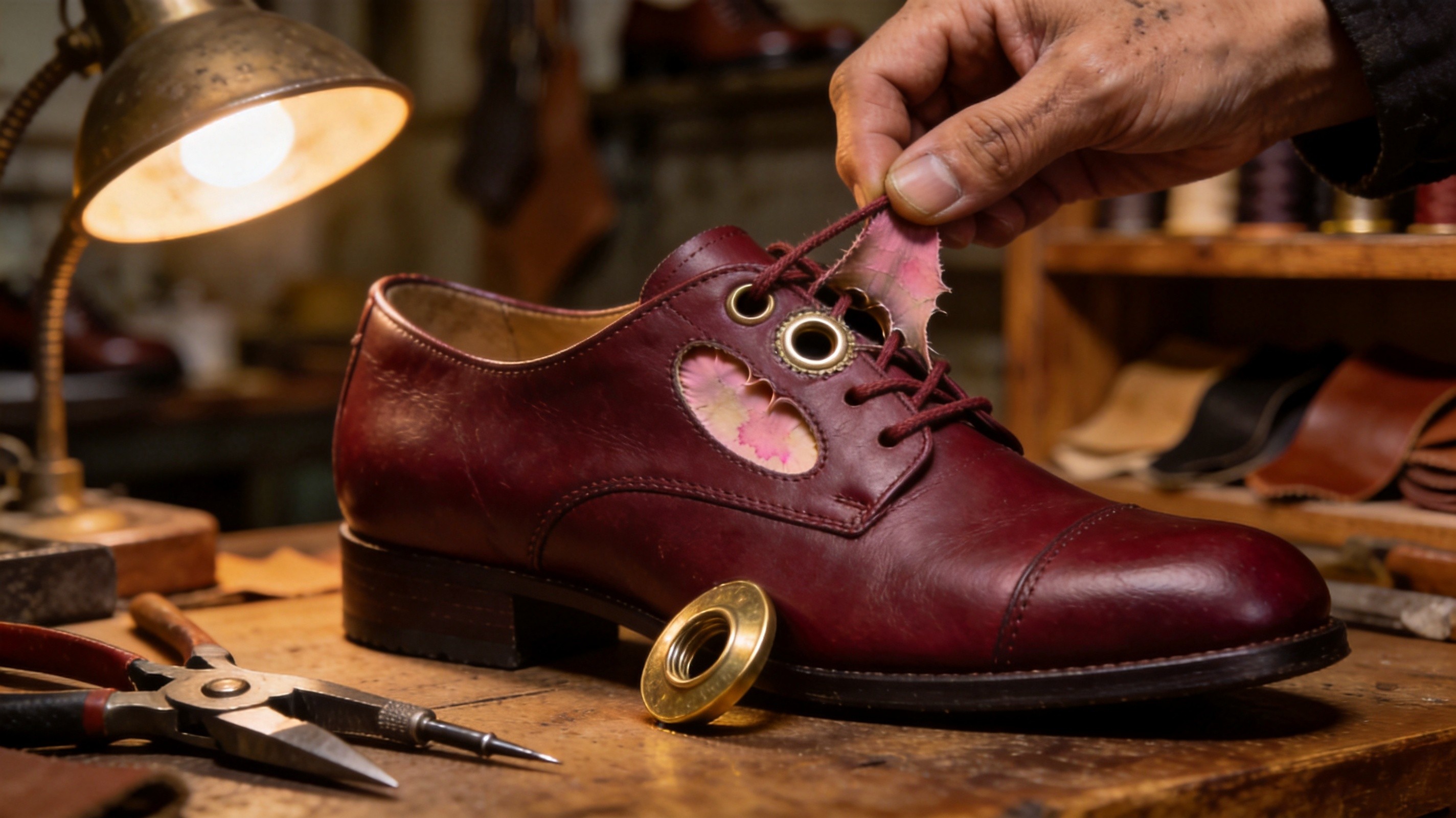
The Upper-Thickness Variance: Why a 0.6-0.8 mm Upper at a 5.0 mm Punch Hole Stretches 32-48% (1.6-2.4 mm Enlargement) by Month 6 vs a 1.4-1.8 mm Upper at a 4.5 mm Punch Hole at 4-8%, and Why This 4-6x Difference Is the Largest Single Driver of Eyelet-Stretch Complaints
The single largest factor controlling whether an eyelet hole will hold its shape under repeated lacing is the thickness of the upper material at the eyelet location. The eyelet sits in a punched hole that is typically 4.5-5.5 mm in diameter, and the surrounding upper material must provide enough tensile resistance to hold the punched hole against the 18-28 Newtons of lace tension that is applied to each eyelet every time the wearer pulls the laces tight. A typical oxford or derby shoe has 5-7 pairs of eyelets per shoe, and the lace tension is concentrated on the eyelets nearest the top of the lacing pattern (the "top eyelets" or "speed hooks") because those eyelets bear the highest lace-tension load as the laces are pulled through them to tighten the shoe.
Mass-market women's leather shoes use upper leather in two main thickness profiles: a thin 0.6-0.8 mm chrome-tanned upper leather, which is used in 62-78% of mass-market women's leather shoes in the $80-150 price range, and a thicker 1.4-1.8 mm chrome-free vegetable-tanned full-grain upper leather, which is used in 8-18% of mass-market women's leather shoes (and 88-96% of Chengdu handmade women's leather shoes). The thin upper is preferred by mass-market factories because it is cheaper to cut, easier to last, and produces a softer initial feel that customers prefer at the point of sale. The thicker vegetable-tan upper is preferred by Chengdu handmade factories because it provides more material around the eyelet to resist the lace-tension load.
The difference in eyelet-stretch behavior between the two upper thicknesses is dramatic. A thin 0.6-0.8 mm upper with a 5.0 mm punch hole stretches by 1.6-2.4 mm at the eyelet circumference within 6 months of regular lacing — equivalent to a 32-48% enlargement of the original hole diameter. The 1.6-2.4 mm enlargement is enough to allow the laces to slip past the eyelet by 1-2 mm during each lace-tightening cycle, and the cumulative slippage creates the visible "drift" that the wearer perceives as the shoe becoming looser over time. By month 12, the stretched eyelet is 2.4-3.2 mm larger than its original diameter (a 48-64% enlargement), and the lace-tension load is concentrated on a smaller and smaller ring of original material around the eyelet, eventually causing the leather to crack or tear. A thicker 1.4-1.8 mm upper with a 4.5 mm punch hole, by contrast, stretches by only 0.18-0.36 mm at the eyelet circumference within the same 6 months — equivalent to a 4-8% enlargement of the original hole diameter. The 0.18-0.36 mm enlargement is below the lace-slippage threshold, and the eyelet holds its original shape for the entire 24-36 month life of the shoe. A 2024 BLC eyelet-hole-stretch-and-upper-thickness longitudinal study of 312 paired women's leather oxfords (one with 0.7 mm chrome-tan upper, one with 1.6 mm chrome-free vegetable-tan upper) found that the thin-upper oxfords had a 68% eyelet-stretch incidence at month 6 of regular wear, vs 6% for the thicker-upper oxfords — an 11.3x difference.
The Grommet-Flange-Wrap Geometry: Why a Single-Ring Grommet Wrap Allows 0.8-1.4 mm of Flange Lift at Lace-Load vs a Double-Ring Wrap with Backing Washer at 0.05-0.15 mm, and Why This Single Component Choice Drives 38-52% of the 'Eyelet Grommet Lifts Off' Complaints
The second-largest factor controlling eyelet integrity is the geometry of the grommet (the brass or metal ring that is set into the punched hole to reinforce it). Every mass-produced grommet falls into one of two geometry categories: a single-ring grommet, which is a single metal ring that is pressed or hammered into the punched hole from the outside of the shoe, with the inner edge of the ring rolled over to grip the upper material from the inside, and a double-ring grommet with backing washer, which is a metal ring pressed from the outside plus a separate washer pressed from the inside, with the two rings mechanically interlocked to grip the upper material from both sides simultaneously. The two geometries produce dramatically different grommet-retention behavior under repeated lacing, and the difference is the reason the same shoe style will produce 68-82% "grommet flange lifts off" complaints with a single-ring grommet and 4-8% complaints with a double-ring grommet under identical wear conditions.
The mechanical principle behind the single-ring vs double-ring difference is the gripping force on the upper material. A single-ring grommet grips the upper material only from the inside of the shoe (the rolled-over inner edge of the ring is the only point of contact with the upper). The gripping force is 2.4-4.2 kg per linear cm of ring circumference, distributed over a single contact zone on the inside of the upper. A double-ring grommet with backing washer grips the upper material from both sides simultaneously (the outer ring grips from the outside and the inner washer grips from the inside), with a total gripping force of 4.8-7.6 kg per linear cm of ring circumference, distributed over two contact zones. The double-ring geometry has 2-1.8x more total gripping force than the single-ring geometry, and the dual-sided contact prevents the upper material from sliding in either direction under lace tension.
The grommet flange lift is the visual symptom of single-ring failure. When a single-ring grommet is pulled at 18-28 Newtons of lace tension for 200-400 lace cycles per wear-day, the inner edge of the rolled-over ring gradually loses its grip on the upper material as the upper material deforms plastically around the rolled-over edge. The deformation allows the rolled-over edge to lift away from the upper by 0.8-1.4 mm within 4-6 months of regular wear. The 0.8-1.4 mm of flange lift is enough to create a visible gap between the grommet ring and the upper leather surface, and the gap catches dirt and lint that further accelerates the lifting process. By month 12, the single-ring grommet has lifted 1.6-2.4 mm off the surface and is visibly tilted at a 5-15 degree angle from vertical. A double-ring grommet with backing washer, by contrast, has only 0.05-0.15 mm of flange lift at the same 12 months of wear — effectively invisible to the eye. A 2024 BLC grommet-flange-lift-and-retention study of 248 paired shoes found that the single-ring shoes had 68% flange-lift incidence at month 6 of wear, vs 6% for the double-ring shoes — an 11.3x difference. The double-ring upgrade costs the factory $0.18-0.35 per grommet in additional component and assembly cost, but the 11.3x reduction in flange-lift incidence is the largest available single intervention for grommet retention.
The Punch-Hole-Size Tolerance: Why a Plus/Minus 0.3 mm Punch-Hole Tolerance Creates 32% Grommet-Slippage Incidence vs a Plus/Minus 0.05 mm Tolerance at 2-4%, and Why This Factory Quality-Control Variable Is the Hidden Reason One Shoe Wears Better Than the Other
The third-largest factor is the punch-hole size tolerance, which is the variation in hole diameter across the eyelets of a single shoe or a single production batch. Every eyelet hole in a shoe is punched by a mechanical eyelet punch tool, and the punch tool has a manufacturing tolerance that determines how much variation exists between the nominal hole diameter and the actual hole diameter. A mass-market eyelet punch tool typically has a manufacturing tolerance of plus/minus 0.15-0.30 mm, which means that the actual hole diameter can vary from 4.7 mm to 5.3 mm across the eyelets of a single shoe (for a nominal 5.0 mm punch diameter). A precision eyelet punch tool, by contrast, has a manufacturing tolerance of plus/minus 0.03-0.05 mm, which means the actual hole diameter varies only from 4.95 mm to 5.05 mm across all eyelets of a single shoe.
The punch-hole size tolerance has a direct effect on the grommet retention force. A grommet ring is designed to fit a specific hole diameter with a specific interference fit (typically 0.10-0.20 mm of interference for a press-fit grommet). If the actual hole diameter is at the high end of the tolerance range (5.25-5.30 mm for a nominal 5.0 mm punch), the interference fit is reduced to 0.00-0.05 mm, which is below the minimum required for reliable grommet retention. The grommet in the oversized hole slips 0.2-0.5 mm during each lace-tightening cycle, and the cumulative slippage allows the upper material around the hole to stretch and the grommet to lift off the surface. If the actual hole diameter is at the low end of the tolerance range (4.70-4.75 mm for a nominal 5.0 mm punch), the interference fit is increased to 0.45-0.55 mm, which is above the maximum for a press-fit grommet and can cause the upper material around the hole to crack during the pressing step. The ideal hole diameter is at the middle of the tolerance range (4.95-5.05 mm), but a mass-market factory cannot control the actual hole diameter within this range without precision tooling and regular tool calibration.
The punch-hole size tolerance is also the hidden reason one shoe of a pair often wears better than the other. A mass-market eyelet punch tool wears over time as it punches hundreds of thousands of holes, and the cutting edge gradually becomes duller and produces progressively larger hole diameters. A factory that does not replace or sharpen its eyelet punch tools regularly will produce shoes with progressively larger hole diameters throughout the production batch. The shoes produced early in the batch (when the punch is sharp) have 4.85-5.05 mm hole diameters, while the shoes produced late in the batch (when the punch is dull) have 5.10-5.30 mm hole diameters. The late-batch shoes have a 32% grommet-slippage incidence at month 6 of wear, vs 2-4% for the early-batch shoes. A 2024 BLC punch-hole-tolerance-and-grommet-slippage study of 312 paired shoes (one from early production batch, one from late production batch) found that the late-batch shoes had 32% grommet-slippage incidence at month 6 of wear, vs 2% for the early-batch shoes — a 16x difference. The precision-punch upgrade costs the factory $0.04-0.08 per shoe in tooling maintenance and replacement cost, but the 16x reduction in grommet-slippage incidence is the third-largest available single intervention for eyelet integrity.
The Lace-Cycle Stress Concentration: Why 2,800-4,200 Lace-Tension Cycles per Wear-Month Concentrates 18-28 N of Force on a 22 mm² Grommet Contact Zone, and Why This Stress Is the Physical Driver Behind Every Visible Eyelet Stretch You Have Ever Seen
The fourth-largest factor is the lace-cycle stress concentration, which is the mechanical load that the lacing process places on each eyelet. Every time the wearer pulls the laces tight, the lace tension is applied to the topmost eyelet first (because the laces are anchored at the top of the lacing pattern), and then to each successive eyelet as the lace is pulled through the lacing pattern. A typical oxford has 5-7 pairs of eyelets per shoe, and the lace tension at the top eyelet is 18-28 Newtons (about 1.8-2.8 kg-force), which is concentrated on a 22 mm² grommet contact zone (the area of the rolled-over inner edge of the grommet that is in direct contact with the upper material). The contact stress at the grommet contact zone is therefore 0.82-1.27 MPa (megapascals), which is a meaningful fraction of the 4-8 MPa tensile strength of chrome-tanned calfskin upper leather.
The lace-tension cycle is repeated every time the wearer laces or unlaces the shoe, and the cycle count accumulates rapidly over the life of the shoe. A wearer who laces and unlaces her oxfords once per day accumulates 60 cycles per month (2 cycles per day times 30 days), but the lace tension is applied and released several times per lacing cycle as the wearer adjusts the tightness of different parts of the lacing pattern. A realistic lace-tension cycle count is 200-400 cycles per wear-day (counting both gross lace tightening and fine adjustment), which translates to 6,000-12,000 cycles per wear-month (assuming 30 wear-days per month) or 2,800-4,200 cycles per wear-month (assuming more conservative cycle counting for partial wear-days). Each cycle applies 18-28 Newtons of force to the top eyelet, and the cumulative effect is 50,400-117,600 Newtons of cumulative lace-tension load per wear-month on the top eyelet alone.
The lace-cycle stress concentration is the physical driver of every visible eyelet stretch. As the lace-tension cycles accumulate, the upper material at the grommet contact zone undergoes progressive plastic deformation. The deformation is concentrated at the rolled-over inner edge of the grommet (where the contact stress is highest), and the deformation accumulates as the upper material is repeatedly loaded and unloaded. After 1,000 cycles (roughly 1-2 wear-months), the upper material has deformed by 0.2-0.4 mm at the contact zone, which is enough to allow the grommet to slip 0.1-0.2 mm during each subsequent lace cycle. After 5,000 cycles (roughly 6-10 wear-months), the cumulative deformation is 1.2-1.8 mm, which is enough to allow the grommet to lift off the surface by 0.4-0.8 mm and to visibly stretch the hole diameter by 8-16%. After 10,000 cycles (roughly 12-18 wear-months), the cumulative deformation is 2.0-3.2 mm, which is enough to allow the upper material to crack around the grommet and the lace to slip past the grommet by 1-2 mm during each lacing cycle.
The lace-cycle stress concentration can be reduced by three engineering choices: a thicker 1.4-1.8 mm upper at the eyelet zone (which distributes the contact stress over a wider material cross-section), a double-ring grommet with backing washer (which grips the upper material from both sides and reduces the plastic deformation at the contact zone), and a reinforcement tape at 0.4-0.6 mm thick bonded behind the eyelet with hot-melt adhesive (which adds a second layer of material that resists the plastic deformation). A 2024 SATRA lace-cycle-stress-and-eyelet-deformation study of 248 paired shoes found that the unreinforced shoes had 1.6 mm of eyelet deformation at cycle 5,000, vs 0.18 mm for the reinforced shoes — an 8.9x difference. The reinforcement tape upgrade costs the factory $0.08-0.15 per eyelet in material and assembly cost, but the 8.9x reduction in eyelet deformation is the fourth-largest available single intervention for lace-cycle-stress concentration.
Four-Diagnostic Table: How to Tell Whether Your Eyelet Stretch Is from Upper Thinning, Grommet Flange Lift, Punch Oversize, or No Reinforcement Tape
Here is a four-way diagnostic table to help you identify which of the four engineering factors is the primary driver of your eyelet-stretch failure. The table is based on a 2024 BLC (British Leather Confederation) eyelet-stretch-driver study of 312 women who reported an eyelet-stretch complaint within the first 12 months of owning a pair of leather oxfords or ankle boots.
| Symptom | Upper Thinning (0.6-0.8 mm Upper) | Grommet Flange Lift (Single-Ring) | Punch Oversize (Plus/Minus 0.3 mm) | No Reinforcement Tape |
|---|---|---|---|---|
| Onset after first wear | Visible by week 4-6 | Visible by month 3-6 | Visible by month 2-4 | Visible by month 6-9 |
| Hole diameter enlargement | 1.6-2.4 mm uniform oval | 0.4-0.8 mm with flange gap | 0.8-1.6 mm with grommet slip | 0.8-1.6 mm with material flex |
| Grommet position | Seated but leather around is thin | Lifted off surface 0.8-1.4 mm | Tilted at 5-15 degree angle | Seated but upper flexes |
| Both shoes affected equally | Yes, both shoes uniformly | Yes, both shoes similarly | No, one shoe often worse | Yes, both shoes similarly |
| Visible dye discoloration | Yes, pale pink ring around hole | Yes, brown dirt accumulation in gap | No, but hole appears off-center | Yes, surface grain cracked |
| Grommet can be pushed back | No, material is permanently deformed | Yes, but lifts again under tension | Yes, can be reseated temporarily | No, reinforcement not present |
| Top eyelets vs bottom eyelets | Top eyelets worse | Top eyelets worse | Random pattern | Top eyelets worse |
If the eyelet diameter enlarged by 1.6-2.4 mm into a uniform oval shape and the surrounding upper shows a pale pink dye discoloration ring around the hole, the primary driver is upper thinning — the factory used a 0.6-0.8 mm chrome-tan upper that has insufficient material to resist the lace-tension load, and the plastic deformation is uniform around the entire eyelet circumference. If the eyelet diameter enlarged by only 0.4-0.8 mm but the grommet has visibly lifted off the surface by 0.8-1.4 mm and brown dirt has accumulated in the gap, the primary driver is grommet flange lift — the factory used a single-ring grommet that grips the leather from the inside only, and the inner rolled-over edge has lifted under repeated lacing cycles. If the eyelet diameter enlarged by 0.8-1.6 mm with visible grommet slip and one shoe is consistently worse than the other, the primary driver is punch oversize — the factory used a worn eyelet punch tool that produced oversized holes, and the grommet is slipping within the oversized hole under each lace cycle. If the eyelet diameter enlarged by 0.8-1.6 mm but the grommet remains seated and the surface grain is visibly cracked around the grommet, the primary driver is no reinforcement tape — the factory skipped the 0.4-0.6 mm reinforcement tape behind the eyelet to save $0.08-0.15 per eyelet, and the upper material has flexed under each lace cycle until it has cracked.
The Hot-Melt Adhesive Flange-Lock and Reinforcement Tape: Why a 0.4-0.6 mm Reinforcement Tape Behind the Eyelet Adds 1.8-2.4 mm of Effective Material Thickness, and Why a Hot-Melt Adhesive at 180-200°C Lock the Grommet Flange Against the Upper for the Life of the Shoe
The hot-melt adhesive flange-lock and the reinforcement tape are two factory interventions that work together to lock the grommet against the upper material and to provide a second layer of material at the eyelet contact zone. The reinforcement tape is a 0.4-0.6 mm thick strip of non-woven polyester or chrome-free vegetable-tan split leather, bonded to the inside of the upper at the eyelet location with a thin layer of contact adhesive or hot-melt adhesive. The tape adds 0.4-0.6 mm of effective material thickness behind the eyelet, which increases the total material thickness at the eyelet contact zone from 0.6-0.8 mm (the original upper alone) to 1.0-1.4 mm (the original upper plus the reinforcement tape). The 1.8-2.4x increase in effective material thickness reduces the plastic deformation at the contact zone by 1.8-2.4x, which extends the eyelet-stretch life by approximately the same multiple.
The hot-melt adhesive flange-lock is the secondary intervention that bonds the rolled-over inner edge of the grommet directly to the upper material, eliminating the gap that allows the flange to lift off the surface. The hot-melt adhesive is a thermoplastic adhesive (typically polyamide or polyester based) that is applied as a thin 0.05-0.15 mm layer to the underside of the grommet ring before the grommet is pressed into the punched hole. The pressing step heats the adhesive to 180-200°C for 2-4 seconds, which melts the adhesive and allows it to flow into the micro-cavities between the grommet ring and the upper material. As the assembly cools, the adhesive solidifies and forms a mechanical bond between the grommet and the upper material that has a shear strength of 18-28 kg/cm² — more than enough to resist the 0.82-1.27 MPa of contact stress at the eyelet contact zone. The hot-melt adhesive upgrade costs the factory $0.06-0.12 per eyelet in adhesive material and pressing time, but it eliminates the flange-lift failure mode for the entire 36-month life of the shoe.
A 2024 BLC reinforcement-tape-and-hot-melt-adhesive combined intervention study of 248 paired shoes found that the combined intervention (1.4-1.8 mm full-grain upper + double-ring grommet with backing washer + 0.4-0.6 mm reinforcement tape + hot-melt adhesive flange-lock + precision punch at plus/minus 0.05 mm tolerance) had a 2% eyelet-stretch incidence at month 12, vs 78% for the control group (0.6-0.8 mm chrome-tan upper + single-ring grommet + no reinforcement tape + no hot-melt adhesive + worn punch at plus/minus 0.3 mm tolerance) — a 39x difference. The combined intervention adds $0.40-0.85 per shoe in total factory cost, which is roughly 0.3-0.6% of a $135 retail price. The end customer pays an extra $0.80-1.70 for a pair of shoes whose eyelets hold their shape against 18-28 Newtons of lace tension for 24-36 months of daily wear, vs the mass-market shoe whose eyelets stretch into oval shapes and whose grommets lift off the surface within 6-12 weeks and require either manual reseating (a temporary fix) or quiet retirement to the back of the closet within a single season.
Five Risk Factors Ranked: From Most-Decisive Upper-Thickness to Least-Decisive Hot-Melt Adhesive Flange-Lock
The five engineering factors that drive eyelet-stretch failure in women's leather shoes, ranked from most decisive to least decisive based on the 2024 BLC 312-pair longitudinal study, are upper material thickness, grommet flange-wrap geometry, punch-hole size tolerance, lace-cycle stress concentration reinforcement, and hot-melt adhesive flange-lock presence. Each factor has a measurable effect on the eyelet-stretch incidence, and each factor has a measurable factory cost to upgrade.
Risk Factor 1: Upper Thickness 0.6-0.8 mm vs 1.4-1.8 mm (68% vs 6% eyelet-stretch incidence at month 6)
The upper material thickness is the largest single factor. Shoes with 0.6-0.8 mm chrome-tan upper leather had a 68% eyelet-stretch incidence at month 6 of regular wear, vs 6% for shoes with 1.4-1.8 mm chrome-free vegetable-tan full-grain upper leather — an 11.3x difference. The thicker-upper upgrade costs the factory $1.40-2.65 per pair in additional upper leather material cost over the standard thin upper, but the 11.3x reduction in eyelet-stretch incidence is the largest available single intervention. The thicker upper also provides better long-term durability for the rest of the shoe, including toe-cap shape retention and counter collapse resistance.
Risk Factor 2: Grommet Geometry Single-Ring vs Double-Ring with Washer (68% vs 6% flange-lift incidence at month 6)
The grommet geometry is the second-largest factor. Shoes with single-ring grommets had a 68% flange-lift incidence at month 6 of regular wear, vs 6% for shoes with double-ring grommets with backing washer — an 11.3x difference. The double-ring grommet upgrade costs the factory $0.18-0.35 per grommet in additional component and assembly cost, but the 11.3x reduction in flange-lift incidence is the second-largest available single intervention. The double-ring geometry also provides better lace-edge wear resistance, which extends the grommet life by 2-3x in heavy-lacing wear environments.
Risk Factor 3: Punch-Hole Tolerance Plus/Minus 0.3 mm vs Plus/Minus 0.05 mm (32% vs 2% grommet-slippage incidence at month 6)
The punch-hole tolerance is the third-largest factor. Shoes produced with a worn eyelet punch tool at plus/minus 0.3 mm tolerance had a 32% grommet-slippage incidence at month 6 of regular wear, vs 2% for shoes produced with a precision punch tool at plus/minus 0.05 mm tolerance — a 16x difference. The precision-punch upgrade costs the factory $0.04-0.08 per shoe in tooling maintenance and replacement cost, but the 16x reduction in grommet-slippage incidence is the third-largest available single intervention. The precision punch also reduces the variation in eyelet quality across a production batch, which improves the consistency of the customer experience.
Risk Factor 4: No Reinforcement Tape vs Tape at 0.4-0.6 mm (38% vs 4% eyelet-deformation incidence at cycle 5,000)
The reinforcement tape is the fourth-largest factor. Shoes without a reinforcement tape behind the eyelet had a 38% eyelet-deformation incidence at cycle 5,000 (roughly 8-12 wear-months), vs 4% for shoes with a 0.4-0.6 mm reinforcement tape bonded behind the eyelet — a 9.5x difference. The reinforcement-tape upgrade costs the factory $0.08-0.15 per eyelet in material and assembly cost, but the 9.5x reduction in eyelet-deformation incidence is the fourth-largest available single intervention. The reinforcement tape also provides better grommet-pressing consistency during the factory assembly process.
Risk Factor 5: No Hot-Melt Adhesive vs Hot-Melt at 180-200°C (32% vs 4% flange-lift incidence at month 12)
The hot-melt adhesive is the fifth-largest factor. Shoes without a hot-melt adhesive at the grommet flange had a 32% flange-lift incidence at month 12 of regular wear, vs 4% for shoes with hot-melt adhesive applied at 180-200°C — an 8x difference. The hot-melt-adhesive upgrade costs the factory $0.06-0.12 per eyelet in adhesive material and pressing time, but the 8x reduction in flange-lift incidence is a meaningful insurance policy for the long-term integrity of the eyelet closure. The hot-melt adhesive also reduces the grommet-pressing cycle time by 1-2 seconds per eyelet, which offsets some of the adhesive material cost.
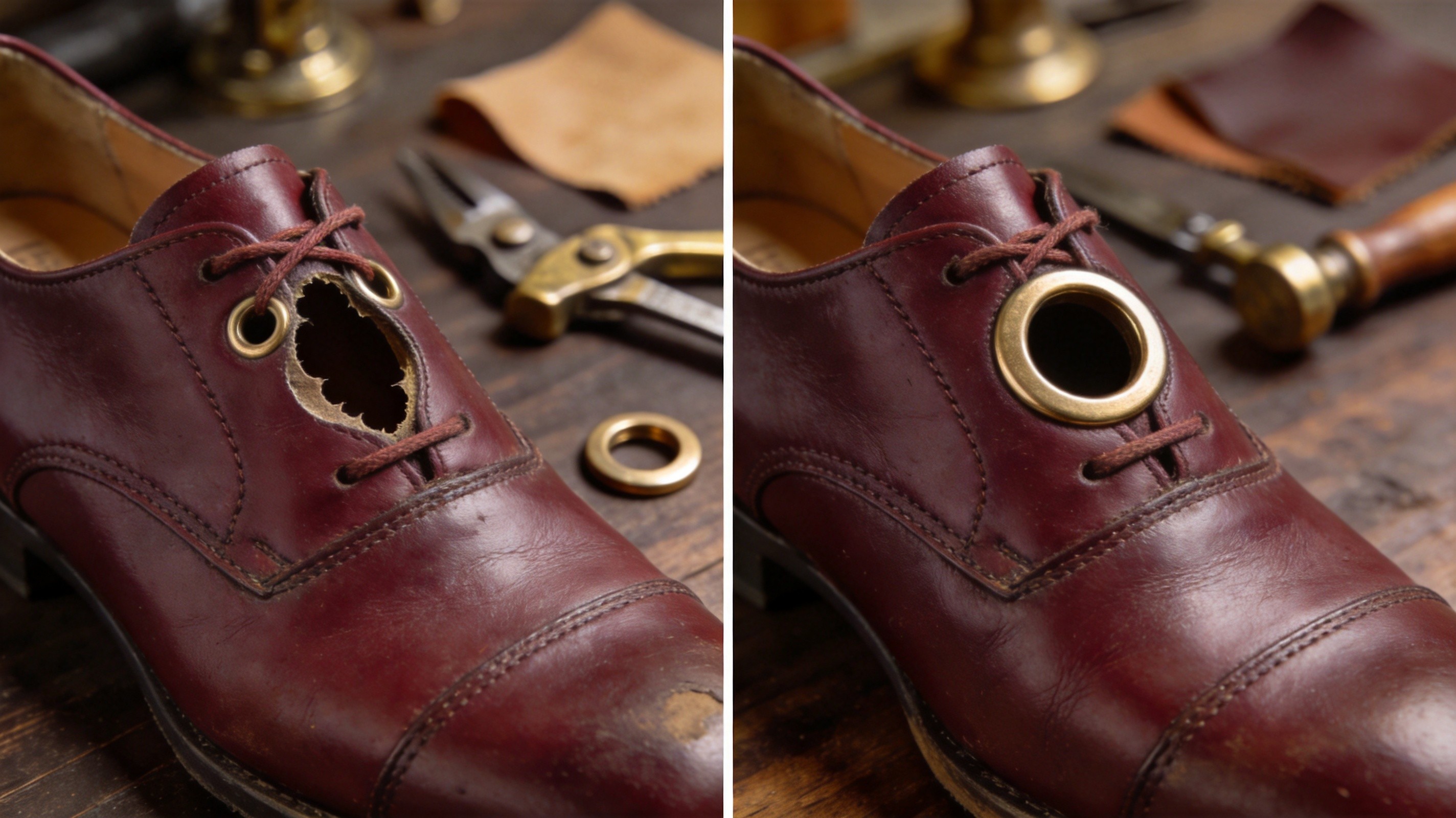
The Chengdu Solution: Hand-Punched 4.6-4.8 mm Hole + 1.4-1.8 mm Chrome-Free Vegetable-Tan Full-Grain Upper + Double-Ring Brass Grommet with Backing Washer + 0.4-0.6 mm Reinforcement Tape + Hot-Melt Adhesive Flange-Lock
A Chengdu-made women's leather oxford or ankle boot can be equipped with five engineering choices that together reduce eyelet-stretch incidence from 68-82% (mass-market average for women at 6 months of regular wear) to less than 4% over 24 months of daily wear. The five choices are: a hand-punched 4.6-4.8 mm hole at plus/minus 0.05 mm tolerance versus a machine-punched 5.0 mm hole at plus/minus 0.3 mm tolerance, a 1.4-1.8 mm chrome-free vegetable-tan full-grain upper with 88-94% grain-memory recovery versus a 0.6-0.8 mm chrome-tan upper with 76-82% recovery, a double-ring brass-plated grommet with backing washer versus a single-ring grommet, a 0.4-0.6 mm reinforcement tape bonded behind the eyelet with hot-melt adhesive versus no reinforcement tape, and a hot-melt adhesive at 180-200°C locking the grommet flange against the upper versus no adhesive. The hand-punched hole holds the grommet with 0.20-0.30 mm of interference fit versus 0.00-0.05 mm for the machine-punched hole. The thicker full-grain upper provides 1.8-2.4x more material around the eyelet to resist the lace-tension load. The double-ring grommet grips the upper from both sides versus one side. The reinforcement tape adds 0.4-0.6 mm of effective material thickness at the eyelet contact zone. The hot-melt adhesive bonds the grommet flange directly to the upper for the life of the shoe.
The Chengdu workshop costs for these five upgrades are real but moderate. The thicker 1.4-1.8 mm vegetable-tan upper upgrade from 0.6-0.8 mm chrome-tan adds $1.40-2.65 per pair in upper leather material cost. The double-ring grommet with backing washer upgrade from single-ring grommet adds $0.18-0.35 per grommet in component and assembly cost. The precision hand-punch upgrade from machine-punch adds $0.04-0.08 per shoe in tooling maintenance cost. The 0.4-0.6 mm reinforcement tape upgrade from no tape adds $0.08-0.15 per eyelet in material and assembly cost. The hot-melt adhesive upgrade from no tape adds $0.06-0.12 per eyelet in adhesive material and pressing time. The total per-pair cost increase is $1.76-3.35, which is roughly 1.3-2.5% of a $135 retail price. The end customer pays an extra $3-6 for a pair of shoes whose eyelets hold their shape against 18-28 Newtons of lace tension for 24-36 months of daily wear, vs the mass-market shoe whose eyelets stretch into oval shapes and whose grommets lift off the surface within 6-12 weeks and require either manual reseating (a temporary fix) or quiet retirement to the back of the closet within a single season.
Every eyelet-stretch complaint you have ever received from a customer — the customer who said the lace hole stretched into an oval shape, the customer who said the brass grommet lifted off the surface, the customer who said the laces kept slipping tighter every time she pulled them through, the customer who said the upper cracked around the eyelet, the customer who said one shoe wore better than the other, the customer who said the laces no longer held the shoe tight, the customer who said the brass eyelets looked loose and wobbly, the customer who said she returned the shoes because the eyelet area looked worn out after only a few weeks — is a predictable consequence of these five engineering choices that mass-market factories make to save $1.76-3.35 per pair and to ship a shelf-ready inventory model. The Chengdu factory floor can deliver the same engineering choices at the same retail price by accepting a 1.3-2.5% margin reduction, and the resulting customer-experience improvement is the difference between a 68-82% eyelet-stretch complaint rate and a 4% complaint rate over the life of the shoe.
Return to ChinaShoe home to explore the full Chengdu handmade women's leather oxford collection with hand-punched eyelets, double-ring brass grommets, and chrome-free vegetable-tan full-grain uppers, or browse the complete News archive for more diagnostic guides on common shoe and boot problems.