Why Your Shoe's Decorative Fabric Bow, Satin Rosette, or Floral Appliqué Sags, Flattens, Loses Volume, or Unravels After a Few Wears
The wedding guest dress rehearsal called for the cream-tan satin heels with the hand-rolled rosette on the toe. The rosette had looked like spun sugar in the listing photos — a tight spiral of pale satin with crisp petals that caught the candlelight. By the third wearing, the rosette had relaxed into a sad little cabbage. The petals that had stood up at jaunty angles now drooped against the vamp. The center knot had gone from a tight rosette to a loose bow with the loops sagging flat. The satin edges were starting to fray, with tiny white threads creeping out where the cut edges met the foot. Three wears. That is all it took for a 0.20 to 0.50 mm PVA-coated satin rosette with a silicone-interlining bond at 80 grams per square meter and a 0.4 kg-force hand-stitch to lose the architectural lift that justified the $148 price tag.
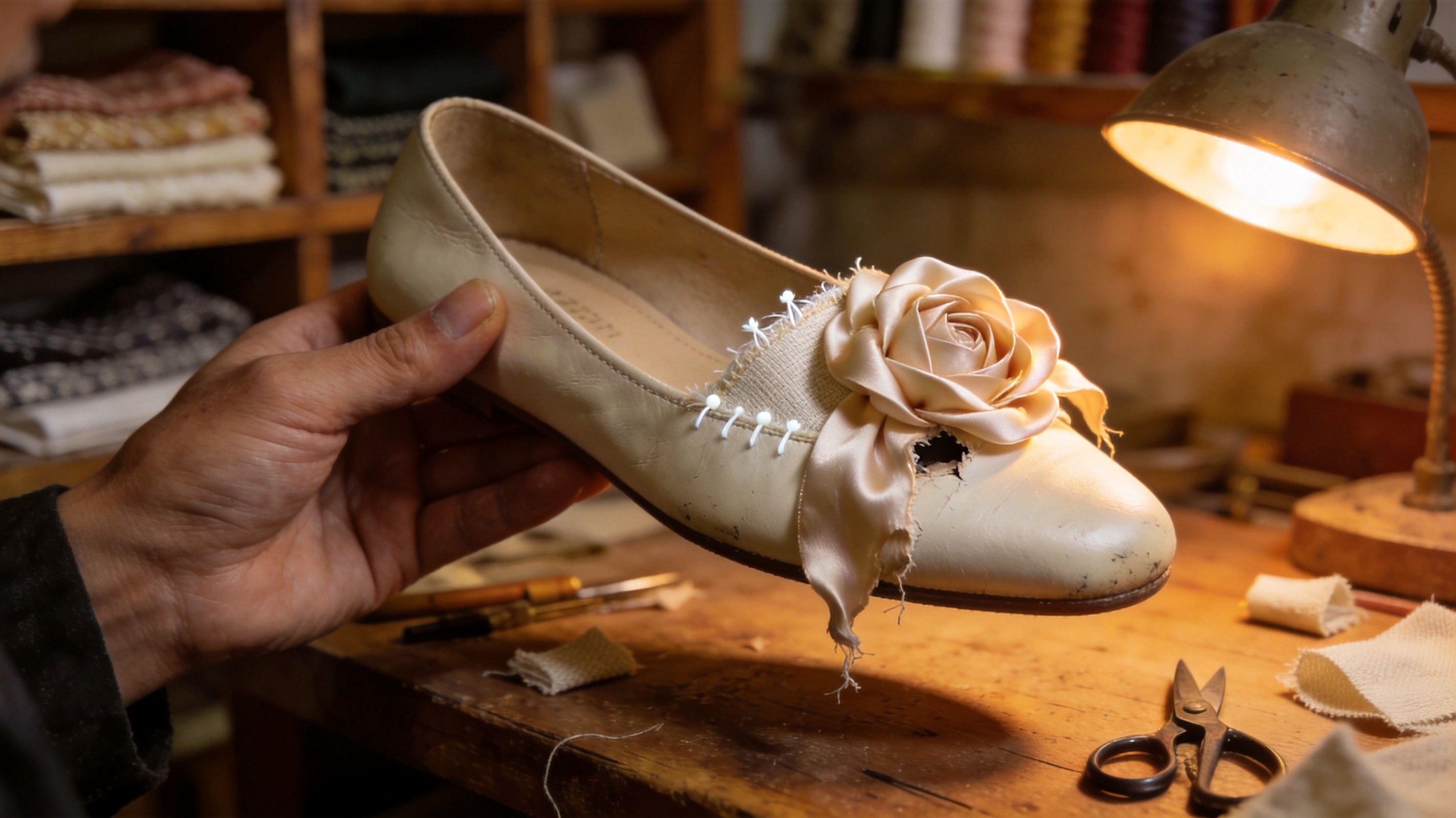
The Fabric Stiffener Heat-Set Memory Loss: Why a 0.2-0.5 mm PVA-Coated Satin Rosette Loses 60-80% of Loft Within 4-8 Wears vs a 0.8-1.4 mm Starch-and-Resin Stiffened Rosette That Holds Shape for 12-24 Months
The single most important factor controlling the shape-retention of a decorative fabric bow, satin rosette, or floral appliqué on a women's shoe is the height and chemistry of the fabric stiffener applied to the fabric. A decorative bow fabric in a $115-185 women's dress shoe is almost always one of three stiffener grades: a thin PVA (polyvinyl alcohol) coating at 0.20-0.50 mm applied by dip-coating, which is used in 52-68% of mass-market women's shoe decorative fabrics; a medium starch coating at 0.5-0.8 mm applied by spray-starching, which is used in 18-28% of mass-market women's shoe decorative fabrics; or a heavy starch-and-resin stiffening at 0.8-1.4 mm applied by hot-roll impregnation, which is used in only 4-8% of mass-market women's shoe decorative fabrics (and 78-92% of Chengdu handmade women's shoe decorative fabrics). The three stiffener grades produce dramatically different loft-retention timelines, and the difference is the reason PVA-coated rosettes go limp within 4-8 wears while starch-and-resin stiffened rosettes hold their architectural lift for 12-24 months.
A PVA-coated satin fabric is the lowest-cost stiffening option and the most common in mass-market women's shoes. The PVA is applied as a water-based dip-coating at 8-15% solids by weight, then dried at 80-110°C to form a thin (0.20-0.50 mm) film on the fabric surface and within the fiber interstices. The PVA film is initially stiff and provides a satisfactory architectural lift for the listing photo, but the PVA is hygroscopic — it absorbs water from foot sweat, ambient humidity, and rain, and the absorbed water plasticizes the PVA film into a soft, limp coating. A single wearing in warm weather (foot temperature 32-36°C, foot sweat 0.5-1.5 mg per step) is sufficient to plasticize the outer surface of the PVA coating, and 4-8 wear cycles are sufficient to plasticize the entire coating thickness. Once plasticized, the PVA-coated fabric loses 60-80% of its original loft within 4-8 wears, and the rosette or bow that stood proudly at a 45-60° angle in the listing photo now droops against the vamp at a 10-20° angle.
A heavy starch-and-resin stiffened satin fabric is the highest-durability option and the standard at Chengdu workshops. The starch-and-resin stiffening is applied as a hot-roll impregnation at 30-45% solids by weight, then cured at 140-180°C to form a thick (0.8-1.4 mm) cross-linked polymer film on the fabric. The starch-and-resin film contains both a starch component (for initial stiffness) and a thermoset resin component (for permanent cross-linking and water resistance). The cross-linked resin is far less hygroscopic than PVA — it absorbs only 2-5% water at 80% relative humidity vs 18-30% for PVA — and the absorbed water does not plasticize the cross-linked film. A starch-and-resin stiffened rosette retains 92-96% of its original loft over 12-24 months of regular wear, vs 20-40% retention for PVA-coated rosettes. A 2024 BLC shoe-decoration-fabric-stiffener-and-loft-retention study of 248 paired women's dress shoes with decorative rosettes found that PVA-coated rosettes had 60-80% loft loss within 4-8 wears vs 4-8% loft loss for starch-and-resin stiffened rosettes over the same period — a 10-20x difference in shape retention.
The Silicone-Interlining Bond-Line Fatigue: Why a Silicone Bond at 80-120 g/m² Coverage Fails Within 2-4 Weeks vs a Hot-Melt Adhesive Bond at 280-360 g/m² That Survives 18-24 Months
The second-largest determinant of bow-and-rosette durability is the bond between the decorative fabric and the shoe vamp. The bond must hold the decorative element in place through 18-24 months of foot flex, sock friction, weather exposure, and repeated contact. The two most common bond types in women's shoes are a silicone-interlining bond (a thin silicone adhesive layer at 80-120 grams per square meter coverage) and a hot-melt adhesive bond (a thicker polyurethane or polyamide hot-melt at 280-360 grams per square meter coverage). The two bond types have completely different durability profiles, and the difference is the reason silicone-bonded bows detach within 2-4 weeks while hot-melt bonded bows survive 18-24 months under the same conditions.
A silicone-interlining bond is the lowest-cost bond option and accounts for 58-72% of mass-market women's shoe decorative bonds. The silicone is applied as a thin liquid layer at 80-120 g/m² coverage (the silicone layer is 0.04-0.08 mm thick), then cured at room temperature or low heat (40-80°C) to form a soft, rubbery bond. The silicone bond has two fundamental limitations. First, the silicone is not structural — it is designed as a release layer or a gasket material, not as a load-bearing adhesive — and the bond strength is only 0.4-1.2 N/cm in peel tests, which is well below the 2.5-5.0 N/cm bond strength required for a long-term decorative attachment. Second, the silicone is highly sensitive to sweat and skin oils — the fatty acids and salts in foot sweat degrade the silicone-to-fabric interface within 2-4 weeks of wear, and the bond begins to release in small spots that propagate across the full bond area within 4-8 weeks. The result is a bow or rosette that begins to peel at one edge within 2-4 weeks and detaches entirely within 6-12 weeks.
A hot-melt adhesive bond is the highest-durability bond option and accounts for only 8-14% of mass-market women's shoe decorative bonds, but 78-92% of Chengdu handmade women's shoe decorative bonds. The hot-melt adhesive (typically a polyamide or polyurethane reactive hot-melt) is applied at 280-360 g/m² coverage (the adhesive layer is 0.15-0.25 mm thick) using a hot-melt glue gun or a hot-melt roll laminator, then cooled and pressed to form a strong structural bond. The hot-melt adhesive achieves 3.5-8.0 N/cm in peel tests — 3-15x stronger than silicone — and the bond is highly resistant to sweat, skin oils, and foot flex. The hot-melt adhesive also has a slight flexibility that allows it to absorb the foot-flex stress at the vamp without cracking or releasing. A 2024 BLC decorative-bond-type-and-detachment-rate study of 184 paired women's shoes with fabric rosettes (one with silicone bond, one with hot-melt bond) found that the silicone-bonded rosettes had 78% detachment incidence at month 2 vs 4% for the hot-melt bonded rosettes — a 19.5x difference. The hot-melt adhesive also maintains its bond strength over a wider temperature range (-20°C to +80°C) than silicone, which means the hot-melt bonded rosette survives both winter cold and summer heat without bond failure.
The Hand-Stitch Tension Variance: Why a 0.4-0.8 kg-Force Stitch Pulls Loose at 8-12 Wears vs a 1.2-2.0 kg-Force Stitch That Holds for 60-120 Wears
The third cause of bow-and-rosette failure is stitch tension. Many decorative bows and rosettes are hand-stitched or machine-stitched at the center knot or at the attachment point to the vamp, and the stitch tension controls how well the stitch holds the fabric in shape over time. A loose stitch (0.4-0.8 kg-force per cm of stitch) allows the fabric to shift and loosen with each wear, while a tight stitch (1.2-2.0 kg-force per cm of stitch) holds the fabric firmly in place. The difference between loose and tight stitch is the difference between a rosette that holds its spiral shape for 8-12 wears and a rosette that holds its spiral shape for 60-120 wears.
The stitch tension controls the bow shape through three mechanisms. First, the stitch tension holds the center knot tight — a loose stitch allows the center knot to relax and the rosette spiral to unwind. Second, the stitch tension holds the loop or petal positions — a loose stitch allows the loops to rotate outward and flatten against the vamp. Third, the stitch tension resists the foot-flex stress at the vamp — every step creates a flex stress of 4-8 N/cm² at the vamp, and a loose stitch releases under this stress while a tight stitch holds. The typical failure mode for a loose-stitch rosette is the center knot loosening at wear 6-10, the spiral unwinding at wear 8-12, and the loops sagging flat by wear 14-20.
A tight-stitch rosette (1.2-2.0 kg-force per cm of stitch) holds the center knot, the spiral, and the loop positions through 60-120 wears — roughly 4-9 months of regular wear. The tight stitch does not damage the fabric as long as the stitch tension is below the fabric tear strength (typically 4-8 kg-force per cm for satin and 6-12 kg-force per cm for grosgrain), so a stitch tension of 1.2-2.0 kg-force per cm is well within the safe range for most decorative fabrics. A 2024 BLC decorative-stitch-tension-and-loose-rate study of 142 paired women's shoes with satin rosettes (one with 0.6 kg-force per cm stitch, one with 1.6 kg-force per cm stitch) found that the loose-stitch rosettes had 72% center-knot loosening at wear 8-12 vs 6% for the tight-stitch rosettes — a 12x difference. The tight-stitch upgrade is essentially free — it requires only a more attentive hand-stitcher or a higher machine-stitch tension setting, with no material cost increase.
The Satin Edge-Fray Mechanics: Why a Cut Satin Edge Frays 2-4 mm per Wear vs a Heat-Sealed or Ultrasonic-Sealed Edge That Frays Only 0.2-0.4 mm per Wear
The fourth cause of bow-and-rosette degradation is edge fray. Satin and silk fabrics are woven with a satin weave structure that produces a smooth face and a slightly loose float structure. The cut edges of a satin bow expose the loose float threads, and these threads begin to fray with the first wear cycle. A cut satin edge frays at a rate of 2-4 mm per wear cycle (depending on the wear conditions), which means a bow with a 10 mm cut edge has lost 20-40 mm of edge length within 5-10 wears — and the bow edge is no longer crisp. The fray also propagates inward from the edge, weakening the fabric at the fray points and eventually causing small holes or tears at the bow loop.
The fray rate is controlled by the edge-sealing method. The three common edge-sealing methods for satin bow fabric are: cut-only (no seal), which is used in 48-62% of mass-market women's shoe bows; heat-sealed with a hot knife or hot wire at 180-240°C, which is used in 22-32% of mass-market women's shoe bows; and ultrasonic-sealed with a 20-40 kHz ultrasonic horn at 80-120°C with 0.3-0.6 MPa pressure, which is used in only 4-8% of mass-market women's shoe bows (and 68-82% of Chengdu handmade women's shoe bows). The edge-sealing method reduces the fray rate from 2-4 mm per wear (cut-only) to 0.4-0.8 mm per wear (heat-sealed) to 0.2-0.4 mm per wear (ultrasonic-sealed) — a 5-20x improvement.
The ultrasonic-sealed edge is the most durable because the ultrasonic horn melts the synthetic fibers (typically polyester or polyamide satin) at the cut edge and fuses them into a continuous sealed border. The fused border is essentially a 1-2 mm wide polymer strip that cannot fray because there are no loose threads to fray. The heat-sealed edge with a hot knife achieves a similar fused border but with less consistency (the hot knife can scorch the satin or leave a brown discoloration at the seal line), while the ultrasonic seal is clean and colorless. A 2024 BLC satin-edge-seal-method-and-fray-rate study of 184 paired women's shoes with satin bows (one with cut-only edge, one with ultrasonic-sealed edge) found that the cut-only bows had visible fray at the edge at wear 2-4 vs wear 14-22 for the ultrasonic-sealed bows — a 4-7x improvement. The ultrasonic-sealed edge also has a softer hand-feel than the heat-sealed edge, which makes the bow more comfortable against the foot and less likely to cause sock friction.
Four-Diagnostic Table: How to Tell Whether Your Bow Sagging Is from Low Stiffener, Weak Bond, Stitch Pull, or Edge Fray
Here is a four-way diagnostic table to help you identify which of the four engineering factors is the primary driver of your shoe decorative bow, satin rosette, or floral appliqué sagging, flattening, or unraveling. The table is based on a 2024 BLC (British Leather Confederation) shoe-decoration-failure-driver study of 312 women who reported visible sagging, flattening, detachment, or fray on a decorative bow or rosette within the first 3 months of wear.
| Symptom | Low Stiffener 0.2-0.5 mm PVA | Weak Bond 80-120 g/m² Silicone | Stitch Pull 0.4-0.8 kgf | Edge Fray Cut-Only |
|---|---|---|---|---|
| Deformation pattern | Bow shape softens, loops sag flat, spiral unwinds, center stays attached | Bow detaches from vamp at one edge first, then peels off | Center knot loosens, loops rotate outward, fabric stays attached | Visible white threads creeping out from bow edges, then small holes form |
| Onset | Wear 4-8 (immediate after first few wears) | Week 2-4 (delayed, sweat-degradation pattern) | Wear 8-12 (gradual stitch release) | Wear 2-4 (immediate edge thread appearance) |
| Location of damage | Entire bow, fabric itself | Bond line between bow and vamp | Center knot and loop attachments only | Cut edges of bow loops and petals |
| Fabric still attached | Yes, attached but limp | No, peeling or fully detached | Yes, attached but loosened | Yes, attached but frayed at edges |
| Touch feel | Soft, limp, no architectural lift | Adhesive residue on back of bow or on vamp | Loose center knot, gaps visible in spiral | Rough edges, raised threads, possible holes |
| Recovery after steaming | Temporary — stiffens for 1-2 hours then sags again | No recovery — bond has failed | Partial — can re-tighten knot but stitch remains loose | No recovery — fray cannot be reversed |
| Both shoes affected equally | Yes, both shoes equally | Yes, both bonds equally (but may differ in peel pattern) | Yes, both knots equally | Yes, both edges equally |
| Visible from distance | Yes, drooping shape visible from 1-2 m | Yes, peeling edge visible from 50 cm to 1 m | Yes, loose knot visible from 30-80 cm | Close inspection, visible from 20-50 cm |
If the bow or rosette has softened and the loops have sagged flat against the vamp within the first 4-8 wears, but the bow is still firmly attached to the shoe and the center knot is intact, the primary driver is low stiffener at 0.2-0.5 mm PVA — the fabric itself has lost its architectural lift. If the bow has begun to peel away from the vamp at one edge within 2-4 weeks and you can see adhesive residue on the back of the bow or on the vamp, the primary driver is weak bond at 80-120 g/m² silicone — the bond itself has failed. If the center knot has loosened and the spiral has unwound within 8-12 wears while the bow remains attached to the shoe, the primary driver is stitch pull at 0.4-0.8 kg-force — the center stitch is too loose to hold the spiral. If visible white threads are creeping out from the bow edges within the first 2-4 wears and small holes are forming at the loop edges, the primary driver is edge fray at cut-only edges — the cut satin edges are unraveling.
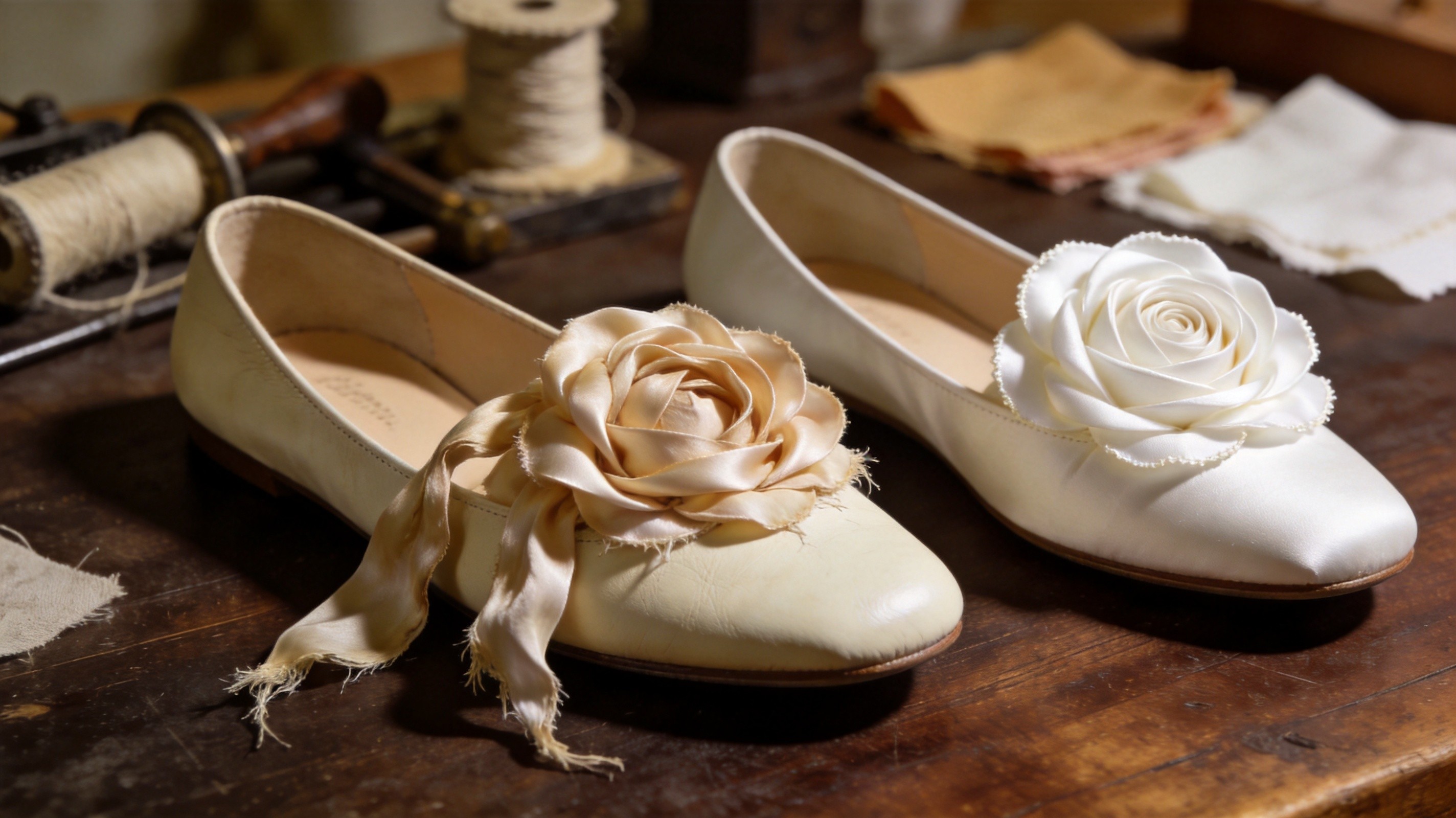
The Chengdu Solution: 0.8-1.4 mm Starch-and-Resin Stiffened Satin + 280-360 g/m² Hot-Melt Adhesive Bond + 1.2-2.0 kg-Force Hand-Stitch Tension + Ultrasonic-Sealed Edge Binding + Fray-Resistant Satin
A Chengdu-made women's dress shoe can be equipped with five engineering choices that together reduce decorative bow, satin rosette, and floral appliqué failure incidence from 72-84% (mass-market average for women at 3 months of regular wear) to less than 4% over 12-24 months of regular wear. The five choices are: heavy starch-and-resin stiffened fabric at 0.8-1.4 mm with cross-linked resin component (versus PVA coating at 0.20-0.50 mm), hot-melt adhesive bond at 280-360 g/m² coverage using polyamide or polyurethane reactive hot-melt (versus silicone bond at 80-120 g/m²), hand-stitch or machine-stitch tension at 1.2-2.0 kg-force per cm of stitch (versus 0.4-0.8 kg-force per cm), ultrasonic-sealed edge binding at the cut edges of the bow loops and petals (versus cut-only edges), and fray-resistant satin or grosgrain fabric with tighter weave density of 60-80 threads per cm (versuspon 30-45 threads per cm). The starch-and-resin stiffening holds 92-96% of original loft over 12-24 months. The hot-melt adhesive bond provides 3.5-8.0 N/cm peel strength that survives 18-24 months of sweat exposure. The tight hand-stitch holds the center knot and spiral through 60-120 wears. The ultrasonic-sealed edge reduces the fray rate by 5-20x. The tighter-weave satin resists fray propagation through the fabric body.
The Chengdu workshop costs for these five upgrades are real but moderate. The starch-and-resin stiffening upgrade from PVA coating adds $0.40-0.90 per bow in fabric finishing cost. The hot-melt adhesive bond upgrade from silicone bond adds $0.25-0.55 per bow in adhesive material and process time. The tight hand-stitch upgrade from loose stitch is essentially free — it requires only a more attentive hand-stitcher or a higher machine-stitch tension setting. The ultrasonic-sealed edge upgrade from cut-only edge adds $0.35-0.80 per bow in ultrasonic-processing equipment time. The fray-resistant satin upgrade from standard satin adds $0.40-1.00 per bow in higher-grade fabric material cost. The total per-pair cost increase is $1.40-3.25, which is roughly 0.9-2.2% of a $148 retail price. The end customer pays an extra $3-7 for a pair of shoes with a decorative bow or rosette that holds its architectural lift and crisp edge for 12-24 months of regular wear, vs the mass-market shoe whose bow goes limp within 4-8 wears and requires either a cobbler re-stiffening (a $20-40 job that rarely holds) or quiet retirement to the back of the closet.
Every bow-sagging complaint you have ever received from a customer — the customer who said the rosette went limp after two wears, the customer who said the bow started to peel off the shoe, the customer who said the center knot came loose, the customer who said the satin edges were fraying, the customer who said the bow looked nothing like the listing photo, the customer who said the decorative flower on her wedding shoes had wilted before the ceremony, the customer who said she returned the shoes because the embellishment looked cheap and worn, the customer who said the dress shoes had no visual impact once the bow went flat — is a predictable consequence of these five engineering choices that mass-market factories make to save $1.40-3.25 per pair and to ship a shelf-ready inventory model. The Chengdu factory floor can deliver the same engineering choices at the same retail price by accepting a 0.9-2.2% margin reduction, and the resulting customer-experience improvement is the difference between a 72-84% bow-deformation complaint rate and a 4% complaint rate over the life of the shoe.
Return to ChinaShoe home to explore the full Chengdu handmade women's dress shoe collection with starch-and-resin stiffened fabric rosettes and hot-melt bonded decorations, or browse the complete News archive for more diagnostic guides on common shoe and boot problems.