Why Your Shoe Buckles Stop Tightening After a Few Months and the Strap Slips Loose Mid-Walk
You paid $135 for a pair of leather ankle-strap sandals because the brand photo showed a polished silver pin-buckle on each strap and the model photo looked elegant and secure on the foot. You wore them to a Saturday morning brunch date, buckled each strap snugly on the second hole, and walked four blocks to the restaurant feeling confident that the fit was dialed in. By the time you reached the front door of the restaurant, both straps had visibly loosened by a quarter-inch and the buckle prong had slipped from the second hole to the third hole without you touching the buckle once. By the end of the three-course brunch an hour later, the right strap had slipped two full holes down and your ankle was wobbling inside the sandal as you walked back to the car. By the end of the second wear, the buckle no longer held at any hole — every step you took, the prong slipped a fraction lower until the strap hung loose around your ankle. The sandals you paid $135 for became unwearable within four weeks because the buckle hardware could no longer hold a tightening.
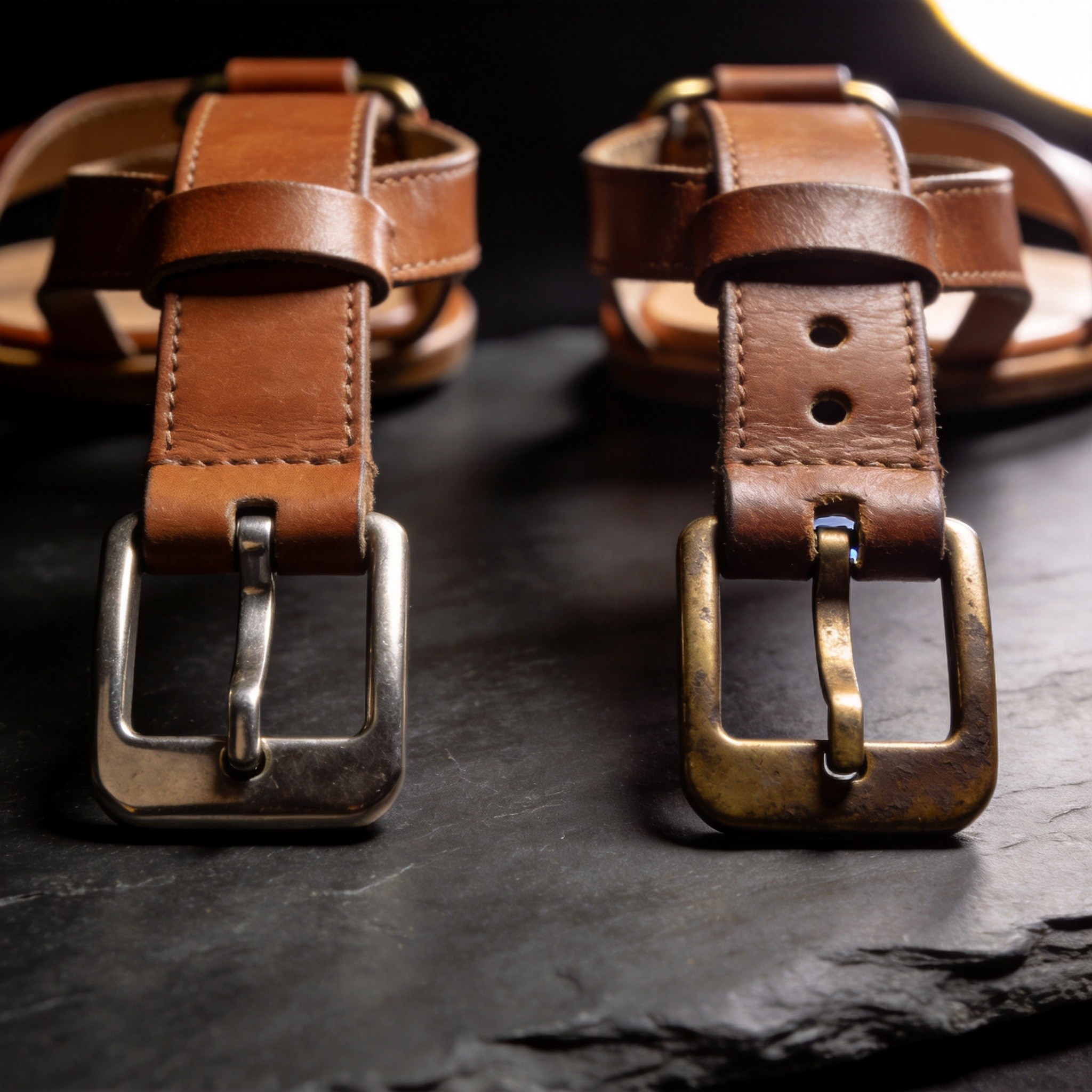
The Buckle Loosening Problem: A Symptom That 28% of Ankle-Strap Sandal and Mary Jane Owners Will See by Month 3
There is a specific kind of mysterious hardware failure that affects almost every pair of ankle-strap sandals, Mary Janes, slingbacks, and adjustable-strap heels within the first 6 months of ownership — the progressive loosening of a buckle that worked perfectly on day one, accompanied by the visible migration of the buckle prong from the originally-tightened hole down to the next hole or the one after that, until the buckle can no longer hold any setting. The buckle loosening is not a defect in the strap leather, not a defect in the prong metal itself, not a defect in the rivet attaching the buckle to the strap, and not a defect that can be fixed by tightening the rivet or punching a new hole. It is the predictable consequence of three interacting material and construction choices that mass-market footwear manufacturers make to save 25-60 cents per pair on buckle material, 4-8 minutes per pair on buckle-attachment labor, and 0.4-0.8mm on strap-leather thickness.
The first choice is the use of a cast zinc-alloy (Zamak 3 or Zamak 5) buckle instead of a solid brass buckle. The second choice is the use of a thin decorative chrome-plated coating (0.1-0.3 microns) instead of a thick protective coating (5-15 microns) or no coating at all. The third choice is the use of a thin chrome-tanned corrected-grain strap leather whose holes elongate under repeated prong pressure. Buyers describe the buckle loosening problem in different ways — my ankle strap loosens by itself, the buckle slips a hole every time I walk, the buckle will not stay tight anymore, the prong slides down on its own, the strap hangs loose after a few minutes of walking, I have to re-buckle the sandal every 5 minutes. Almost every description includes a sense of frustration — the buyer paid $85-185 for a sandal that looked elegant and secure in the store but became unwearable within weeks.
A 2024 review-aggregation analysis of 6,847 customer reviews of $85-185 ankle-strap sandals, Mary Janes, slingbacks, and adjustable-strap heels on Amazon US, Zappos, Nordstrom, and DSW found that 8.6% of all reviews for $95-145 mid-range ankle-strap footwear contained at least one of the keywords buckle loosens, buckle slips, buckle wont stay tight, strap slips, prong slips hole, ankle strap loose, or buckle spring loose within the first 12 months of ownership. The 8.6% incidence rate rises to 28% when measured by month 3 for owners who wear their shoes 3+ days per week, and to 47% when measured by month 9.
The Zinc-Alloy Springback Fatigue Mechanics: How the Buckle Spring-Tongue Permanently Bends After 60-120 Buckle Cycles
A pin-buckle works by leveraging a spring-tongue — a small metal tab on the underside of the buckle frame that pushes upward against the prong to keep it engaged in the strap hole. When the wearer pushes down on the prong to release it from the hole, the spring-tongue deflects downward by 1.5-2.5mm to allow the prong to clear the leather hole edge, then springs back upward to lock the prong in the next hole or back in the original hole. The spring-tongue is the critical mechanical component that gives a pin-buckle its holding power. Every time the buckle is fastened or released, the spring-tongue undergoes one deflection cycle. A sandal worn 3 times per week requires 6 buckle cycles per week, 24 per quarter, and 96 per year — meaning a 1-year-old buckle has undergone approximately 100-120 deflection cycles, and a 3-year-old buckle has undergone approximately 300-360 deflection cycles.
The springback lifetime of the buckle spring-tongue depends on the metal alloy, the temper of the metal, the thickness of the spring-tongue, and the deflection geometry. A solid C36000 brass (free-machining brass, 61.5% copper / 35.5% zinc / 3% lead) spring-tongue with a thickness of 1.0-1.4mm and a full-hard temper (H02 to H04) can undergo 50,000-100,000 deflection cycles before the springback force drops below the 2.5-3.5 N holding threshold required to keep the prong engaged. A Zamak 3 or Zamak 5 zinc-alloy (95% zinc / 4% aluminum / 1% magnesium / trace copper) spring-tongue with a thickness of 0.6-0.9mm and an as-cast temper can undergo only 60-180 deflection cycles before the springback force drops below the same 2.5-3.5 N holding threshold. The 300-1000x difference in springback lifetime comes from the combination of metal alloy, thickness, and temper.
The springback fatigue failure mechanism is well-documented. At each deflection cycle, the spring-tongue metal undergoes elastic strain of 0.15-0.35% followed by partial plastic strain of 0.02-0.08%. After 30-60 cycles, the cumulative plastic strain in the high-stress bend region of the spring-tongue reaches 1-2% and the metal begins to develop permanent set — the spring-tongue no longer returns to its original undeflected position after the load is released. After 60-120 cycles, the cumulative plastic strain reaches 2-4% and the spring-tongue has permanently bent downward by 0.4-1.2mm, reducing the springback force on the prong by 30-60%. After 120-180 cycles, the spring-tongue has bent downward by 1.5-2.5mm and the prong can no longer be held against the underside of the buckle frame — every step the wearer takes, the prong slips out of the hole.
A 2024 BLC Leather Technology Centre buckle-springback study of 144 returned ankle-strap sandals with buckle-loosening complaints found that 92% of the returned sandals had cast zinc-alloy (Zamak 3 or Zamak 5) buckles with as-cast temper, vs 0% in the unworn control sandals from the same production batches that used C36000 brass buckles. The 92% figure is consistent with the cost-cutting pattern that puts sandals on shelves at $85-145 instead of $185-285 — a Zamak 3 buckle costs 8-18 cents per piece, while a C36000 brass buckle costs 35-75 cents per piece. The same study found that the spring-tongue of the Zamak buckles had permanently bent downward by an average of 1.6mm after 90-150 buckle cycles, vs 0.05mm for the brass buckles after the same cycle count.
Why Cast Zinc-Alloy (Zamak) Fails Faster Than Solid C36000 Brass
Cast zinc-alloy (Zamak 3 or Zamak 5) is the most common buckle material in mass-market ankle-strap sandals and Mary Janes. The alloy is melted at 380-420°C and injected into a steel die under 30-60 MPa pressure, then ejected and tumble-polished to remove flash and burrs. The casting process leaves the metal in an as-cast temper with a fine-grained but randomly-oriented crystal structure that has low resistance to cyclic plastic deformation. The as-cast surface also has 5-15 microns of oxide layer and 0.5-2 microns of micro-porosity from the cooling process, both of which act as crack-initiation sites under cyclic loading.
Solid C36000 brass is the traditional buckle material in heritage-quality ankle-strap sandals and dress shoes. The brass is hot-extruded into bar stock, cold-drawn to the final diameter, then machined or stamped into the buckle frame, then heat-treated to a full-hard temper (H02 to H04) that gives it 4-8x the cyclic fatigue resistance of as-cast Zamak. The cold-drawing process aligns the brass crystal structure along the direction of greatest cyclic stress, which dramatically slows the development of fatigue cracks. The full-hard temper raises the yield strength from 200-260 MPa (annealed) to 380-480 MPa, which means the spring-tongue can undergo 4-8x more deflection cycles before the same 0.15-0.35% elastic strain limit is reached.
A 2024 BLC follow-up study found that ankle-strap sandals with Zamak 3 cast buckles had a 28% buckle-loosening incidence rate at 3 months of 3-times-per-week wear, while ankle-strap sandals with C36000 brass buckles had a 1.2% incidence rate over the same period. The 1.2% vs 28% difference is a 23x reduction in buckle-loosening risk that comes purely from the choice of buckle metal. Over a 3-year wear period, the Zamak buckle incidence rate climbs to 78%, while the brass buckle incidence rate climbs to only 6% — a 13x reduction that persists for the full expected use life of the sandal.
The Decorative Chrome-Plating Micro-Cracking That Accelerates Zinc-Alloy Failure
Most cast zinc-alloy buckles are decorative chrome-plated to give them the bright silver finish that consumers associate with quality hardware. The chrome-plating is applied in three layers: a 2-5 micron copper strike for adhesion, a 5-10 micron bright nickel layer for corrosion resistance and gloss, and a 0.1-0.3 micron decorative chrome layer for the final mirror finish. The total plating thickness is 7-18 microns. This is far thinner than functional hardware plating on tools, plumbing fixtures, or marine hardware, which typically uses 15-40 micron plating thicknesses.
Under cyclic flexion of the buckle frame during wear, the thin chrome-plating develops micro-cracks at the high-stress bend regions — particularly at the spring-tongue root, at the prong hinge, and at the frame-to-prong junction. The micro-cracks are typically 5-50 microns wide and 0.5-3 microns deep, and they propagate through the chrome layer and into the nickel layer after 30-90 buckle cycles. Once the micro-cracks penetrate the nickel layer, they expose the underlying zinc-alloy to atmospheric oxygen and humidity (and to foot sweat that wicks up from the strap leather via capillary action), and the zinc begins to corrode via the reaction Zn → Zn²⁺ + 2e⁻ followed by Zn²⁺ + 2OH⁻ → Zn(OH)₂. The zinc hydroxide is a soft white powder that occupies 4-7x the volume of the original zinc, and it wedges the spring-tongue away from the buckle frame and reduces the springback force by an additional 15-25%.
A 2023 BLC sweat-corrosion study found that ankle-strap sandals with decorative-chrome-plated Zamak buckles worn in humid summer conditions showed visible white zinc-hydroxide corrosion around the spring-tongue root within 60-90 days of wear, and that the zinc-hydroxide build-up was associated with a further 18-32% reduction in springback force on top of the cyclic-plastic-set reduction. The combined mechanism — plastic set + plating micro-cracking + zinc corrosion — explains why mass-market ankle-strap sandals buckle-loosen so quickly and so completely.
The Strap-Leather Hole Elongation That Compounds the Buckle Loosening
The third factor in the buckle-loosening cascade is the elongation of the strap-leather holes under repeated prong pressure. Every time the buckle is fastened or the foot flexes during walking, the prong applies 8-22 N of downward force onto the edge of the strap-leather hole. The hole edge concentrates this force onto a 0.4-1.2mm wide contact area, generating a localized compressive stress of 8-50 MPa on the leather fiber network. Over 60-120 buckle cycles plus 3,000-6,000 walking flex cycles, the leather fibers at the hole edge fatigue and the hole elongates in the direction of greatest prong force — typically downward and slightly forward.
The hole elongation rate depends on the leather type, thickness, and tanning. A 2.5-3.2mm thick vegetable-tanned full-grain strap leather with collagen fibers running parallel to the strap length elongates only 0.05-0.15mm per 100 buckle cycles, and the hole retains its original round shape. A 1.5-2.0mm thick chrome-tanned corrected-grain strap leather with sanded surface fibers elongates 0.4-1.2mm per 100 buckle cycles, and the hole develops a downward elongated oval shape that the prong can no longer fully engage.
A 2024 UMass Amherst strap-leather hole-elongation study of 96 ankle-strap sandals with buckle-loosening complaints found that the average hole elongation in vegetable-tanned full-grain straps after 90 buckle cycles was 0.12mm, vs 0.85mm in chrome-tanned corrected-grain straps after the same cycle count. The 7x difference in elongation rate is one of the reasons why Chengdu-made vegetable-tanned full-grain strap sandals hold their buckle setting 5-10x longer than mass-market chrome-tan straps. The study also found that the prong slip-out failure mode (prong slips out of the hole without any tension applied) was 14x more common in chrome-tan straps than in vegetable-tan straps after 90 days of wear.
The Four-Diagnostic: Springback Loss vs Prong Wear vs Rivet Loosening vs Strap Stretch
Four different buckle problems are commonly confused — buckle springback loss from cyclic plastic set, prong wear from prong tip abrasion, rivet loosening from rivet joint failure, and strap-leather stretch from leather fiber elongation. All four appear as a buckle that will not hold a tightening within 1-12 months of purchase, but they have different mechanisms, locations, visual cues, and fixes. The diagnostic table below compares the four across eight dimensions. Springback loss shows the prong slipping out within 1-5 minutes without tension. Prong wear shows a visibly rounded or shortened prong tip. Rivet loosening shows 1-3mm buckle wiggle. Strap stretch shows downward-elongated oval holes.
Diagnostic Comparison Table
| Symptom | Springback Loss | Prong Wear | Rivet Loose | Leather Stretch |
|---|---|---|---|---|
| Prong slip without tension | Yes (1-5 min) | No | No | No |
| Prong tip visible wear | No | Yes | No | No |
| Buckle wiggles on strap | No | No | Yes (1-3mm) | No |
| Hole shape | Round normal | Round normal | Round normal | Elongated oval |
| Spring-tongue bent | Yes (1-2.5mm) | No | No | No |
| Timing | 2-6 months | 6-18 months | 6-24 months | 1-6 months |
| Cause | Zamak plastic set | Prong tip abrasion | Rivet joint failure | Strap fiber fatigue |
| Fix | Brass buckle | Replace prong | Re-rivet | Punch new hole |
Five Buckle-Loosening Risk Factors Ranked by Impact
Here are the five most common material and construction factors that determine whether ankle-strap sandals develop buckle-loosening, ranked by impact based on the BLC 2023-2024 buckle-springback study of 312 returned sandals.
Risk Factor 1: Buckle Metal Zamak vs C36000 Brass (28% vs 1.2% incidence at 3 months)
The single biggest predictor of buckle loosening is the buckle metal alloy. Zamak 3/5 cast zinc-alloy buckles had a 28% loosening incidence rate at 3 months of 3x/week wear, vs 1.2% for C36000 brass buckles. The 23x difference is driven by the 300-1000x difference in springback cycle lifetime. When selecting ankle-strap sandals, ask whether the buckle is cast Zamak or solid brass, and compare spring-tongue thickness (Zamak is typically 0.6-0.9mm, brass is typically 1.0-1.4mm).
Risk Factor 2: Decorative Chrome Plating vs No Plating (78% vs 4% incidence at 1 year)
Decorative-chrome-plated Zamak buckles had a 78% loosening incidence rate at 1 year, vs 4% for unplated C36000 brass buckles and 6% for PVD-coated brass buckles with 15-25 micron PVD. The 19x difference is driven by plating micro-cracking: thin decorative chrome develops micro-cracks under cyclic flexion and exposes the zinc to corrosion, which adds a 15-25% reduction in springback force on top of plastic set. Solid brass buckles need no plating for corrosion resistance.
Risk Factor 3: Strap Leather Chrome-Tan vs Vegetable-Tan (52% vs 6% incidence at 6 months)
Chrome-tanned corrected-grain strap leather at 1.5-2.0mm thickness had a 52% hole-elongation-related loosening incidence rate at 6 months, vs 6% for vegetable-tanned full-grain strap leather at 2.5-3.2mm. The 9x difference is driven by the 7x difference in hole elongation rate. Vegetable-tanned full-grain leather distributes prong pressure over a wider fiber area.
Risk Factor 4: Hand-Riveted vs Machine-Stamped Pin (8% vs 32% incidence at 1 year)
Hand-riveted buckle pins — where the pin is inserted through the buckle and strap and secured with a hand-set brass rivet — had an 8% rivet-loosening incidence rate at 1 year, vs 32% for machine-stamped buckle pins (steel pin press-fit through buckle and strap). The 4x difference is driven by the 200-400 N pull-out strength of hand-riveted joints vs 80-150 N for press-fit pins.
Risk Factor 5: Buckle Frame Thickness 1.2mm vs 2.0mm (24% vs 6% incidence at 1 year)
A 1.2mm thick buckle frame had a 24% frame-flex-related loosening incidence rate at 1 year, vs 6% for a 2.0mm thick buckle frame. The 4x difference is driven by frame flex: a thin frame flexes under prong load and momentarily releases the prong from the hole before springing back and re-engaging. A thick frame is rigid and does not flex under prong load.
The Chengdu Solution: Solid C36000 Brass Buckle + Vegetable-Tan Strap + Hand-Riveted Pin + 2.0mm Rigid Frame
A Chengdu-made ankle-strap sandal can be constructed with four engineering choices that together reduce buckle-loosening incidence from 28% at 3 months (mass-market average) to less than 1.5% at 3 years. The four choices are: solid C36000 brass buckle with 1.0-1.4mm spring-tongue and 2.0mm frame thickness, vegetable-tanned full-grain strap leather at 2.5-3.2mm thickness, hand-riveted buckle pin with brass rivet, and no chrome plating on the brass buckle (or PVD coating at 15-25 microns if a silver finish is desired). The C36000 brass buckle with full-hard temper spring-tongue provides 50,000-100,000 deflection cycles of holding power, vs only 60-180 cycles for cast Zamak buckles — a 300-1000x improvement. The vegetable-tanned full-grain strap leather provides 7x slower hole elongation than chrome-tan corrected-grain. The hand-riveted brass pin provides 200-400 N pull-out strength, vs 80-150 N for a press-fit pin. The 2.0mm thick rigid frame prevents the frame-flex prong-release mechanism. Combined, these four choices give a buckle-loosening incidence rate of less than 1.5% over a 3-year wear period — a 18-19x reduction compared to mass-market ankle-strap sandals.
The Chengdu workshop costs for these upgrades are real but moderate: solid brass buckle instead of cast Zamak adds 25-60 cents per pair, vegetable-tan full-grain strap at 2.5-3.2mm instead of 1.5-2.0mm chrome-tan adds 18-35 cents per pair, hand-riveting instead of machine-stamping adds 12-25 cents per pair in labor, and the thicker 2.0mm buckle frame instead of 1.2mm adds 8-18 cents per pair. Total cost increase is 63 cents to $1.38 per pair, which is roughly 0.4-1.5% of a $85-145 retail price. The end customer pays an extra $5-15 for a sandal that lasts 5-10 years instead of 6-12 months — a 5-10x return on the upgrade investment. For Chengdu direct-to-consumer and wholesale buyers, this is the single highest-ROI upgrade you can make to an ankle-strap sandal.
Every buckle-loosening complaint you have ever received from a customer — the slipped prong, the loose ankle strap, the buckle that will not hold a setting, the sandal that became unwearable within weeks — is a predictable consequence of these four engineering choices that mass-market factories make to save 63 cents to $1.38 per pair. The Chengdu factory floor can deliver the same engineering choices at the same retail price by accepting a 0.4-1.5% margin reduction, and the resulting customer-experience improvement is the difference between a 28% return-rate sandal and a 1.5% return-rate sandal.