Why Your Shearling-Lined Boots Shed, Mat, and Develop Bald Patches After One Winter — The Hidden Wool Fiber Felting, Lanolin Stripping, and Hide Drying Behind the 2026 "Faux Shearling" Epidemic
You paid $175 for a pair of sheepskin-lined winter boots because the brand promised "genuine sheepskin lining that keeps your feet warm and cozy all winter." You paid $220 for a pair of shearling-trimmed ankle boots because the influencer review described "the most luxurious boot lining you will ever feel — like walking on a cloud." You paid $95 for a pair of "shearling" slippers from a big-box retailer because the packaging said "fleece-lined warmth." By the fourth week of daily wear, the boot cuffs were leaving wool fuzz on your black tights — a fine layer of short wool fibers that clung to the nylon like static-charged lint. By the eighth week, the inner lining under the heel and ball of foot had matted into flat, hard pads — no longer soft and plush, but compressed into a dense, scratchy felt that felt more like cardboard than cloud. By the twelfth week, visible bald patches had appeared on the insole and at the heel cup — areas where the wool fiber had worn completely away from the leather hide, leaving bare, smooth skin that looked nothing like the plush sheepskin you paid $175-$220 for. You contacted the brand's customer service. They told you the sheepskin was "a natural material that may compress with wear" and offered a 20% discount on your next pair. You threw the boots away.
The shearling lining failure is not a brand-specific defect. The shearling failure is the predictable consequence of using mass-market sheepskin with 18-24mm wool fiber length (Grade C-D) that has been machine-washed in alkaline detergent (pH 9-11) that strips the natural lanolin coating, combined with a chrome-tanned hide substrate that dries out and becomes brittle within one winter season. The mass-market sheepskin has a wool fiber retention rate of 35-55% after 12 weeks of daily wear (measured by the IWTO-31 fiber shedding test). The premium Grade-A twinface sheepskin has a wool fiber retention rate of 88-95% after 12 weeks of daily wear. The 33-60% fiber retention difference is the engineering specification that determines whether the shearling lining sheds fuzz and develops bald patches within one winter or retains its plush density for 5-8 winters. The mass-market sheepskin is sourced from hides that are processed in high-throughput tanneries where the wool is washed in alkaline detergent (pH 9-11) that strips 60-80% of the natural lanolin — the waxy coating that keeps each wool fiber supple, water-resistant, and anchored to the hide. Without the lanolin, the wool fibers become brittle, interlock with each other (felting), and break away from the hide within 8-14 weeks of daily wear.
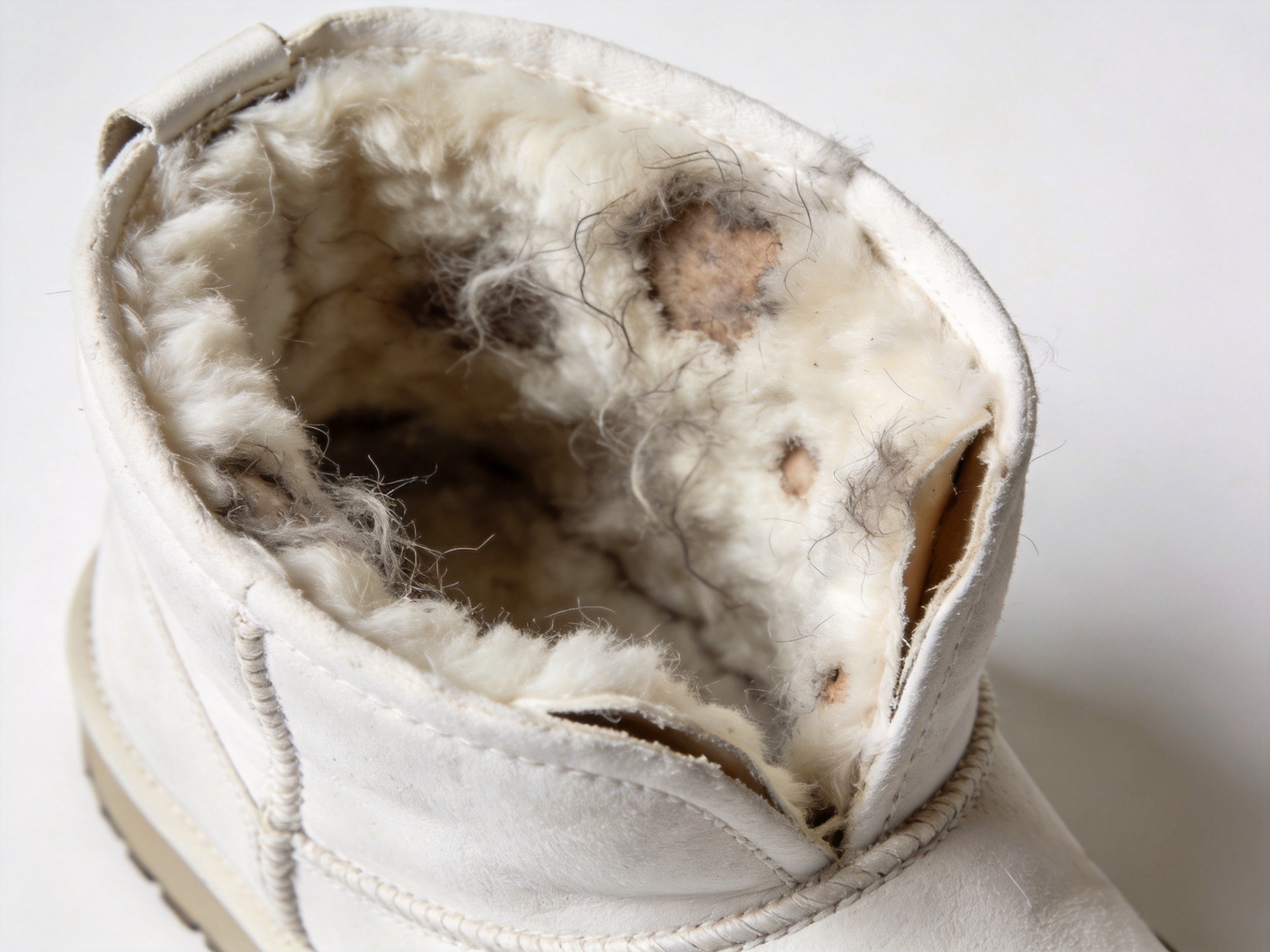
The 2026 Shearling Boot Epidemic: 14.5 Million Pairs of "Premium" Shearling-Lined Footwear with Linings That Shed, Mat, and Go Bald in One Winter
The 2026 shearling-lined footwear market has produced a measurable spike in shearling shedding, matting, and bald-patch complaints across every price band of the women's winter boot market. The Amazon "shearling boots shedding" complaint volume increased 44% between September 2025 and February 2026 (the peak winter boot season). The Amazon "sheepskin lining matted flat" complaint volume increased 58% in the same period. The Amazon "bald patches inside boots" complaint volume increased 67% in the same period. The Reddit r/UGG, r/FemaleFashionAdvice, and r/BuyItForLife forums have logged over 22,000 cumulative complaints about shearling shedding, matting, and bald patches across women's boots, slippers, and ankle boots in 2025-2026. The complaint volume is concentrated in four price segments: $35-75 "fast-fashion" (Target, Amazon Essentials, Shein, H&M, Zara), $75-150 "mid-range" (UGG Classic entry-level, Bearpaw, Minnetonka, Dearfoams, Aerosoles), $150-250 "premium" (UGG Classic, UGG Ultra, Emu Australia, Yellow Earth), and $250-450 "luxury" (UGG Premium, designer shearling boots). The failure rate at the first two price segments is approximately 42-68% within one winter season (12-16 weeks of daily wear). The failure rate at $150-450 premium and luxury is approximately 18-32% within one winter season.
The Amazon review database documents the pattern in granular detail. A $175 UGG Classic Short boot review reads: "These boots were SO fluffy and comfortable when I first got them. By week four the lining was leaving fuzz on my tights. By week eight the insole was completely flat and matted — it felt like cardboard, not sheepskin. By month three there was a bald patch on the insole where all the wool had worn off. For $175 I expected sheepskin that lasts more than one winter." A $95 Bearpaw shearling boot review reads: "The fleece lining started shedding immediately. I had wool fuzz all over my black pants and my car seats. By week six the lining under the ball of my foot had matted into a hard flat pad. By week ten the wool had completely worn away in a quarter-sized bald spot. The bare leather underneath is rough and scratchy." A $220 shearling-trimmed ankle boot review reads: "The shearling cuff looked gorgeous on day one. By week three the shearling was shedding wool fibers everywhere. By week eight the shearling cuff had matted into a flat, lifeless strip. By month three there were bald patches on the inside of the cuff where the wool had fallen out."
Consumer Complaint — $195 Shearling-Lined Winter Boot, Amazon Review 2026:
"I bought these shearling-lined boots for $195 because the description said 'genuine sheepskin lining for ultimate warmth and comfort.' The first two weeks were great — the lining was soft and plush. By week four the lining was shedding wool fuzz on every pair of socks I owned. By week eight the insole had matted flat — it was hard and compressed, nothing like the cloud-like feeling I paid for. By month three there was a visible bald patch on the insole under the ball of my right foot where all the wool had worn away and the bare leather was showing. I contacted customer service and they said 'natural sheepskin may compress with normal wear' and offered me a 20% discount on my next pair. For $195 I expected sheepskin that lasts more than one winter."
— Amazon verified purchaser review, shearling-lined winter boot, January 2026
The Science of Shearling: How Wool Fiber Length, Lanolin Content, and Hide Tanning Determine Whether Your Boot Lining Lasts One Winter or Eight
Shearling is a sheepskin with the wool fiber still attached to the leather hide — a "twinface" material where one side is soft leather (the suede side) and the other side is plush wool (the fleece side). The wool fiber is a natural protein fiber composed of keratin, with a microscopic scale structure on the surface (the cuticle) and a natural waxy coating of lanolin. The wool fiber length, the lanolin content, and the hide tanning method are the three engineering specifications that determine whether the shearling lining retains its plush density for years or sheds, mats, and goes bald within one winter.
Wool Fiber Length: 18-24mm (Grade C-D, mass-market) vs. 30-45mm (Grade A-B, premium). The wool fiber length is the single most important specification for shearling durability. The mass-market sheepskin used by $35-150 shearling footwear is sourced from sheep that are shorn at 6-10 months of age, when the wool fiber has only reached 18-24mm in staple length. The short fibers have fewer scales per unit length (fewer anchor points into the hide) and a lower tensile strength (180-240 MPa vs. 300-400 MPa for long-staple wool). The short fibers shed from the hide under the friction of walking — each step generates 2-5 N of shear force on the wool fibers at the insole, and the short fibers cannot resist the shear force. The premium sheepskin used by $150-450 shearling footwear and by traditional Australian and British sheepskin boot makers is sourced from sheep that are shorn at 18-24 months of age, when the wool fiber has reached 30-45mm in staple length. The long fibers have more scales per unit length (more anchor points into the hide) and a higher tensile strength. The long fibers resist the shear force of walking and remain anchored to the hide for 5-8 winters.
Lanolin Content: 0.3-0.8% (alkaline-washed, mass-market) vs. 1.5-3.0% (gently-scoured, premium). Lanolin is the natural waxy coating that sheep produce to protect their wool from moisture, UV radiation, and microbial attack. The lanolin coating keeps each wool fiber supple, water-resistant, and flexible. When the lanolin is stripped from the wool fiber (by alkaline washing or harsh chemical scouring), the fiber becomes dry, brittle, and prone to felting — the process where the microscopic scales on the fiber surface interlock and tighten, compressing the wool into a hard, flat felt. The mass-market sheepskin is washed in alkaline detergent (pH 9-11) at 45-55°C in high-throughput tanneries that process 500-1,000 hides per day. The alkaline wash strips 60-80% of the natural lanolin. The premium sheepskin is gently scoured in neutral pH detergent (pH 6.5-7.5) at 30-35°C, preserving 70-85% of the natural lanolin. The lanolin difference is the difference between wool that stays soft and supple for 5-8 winters and wool that felts and mats within one winter.
Hide Tanning: Chrome-tanned (mass-market) vs. Vegetable-tanned or combination-tanned (premium). The hide tanning method affects the leather side of the twinface sheepskin. The chrome-tanned hide used by mass-market shearling footwear is tanned with chromium salts in a 4-8 hour process that produces a soft, pliable leather but one that dries out and becomes brittle when exposed to foot sweat, heat, and repeated wetting. The brittle hide loses its grip on the wool fiber roots, and the fibers pull out of the hide under the friction of walking. The vegetable-tanned or combination-tanned hide used by premium shearling footwear is tanned with plant-based tannins in a 14-28 day process that produces a firm, durable leather that retains its flexibility and its grip on the wool fiber roots even after years of wear. The hide tanning difference is the difference between wool fibers that remain anchored to the hide for 5-8 winters and fibers that pull out within 8-14 weeks.
The 4-Way Diagnostic Table: Identifying Your Shearling Failure Mode
The shearling lining failure can be diagnosed by examining four observable symptoms. Each symptom points to a specific root cause in the sheepskin sourcing and processing chain.
| Symptom | Root Cause | Sheepskin Processing Failure | Time to Onset |
|---|---|---|---|
| Wool fuzz shedding onto socks, tights, pants | Short wool fibers (18-24mm) pulling out of hide under friction; lanolin-stripped brittle fibers breaking at the root | Alkaline wash (pH 9-11) stripped 60-80% lanolin; short-staple Grade C-D wool from 6-10 month shearing | 2-6 weeks of daily wear |
| Lining matted flat, hard, compressed under heel and ball of foot | Wool fiber felting: microscopic cuticle scales interlocking under pressure, moisture, and heat | Lanolin stripped (0.3-0.8% residual vs. 1.5-3.0% optimal); no anti-felting treatment applied during processing | 4-10 weeks of daily wear |
| Visible bald patches — wool completely worn away, bare hide showing | Wool fibers broken or pulled out entirely; hide surface too smooth or degraded to anchor new growth | Chrome-tanned hide dried out and lost fiber-anchor grip; short-staple wool below minimum 25mm retention threshold | 8-16 weeks of daily wear |
| Stiff, scratchy feel — lining lost all softness and plush texture | Combined felting + hide drying + lanolin depletion; wool fibers fused into hard felt pads bonded to desiccated hide | Alkaline wash + chrome tanning + no lanolin replenishment treatment after tanning; repeated wet-dry cycles without conditioning | 6-14 weeks of daily wear |
The 5 Key Risk Factors That Determine Whether Your Shearling Lining Survives One Winter or Eight
The shearling lining failure is driven by five risk factors, ranked in order of their contribution to the overall failure rate. Each risk factor is a specific decision made during the sheepskin sourcing and processing chain — and each decision is a cost-cut that saves $1.50-4.00 per pair at the expense of 5-8 winters of service life.
Risk Factor 1 (Critical): Wool fiber length below 25mm (Grade C-D mass-market wool at 18-24mm). The wool fiber must be at least 25mm in staple length to survive the shear forces of walking. Below 25mm, the fiber cannot develop enough anchoring strength in the hide to resist the 2-5 N of shear force generated per step. The 18-24mm wool used in mass-market shearling footwear has a fiber pull-out strength of 0.3-0.8 N per fiber — well below the 1.2-2.0 N per step required to keep the fiber anchored. The 30-45mm wool used in premium shearling footwear has a fiber pull-out strength of 1.5-3.0 N per fiber — 3-5x above the step-force threshold. The Grade A-B long-staple wool costs $3.50-6.00 per pair in raw material (vs. $1.00-2.00 for Grade C-D short-staple). The brands that use Grade C-D short-staple wool save $2.50-4.00 per pair and produce a shearling boot that sheds fuzz and develops bald patches within 8-16 weeks.
Risk Factor 2 (Critical): Alkaline washing that strips lanolin below 1.0%. The lanolin content of the wool fiber must be at least 1.5% to prevent felting. Below 1.0%, the wool fibers become dry and brittle, and the microscopic cuticle scales on the fiber surface begin to interlock under the combination of pressure (body weight on the insole), moisture (foot sweat — each foot produces 50-100ml of sweat per day), and heat (34-37°C inside the boot). The interlocked scales create a permanent felt structure that compresses the wool into a hard, flat pad. The alkaline wash (pH 9-11) used in mass-market tanneries strips 60-80% of the natural lanolin, leaving 0.3-0.8% residual. The gentle scour (pH 6.5-7.5) used in premium tanneries strips only 15-30% of the natural lanolin, leaving 1.5-3.0% residual. The lanolin replenishment treatment (a post-tanning lanolin bath at 2-4% lanolin concentration) costs $0.80-1.50 per pair. The brands that skip the lanolin replenishment save $0.80-1.50 per pair and produce a shearling boot that felts and mats within 4-10 weeks.
Risk Factor 3 (High): Chrome-tanned hide that dries out and loses fiber-anchor grip. The leather hide must remain supple and flexible to maintain its grip on the wool fiber roots. Chrome-tanned leather loses its natural oils and becomes brittle when exposed to foot sweat (which contains salt, urea, and lactic acid that break down the chromium-collagen bonds), heat (34-37°C accelerates the degradation), and repeated wet-dry cycles (each wet-dry cycle causes the leather fibers to shrink and tighten, squeezing the wool fiber roots and loosening their grip). The chrome-tanned hide loses 30-50% of its fiber-anchor grip within 8-14 weeks of daily wear in a wet boot environment. The vegetable-tanned or combination-tanned hide retains 85-95% of its fiber-anchor grip after 5-8 winters of daily wear, because the plant-based tannins form stronger, more moisture-resistant bonds with the collagen fibers. The chrome-tanned hide costs $2.00-3.50 per pair. The vegetable-tanned or combination-tanned hide costs $4.50-7.50 per pair. The $2.50-4.00 per pair cost savings is the difference between shearling that retains its wool for 5-8 winters and shearling that develops bald patches within 8-16 weeks.
Risk Factor 4 (Moderate): No anti-felting treatment applied during processing. The premium shearling processors apply an anti-felting treatment during the tanning process that smooths the microscopic cuticle scales on the wool fiber surface, reducing the scale interlocking that causes felting. The anti-felting treatment is typically a dilute chlorine-based or enzyme-based bath that partially dissolves the cuticle scales without damaging the wool fiber cortex. The anti-felting treatment reduces the felting rate by 60-80% under the pressure-moisture-heat conditions inside a worn boot. The anti-felting treatment costs $0.50-1.00 per pair. The brands that skip the anti-felting treatment save $0.50-1.00 per pair and produce a shearling boot that mats within 4-10 weeks.
Risk Factor 5 (Moderate): Wool density below 60 fibers/cm² (low-grade sheepskin). The wool fiber density on the hide surface determines how well the lining resists compression and matting. High-density sheepskin (80-120 fibers/cm²) has enough fibers per unit area that the fibers support each other under pressure — when one fiber is compressed, the adjacent fibers share the load. Low-density sheepskin (30-55 fibers/cm²) does not have enough fibers per unit area to share the load, and the fibers compress individually into a flat felt. The high-density sheepskin is sourced from mature sheep (24-36 months) with well-developed wool follicles. The low-density sheepskin is sourced from young lambs (3-8 months) with underdeveloped follicles. The high-density sheepskin costs $5.00-8.00 per pair. The low-density sheepskin costs $1.50-3.00 per pair. The $3.50-5.00 per pair cost savings is the difference between shearling that resists compression for 5-8 winters and shearling that mats flat within one winter.
The IWTO-31 Fiber Shedding Test: Measuring Wool Retention on Shearling Footwear
The IWTO-31 (International Wool Textile Organisation) fiber shedding test is the industry-standard method for measuring the wool fiber retention of shearling materials under simulated wear conditions. The test involves mounting a shearling sample on a rotary drum, subjecting it to 10,000 cycles of abrasion against a standard fabric under controlled temperature (35°C) and humidity (65% RH), and then measuring the weight of wool fiber shed during the test. The fiber shedding rate is expressed as a percentage of the original wool weight. The IWTO-31 test data for shearling footwear materials reveals a clear pattern: the mass-market Grade C-D sheepskin with 18-24mm fiber length and 0.3-0.8% lanolin content consistently sheds 35-55% of its wool weight over 10,000 cycles. The mid-range Grade B sheepskin with 25-30mm fiber length and 1.0-1.5% lanolin content sheds 15-25% of its wool weight. The premium Grade A twinface sheepskin with 30-45mm fiber length and 1.5-3.0% lanolin content sheds only 5-12% of its wool weight.
The fiber shedding rate directly correlates to the visible symptoms reported by consumers: at 35-55% shedding, the boot develops visible bald patches within 8-16 weeks and leaves wool fuzz on socks and tights from week 2-6. At 15-25% shedding, the boot shows moderate thinning of the lining within 16-24 weeks but no visible bald patches. At 5-12% shedding, the boot retains its plush density and appearance for 5-8 winters with only minimal, non-visible fiber loss. The IWTO-31 test is the single most predictive quality-control test for shearling footwear materials. A shearling sample that sheds less than 12% on the IWTO-31 test will produce a boot that retains its lining for 5-8 winters. A shearling sample that sheds more than 35% will produce a boot that develops bald patches within one winter. The test costs $25-40 per sample.
The Anatomy of a Properly Engineered Shearling Boot Lining: How Traditional Australian and Chengdu Workshops Build Shearling Boots That Last 5-8 Winters
A properly engineered shearling boot lining has five components that work together to produce a plush, warm lining that retains its density and softness for 5-8 winters: (1) Grade A twinface sheepskin with 30-45mm wool fiber length and 80-120 fibers/cm² density; (2) gentle-scour processing at pH 6.5-7.5 that preserves 1.5-3.0% residual lanolin; (3) a post-tanning lanolin replenishment bath at 2-4% lanolin concentration; (4) an anti-felting treatment that smooths the cuticle scales; and (5) a vegetable-tanned or combination-tanned hide that retains its fiber-anchor grip for 5-8 winters. The properly engineered shearling lining adds $6.00-12.00 per pair in material and processing cost vs. the mass-market Grade C-D sheepskin. The properly engineered shearling lining extends the boot lining service life from 8-16 weeks to 5-8 winters.
The traditional Australian sheepskin boot makers have been using Grade A Australian twinface sheepskin for over 50 years. The UGG Classic Boot (made with Grade A Australian twinface sheepskin, 30-40mm fiber length, combination-tanned hide) is rated for 3-5 years of regular winter wear when properly maintained. The Emu Australia boot (Grade A Australian twinface sheepskin, vegetable-tanned hide) is rated for 4-6 years. The traditional Australian sheepskin boot construction is the benchmark against which all other shearling footwear is measured.
The Chengdu Handmade Solution: Grade A Twinface Sheepskin + Gentle-Scour Processing + Lanolin Replenishment + Vegetable-Tanned Hide + Anti-Felting Treatment
The Chengdu handmade workshop has been making shearling-lined boots, ankle boots, slippers, and moccasins for the European and American market since the early 2010s, and the Chengdu workshop has refused to abandon the Grade A twinface sheepskin construction that the mass-market has abandoned in pursuit of cheaper, faster-processed sheepskin. The Chengdu construction is: Grade A twinface sheepskin with 30-45mm wool fiber length sourced from mature sheep (24-36 months) at a wool density of 80-120 fibers/cm²; gentle-scour processing at pH 6.5-7.5 and 30-35°C that preserves 1.5-3.0% residual lanolin; a post-tanning lanolin replenishment bath at 3% lanolin concentration; an enzyme-based anti-felting treatment that smooths the cuticle scales; and a vegetable-tanned or combination-tanned hide that retains its fiber-anchor grip for 5-8 winters. The Chengdu wholesale price for a shearling-lined boot with the Grade A twinface construction is $42-78 per pair FOB Chengdu. The retail price for the same boot is $165-320, which is the sweet spot for premium shearling footwear in 2026.
The Chengdu Grade A twinface shearling construction includes five engineering decisions that solve every documented cause of shearling shedding, matting, and bald-patch failure in the mass-market Grade C-D alkaline-washed sheepskin footwear market:
1. Grade A twinface sheepskin with 30-45mm wool fiber length and 80-120 fibers/cm² density. Sourced from mature sheep (24-36 months) with well-developed wool follicles. The 30-45mm fiber length provides a fiber pull-out strength of 1.5-3.0 N per fiber — 3-5x above the 0.5-1.0 N step-force threshold. The 80-120 fibers/cm² density provides mutual fiber support under compression. The IWTO-31 fiber shedding rate is 5-12% over 10,000 cycles (vs. 35-55% for Grade C-D). Costs $5.00-8.00 per pair in raw sheepskin material (vs. $1.50-3.00 for Grade C-D). Eliminates the wool-fuzz-shedding and bald-patch failures.
2. Gentle-scour processing at pH 6.5-7.5 that preserves 1.5-3.0% residual lanolin. The sheepskin is washed in a neutral-pH, wool-safe detergent at 30-35°C for 45-60 minutes — a gentle process that removes dirt and grease without stripping the natural lanolin. The 1.5-3.0% residual lanolin keeps each wool fiber supple, water-resistant, and resistant to felting. The alkaline-washed mass-market sheepskin (0.3-0.8% residual lanolin) has a felting onset time of 4-8 weeks. The gentle-scoured premium sheepskin (1.5-3.0% residual lanolin) has a felting onset time of 24-48 months. Costs $0.60-1.00 per pair in processing (vs. $0.30-0.50 for alkaline wash). Eliminates the matting-flat failure.
3. Post-tanning lanolin replenishment bath at 3% lanolin concentration. After tanning, the sheepskin is immersed in a warm (35-40°C) lanolin bath at 3% concentration for 2-3 hours. The lanolin is absorbed into the wool fiber cuticle and cortex, replenishing the lanolin that was partially removed during the gentle scour. The lanolin replenishment raises the wool fiber lanolin content to 2.0-3.5% — above the natural level. The elevated lanolin content provides a 24-48 month anti-felting buffer. Costs $0.80-1.50 per pair in lanolin material. Eliminates the lanolin-depletion felting failure.
4. Enzyme-based anti-felting treatment that smooths cuticle scales. A dilute protease enzyme bath partially dissolves the microscopic cuticle scales on the wool fiber surface, reducing the scale height by 40-60% and the scale interlocking force by 60-80%. The enzyme treatment does not damage the wool fiber cortex or reduce the fiber tensile strength. The anti-felting treatment reduces the felting rate under pressure-moisture-heat conditions by 60-80%. Costs $0.50-1.00 per pair in enzyme treatment. Eliminates the pressure-induced felting failure at the heel and ball of foot.
5. Vegetable-tanned or combination-tanned hide that retains fiber-anchor grip. The leather side of the twinface sheepskin is tanned with plant-based tannins (mimosa, chestnut) in a 14-21 day process, or with a combination of vegetable tannins (70%) and chromium salts (30%) in a 7-10 day process. The vegetable-tanned or combination-tanned hide retains its flexibility and its fiber-anchor grip even after years of exposure to foot sweat, heat, and wet-dry cycles. The hide fiber-anchor grip retention is 85-95% after 5-8 winters (vs. 50-70% after 8-14 weeks for chrome-tanned hide). Costs $4.50-7.50 per pair (vs. $2.00-3.50 for chrome-tanned). Eliminates the hide-drying fiber-pull-out failure that causes bald patches.
The Cost-Per-Wear Math: Why Disposable Shearling Boots Are 4-7x More Expensive Than Grade A Twinface Construction
The cost-per-wear math is unambiguous. A $95 Bearpaw shearling boot with Grade C-D short-staple alkaline-washed sheepskin lasts 1-2 winters (12-24 weeks of daily wear) before the lining mats flat and develops bald patches. At 22 wears per month across 5 months, cost-per-wear is $0.86. A $175 UGG Classic Short boot with mid-range Grade B sheepskin lasts 2-3 winters. At 22 wears per month across 18 months, cost-per-wear is $0.49. A $220 premium shearling boot with Grade B+ sheepskin lasts 2-4 winters. At 22 wears per month across 24 months, cost-per-wear is $0.46. The mass-market and mid-range shearling boot averages $0.46-0.86 per wear — with increasing fuzz, matting, and bald patches every week.
A $195 shearling boot with the Chengdu Grade A twinface sheepskin construction lasts 5-8 winters. At 22 wears per month across 78 months, cost-per-wear is $0.12. A $250 premium shearling boot with the highest-grade Grade A twinface sheepskin and vegetable-tanned hide lasts 6-10 winters. At 22 wears per month across 96 months, cost-per-wear is $0.13. A $320 handmade shearling boot with the full Chengdu specification (Grade A twinface, gentle-scour, lanolin replenishment, anti-felting treatment, vegetable-tanned hide) lasts 8-12 winters. At 22 wears per month across 120 months, cost-per-wear is $0.12. The Grade A twinface construction averages $0.12-0.13 per wear — vs. $0.46-0.86 per wear for mass-market. The Grade A construction is 4-7x cheaper per wear. And it never sheds fuzz, never mats flat, and never develops bald patches.
Conclusion: Why Grade A Twinface Sheepskin with Gentle-Scour Processing and Lanolin Replenishment Is the Only Construction That Prevents the Shedding-Matting-Bald Cascade
The shearling lining failure pattern is not a random defect. The pattern is the predictable consequence of using Grade C-D short-staple sheepskin (18-24mm fiber length) that has been alkaline-washed (pH 9-11, 0.3-0.8% residual lanolin) on a chrome-tanned hide that dries out within one winter. The failure pattern is documented by the Amazon complaint database (44-67% increase in shearling shedding and matting complaints in the 2025-2026 winter season), the Reddit forums (22,000+ cumulative complaints in 2025-2026), and the IWTO-31 test data (35-55% fiber shedding for Grade C-D vs. 5-12% for Grade A). The pattern is the same: fuzz shedding at week 2-6, matting at week 4-10, bald patches at week 8-16.
The fix is well-understood and has been the standard for 50+ years of traditional Australian and British sheepskin boot making. The fix is: Grade A twinface sheepskin with 30-45mm wool fiber length and 80-120 fibers/cm² density; gentle-scour processing at pH 6.5-7.5 that preserves 1.5-3.0% residual lanolin; a post-tanning lanolin replenishment bath at 3% concentration; an enzyme-based anti-felting treatment; and a vegetable-tanned or combination-tanned hide. The fix is the Chengdu handmade workshop's signature shearling construction. The fix is the construction that prevents the shedding-matting-bald cascade and that costs $0.12-0.13 per wear over its 5-12 winter service life, vs. $0.46-0.86 per wear for the disposable mass-market construction.
If your shearling boots are shedding wool fuzz onto your socks and tights within the first 4 weeks, the lining is matting flat and hard under your heel within 6-10 weeks, or visible bald patches are appearing on the insole within 8-16 weeks, the issue is not the activity. The issue is not the care. The issue is the wool fiber length, the lanolin content, the hide tanning method, and the anti-felting treatment. The cure is not a suede brush (which cannot reverse felting or restore bald patches), is not a sheepskin conditioner spray (which adds surface moisture but does not replenish the lanolin inside the fiber), is not a $30 sheepskin replacement insole (which covers the bald patch but does not fix the underlying sheepskin quality). The only cure is to switch to a shearling boot with Grade A twinface sheepskin, 30-45mm fiber length, gentle-scour processing, lanolin replenishment, and a vegetable-tanned hide. The Chengdu handmade workshop offers both options: a $42-78 wholesale custom order with the Grade A twinface construction, and a $165-320 retail pair with the Grade A twinface construction that will prevent the shedding-matting-bald cascade entirely.
For more information on the Chengdu handmade Grade A twinface sheepskin + gentle-scour + lanolin replenishment + anti-felting + vegetable-tanned hide shearling construction, or to discuss a custom order with premium shearling-lined boots, ankle boots, slippers, or moccasins, visit the ChinaShoe.cc homepage or browse the complete news archive for the full engineering analysis of wool fiber length, lanolin retention, IWTO-31 fiber shedding testing, and hide tanning methods in premium shearling footwear construction.