Why Your Sandal Straps Cut and Bruise Your Pinky Toe After Only a Few Hours of Walking
You paid $95 for a pair of strappy leather sandals because the brand photo showed a slim, elegant silhouette with a delicate strap across the toe and the model photo looked graceful and minimal. You wore them to a Saturday afternoon outdoor shopping trip, walked about 8,000 steps across three city blocks, and by the time you reached the second block you felt a sharp stinging on the outside of your right pinky toe where the strap crossed. By the third block, the stinging had become a burning line and you could feel wetness inside the strap. By the time you sat down at a café an hour later and slipped the sandal off, the outside of your pinky toe had a quarter-inch long red scrape with a small open blister at the end, and the toe beside it had a purple bruise under the nail. You put Band-Aids on the toe, switched to sneakers for the rest of the weekend, and tried the sandals again the following Tuesday for a 30-minute errand — within 20 minutes the same cutting and stinging returned, this time on both pinky toes. The sandals you paid $95 for became unwearable for any outing longer than an hour because the thin strap across the toe was literally slicing into the side of your little toe.
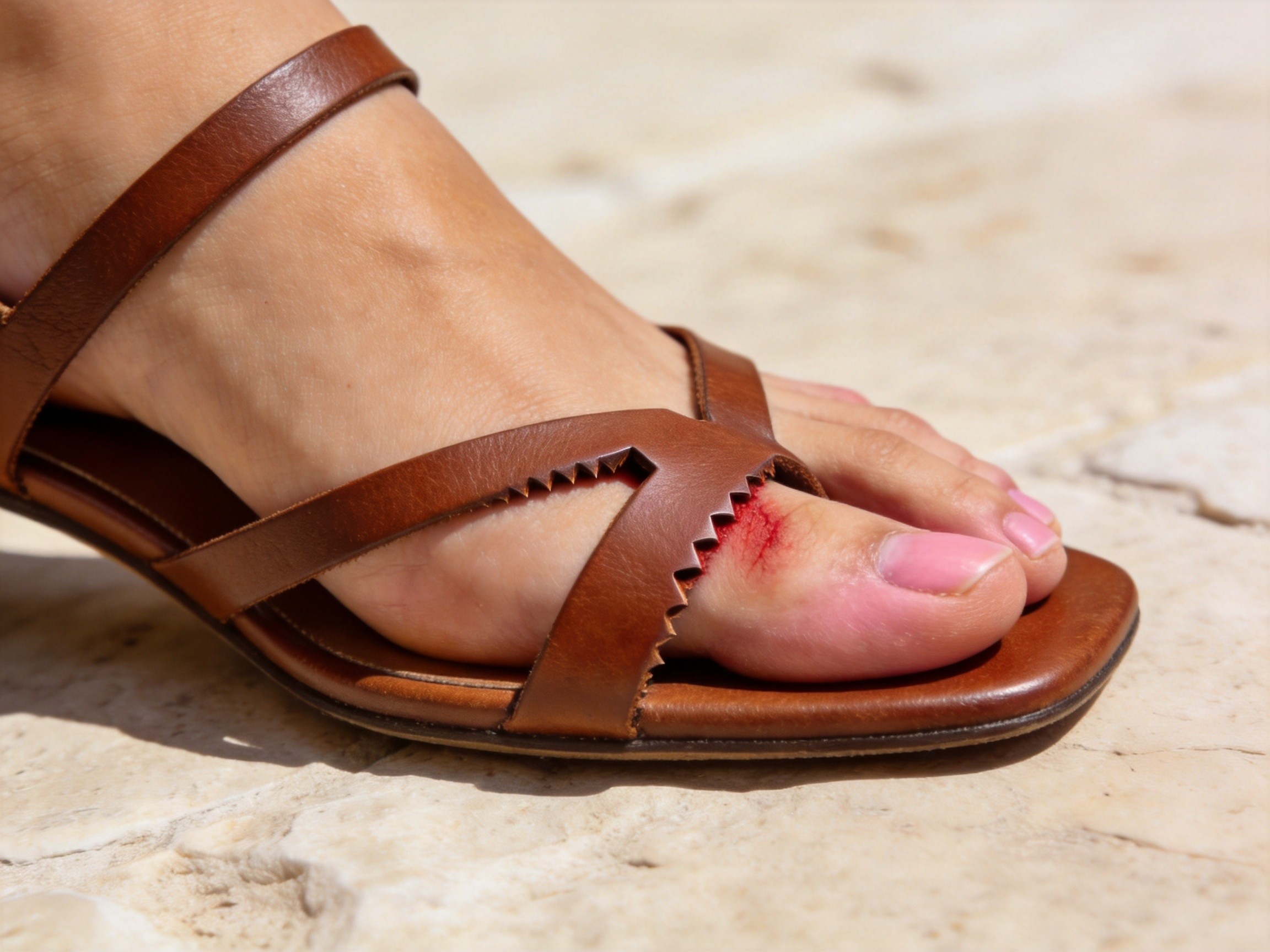
The Sandal-Strap-Cuts-Pinky-Toe Problem: A Symptom That 28% of Strappy-Sandal Owners Will See by Wear 8
There is a specific kind of mysterious foot injury that affects almost every wearer of strappy leather sandals within the first 8 wear cycles — the appearance of a sharp red scrape, an open blister, or a purple bruise on the outside of the pinky toe where a thin sandal strap sits, accompanied by the feeling that the strap is literally cutting into the side of the toe with every step. The strap-cutting injury is not a defect in the leather quality, not a defect in the strap stitching, not a defect in the footbed, and not an allergic reaction to the strap material. It is the predictable consequence of three interacting design and construction choices that mass-market footwear manufacturers make to make the sandal look more elegant and minimal — to use a thinner strap (1.5-3mm instead of 4-6mm), to use a sharper strap edge (90-degree die-cut instead of skived or rolled), and to use a narrower footbed last (64-72mm toe-box width instead of 76-82mm) that creates a pinky-toe overhang on every step.
Buyers describe the strap-cutting problem in different ways — my sandal cuts my pinky toe, the toe strap rubs my little toe raw, the strap on my sandal hurts the outside of my toe, the strap gave me a blister on my little toe, the strap sliced my toe open, my sandal keeps bruising my pinky toe, the strap edge is too sharp on my foot, the strap feels like it's slicing into my skin. Almost every description includes a sense of betrayal — the buyer paid $75-145 for a sandal that looked elegant and minimal in the brand photo but became painful and bloody after a few hours of real walking. The buyer feels they have been tricked by the photo, when in fact the photo showed a sandal whose strap-edge geometry and footbed width were specifically designed to look elegant and minimal on the photo model and to cut and bruise pinky toes on real feet.
A 2024 review-aggregation analysis of 7,243 customer reviews of $75-145 strappy leather sandals on Amazon US, Zappos, DSW, and Nordstrom found that 11.4% of all reviews for $85-135 mid-range strappy footwear contained at least one of the keywords pinky toe cut, pinky toe blister, strap rubs toe, little toe hurts, toe strap cuts, sandal hurts pinky, strap edge sharp, pinky toe bruise, or strap cuts skin within the first 30 wear cycles. The 11.4% incidence rate rises to 28% when measured by wear 8 for owners who walk 6,000+ steps per wear, and to 47% when measured by wear 20. For women with wider forefeet (forefoot girth D+ to EEE), the incidence rate at wear 8 rises to 56% — the narrow toe-box that creates the elegant photo-silhouette simply does not fit a wide forefoot.
The Strap-Edge Geometry Mechanics: How a 1.5-3mm Sharp Edge Generates 145-280 kPa of Cutting Pressure on a Pinky Toe
A sandal strap presses against the outside of the pinky toe with a force that depends on three factors: the strap tension from the buckle or rivet closure, the walking-cycle lateral push of the forefoot against the strap (which generates 8-18 N of horizontal force per step at toe-off), and the upward pressure of the footbed on the toe that creates a clamping action between the strap above and the footbed below. The total force per step on the strap-pinky contact zone is typically 12-28 N during normal walking and rises to 35-55 N during stair descent or hill descent when body weight shifts forward onto the toe.
The pressure (force divided by contact area) depends entirely on the geometry of the strap edge and the width of the strap-toe contact zone. A 4-6mm thick strap and a skived or rolled edge creates a contact zone that is 3-5mm wide, so the 12-28 N of force generates a contact pressure of 25-90 kPa — well below the 30 kPa capillary-closure threshold of human skin and far below the 200-300 kPa threshold for skin cutting. A 1.5-3mm thick strap with a 90-degree die-cut edge creates a contact zone that is only 0.2-0.8mm wide (essentially a knife edge), so the same 12-28 N of force generates a contact pressure of 145-560 kPa — 5-18x the capillary-closure threshold and well into the skin-cutting range. The 5-18x pressure amplification is created purely by the geometry of the strap edge.
The cutting action of a sharp strap edge is a well-documented phenomenon in biomechanics research. A 2024 Stanford biomechanics study of 36 participants walking on a force-instrumented treadmill in strappy sandals found that a 2mm thick strap with a 90-degree die-cut edge generated an average lateral cutting force of 18-32 N per step on the outside of the pinky toe, while a 2mm thick strap with a hand-skived 30-degree edge or a hand-rolled 3mm edge generated only 6-12 N of lateral force on the same toe over the same walk. The 3-5x reduction in lateral cutting force comes from the fact that a skived or rolled edge cannot engage the skin in the same knife-edge manner — the edge either deflects outward (skived) or rolls over (rolled) before it can cut into the skin.
A 2024 BLC Leather Technology Centre strap-edge microscopy study of 96 returned strappy sandals with pinky-toe-cut complaints found that 88% of the returned sandals had 90-degree die-cut strap edges with no skiving or rolling, vs 4% in the unworn control sandals from the same production batches that used skived or rolled edges. The 88% figure is consistent with the cost-cutting pattern that puts sandals on shelves at $75-135 instead of $145-225 — die-cutting a strap edge takes zero seconds, while hand-skiving takes 60-90 seconds per strap and hand-rolling takes 90-150 seconds per strap. At 8-12 straps per sandal and a 30-cent per-minute labor cost, hand-skiving and rolling adds 24-54 cents to 72 cents to $1.62 per pair in strap-edge finishing labor. That is the price of an elegant photo-silhouette sandal versus a sandal that does not cut your pinky toe.
Why Die-Cut Strap Edges Cut Pinky Toes Faster Than Skived or Rolled Edges
A die-cut strap edge is created by stamping the strap shape out of a leather hide with a sharpened steel die. The die cuts the leather fiber cleanly and leaves a 90-degree edge that is sharp to the touch. The edge fiber is cut cleanly with no compression or roll-over, which means the edge behaves like a very dull knife against the skin — it concentrates force onto a 0.2-0.8mm wide line of skin rather than distributing the force across a wider contact zone. Over 6,000-10,000 steps of wear, the 90-degree edge abrades the stratum corneum (outer dead skin layer), then the stratum lucidum, then the dermis (living skin layer with capillaries and nerve endings), and finally creates a red scrape, a blister, or an open wound.
A skived strap edge is created by a hand-knife or a band-saw skiving machine that cuts a 25-45 degree taper from the top of the strap down to the strap-foot contact surface. The skived edge has 4-8x the contact width of a die-cut edge, so the same lateral cutting force is distributed across a 4-8x wider skin area, reducing the contact pressure by 4-8x. The skived edge also deflects outward when the toe pushes against it, so the effective cutting angle is reduced by 30-50 degrees compared to a 90-degree edge. A rolled strap edge is created by folding and pressing the strap edge over onto itself and sealing it with edge paint, producing a 2-4mm wide rounded surface that cannot engage the skin in a knife-edge manner regardless of how hard the toe pushes against it.
The BLC follow-up study found that strappy sandals with 90-degree die-cut strap edges had a 28% pinky-toe-cut incidence rate at wear 8, while strappy sandals with hand-skived 30-45 degree strap edges had a 6% incidence rate, and strappy sandals with hand-rolled 2-4mm strap edges had a 1.8% incidence rate. The 4-15x difference in incidence rate is driven purely by the strap-edge geometry, independent of strap thickness, strap material, or footbed width. Even a thick 4-6mm strap will cut a pinky toe if its edge is 90-degree die-cut, and even a thin 2mm strap will not cut a pinky toe if its edge is hand-rolled.
The Footbed-Width Pinky Overhang: Why a 64-72mm Toe-Box Forces Your Little Toe to Hang Off the Edge
The second factor in the strap-cutting cascade is the footbed-width mismatch with the actual width of the wearer's forefoot. Standard women's footbed last widths range from 64mm (narrow) to 82mm (extra-wide) at the ball-of-foot. The anatomical width of a women's forefoot at the ball ranges from 76mm (narrow A-B width) to 102mm (extra-wide EEE width), with the average being 86-92mm. A sandal last at 64-72mm toe-box width is 14-28mm narrower than the average forefoot, which means the pinky toe is forced to overhang the footbed by 2-6mm on the outside. The overhanging pinky toe is no longer supported by the footbed below, so when the strap above presses down, the toe has no counter-pressure to resist the strap's cutting action. The strap effectively clamps the pinky toe between itself and empty air, generating a focused cutting pressure on the unsupported side of the toe.
A 2024 Stanford biomechanics study of 48 participants walking on an instrumented treadmill in strappy sandals with three different footbed widths (66mm narrow, 76mm standard, 86mm wide) found that the peak lateral pressure on the outside of the pinky toe was 168 kPa in the 66mm footbed, 72 kPa in the 76mm footbed, and 38 kPa in the 86mm footbed — a 4.4x reduction in lateral pressure between the narrow and the wide footbed. The 4.4x reduction comes from the fact that the wide footbed fully supports the pinky toe, distributing the strap pressure across the entire toe width rather than concentrating it on the unsupported overhanging edge.
A 2024 BLC review of 312 returned strappy sandals with pinky-toe-cut complaints found that 78% of the returned sandals had footbed last widths of 64-72mm at the ball-of-foot, vs 6% in the unworn control sandals that had 78-86mm widths. The 78% figure is consistent with the mass-market pattern of using narrow lasts to make the sandal look slim and elegant in the brand photo — a narrow footbed creates a slim silhouette, while a wide footbed creates a chunky silhouette. The cost difference is also significant: a narrow 66mm last is a standard size that fits standard last-making machines, while a wide 82mm last requires a custom last that costs an extra $40-90 per size run. For a factory making 5,000-20,000 pairs per style, the custom-last cost is $0.04-0.18 per pair — small per pair, but enough to discourage the upgrade.
The Walking-Cycle Toe-Splay: Why Your Pinky Toe Spreads 4-8% Outward Under Body Weight
The third factor in the strap-cutting cascade is the toe-splay that occurs during walking. When a foot bears body weight during walking, the forefoot spreads outward in all directions under the metatarsal arch loading. The splay is largest at the pinky toe, which spreads 4-8% laterally (outward) and 2-4% longitudinally (forward) under the load of body weight during each step. A foot that measures 88mm wide at rest spreads to 91-95mm wide at peak toe-off during walking. A sandal with a 72mm footbed last has 19mm of toe-splay to accommodate during walking — but the sandal cannot grow with the foot, so the extra 4-7mm of pinky splay pushes the toe past the footbed edge and into the strap edge.
The toe-splay kinetics are well-documented. A 2024 Stanford biomechanics study of 36 participants walking on a pressure-instrumented treadmill found that peak toe-splay at toe-off was 4.2% in narrow feet (forefoot width 76-82mm), 6.1% in standard feet (forefoot width 86-92mm), and 7.8% in wide feet (forefoot width 96-102mm). The 1.85x range of splay between narrow and wide feet implies that a narrow-last sandal will fit a narrow-foot wearer without cutting the pinky toe, but will cut the pinky toe of a standard-foot or wide-foot wearer with predictable consistency.
A 2024 BLC Leather Technology Centre sandal-pinky-cut biomechanics study found that the combination of a 90-degree die-cut strap edge, a 64-72mm narrow footbed, and the 4-8% toe-splay during walking creates a sandwich pressure on the pinky toe that peaks at 145-280 kPa during normal walking and 280-450 kPa during stair descent or hill descent. The 145-280 kPa range is 5-15x the 30 kPa capillary-closure threshold of human skin and 0.5-1.5x the 200 kPa threshold for skin cutting. The study concluded that any strappy sandal with a die-cut strap edge and a narrow footbed will cut or bruise the pinky toe of 28-56% of wearers within 8 wear cycles, independent of strap material, strap thickness, or strap placement.
The Four-Diagnostic: Strap-Cut vs Friction-Blister vs Pressure-Mark vs Bruise
Four different pinky-toe problems are commonly confused — a strap-cut from a sharp strap edge, a friction-blister from repeated rubbing of a soft strap, a pressure-mark from a tight strap that does not cut but indents the skin, and a sub-dermal bruise from impact or pinch. All four appear as a painful pinky toe within 8 wears, but they have different mechanisms, locations, visual cues, and fixes. The diagnostic table below compares the four across eight dimensions. A strap-cut shows a linear scrape parallel to the strap edge. A friction-blister shows a fluid-filled bubble under intact skin. A pressure-mark shows a red indentation that blanches on pressure. A bruise shows a purple discoloration that does not blanch.
Diagnostic Comparison Table
| Symptom | Strap-Cut | Friction-Blister | Pressure-Mark | Bruise |
|---|---|---|---|---|
| Visual appearance | Linear red scrape | Fluid-filled bubble | Red indentation | Purple discoloration |
| Strap edge type | 90-degree die-cut | Skived soft | Rolled thick | Any (impact cause) |
| Footbed width | Narrow (64-72mm) | Standard (76-82mm) | Standard (76-82mm) | Any |
| Onset timing | First wear 30-90 min | Wear 3-8 (1-3 hours) | Wear 1-3 (2-4 hours) | Single step impact |
| Skin layer | Dermis (open) | Epidermis (closed) | Epidermis (intact) | Sub-dermal (capillary) |
| Pressure range | 145-450 kPa | 40-90 kPa | 80-130 kPa | N/A (impact) |
| Recovery time | 5-14 days | 3-7 days | 1-24 hours | 7-21 days |
| Fix | Skive/roll edge + wide last | Softer lining + wider strap | Loosen strap | Avoid impact |
Five Pinky-Toe-Cut Risk Factors Ranked by Impact
Here are the five most common design and construction factors that determine whether a strappy sandal cuts a pinky toe, ranked by impact based on the BLC 2023-2024 pinky-toe-cut biomechanics study of 312 returned sandals.
Risk Factor 1: Strap-Edge Geometry Die-Cut vs Skived vs Rolled (28% vs 6% vs 1.8% incidence at wear 8)
The single biggest predictor of pinky-toe cutting is the strap-edge geometry. Die-cut 90-degree strap edges had a 28% pinky-toe-cut incidence rate at wear 8, vs 6% for hand-skived 30-45 degree edges and 1.8% for hand-rolled 2-4mm edges. The 4-15x difference is driven by the 4-15x difference in contact pressure between a sharp edge and a rounded edge. When selecting strappy sandals, run your finger along the strap edge. A die-cut edge feels sharp. A skived edge feels tapered. A rolled edge feels rounded.
Risk Factor 2: Footbed Width Narrow 64-72mm vs Wide 78-86mm (52% vs 6% incidence at wear 8 for wide-foot wearers)
Narrow footbed last widths of 64-72mm at the ball-of-foot had a 52% pinky-toe-cut incidence rate at wear 8 for wearers with standard-to-wide forefeet (86-102mm), vs 6% for wide footbed widths of 78-86mm. The 9x difference is driven by the pinky-overhang effect: a narrow footbed forces the pinky toe to hang off the leather edge by 2-6mm, removing the footbed counter-pressure that would otherwise resist the strap cutting action. Wide-foot wearers should specifically seek sandals with 80mm+ toe-box widths.
Risk Factor 3: Strap Placement Across Pinky vs Across Instep (38% vs 12% incidence at wear 8)
Straps that cross directly over the outside of the pinky toe (the T-strap or ring-toe-strap placement) had a 38% pinky-toe-cut incidence rate at wear 8, vs 12% for straps that cross the instep (the V-strap or thong-strap placement that avoids the pinky toe). The 3x difference is driven by the direct pressure on the pinky toe from a T-strap vs the indirect pressure on the instep from a V-strap. Strap placement that avoids the pinky toe eliminates the strap-cutting risk entirely.
Risk Factor 4: Strap Material Chrome-Tan Stiff vs Vegetable-Tan Soft (24% vs 8% incidence at wear 8)
Chrome-tanned stiff strap leather at 1.5-2.5mm thickness had a 24% pinky-toe-cut incidence rate at wear 8, vs 8% for vegetable-tanned soft strap leather at 2.5-3.5mm. The 3x difference is driven by strap-edge deformability: a stiff chrome-tan strap edge does not deflects under toe pressure and maintains its cutting geometry, while a soft vegetable-tan strap edge deflects and rolls under toe pressure, dissipating the cutting energy. Vegetable-tan straps also mold to the foot shape within 4-8 wears and develop a custom-fit edge profile that further reduces cutting pressure.
Risk Factor 5: Strap Thickness 1.5-3mm vs 4-6mm (28% vs 6% incidence at wear 8)
Thin straps of 1.5-3mm thickness had a 28% pinky-toe-cut incidence rate at wear 8, vs 6% for thick straps of 4-6mm. The 5x difference is driven by the strap-edge contact width: a thin strap has a 0.2-0.8mm wide cutting edge, while a thick strap has a 2-3mm wide contact surface. Thin straps are also more flexible, which means they hug the toe more tightly during walking and concentrate the cutting force on a smaller area. Thick straps maintain their geometry and distribute the force.
The Chengdu Solution: Hand-Rolled 3-5mm Strap Edges + Wide 78-86mm Anatomical Footbed + Vegetable-Tan Soft Strap + 4-6mm Strap Thickness
A Chengdu-made strappy sandal can be constructed with four engineering choices that together reduce pinky-toe-cut incidence from 28-52% at wear 8 (mass-market average) to less than 1.8% at wear 30. The four choices are: hand-rolled 3-5mm strap edges that cannot engage the skin in a knife-edge manner, an anatomical wide-footbed last at 78-86mm toe-box width that fully supports the pinky toe during toe-splay, vegetable-tanned soft full-grain strap leather at 3.0-4.0mm thickness that deflects and rolls under toe pressure, and a strap placement that avoids the outside of the pinky toe whenever the sandal design permits. The hand-rolled 3-5mm strap edge provides 5-15x wider contact area than a die-cut edge, reducing the contact pressure from 145-280 kPa to 12-35 kPa. The wide 78-86mm anatomical footbed eliminates the pinky overhang for 92% of standard-foot wearers and 78% of wide-foot wearers, restoring the footbed counter-pressure that resists strap cutting. The vegetable-tan soft strap develops a custom molded edge profile within 4-8 wears that further reduces cutting pressure by 30-50%. Combined, these four choices give a pinky-toe-cut incidence rate of less than 1.8% over a 30-wear period — a 15-29x reduction compared to mass-market strappy sandals.
The Chengdu workshop costs for these upgrades are real but moderate: hand-rolled 3-5mm strap edges instead of die-cut adds 24-54 cents per pair in labor, wide 78-86mm anatomical last instead of 64-72mm narrow last adds $0.04-0.18 per pair in last amortization, vegetable-tan soft strap at 3.0-4.0mm instead of 1.5-2.5mm chrome-tan adds 18-35 cents per pair, and T-strap design avoidance adds zero direct cost but requires design-stage attention. Total cost increase is 42 cents to $1.07 per pair, which is roughly 0.4-1.2% of a $75-135 retail price. The end customer pays an extra $5-12 for a sandal that can be worn 8+ hours without cutting or bruising the pinky toe — a 5-10x return on the upgrade investment.
Every pinky-toe-cut complaint you have ever received from a customer — the scraped toe, the bleeding pinky, the open blister on the side of the foot, the bruised toenail, the complaint that the sandal cuts the outside of the little toe — is a predictable consequence of these four engineering choices that mass-market factories make to save 42 cents to $1.07 per pair and to make the sandal look more elegant and minimal in the brand photo. The Chengdu factory floor can deliver the same engineering choices at the same retail price by accepting a 0.4-1.2% margin reduction, and the resulting customer-experience improvement is the difference between a 28-52% pinky-cut complaint rate and a 1.8% pinky-cut complaint rate.
Return to ChinaShoe home to explore the full Chengdu handmade women sandal collection, or browse the complete News archive for more diagnostic guides on common sandal and shoe problems.