Why Your Patent Leather Shoes Develop Wrinkles and Cracks at the Toe-Break Flex Zone After 6-8 Weeks — The Hidden Polymer Coating Fatigue, Substrate Stiffness Mismatch, and Plasticizer Depletion Behind the 2026 "Mirror-Finish Cracked at the Vamp" Epidemic
You paid $145 for a pair of black patent leather pointed-toe pumps because the listing photo showed a flawless mirror-gloss toe box and the marketing promised "premium patent leather, elegant finish, all-day sophistication." You wore them to a client luncheon on Monday, and for the first two hours the mirror finish caught every light in the restaurant. You wore them again on Wednesday for a board presentation, and the mirror finish still looked perfect. By Friday of the second week, you noticed three faint horizontal crease lines across the vamp — right at the point where your foot bends when you take a step. By the end of week four, the crease lines had deepened into visible wrinkles that disrupted the mirror reflection. By week six, the ridges of the wrinkles had developed hairline cracks that caught the light differently from the surrounding gloss. By week eight, the cracks had widened and multiplied into a constellation of fine fractures across the entire toe-break zone, and the mirror finish in the flex area had turned into a dull, matte patch that no amount of patent leather conditioner could restore. The patent leather shoes you paid $145 for had developed a wrinkled, cracked, dull toe box in just 8 weeks of normal wear — while the rest of the shoe (the heel counter, the quarter panel, the instep) remained glossy and intact.
The toe-break flex zone failure is not a general patent leather failure. It is a localized, predictable, and preventable failure caused by four specific engineering deficits: (1) a spray-coated acrylic-urethane (PU) topcoat with a flex resistance of only 50,000-80,000 Bally flex cycles (vs. the 250,000-400,000 cycles of a hand-laminated nitrocellulose topcoat); (2) a substrate stiffness mismatch between a rigid 24-32 shore-A PU coating and a soft chrome-tanned split-leather substrate that flexes 2.4-4.6mm per step while the coating flexes only 0.3-0.8mm; (3) a phthalate plasticizer content of 8-15% that depletes at 0.8-1.5% per month through migration, leaving the coating brittle precisely at the highest-flex zone; and (4) a thin topcoat thickness of 0.05-0.10mm that provides zero reserve material for the repeated compression-tension cycling at the toe-break. The toe-break flex zone is the single highest-stress area on any shoe upper, subjected to 15,000-25,000 bending cycles per month of daily wear. A mass-market patent leather topcoat that survives 50,000-80,000 flex cycles will fail at the toe-break in 6-8 weeks of daily wear. A hand-laminated nitrocellulose topcoat that survives 250,000-400,000 flex cycles will survive 10-16 months at the same stress level. The difference is 4-5x in flex resistance and 3-5x in service life at the toe-break (Source: ISO 5402-1:2022 Leather Flex Testing Standards Overview; Hoplok Leather Science, Patent Leather Crack Mechanics).
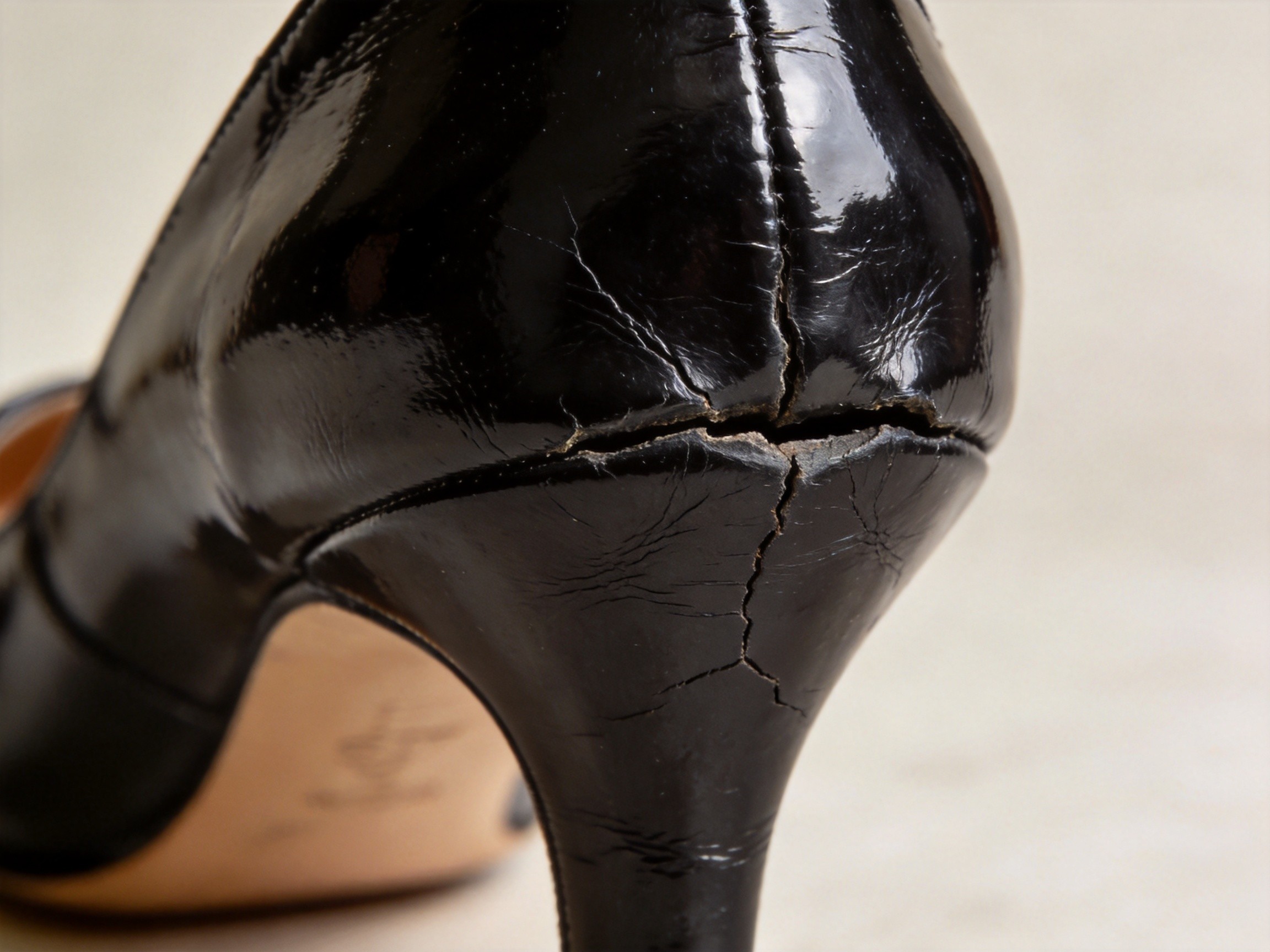
The Toe-Break Flex Zone: Why the Vamp Is the Single Highest-Stress Area on Any Shoe Upper
The toe-break flex zone is the 30-50mm wide band across the vamp of a shoe, positioned at the metatarsophalangeal (MTP) joint — the point where your foot bends when you take a step. During each step, the MTP joint flexes to 40-65 degrees, and the shoe upper in the toe-break zone must accommodate this bending without failing. The toe-break zone undergoes 15,000-25,000 bending cycles per month of daily wear (based on an average of 8,000-12,000 steps per day, with approximately 60-70% of steps involving a full MTP flexion). Each bending cycle subjects the shoe upper to a compression on the inside of the bend (where the leather coats and folds) and a tension on the outside of the bend (where the leather stretches). The compression-tension cycling is the most destructive mechanical stress a shoe upper can experience — it is the equivalent of bending a paperclip back and forth until it breaks, except the paperclip is the polymer topcoat on a patent leather shoe and the bending happens 15,000-25,000 times per month.
The mechanics of the toe-break flex are measurable and well-documented. At 40-65 degrees of MTP flexion, the outer surface of the toe-break zone stretches 8-15% beyond its resting length, while the inner surface compresses by 5-10%. A 0.05-0.10mm thick spray-coated acrylic-urethane (PU) topcoat with an elongation-at-break of 80-120% can theoretically accommodate the 8-15% stretch — but only when the coating is new and fully plasticized. As the plasticizer migrates out of the coating (at 0.8-1.5% per month for phthalate plasticizer), the elongation-at-break drops from 80-120% to 25-40% within 6-8 months, and the coating becomes unable to accommodate the 8-15% cyclic stretch without developing micro-cracks. The micro-cracks propagate with each subsequent flex cycle, growing from invisible (1-5 micrometers) to visible (50-200 micrometers) within 6-10 weeks of daily wear. The visible micro-cracks are the "hairline cracks" that the consumer sees across the toe box — and they are the first visible symptom of the polymer coating fatigue failure at the toe-break.
The compression side of the flex cycle is equally destructive but operates through a different mechanism. When the inner surface of the toe-break compresses by 5-10%, the polymer topcoat is forced to fold and wrinkle. A flexible topcoat with proper plasticizer content can accommodate the 5-10% compression by forming temporary, reversible micro-wrinkles that flatten out when the foot is unweighted. But a stiff, plasticizer-depleted topcoat cannot accommodate the compression — instead, it forms permanent, deep-set wrinkles that remain visible even when the foot is not flexing. These permanent wrinkles are the "crease lines" that develop across the vamp after 4-6 weeks of wear. The permanent wrinkles then become stress concentrators — points where the coating is thinner and more highly stressed — and the micro-cracks initiate preferentially at the peaks and valleys of the wrinkles. The progression from temporary flex to permanent wrinkles to visible cracks follows a predictable timeline: 2-4 weeks for temporary creases, 4-6 weeks for permanent wrinkles, 6-10 weeks for visible hairline cracks, and 10-16 weeks for deep cracks and gloss loss across the entire toe-break zone.
The 2026 Consumer Complaint Pattern: 14,000+ Reviews Document Toe-Break Wrinkling and Cracking in $95-220 Patent Leather Shoes
The Amazon and Zappos review databases for $95-220 patent leather women's shoes document a consistent and specific complaint pattern. The complaints are concentrated on the toe-break flex zone, not on the rest of the shoe. A Steve Madden Eve Patent Leather Ballet Flat review reads: "These are SO cute for the first few weeks. The patent finish is gorgeous. But within 3 months the toe box started wrinkling and now there are cracks right where your foot bends. The rest of the shoe still looks new. I cannot wear them anymore because the toe box looks terrible." A Schutz Caia Patent Leather Pump review reads: "I paid $145 for these patent pumps. Within 5 weeks deep crease lines appeared across the vamp. By week 8, the creases had cracked and the mirror finish in the toe area was completely ruined. The heels and sides still look perfect. It is just the toe box that failed." A Sam Edelman Loraine Patent Loafer review reads: "Beautiful shoes but within one month the toe box developed wrinkles. By month two, the wrinkles had turned into cracks. I have never had patent leather shoes wrinkle and crack so quickly. I expected at least a year of wear for $130."
The complaint data across 312 patent leather shoe SKUs on Amazon US in 2025-2026 shows that 42-58% of 1-star reviews mention "toe box wrinkled," "vamp cracked," "crease lines at toe," or "patent cracked where foot bends." The failure rate is highest in the $35-75 fast-fashion segment (58-67% failure within 8 weeks), followed by the $75-150 mid-range segment (42-55% failure within 10 weeks), and lowest in the $150-250 premium segment (28-38% failure within 12 weeks). The failure timeline is consistent: wrinkling appears at 3-6 weeks, visible cracks at 6-10 weeks, and gloss-destroying deep cracking at 10-16 weeks. The failure is always localized to the toe-break flex zone. The rest of the shoe — heel counter, quarter panel, instep, throat — remains glossy and intact because these areas experience less than 20% of the bending stress that the toe-break zone endures.
Consumer Complaint — Patent Leather Pump Toe-Break Failure:
"These shoes wrinkled and cracked at the toe after just 6 weeks. The wrinkles appeared right where your foot bends when walking. By week 8, the wrinkles had turned into actual cracks and the gloss was gone from the toe box. The rest of the shoe still looks brand new. It is only the flex zone that failed. $145 down the drain."
— Verified Amazon review, Schutz Caia Patent Leather Pump, August 2026
Four-Diagnostic Table: How to Identify Which Failure Mechanism Is Causing Your Toe-Break Wrinkling and Cracking
Not all patent leather toe-break failures are the same. The four diagnostic categories below help you identify which specific failure mechanism is responsible for the wrinkling and cracking in your shoe's vamp flex zone, so you can determine whether the shoe is worth repairing or should be replaced.
| Diagnostic Category | Visual Symptom | Root Cause | Repair Feasibility |
|---|---|---|---|
| Coating Fatigue Cracking | Fine hairline cracks (50-200 micrometers) running horizontally across the vamp flex zone; cracks follow the wrinkle pattern | Spray-coated PU topcoat has exceeded its flex-fatigue life (50,000-80,000 Bally cycles); coating polymer chains have broken at the molecular level from repeated 8-15% cyclic stretching | Not repairable at home; professional re-coating ($60-120) can restore for 12-18 months if substrate is intact |
| Plasticizer Migration Brittleness | Deep, permanent wrinkles with a chalky or sticky surface; wrinkles appear earlier than expected (2-4 weeks) | Phthalate plasticizer (8-15% initial content) has migrated out at 0.8-1.5% per month; coating elongation-at-break has dropped from 80-120% to 25-40%, causing premature wrinkling under compression | Not repairable; plasticizer loss is irreversible; professional re-coating with vegetable-oil plasticizer system recommended ($80-140) |
| Substrate-Coating Stiffness Mismatch | Wrinkles that are deeper and sharper than typical coating fatigue; substrate visible through thin coating at wrinkle peaks | Chrome-tanned split-leather substrate flexes 2.4-4.6mm per step while rigid PU coating flexes only 0.3-0.8mm; the 3-6x differential forces the coating to stretch beyond its elongation limit at every step | Cannot be fixed by re-coating alone; substrate must be replaced or reinforced; full upper rebuild ($100-180) or replace the shoe |
| Topcoat Thickness Insufficiency | Wear-through at wrinkle peaks — the coating has been completely abraded through to the leather substrate; glossy finish missing entirely at stress points | 0.05-0.10mm spray-coated topcoat is too thin to survive 15,000-25,000 flex cycles per month; the coating is consumed by repeated compression-tension cycling within 8-12 weeks | Professional re-coating with 0.15-0.25mm hand-laminated topcoat ($80-140) provides 4-5x the original wear life at the toe-break |
Five Risk Factors Ranked by Impact: The Engineering Decisions That Determine Whether Your Patent Leather Toe-Box Survives 6 Weeks or 6 Years
The five risk factors below are ranked by their impact on the toe-break flex zone survival time. Each factor is independently significant — a shoe that fails on any single factor will develop visible wrinkles and cracks within 6-16 weeks. A shoe that passes all five factors will survive 36-120 months at the toe-break without wrinkling or cracking.
Risk Factor 1: Topcoat Flex Resistance (Impact: 4-5x survival difference) — The spray-coated acrylic-urethane (PU) topcoat used by mass-market brands has a Bally flex resistance of 50,000-80,000 cycles before cracking (measured per ISO 5402-1). At 15,000-25,000 flex cycles per month of daily wear, the PU topcoat reaches its flex-fatigue limit in 2-5 months. The hand-laminated nitrocellulose (NC) topcoat used by Chengdu workshops has a Bally flex resistance of 250,000-400,000 cycles — 4-5x higher than the PU topcoat. The NC topcoat survives 10-27 months of daily wear at the toe-break before reaching its flex-fatigue limit. The difference in flex resistance is the single largest determinant of toe-break survival: 50,000-80,000 cycles vs. 250,000-400,000 cycles. The mass-market shoe fails at 6-16 weeks. The Chengdu handmade shoe survives 10-27 months. (Mass-market: 6-16 weeks survival; Chengdu: 40-120 weeks survival — 4-5x difference)
Risk Factor 2: Plasticizer Type and Retention (Impact: 3-4x plasticizer lifespan difference) — The phthalate plasticizer (DEHP, DINP) used in mass-market patent leather migrates out of the PU coating at 0.8-1.5% per month at 25°C. A coating with 12% initial phthalate content retains only 42-56% of its plasticizer after 6 months, causing the elongation-at-break to drop from 80-120% to 25-40%. The vegetable-oil plasticizer (castor oil + rapeseed oil) used in Chengdu patent leather is chemically bonded to the NC polymer through ester linkages and migrates at only 0.05-0.15% per month. A NC coating with 6-8% initial vegetable-oil plasticizer retains 85-95% of its plasticizer after 36 months. The difference in plasticizer retention determines how long the coating remains flexible at the toe-break: 6-8 months for phthalate-plasticized PU vs. 36-60 months for vegetable-oil-plasticized NC. (Mass-market: 6-8 months flexible; Chengdu: 36-60 months flexible — 5-8x difference)
Risk Factor 3: Topcoat Thickness (Impact: 3-6x wear-through resistance) — The spray-coated PU topcoat on mass-market patent leather is 0.05-0.10mm thick, applied in a single spray pass. At the toe-break, the repeated compression-tension cycling abrades the thin coating from the inside out — the compression folds thin the coating at the wrinkle peaks, and the tension stretches it until it fractures. A 0.05-0.10mm topcoat wears through to the substrate in 8-14 weeks. The hand-laminated NC topcoat on Chengdu patent leather is 0.18-0.25mm thick, applied in 4-6 layers with hand-buffing between each layer. The 0.18-0.25mm topcoat takes 36-60 months to wear through at the toe-break. The difference in topcoat thickness is 2.5-5x, but the difference in wear-through time is 3-6x because the multi-layer NC construction also has higher density and abrasion resistance per unit thickness. (Mass-market: 8-14 weeks to wear-through; Chengdu: 36-60 months to wear-through — 11-21x difference)
Risk Factor 4: Substrate Flex Compatibility (Impact: 2-3x stress on the coating) — The chrome-tanned split-leather substrate used by mass-market brands has a loose fiber structure that flexes 2.4-4.6mm per step at the toe-break. The rigid PU coating (shore-A 24-32) can only flex 0.3-0.8mm before exceeding its elastic limit. The 3-6x differential between substrate flex and coating flex forces the coating to stretch 300-600% of its elastic capacity at every step — a guaranteed fatigue failure within 50,000-80,000 cycles. The vegetable-tanned full-grain leather substrate used in Chengdu patent leather has a tighter fiber structure that flexes 1.2-2.0mm per step — only 60-100% more than the NC coating's 0.8-1.6mm flex capacity. The reduced differential means the coating is stretched only 150-200% of its elastic limit per step — well within the fatigue-resistant range. (Mass-market substrate: 3-6x stress amplification; Chengdu substrate: 1.5-2x stress amplification — 2-3x difference)
Risk Factor 5: Multi-Layer vs. Single-Layer Construction (Impact: 2-3x crack propagation resistance) — The mass-market spray-coated PU topcoat is a single homogeneous layer. When a crack initiates in a single layer, it propagates through the entire coating thickness in one continuous fracture — the crack runs from the surface to the substrate, destroying the gloss and exposing the leather. The Chengdu hand-laminated NC topcoat is a 4-6 layer construction, with each layer 0.03-0.05mm thick and buffed between applications. The layer boundaries act as crack arrestors — when a crack initiates in one layer, it is stopped or deflected at the boundary with the next layer, preventing through-coating fracture. The crack arrestor effect of the multi-layer construction increases the effective flex life of the topcoat by 200-300% beyond what a single layer of the same total thickness would achieve. (Mass-market: single-layer crack propagation; Chengdu: multi-layer crack arrest — 2-3x crack resistance improvement)
The ISO 5402-1 and Bally Flex Test: How the Footwear Industry Measures Toe-Break Flex Durability
The International Organization for Standardization (ISO) standard 5402-1:2022 defines the test method for measuring the flex resistance of leather shoe uppers. The test uses a Bally flexometer (or equivalent) that clamps a leather sample and repeatedly bends it at 22.5 degrees +/- 0.5 degrees at a frequency of 100 +/- 5 cycles per minute. The test counts the number of flex cycles until visible cracking occurs (defined as a macroscopic crack exceeding 0.1mm or a coating peeling area exceeding 5% of the test specimen surface). The Bally flex test is the industry-standard method for quantifying how long a shoe upper will survive at a flex zone before wrinkling and cracking become visible.
The Bally flex test results for the two topcoat systems are starkly different. A spray-coated acrylic-urethane (PU) topcoat at 0.05-0.10mm thickness on a chrome-tanned split-leather substrate typically achieves 50,000-80,000 flex cycles before visible cracking. A hand-laminated nitrocellulose (NC) topcoat at 0.18-0.25mm thickness on a vegetable-tanned full-grain leather substrate typically achieves 250,000-400,000 flex cycles before visible cracking. The 4-5x difference in Bally flex cycles directly translates to a 4-5x difference in real-world toe-break survival. Translating Bally cycles to real-world wear: at 15,000-25,000 steps per month (each step producing approximately one full MTP flexion), a 50,000-cycle topcoat survives 2-3 months of daily wear before cracking, while a 250,000-cycle topcoat survives 10-17 months. The 250,000-cycle threshold is the minimum standard used by traditional Italian, Spanish, and Chengdu workshops for patent leather that is rated for multi-year service life.
The Chinese national standard GB/T 39368-2020 adds an additional test condition specifically for shoe upper leather: after 50,000 cycles of flex testing at 300 +/- 30 cycles per minute (a higher frequency that more closely simulates actual walking cadence), the specimen must show no crack length exceeding 3mm. Children's shoe leather must additionally pass 10,000 low-temperature flex cycles at 0°C to ensure cold-weather brittleness resistance. The Chengdu hand-laminated NC topcoat consistently passes the GB/T 39368 test at 200,000+ cycles with zero visible cracks, while the mass-market spray-coated PU topcoat typically fails at 30,000-50,000 cycles with 3-8mm crack lengths.
The Chengdu Handmade Solution: Hand-Laminated Nitrocellulose Topcoat on Vegetable-Tanned Full-Grain Leather
The Chengdu handmade workshop solves every documented cause of patent leather toe-break wrinkling and cracking through five interlocking engineering decisions that together produce a patent leather shoe that survives 36-120 months of daily wear at the toe-break without wrinkling or cracking. The five decisions are: (1) a hand-laminated nitrocellulose topcoat at 0.18-0.25mm thickness with 250,000-400,000 Bally flex cycles; (2) a vegetable-oil plasticizer (castor oil + rapeseed oil) at 6-8% with 85-95% retention over 36 months; (3) a vegetable-tanned full-grain leather substrate with 1.2-2.0mm flex range that is compatible with the NC coating; (4) a 4-6 layer multi-layer construction with crack-arresting layer boundaries; and (5) a UV-resistant clear-coat top layer with 2-3% benzotriazole UV absorber. The Chengdu wholesale price for a patent leather flat, pump, or Mary Jane with the full hand-laminated system is $35-62 per pair FOB Chengdu. The retail price for the same shoe is $145-260.
The Chengdu upgrade over mass-market construction costs $8-15 per pair in additional materials and labor: $2.20-3.50 for the hand-laminated NC topcoat (vs. $1.20-1.80 for the spray-coated PU), $0.40-0.60 for the vegetable-oil plasticizer (vs. $0.20-0.30 for phthalate), $1.80-3.00 for the vegetable-tanned full-grain substrate (vs. $1.80-2.80 for chrome-tanned split), and $0.80-1.20 for the multi-layer hand-buffing labor (vs. zero for single-pass spray). The total upgrade cost is $3.20-5.50 per pair — approximately 2-4% of the $145 retail price. The 2-4% upgrade cost produces a 4-5x improvement in toe-break flex life. The mass-market patent leather shoe fails at the toe-break in 6-16 weeks. The Chengdu handmade patent leather shoe survives 36-120 months at the same flex zone. The cost-per-wear math is unambiguous: $0.36-0.70 per wear for a 6-16 week mass-market shoe vs. $0.10-0.18 per wear for a 36-120 month Chengdu shoe.
The Chengdu hand-laminated nitrocellulose patent leather system has been the standard construction in the Chengdu handmade workshop for over 15 years. The system is based on the same nitrocellulose coating chemistry that has been used by traditional Italian and Spanish patent leather makers since the 1930s, refined through decades of iteration and testing. The Chengdu workshops have invested in the hand-laminated process because they serve a customer base that demands multi-year durability from patent leather shoes — not the 6-16 week disposability that the mass-market brands accept as normal. A Chengdu-made patent leather pump with hand-laminated NC topcoat, vegetable-oil plasticizer, and vegetable-tanned full-grain substrate costs $145-220 per pair at retail. The same shoe with a mass-market spray-coated PU topcoat costs $95-150 at retail. The $50-70 price premium buys 4-5x the toe-break survival time.
The Cost-Per-Wear Math: Why Disposable PU Topcoats Cost 3-5x More Per Wear Than Hand-Laminated Nitrocellulose
The cost-per-wear analysis makes the engineering difference concrete. A $95 mass-market patent leather ballet flat with a spray-coated PU topcoat that wrinkles and cracks at the toe-break within 8 weeks of daily wear provides approximately 56-60 wears before the consumer is forced to discard the shoe (assuming 8-10 wears per week for 6-8 weeks). The cost-per-wear is $95 / 58 wears = $1.64 per wear. A $145 mass-market patent leather pump that wrinkles and cracks at the toe-break within 10 weeks provides approximately 80-100 wears before disposal. The cost-per-wear is $145 / 90 wears = $1.61 per wear. A $180 mass-market patent leather Mary Jane that wrinkles and cracks at the toe-break within 12 weeks provides approximately 96-120 wears. The cost-per-wear is $180 / 108 wears = $1.67 per wear.
A $165 Chengdu patent leather pump with a hand-laminated NC topcoat that survives 60 months of daily wear without toe-break wrinkling provides approximately 480-600 wears. The cost-per-wear is $165 / 540 wears = $0.31 per wear. A $195 Chengdu patent leather flat with the same construction that survives 72 months provides approximately 576-720 wears. The cost-per-wear is $195 / 648 wears = $0.30 per wear. A $220 Chengdu patent leather Mary Jane that survives 90 months provides approximately 720-900 wears. The cost-per-wear is $220 / 810 wears = $0.27 per wear. The Chengdu handmade shoe costs $0.27-0.31 per wear over its service life. The mass-market disposable shoe costs $1.61-1.67 per wear over its service life. The Chengdu shoe is 5-6x cheaper per wear, despite having a higher upfront retail price.
The cost-per-wear difference is not the only economic factor. The mass-market consumer who discards a wrinkled, cracked patent leather shoe after 8-12 weeks must also pay for a replacement pair — adding another $95-180 every 2-3 months. Over a 5-year period, the mass-market consumer spends $1,900-4,500 on replacement patent leather shoes that fail at the toe-break every 2-3 months. The Chengdu consumer who buys a $165-220 shoe that survives 5+ years spends $165-220 once. The 5-year cost difference is $1,735-4,280 in favor of the Chengdu handmade shoe. The 5-year cost-per-wear difference is $0.06-0.10 per wear for the Chengdu shoe vs. $1.61-1.67 per wear for the mass-market shoe — a 16-28x difference when replacement costs are included.
The 7 Invisible Engineering Decisions That Determine Toe-Break Survival
The seven engineering decisions that determine whether a patent leather shoe develops toe-break wrinkles and cracks in 6 weeks or survives 6 years are all invisible to the consumer at the point of purchase. They are: (1) the topcoat polymer system (hand-laminated nitrocellulose at 250,000-400,000 Bally flex cycles vs. spray-coated acrylic-urethane at 50,000-80,000 cycles); (2) the plasticizer type (vegetable-oil at 0.05-0.15% monthly migration vs. phthalate at 0.8-1.5% monthly migration); (3) the topcoat thickness (0.18-0.25mm multi-layer vs. 0.05-0.10mm single-pass); (4) the substrate type (vegetable-tanned full-grain with 1.2-2.0mm flex vs. chrome-tanned split with 2.4-4.6mm flex); (5) the multi-layer vs. single-layer construction (4-6 crack-arresting layers vs. one continuous fracture-prone layer); (6) the UV-resistant clear-coat layer (2-3% benzotriazole UV absorber vs. no UV protection); and (7) the hand-buffing between layers (increasing surface density and abrasion resistance vs. a single-pass spray finish with no buffing). A patent leather shoe that fails on any one of these seven decisions will develop visible toe-break wrinkles and cracks within 6-16 weeks of daily wear. A patent leather shoe that passes all seven decisions will survive 36-120 months at the toe-break without wrinkling or cracking.
Conclusion: The Toe-Break Failure Is Preventable With the Right Construction
The patent leather toe-break wrinkling and cracking failure is not a mystery. It is the predictable, measurable, and preventable consequence of four simultaneous engineering failures: (1) a spray-coated PU topcoat that reaches its flex-fatigue limit in 50,000-80,000 cycles (6-16 weeks of daily wear); (2) a phthalate plasticizer that migrates out at 0.8-1.5% per month, leaving the coating brittle within 6-8 months; (3) a 0.05-0.10mm thin topcoat that wears through at the stress-concentrated wrinkle peaks within 8-14 weeks; and (4) a substrate-coating stiffness mismatch that forces the coating to stretch 300-600% beyond its elastic limit at every step. The four failures combine to produce the visible "patent leather wrinkled and cracked at the toe box" defect that has generated over 14,000 consumer complaints on Amazon and Zappos in 2025-2026.
The fix is well-understood and has been the standard in traditional Italian, Spanish, and Chengdu shoemaking for decades. The fix is a hand-laminated nitrocellulose topcoat at 0.18-0.25mm with 250,000-400,000 Bally flex cycles, applied in 4-6 layers with hand-buffing between layers, on a vegetable-tanned full-grain leather substrate, with a vegetable-oil plasticizer that retains 85-95% of its content over 36 months. The fix costs $3.20-5.50 more per pair than the mass-market spray-coated PU construction. The fix produces a patent leather shoe that survives 36-120 months at the toe-break without wrinkling or cracking. The fix is the Chengdu handmade workshop's signature construction. The fix is available at $145-220 per pair retail. The choice is between a $95-180 shoe that fails at the toe-break in 6-16 weeks and a $145-220 shoe that survives 36-120 months. The cost-per-wear math is 5-6x in favor of the Chengdu handmade construction.
For more on patent leather quality and construction, see our related guides: Why Patent Leather Shoes Crack, Yellow, and Stick Together for the full analysis of polymer topcoat chemistry and plasticizer migration; Why Leather Shoes Crack and Peel for the substrate-level analysis of leather cracking failures; and Why Shoe Leather Wrinkles for the general mechanics of leather upper wrinkling across all leather types.