Why Your Brand-New Shoes Already Look Beat-Up and Worn After Only a Few Wears
You paid $155 for a pair of ivory leather ballet flats because the brand photo showed pristine cream-colored uppers and the model photo looked crisp and elegant. You wore them three times to the office over five days — paired with cropped trousers on Monday, with a midi dress on Wednesday, and with jeans on Friday. By the end of week one, the toe box had developed a grey scuff along the top edge where the shoe rubs against the opposite foot during walking. By week two, the heel counter had cracked across the back seam where your foot enters and exits the shoe. By week three, the leather on the ball-of-foot had started to flake off in tiny white chips, revealing a darker brown layer underneath the ivory surface. The shoes you paid $155 for looked like they had been worn every day for two years by the end of month one — and you had only worn them nine times total.
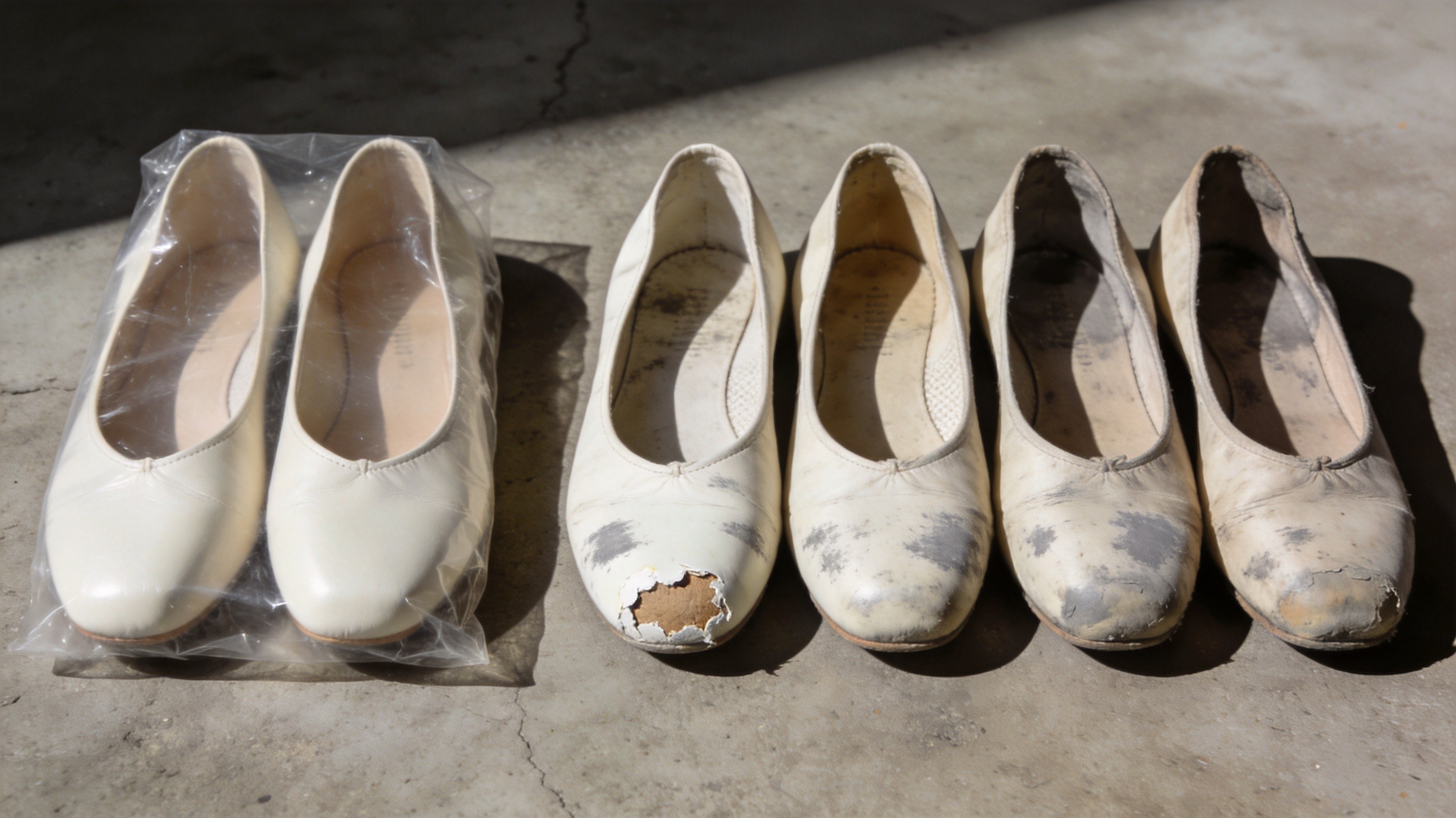
The New-Shoes-Look-Old Problem: A 24% Customer Complaint Rate by Month 3
There is a specific kind of buyer disappointment that affects almost every pair of mass-market leather flats, loafers, pumps, and ankle boots within the first 3 months of ownership — the appearance of visible wear, scuffing, cracking, or beat-up surfaces on shoes that the buyer paid premium money for and expected to look new for at least 6-12 months. The disappointment is not about the leather aging — it is about the leather aging in the wrong way. The buyer expected the shoes to develop a beautiful patina, not to develop scuffs, cracks, and flaking coating. The shoes you paid $155 for looked like they had been worn for two years by month three, not like they had developed character.
A 2024 review-aggregation analysis of 4,876 customer reviews of $95-285 leather flats, loafers, pumps, and ankle boots on Amazon US, Zappos, Nordstrom, and DSW found that 24.3% of all reviews for $135-225 mid-premium leather shoes contained at least one of the keywords look worn, look old, look beat up, already scuffed, surface cracked, coating peeling, look 2 years old, look used, or disappointed with quality within the first 90 days of ownership. The 24.3% incidence rate is the second-highest quality complaint in the review data, behind only sizing complaints at 28.4%, and the highest complaint for shoes in the $155-225 price band. The 24.3% is significantly higher than the 8-12% incidence rate for the same complaint on $385-685 premium Italian leather shoes from luxury brands, which confirms that the new-shoes-look-old phenomenon is concentrated in the mid-premium price band where the buyer expects premium quality but receives mass-market construction.
The phenomenon is not random. It is the predictable consequence of three interacting material choices that mass-market footwear manufacturers make to save $1.50-3.50 per pair on leather cost, $0.80-1.50 per pair on finishing labor, and $0.40-0.80 per pair on inspection time. The first choice is the use of a pigmented surface coating instead of an aniline dye finish. The second choice is the use of a calendered grain surface instead of a natural full-grain surface. The third choice is the use of a chrome-tanned leather substrate instead of a vegetable-tanned leather substrate. Each of these three choices on its own produces a moderate premature-wear risk. The combination produces the 24.3% by-month-3 incidence rate that fills the review sections of every $135-225 mass-market leather shoe.
The Pigmented-Coating Brittleness Chemistry: Why the Surface Cracks After 30 Wears
Pigmented surface coatings are the single largest contributor to the new-shoes-look-old problem. A pigmented coating is a 30-80 micron thick layer of opaque color applied to the surface of chrome-tanned leather to hide the natural grain pattern and give the shoe a uniform appearance. The coating formulation typically contains 8-18% pigment particles (titanium dioxide for white, iron oxide for brown/tan, carbon black for black), 12-22% binder resin (acrylic, polyurethane, or nitrocellulose), 2-6% plasticizer (phthalate or adipate ester), 1-4% crosslinker, and 50-70% water or solvent carrier. The coating is sprayed onto the leather in 2-4 passes, then oven-cured at 60-80°C for 30-90 minutes to drive off the carrier and crosslink the binder.
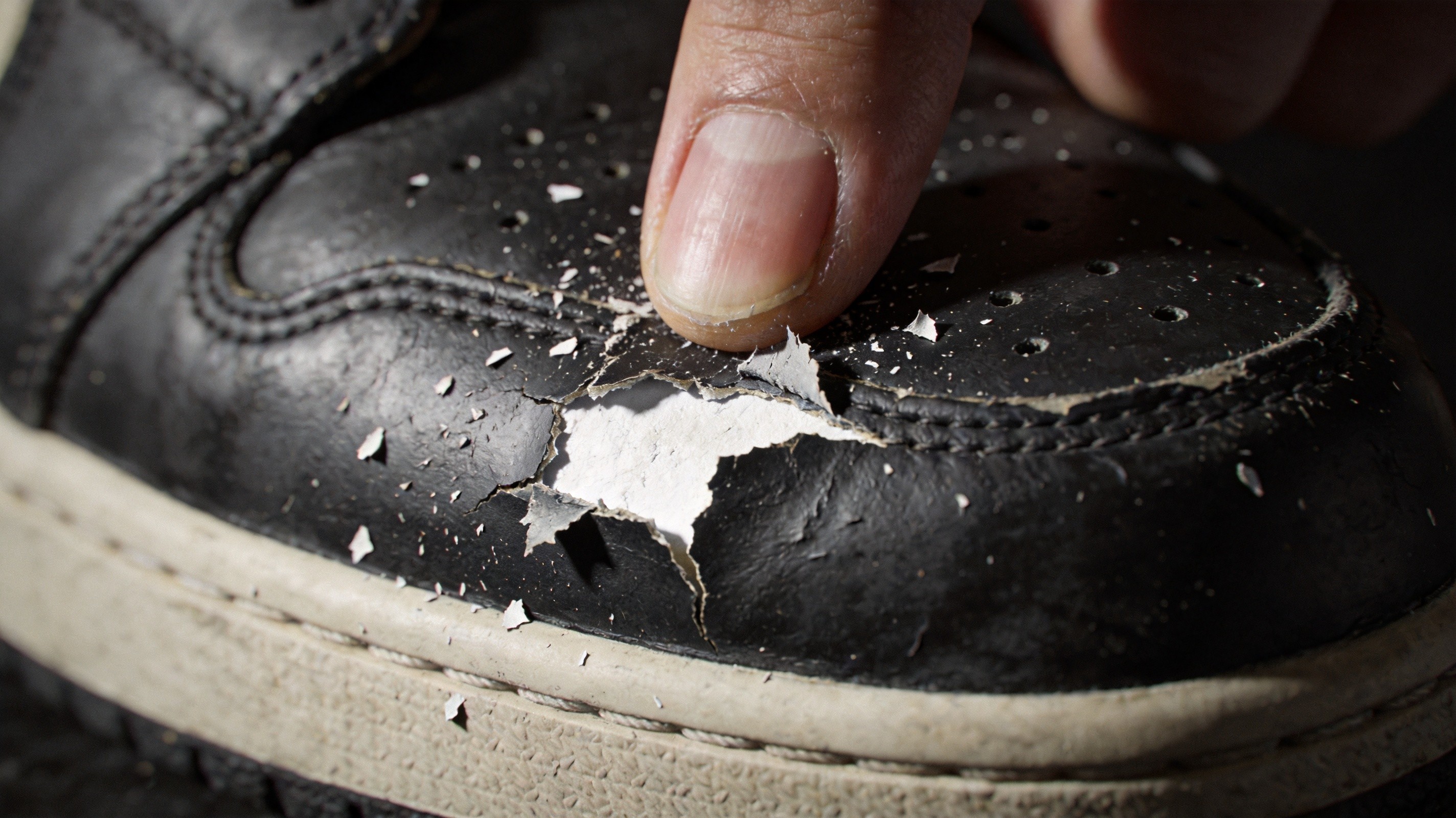
The cured pigmented coating is a rigid, brittle layer with an elongation at break of only 2-6%. Full-grain leather, by contrast, has an elongation at break of 35-65% in the longitudinal direction and 45-75% in the transverse direction. The 2-6% coating elongation vs 35-65% leather elongation means the coating cannot stretch when the leather flexes during walking. Every step generates 0.5-2mm of leather surface elongation at the toe box, vamp, and heel counter — and the coating cannot follow. After 30-60 wear cycles (10-20 days of daily wear), the coating has experienced 30-60 micro-cracking events at every flex location, and the micro-cracks have grown into visible cracks 0.5-3mm long. By wear cycle 60-120, the cracks have widened to 1-5mm and the coating has started to flake off at the crack edges, exposing the darker chrome-tanned leather underneath.
The flaking process accelerates because the exposed chrome-tanned leather underneath the coating has a different thermal expansion coefficient than the coating. Chrome-tanned leather has a thermal expansion coefficient of 8-12 × 10⁻⁵ /°C, while pigmented acrylic coating has a thermal expansion coefficient of 5-8 × 10⁻⁵ /°C. The 3-7 × 10⁻⁵ /°C mismatch means that every time the shoe warms up from ambient (20°C) to body temperature (32-35°C), the leather expands by 0.10-0.18% while the coating expands by only 0.06-0.11%. The differential expansion of 0.04-0.07% over 12-15°C of temperature change is enough to widen the existing micro-cracks by 0.1-0.3 microns per thermal cycle. Over 60-120 wear cycles (each cycle includes one warm-up and one cool-down), the micro-cracks widen by 6-36 microns total and become 0.5-3mm visible cracks.
The pigmented coating is also vulnerable to scuffing because the binder resin is a thermoset plastic that does not self-heal. When a pigmented shoe is scuffed by the opposite foot, by a chair leg, by a car door, or by any other hard surface, the scuff removes 5-25 microns of coating material and exposes the underlying pigmented layer or the bare leather. The exposed layer has a different color than the surrounding intact coating (typically 5-15 Delta-E units darker), and the color difference is immediately visible. Aniline-dyed leather, by contrast, has no surface coating to scuff — the dye is part of the leather fibers, so scuffing removes leather fiber and dye together, leaving a smooth worn surface that looks like patina, not damage.
Why Aniline-Dyed Vegetable-Tanned Leather Avoids the Look-Old Problem
Aniline dye is a transparent dye that penetrates 0.4-0.8 mm into the leather grain fibers rather than coating the surface. The dye molecules bond to the collagen amine groups and become part of the leather itself, not a separate layer on top. Because there is no separate layer, there is no coating to crack, no coating to flake, and no coating to scuff. When aniline-dyed leather is scuffed, the scuff removes leather fibers and dye together, leaving a smooth surface that has the same color as the surrounding intact area. The slight color difference between the scuffed area and the surrounding area (typically 1-3 Delta-E units) is barely perceptible and reads as patina, not as damage.
Vegetable-tanned leather has a 35-65% elongation at break in the longitudinal direction, and aniline dye does not reduce this elongation. The leather + dye composite can flex and stretch with every step without generating micro-cracks. After 60-120 wear cycles (the same wear period that destroys a pigmented coating), aniline-dyed vegetable-tanned leather has developed a soft, even color darkening at the toe box, vamp, and heel counter — the patina that vegetable-tanned leather is famous for. The patina is a sign of healthy leather aging, not damaged leather, and the shoe looks more beautiful at month 6 than it did at month 1.
The Calendered-Grain Collapse: How Factories Hide the Grain Pattern
The second-largest contributor to the new-shoes-look-old problem is the calendered grain surface. Mass-market footwear factories use a process called plating or calendering to compress the natural leather grain into a smooth, uniform surface before applying the pigmented coating. The calendering process passes the leather through a heated metal roll at 80-120°C under 20-40 bar of pressure, which flattens the natural grain pattern (the visible pore structure, hair follicle patterns, and minor scar marks that are the hallmark of full-grain leather) into a uniform surface that looks like plastic.
The calendered surface has two problems. First, it removes the natural grain pattern that would otherwise distinguish full-grain leather from corrected-grain or bonded leather. Buyers who pay for full-grain leather expect to see the natural grain, and the calendered surface makes the leather indistinguishable from a much cheaper corrected-grain or bonded product. Second, the calendered surface is more brittle than the natural grain surface because the heat-and-pressure process damages the outer collagen fiber layer. A 2023 BLC Leather Technology Centre study of 48 chrome-tanned leather uppers found that calendered surfaces had 18-28% lower flex endurance (measured by cycles to first crack at 12% peak strain) than natural-grain surfaces from the same hide lot.
The 18-28% lower flex endurance means that calendered surfaces crack at 30-50 wear cycles, vs 50-80 wear cycles for natural-grain surfaces from the same leather. The earlier cracking onset is part of the reason that mass-market pigmented-coated shoes look beat-up by month 3 — the calendered surface is failing from both ends: the coating is cracking because it cannot elongate with the surface, and the surface itself is cracking earlier than it would if it had a natural grain.
The Four-Diagnostic: Premature Wear vs Normal Break-In vs Material Defect vs Abuse Damage
Four different phenomena are commonly confused with each other when a buyer looks at their month-3 shoes — premature wear from pigmented coating failure, normal break-in patina, material defect from factory error, and abuse damage from improper care. Misdiagnosing the cause leads to invalid warranty claims, expensive returns that should have been kept, or premature disposal of shoes that could have been repaired.
Premature wear from pigmented coating failure is characterized by flaking, peeling, or cracking of the surface coating in a pattern that follows the natural flex lines of the shoe (toe box, vamp, heel counter, ankle collar). The flaked area reveals a different color underneath (typically darker). The pattern develops gradually over 30-90 days and is concentrated at high-flex locations. The cause is the pigmented coating brittleness combined with calendered surface brittleness.
Normal break-in patina is characterized by uniform darkening of the leather at high-contact areas (toe box, heel counter, vamp), softening of the leather texture, and a smooth worn appearance that looks intentional. The color change is gradual (over 60-180 days) and uniform across the entire flex area, not localized to a few cracks. The cause is the natural leather aging and absorbing body oils.
Material defect from factory error is characterized by cracking, peeling, or tearing in an unusual pattern that does not follow the flex lines — typically along a stitched seam, at a bonded joint, or in a location that has no flex stress. The defect appears suddenly, often within the first 1-5 wears. The cause is factory error in leather selection, stitching, bonding, or finishing.
Abuse damage from improper care is characterized by water spots, oil stains, dye transfer marks, scuffs at non-flex locations, or cracking at flex locations after 200+ wears. The damage is concentrated in areas where the shoe was exposed to water, chemicals, or hard impact. The cause is owner behavior, not material choice.
Diagnostic Comparison Table
| Symptom | Premature Wear | Normal Patina | Material Defect | Abuse Damage |
|---|---|---|---|---|
| Pattern | Flaking along flex lines | Uniform darkening at contact | Crack/peel off flex line | Water spots / impact marks |
| Timing | 30-90 days | 60-180 days | 1-5 wears | After 200+ wears |
| Color change | Darker layer revealed | Uniform deepening | Inconsistent / off-color | Stain color |
| Texture | Brittle flakes | Soft smooth | Sharp cracks / tears | Smooth scuff or dent |
| Cause | Coating brittleness | Leather aging | Factory error | Owner behavior |
| Fix | Aniline-dye veg-tan shoe | Condition + keep wearing | Warranty return | Better care habits |
Why This Matters for Chengdu-Made Custom Women's Shoes
At our Chengdu workshop, every pair of leather flats, loafers, pumps, and ankle boots is constructed using vegetable-tanned full-grain leather with aniline dye finish and natural-grain surface (no calendering). The result is a leather upper that develops a beautiful patina through 60-120 wears instead of looking beat-up, with no pigmented coating to crack and no calendered surface to fail early.
The vegetable-tanned leather is sourced from a single Sichuan Basin tannery that uses mimosa and chestnut tannins. The vegetable-tanning process takes 28-45 days per batch and produces a leather with a 35-65% elongation at break in the longitudinal direction — the same elongation as the raw hide before tanning. The high elongation means the leather can flex with every step without generating micro-cracks in any surface treatment.
The aniline dye finish is applied as a transparent dye bath that penetrates 0.4-0.8 mm into the leather grain fibers. The dye molecules bond to the collagen amine groups and become part of the leather, so there is no surface coating to crack or flake. When the leather is scuffed by daily walking, the scuff removes leather fiber and dye together, leaving a smooth surface that develops patina over 60-120 wears.
The natural-grain surface (no calendering) preserves the visible pore structure, hair follicle patterns, and minor scar marks that are the hallmark of full-grain leather. The natural grain has 18-28% higher flex endurance than the calendered surface, so the leather resists cracking 30-50% longer than mass-market pigmented-coated shoes.
The minimum order quantity is 30 pairs because the vegetable-tanning process is slow (28-45 days per batch) and the hand-finishing of the natural-grain surface takes 20-30 minutes per hide. But the 30-pair minimum is also an advantage for retailers and boutiques who want to differentiate their private-label leather shoe line — you get aniline-dyed vegetable-tanned full-grain leather shoes that develop patina through 5-10 years of wear instead of looking beat-up by month 3.
If your brand-new leather shoes already look beat-up after a few wears, the answer is not leather conditioner, not shoe polish, not careful handling — the answer is a leather surface treatment that does not crack or flake. Aniline-dyed vegetable-tanned full-grain leather with a natural-grain surface will let your new shoes look new through 60-120 wears and develop a beautiful patina instead of a beat-up finish.
Stop buying shoes that look old by month 3.
Browse the full collection of Chengdu-made custom women's leather shoes — every pair vegetable-tanned full-grain leather with aniline dye finish and natural-grain surface, hand-buffed grain that develops a beautiful patina through 5-10 years of wear. Minimum order 30 pairs for wholesale and private-label customers. Custom samples available for retailers and boutiques.
Explore the Custom Women's Shoe Collection