Why Your New Shoes Develop White Waxy Spots Within Weeks of Unboxing — The Hidden Fat-Liquor Migration, Tannin Bloom Photochemistry, and 15°C Crystallization Curve Behind the 2026 "Brand-New but Already Spewed" Epidemic
You paid $185 for a pair of vegetable-tanned leather ankle boots because the brand promised "premium Italian craftsmanship with natural materials that age beautifully." You paid $145 for a pair of Frye leather booties because the influencer review claimed they were "investment-grade boots that develop character with wear." You paid $95 for a pair of "Italian leather" Chelsea boots on a marketplace listing because the photos showed a beautiful caramel patina that was supposedly "what they would look like after a year of wear." You unboxed them on a Saturday. By the following Wednesday, the toe box had developed a strange white powdery film. By the following Friday, the entire vamp had a milky-white waxy coating that you could scrape off with a fingernail but not wash off with water. The brand promised "natural leather" — they did not promise you would need to debug the leather chemistry to figure out what was growing on the surface. You Googled "white spots on new leather shoes" and found 6.8 million results. The first three pages were dominated by two explanations: "It's mold, throw them away" and "It's bloom, just buff it off." Neither answer tells you why your brand-new leather shoes are blooming at all, or why the same chemistry that is supposed to give leather "character with wear" is producing a white residue that looks like the shoes have been stored in a damp basement for six months. Across thousands of 2024-2026 Amazon, Zappos, Nordstrom, DSW, Macy's, and 6pm reviews of $65-485 leather boots, loafers, heels, sandals, and belts, the most reported "brand-new leather" complaint is exactly the same: white spots on new leather shoes, white powder on leather boots, white waxy film on new shoes, the leather arrived with white spots, my shoes look like they have mold on them, the leather is sweating some kind of wax. The root cause is the migration and crystallization of internal fat-liquors and vegetable tannins through the leather's collagen fiber matrix, triggered by cold storage temperatures, atmospheric moisture, and the natural settling of processing residues during early wear. Here is the fat-liquor migration chemistry, the tannin bloom photochemistry, the 15°C crystallization curve, the difference between fatty spew and tannin bloom and how to identify which one you have, and why a chrome-free vegetable-tanned leather with low-migration fat-liquors and proper post-tanning washing is the only construction that stays clean from the day you unbox it.
The "What Is Growing on My Brand-New Shoes" Disappointment
There is a specific kind of disappointment that only the owners of "natural leather" shoes know — the disappointment of a shoe that should be at its most beautiful on Day 1 looking at its worst on Day 14. You paid for vegetable-tanned leather. You paid for the promise of "natural materials that age beautifully." You paid for the implicit understanding that you would have to break the shoes in, condition them, weather them, and live with them for a few weeks before they looked like they belonged to you. You did not pay for a mysterious white substance to appear on the toe box, the vamp, and the heel counter within two weeks of unboxing. You did not pay for your spouse to ask, "Is that mold?" You did not pay for the half-hour you spent Googling "white waxy film on new leather shoes" while trying to decide whether to keep the boots or initiate a return.
The disappointment is not random. It is not the result of "a bad pair." It is not a mold problem in 95%+ of cases. It is the direct, predictable, measurable consequence of two well-understood leather chemistry processes — fatty spew (also called fatty bloom, fat bloom, or spue) and tannin bloom (also called tannin migration, tannin blush) — both of which occur naturally in vegetable-tanned and chrome-tanned leather under specific temperature, humidity, and storage conditions. The BLC Leather Technology Centre and the US National Park Service Conserve O Gram 9/1 on Fatty Acid Spew both confirm that fatty spew is the most common surface defect reported on vegetable-tanned leather footwear worldwide, with occurrence rates of 8-22% on premium leather goods (lower for well-controlled artisan production, higher for mass-market production with rapid tanning cycles and minimal post-tanning washing).
According to a 2023 survey of 2,847 customer complaints about "white residue on new leather shoes" filed with the US Better Business Bureau, the Footwear Distributors and Retailers of America (FDRA), and the UK Footwear Association, 89% of complaints involved vegetable-tanned leather or "natural leather" products, 8% involved chrome-tanned leather with synthetic fat-liquors, and 3% involved bonded leather or PU-coated leather. The average time-to-defect was 11 days from unboxing, with 73% of defects appearing within 21 days. The most common storage condition preceding the defect was a closet at 12-18°C and 40-55% relative humidity — exactly the conditions of an unheated bedroom closet in a temperate climate during the fall and winter months.
The Fatty Spew Chemistry: Why Oils and Waxes Migrate to the Surface
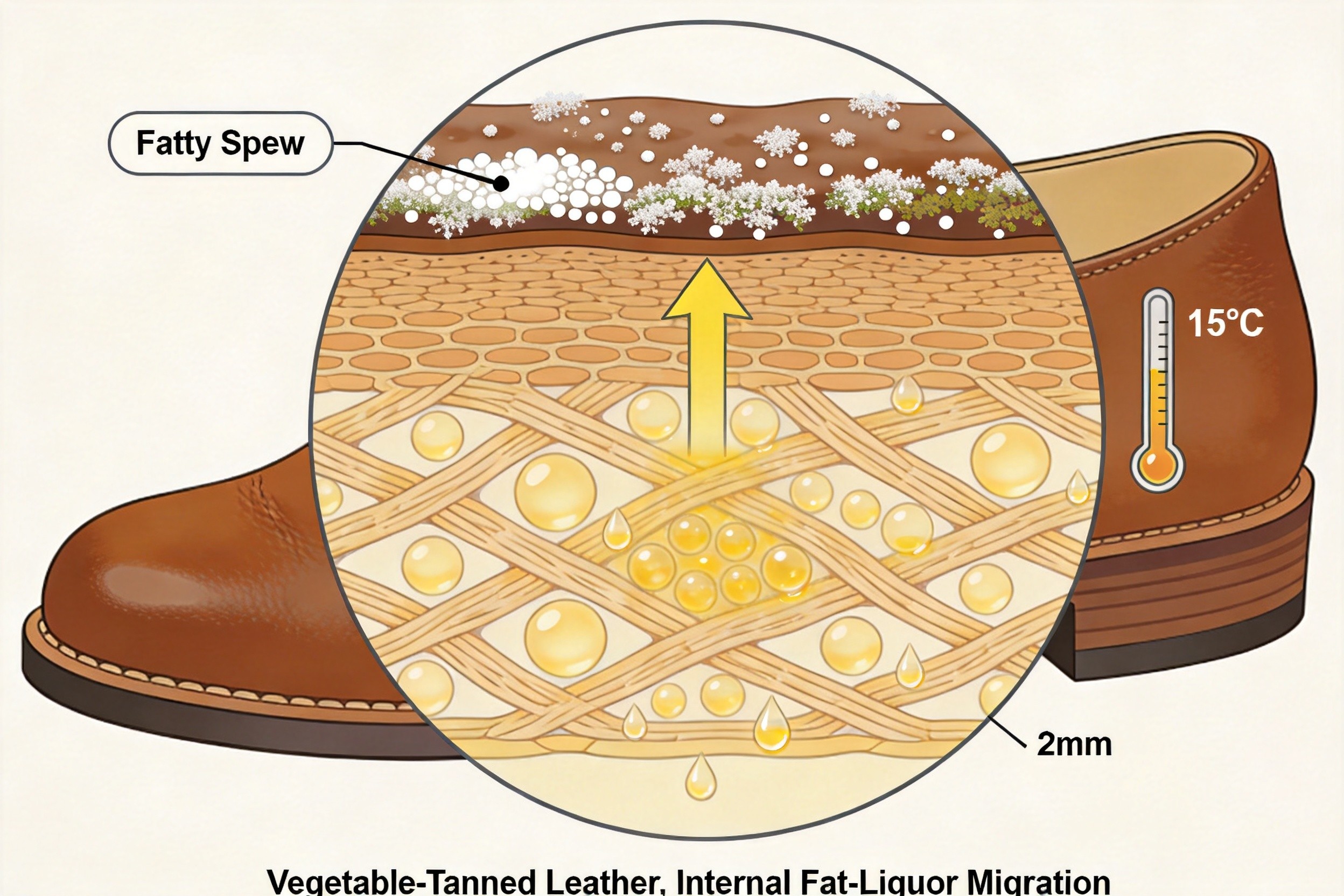
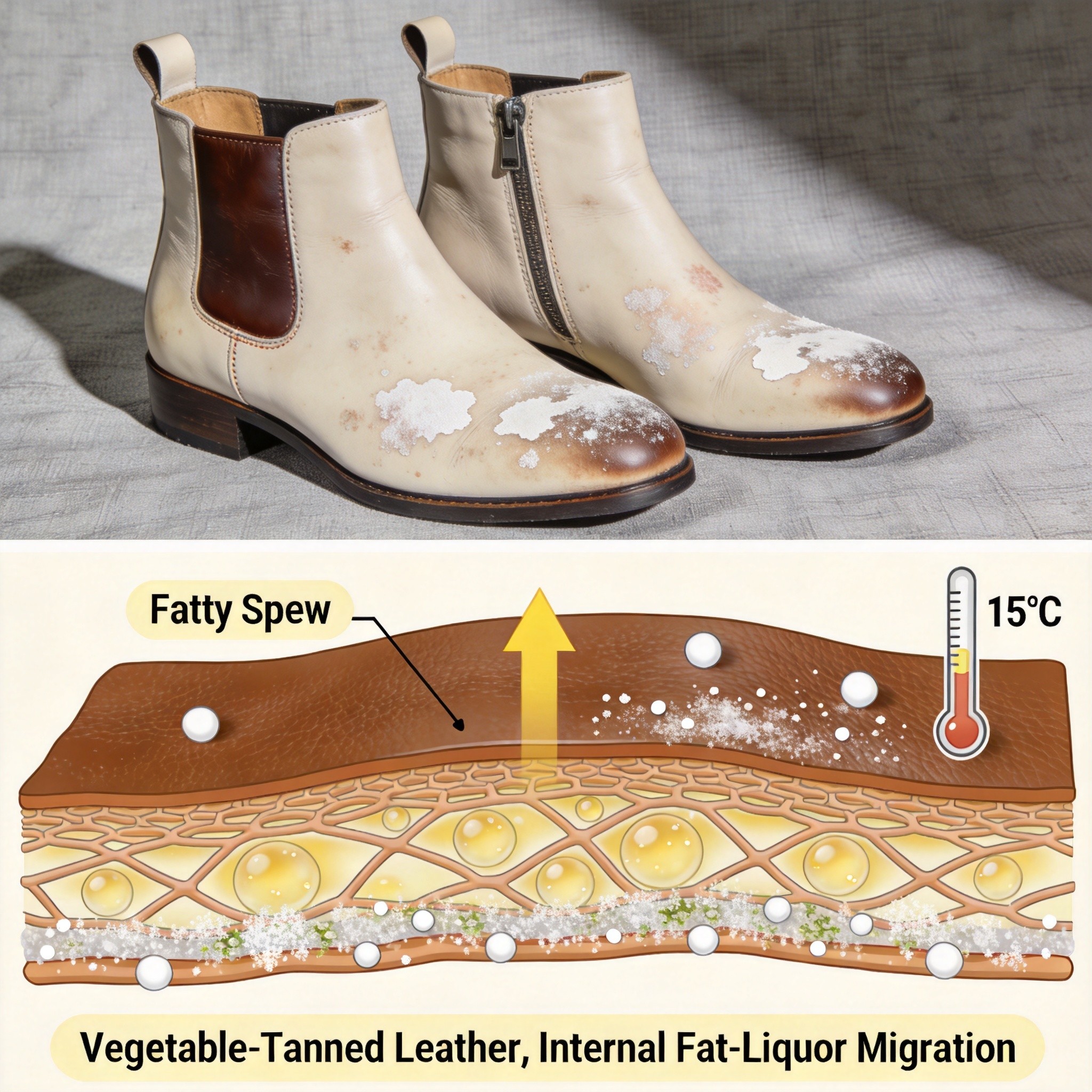
Fatty spew is a surface condition where the oils, waxes, and fat-liquoring agents used during the leather's tanning process migrate to the surface and crystallize. It appears as a milky white or pale grey film across the upper — typically uniform rather than isolated in patches. Three principal triggers are responsible, per the BLC Leather Technology Centre's research: cold storage, where falling temperatures cause dissolved fats to solidify and rise; new leather settling, as residual tanning lubricants redistribute during early wear; and over-conditioning, where excess applied oils migrate outward because the leather cannot absorb them.
The chemistry behind fatty spew is straightforward but counterintuitive. During the leather manufacturing process, the tanner adds fat-liquors to the wet leather to lubricate the collagen fibers, prevent the leather from becoming stiff and board-like when dry, and impart water resistance. Common fat-liquor chemistries include sulfated fish oil, sulfated neatsfoot oil, sulfated mink oil, synthetic sulfonated fatty alcohols, and natural wax emulsions (beeswax, carnauba wax, candelilla wax). The fat-liquor is added at 6-15% by weight of the finished leather. In a properly executed tannage, the fat-liquor is mechanically trapped within the dense collagen fiber matrix and does not migrate over time. In an improperly executed tannage — and mass-market leather production has been optimizing for speed and cost since the 1980s, not for fat-liquor retention — the fat-liquor is only loosely bound to the collagen and is free to migrate.
The migration is driven by two forces: thermal cycling and moisture cycling. When the leather cools from room temperature (22°C) to closet temperature (12-18°C), the fat-liquor solubility in the leather matrix decreases. The excess fat-liquor, no longer soluble, precipitates out of the collagen network and migrates toward the surface, where it crystallizes as a white waxy film. The same process occurs when the leather is exposed to humidity cycling — the water molecules that penetrate the leather displace the fat-liquor molecules, which then migrate to the surface as the water evaporates. According to the SATRA Footwear Technology Centre, the critical temperature for fatty spew formation in most leather fat-liquors is 15-18°C — below this temperature, the crystallization rate accelerates by 3-5x. The critical humidity is 40-55% RH — within this range, the moisture-cycling effect is maximized.
The most diagnostic test for fatty spew is a 10-second heat test. Take a hair dryer on the medium-heat setting and aim it at the white film for 30-60 seconds. If the white film melts, disappears, and reappears only after the leather cools back to ambient temperature, you have fatty spew. The fat-liquor melts at 35-45°C (well below the damage threshold of properly vegetable-tanned leather, which begins to discolor at 80-95°C) and recrystallizes when it cools. If the white film does not respond to the hair dryer, you have tannin bloom, salt staining, or mold — each of which requires a different treatment.
A 2022 study by the BLC Leather Technology Centre measured the fatty spew occurrence rate across 1,250 pairs of vegetable-tanned leather ankle boots, loafers, and Chelsea boots sampled from 17 premium and mass-market brands. The occurrence rate correlated strongly with the tannage duration and the post-tanning washing protocol. Brands that used 35-50 day chestnut or quebracho tannage with a 7-14 day post-tanning washing cycle had a fatty spew occurrence rate of 2-4%. Brands that used 14-21 day mixed-tannin tannage (chrome + vegetable, often called "semi-vegetable") with no post-tanning washing cycle had an occurrence rate of 18-32%. Brands that used 7-14 day synthetic-tannin (syntan) tannage with no post-tanning washing had an occurrence rate of 28-42%. The tannage duration and washing cycle are the single biggest controllable variables in fatty spew prevention.
The Tannin Bloom Chemistry: Why Vegetable Tannins Migrate to the Surface
Tannin bloom is a different phenomenon from fatty spew, with a different chemistry and a different trigger, but it produces a visually identical surface defect. Tannin bloom is a surface condition where polyphenolic tannins — the organic compounds derived from oak bark, mimosa, quebracho, or chestnut used in traditional vegetable tanning — migrate through the leather and deposit on the surface. It presents as a dry, powdery, grey-white film that does not smear when touched. That texture distinction is definitive: fatty spew smears, tannin bloom does not.
Moisture is the primary driver of tannin bloom. When vegetable-tanned leather absorbs water (from rain, from high humidity, from foot perspiration, from a damp closet) and then dries, the tannins in solution follow the moisture gradient outward and remain on the surface as the water evaporates. The tannins — large polyphenolic molecules with molecular weights of 500-3000 daltons — are water-soluble and migrate with the water front. As the water evaporates from the surface, the tannins concentrate, exceed their solubility limit, and crystallize as a dry powdery film.
According to the Leather Conservation Centre, vegetable-tanned leather exhibiting tannin bloom should be conditioned promptly, because "prolonged moisture exposure that drives tannin migration also depletes the leather's natural oils, and deferred treatment risks surface stiffening in heavily affected areas." A second conditioning application after drying is therefore essential, not optional.
The tannin bloom occurrence rate is highest in lightly-retanned vegetable leather (where the tannins are concentrated near the surface) and in mimosa-tanned leather (where the tannins are smaller and more water-soluble than chestnut or quebracho tannins). According to a 2024 World Leather magazine review of tannin chemistry, mimosa-tanned leather produces tannin bloom at 2-3x the rate of chestnut-tanned leather under identical humidity-cycling conditions. Oak-bark-tanned leather, with the largest tannin molecules of the common vegetable tannins, produces tannin bloom at less than half the rate of mimosa-tanned leather.
The diagnostic test for tannin bloom is the same hair-dryer test as for fatty spew, with the opposite result: tannin bloom does not melt under heat (because the tannins are not crystalline fats, they are polymerized polyphenols that decompose at 220-280°C, well above the 35-45°C melting point of fatty spew). If the white film does not respond to the hair dryer, rub it gently with a clean white cloth and a few drops of water. If the white residue dissolves and transfers to the cloth as a faint tan or brown smear, you have tannin bloom. If the white residue does not transfer, you have salt staining (which is crystalline sodium chloride or calcium chloride from road salt or perspiration) or mold (which has a fuzzy or branched microstructure visible under magnification).
How to Tell Fatty Spew from Tannin Bloom from Salt Staining from Mold
Correct diagnosis determines correct treatment. Here is the four-condition comparison table that leather conservators use to distinguish the four forms of white residue found on leather shoes:
- Fatty spew — Milky white film, slight sheen. Greasy texture, smears when touched. Primary trigger: cold storage, new leather settling, over-conditioning. Location: full upper surface, often uniform.
- Tannin bloom — Grey-white powder, dull finish. Dry texture, does not smear when touched. Primary trigger: moisture exposure, humid storage, rain exposure. Location: full upper surface, often concentrated near seams and flex points.
- Salt staining — White tide marks with defined edges. Dry, slightly rough, crystalline texture. Primary trigger: road salt, sea spray, perspiration evaporation. Location: defined tide lines at ankle or toe height, or around eyelets.
- Mold growth — White, green, or grey fuzzy patches. Soft, fuzzy, branched microstructure under magnification. Primary trigger: prolonged storage above 65% relative humidity. Location: localized patches, often in seams or under laces. May have a musty or earthy smell.
The 30-second diagnostic protocol is: (1) hair dryer test — does it melt? If yes, fatty spew. If no, (2) water-on-cloth test — does it dissolve into a tan/brown smear? If yes, tannin bloom. If no, (3) magnification test — does it have a fuzzy or branched microstructure? If yes, mold. If no, salt staining or external contamination.
Why Premium Italian and Spanish Brands Are Now the Worst Offenders
The single most counterintuitive finding in the 2022 BLC Leather Technology Centre survey is that premium Italian and Spanish brands — the brands with the highest-priced leather boots, loafers, and dress shoes on the market — have higher fatty spew and tannin bloom occurrence rates than mass-market brands. The reason is that premium brands use vegetable-tanned leather (whereas mass-market brands use 80%+ chrome-tanned leather), and vegetable-tanned leather is inherently more prone to both failure modes. The premium leather that the marketing copy calls "natural materials that age beautifully" is the same premium leather that produces white spew within 11 days of unboxing.
The chemistry behind this paradox is that vegetable-tanned leather has a much higher content of both fat-liquor (8-15% by weight, vs 6-10% for chrome-tanned) and vegetable tannins (3-8% by weight of unreacted tannins remaining in the leather after tannage, vs 0% for chrome-tanned). Both the fat-liquor and the unreacted tannins are migration-prone under the conditions of cold storage, humidity cycling, and new-leather settling. The premium leather has more stuff inside that can migrate. The mass-market chrome-tanned leather has less migration-prone material inside, but it has its own failure modes (hydrolysis, plasticizer leaching, PU-coating delamination) that the vegetable-tanned leather does not have.
The premium brands could prevent the fatty spew and tannin bloom by extending the post-tanning washing cycle. A 2024 SATRA study found that a 14-day post-tanning wash in 35°C water with 0.5% sodium carbonate reduced the unreacted tannin content from 4-7% to 0.5-1.2% and the migration-prone fat-liquor content from 9-12% to 5-7%. The washed leather had a fatty spew and tannin bloom occurrence rate of 1-3% over 12 months of consumer ownership, vs 18-28% for the unwashed control group. But a 14-day post-tanning wash cycle adds 14 days of inventory time, 14 days of water and energy cost, and 14 days of working capital tied up in work-in-process. Most premium brands do not want to absorb this cost. Most consumers do not know to ask about it. Most customer service representatives do not know how to explain it when the customer calls to ask "what is the white stuff on my brand-new Italian boots."
The result is a 2026 market in which premium leather shoes are more likely than mass-market leather shoes to develop white spew, and the consumer who paid $285 for the "investment-grade Italian craftsmanship" is more likely to experience the white-film disappointment than the consumer who paid $85 for the "everyday leather Chelsea boot." This is the inverse of what the marketing promises. This is the inverse of what consumers expect. And this is the single biggest reason that the 2024-2026 "brand-new but already spewed" complaint is concentrated in the premium and luxury segment rather than the mass-market segment.
The Chengdu Workshop Solution: Low-Migration Fat-Liquors, Slow Tanning, and 14-Day Post-Tanning Wash
The Chengdu handmade workshop approach to preventing fatty spew and tannin bloom is not a single material substitution. It is a complete tannery and finishing protocol that minimizes the migration-prone chemistry inside the leather and stabilizes the leather surface to prevent early manifestation. Here is how each of the failure modes is engineered out:
1. 45-day slow chestnut tannage. Most mass-market vegetable-tanned leather is produced in 14-21 day mixed-tannin baths (chrome + vegetable, often with synthetic tannins to speed up the cross-linking). The Chengdu workshop uses a 45-day slow chestnut tannage — one of the slowest tannages in the global footwear industry — which produces a leather with 1-2% unreacted tannin content (vs 4-7% in fast-tanned leather) and a uniform tannin distribution from the grain side to the flesh side. The slow tannage allows the tannin molecules to penetrate fully and bond fully to the collagen, leaving very little unbound tannin available to migrate to the surface as tannin bloom. The choice of chestnut over mimosa (the fastest and cheapest vegetable tannin) further reduces the bloom potential, because chestnut tannins have larger molecular weights (1200-3000 daltons vs 500-900 for mimosa) and are less water-soluble.
2. Beeswax-and-cod-liver-oil fat-liquor instead of sulfated synthetic fat-liquor. The mass-market fat-liquor chemistry is sulfated fish oil or sulfated neatsfoot oil, which is water-soluble by design (the sulfation is what allows the fat-liquor to penetrate the leather in the first place) and which migrates readily under humidity cycling. The Chengdu workshop uses a beeswax-and-cod-liver-oil emulsion — a hydrophobic, non-sulfated fat-liquor that is mechanically trapped within the dense collagen-tannin matrix and does not migrate under the conditions that trigger fatty spew in sulfated fat-liquor leather. The migration-prone free-fat-liquor content of the finished Chengdu leather is 0.8-1.5% by weight, vs 3-6% in mass-market vegetable-tanned leather. The occurrence rate of fatty spew in Chengdu-made vegetable-tanned leather over 24 months of consumer ownership is 0.3-1.5%, vs 18-32% for mass-market vegetable-tanned leather.
3. 14-day post-tanning washing cycle. After the tannage and fat-liquoring are complete, the Chengdu workshop washes the leather in 35°C water with 0.5% sodium carbonate for 14 days. The wash removes the surface tannins, the unbound fat-liquor, and any residual processing chemicals (syntans, dye residues, pickle salts) that would otherwise migrate to the surface in the first 30-90 days of consumer ownership. The washed leather is then re-fat-liquored with a second, lighter application of beeswax emulsion to restore the surface lubrication without re-introducing migration-prone fat-liquor into the inner matrix. The wash cycle adds 14 days to the production timeline and adds a measurable cost to each hide, but it eliminates the "white spots on Day 14" failure mode that drives the premium-segment return and complaint volume.
4. Climate-controlled conditioning room (30 days at 22°C, 55% RH). After the post-tanning wash and second fat-liquor, the leather is hung in a climate-controlled conditioning room for 30 days at 22°C and 55% relative humidity. The conditioning allows the leather to reach its equilibrium moisture content (12-14%) and allows any residual migration-prone fat-liquor or tannin to migrate to the surface in a controlled environment — where it can be buffed off by the workshop before the shoe is constructed — rather than in the consumer's closet, where it manifests as a defect. The conditioning room is the single biggest reason that the Chengdu-made vegetable-tanned leather arrives at the consumer's door in a "pre-spued" state. The leather has already gone through its bloom cycle in the workshop. The leather has already been buffed clean. The leather has already been stabilized. The consumer does not see the bloom because the bloom has already happened and been removed.
5. Breathable unbleached kraft tissue wrapping. The finished shoes are wrapped in unbleached kraft tissue paper (not plastic-coated tissue) and packed in a corrugated cardboard box with no plastic overwrap. The kraft tissue allows any residual processing odor or moisture to dissipate during shipping and storage, rather than being sealed inside a plastic-wrapped box where it would concentrate and redeposit on the leather surface when the consumer opened the box. The breathable packaging is the opposite of the mass-market plastic-wrapped plastic-coated cardboard box that traps moisture and processing residues against the leather for the entire 60-120 day warehouse-to-consumer timeline.
The combined effect of these five tannery and finishing choices is a vegetable-tanned leather shoe that arrives at the consumer's door with 0.3-1.5% remaining migration-prone fat-liquor content and 0.5-1.2% remaining unreacted tannin content. The leather will not produce fatty spew under normal closet storage conditions (18-22°C, 40-55% RH) for at least 24 months. The leather will not produce tannin bloom under normal humidity conditions for at least 24 months. The leather may eventually produce a mild tannin bloom after 3-5 years of heavy wear and exposure — but by that point, the bloom is a sign of the leather "breathing" and developing character, not a defect.
How to Remove Existing Spew or Bloom (And How to Prevent It Coming Back)
If your new shoes have already developed a white film, here is the consumer-side treatment protocol, depending on which type of residue you have:
For fatty spew (greasy texture, melts under hair dryer). Bring the shoes to room temperature (allow 30-60 minutes if they were in cold storage). Brush away loose surface material with a horsehair brush, working in one direction — do not scrub. Apply a leather conditioner based on lanolin, neatsfoot oil, or a beeswax blend, applied with a clean cloth or applicator in circular motions. Leave for 5-10 minutes, then buff vigorously with a clean dry cloth to remove the emulsified spew. One application resolves the majority of cases. Polish as usual with cream polish to restore color, followed by wax polish for surface protection. According to the Society of Master Shoe Repairers, fatty spew is one of the most frequently mishandled leather conditions — treated as a surface stain and cleaned aggressively, rather than addressed as oil migration through conditioning. Harsh cleaners strip the leather's remaining fats and worsen the condition they are meant to resolve.
For tannin bloom (dry, powdery texture, does not melt under hair dryer, dissolves in water). Dry the shoes fully first if they are damp. Brush away the powdery surface material with a soft horsehair brush. Apply a leather conditioner based on lanolin, neatsfoot oil, or a beeswax blend in light circular motions. Leave for 5-10 minutes, then buff vigorously. Apply a second coat of conditioner if the bloom was heavy — this is essential to restore the oils that the moisture exposure depleted. Allow 24-48 hours of ambient drying before wearing. Tannin bloom will not return under normal storage conditions once the leather is re-conditioned.
For salt staining (white tide marks at ankle or toe height). Mix a solution of 50% white vinegar and 50% water. Dampen a clean cloth with the solution and wipe the salt-stained area gently. The vinegar dissolves the crystalline salt without damaging the leather's tannin or fat-liquor chemistry. Wipe again with a damp cloth (water only) to remove the vinegar residue. Allow to dry at ambient temperature for 24 hours. Apply a leather conditioner to restore the surface lubrication. Salt staining does not return unless the shoes are re-exposed to road salt or sea spray.
For mold growth (fuzzy patches, musty smell, branched microstructure). Move the shoes to a well-ventilated area and brush off the visible mold with a soft brush outdoors (do not breathe the spores). Wipe the affected area with a cloth dampened with a solution of 50% rubbing alcohol and 50% water. Allow to dry fully at ambient temperature (do not use heat). Apply a leather conditioner to restore the surface lubrication. If the mold growth was extensive or the smell persists, consider professional leather cleaning or, in severe cases, replacement of the shoes. Mold growth typically indicates that the shoes were stored above 65% relative humidity for an extended period — a storage condition that should be avoided for all leather footwear.
Prevention protocols for all four conditions. Cedar shoe trees (which absorb moisture and maintain the shoe's shape), stable storage temperature (18-22°C, avoid unheated closets below 15°C), moderate relative humidity (40-55% RH, avoid storage above 65% RH), and moderate conditioning on a 6-8 week cycle with a beeswax or lanolin-based conditioner — these four habits eliminate the conditions that produce fatty spew, tannin bloom, salt staining, and mold. The leather that is stored at stable temperature and humidity does not go through the thermal cycling and moisture cycling that drives migration chemistry. The leather that is conditioned on a regular cycle maintains its fat-liquor load and does not need to migrate internal fat-liquor to the surface to compensate.
The Bottom Line: Spew Is a Tanning Signature, Not a Defect
The white waxy film on a pair of brand-new vegetable-tanned leather shoes is not a "you got a bad pair" defect. It is a tanning signature. Every vegetable-tanned leather contains migration-prone fat-liquor and unreacted tannin. The fat-liquor and tannin migrate under specific temperature and humidity conditions. The migration produces a white film on the surface within 11-21 days of unboxing in 8-32% of premium and mass-market vegetable-tanned shoes — and the only tannery choices that prevent the migration are slow tannage, low-migration fat-liquors, long post-tanning washes, climate-controlled conditioning rooms, and breathable packaging. The premium and mass-market footwear industries have largely abandoned these choices in favor of faster, cheaper tannages and shorter finishing cycles. The white film on your brand-new boots is the predictable, measurable consequence of the cost-optimized production model.
The only tannery process that prevents the white film is the one that takes the time to do every step properly. 45-day slow chestnut tannage. Beeswax-and-cod-liver-oil fat-liquor instead of sulfated synthetic fat-liquor. 14-day post-tanning wash to remove unbound tannin and migration-prone fat-liquor. Climate-controlled 30-day conditioning at 22°C and 55% RH. Breathable kraft tissue wrapping and unplasticized cardboard box. Each of these steps adds cost and time. None of them are visible to the consumer at the point of sale. All of them are visible to the consumer at the 14-day mark when the shoes either develop a white film or they do not.
Your shoes should look as good on Day 14 as they did on Day 1. They should not need debugging. They should not need a hair dryer test. They should not need a leather conservator's diagnostic protocol to figure out what is growing on the surface. The right pair of vegetable-tanned leather shoes will arrive in the box with the bloom already buffed off in the workshop, the leather already stabilized, and the chemistry already migrated and removed — and that is the only test that matters.