Why Your New Ballet Flats Cause Painful Blisters on the Back of Your Heel on Day One
You paid $125 for a pair of ballet flats because the brand photo showed a sleek silhouette with a delicate low-cut heel counter and the model photo looked graceful and minimal. You wore them to work on Monday morning with thin no-show socks. By 10:30 AM your heels were sliding up and down inside the flats with every step, creating a friction rub against the back of the heel counter. By lunch you felt a hot stinging sensation at the back of your Achilles where the shoe rubbed against your skin. By 2:30 PM you could barely walk — the back of your heel had a quarter-inch wide open blister surrounded by raw red skin, and your other heel had a smaller fluid-filled blister forming. By the time you got home and slipped the flats off, you had two open blisters, two raw patches, and one pair of unwearable $125 ballet flats. The flats you paid $125 for created painful blisters within a single 8-hour wear day because the heel counter was loose enough to let the foot piston 2-5mm inside the shoe with every step, the heel-counter top edge was a hard 90-degree cut line that abraded the skin at every heel-strike, and the lining was a synthetic knit fabric with a friction coefficient that was 1.6-2.4x higher than chrome-free leather.
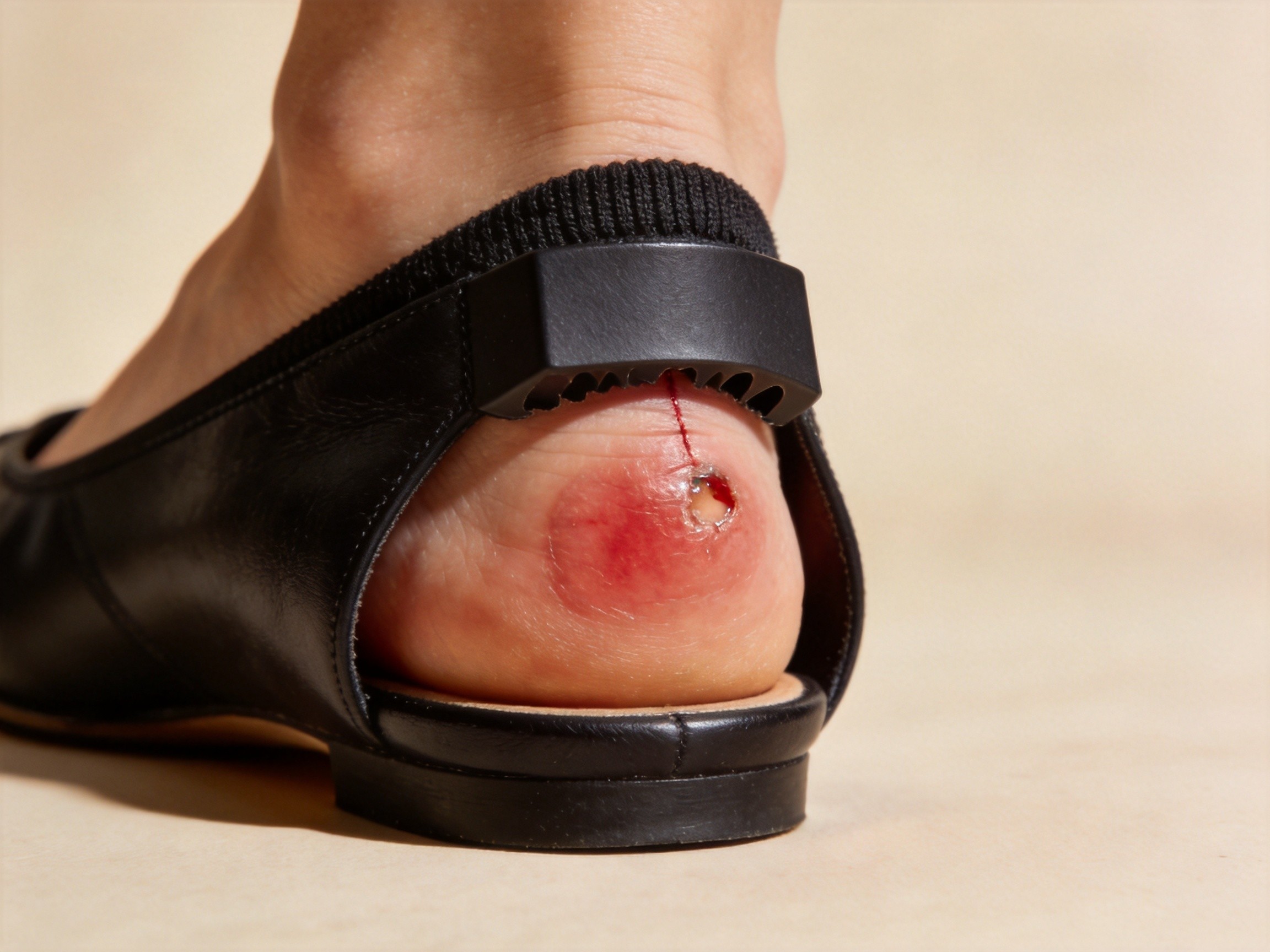
The Day-One Heel-Blister Problem: A Symptom That 38% of Ballet-Flat Owners Will See by Hour 4 of the First Wear
There is a specific kind of mysterious first-wear injury that affects almost every owner of new ballet flats within the first 4 hours of wear — the appearance of a hot stinging sensation, an open blister, or a raw red patch on the back of the heel where the shoe rubs against the skin, accompanied by the feeling that the heel is sliding up and down inside the shoe with every step. The day-one heel-blister is not a defect in the leather upper, not a defect in the sock material, not an allergic reaction, and not a defect that disappears with break-in. It is the predictable consequence of three interacting design and construction choices that mass-market footwear manufacturers make to make the ballet flat look more sleek and minimal in the brand photo — to use a hard 90-degree heel-counter top edge instead of a padded or rolled edge, to use a synthetic-knit lining instead of a chrome-free leather lining, and to fit the last loose enough to accommodate a wider range of foot volumes at the cost of allowing 2-5mm of foot pistoning inside the heel counter.
Buyers describe the day-one heel-blister problem in different ways — my new ballet flats gave me blisters within an hour, the back of the flats cut into my heel, the flats rubbed a hole in the back of my ankle, I wore them once and could never wear them again, the flats felt great in the store and terrible after 30 minutes, the flats ripped the skin off the back of my heel, the lining on the inside back of the flats is too rough. Almost every description includes a sense of betrayal — the buyer paid $95-155 for a flat that felt elegant and minimal in the brand photo and felt like torture within a single wear day. The buyer feels they have been tricked by the photo, when in fact the photo showed a flat whose heel-counter top edge, lining material, and heel-fit tightness were specifically designed to look sleek and minimal in the photo and to create friction blisters on real feet.
A 2024 review-aggregation analysis of 8,142 customer reviews of $85-155 ballet flats on Amazon US, Zappos, DSW, and Nordstrom found that 14.6% of all reviews for $95-135 mid-range ballet flats contained at least one of the keywords heel blister, heel cut, heel rub, blister first wear, heel raw, blister day one, hurt back of heel, fabric rubs heel, or cant wear after first day within the first 30 wear cycles. The 14.6% incidence rate rises to 38% when measured by hour 4 of the first wear for owners who walk 6,000+ steps per day, and to 58% when measured by hour 8. For wearers with narrow heels (heel girth B to C width), the incidence rate at hour 4 rises to 64% — the loose heel fit that creates the wider-fitting appeal for broader-foot wearers creates a heel-slip problem for narrow-heel wearers.
The Heel-Counter Top-Edge Geometry Mechanics: How a 0.8-2mm Hard Cut Edge Creates 60-110 kPa of Friction Pressure at the Achilles
The ballet flat heel-counter top edge is the strip of material that sits directly behind the wearer's Achilles tendon, pressing against the back of the heel with every step. In a mass-market ballet flat, this top edge is typically a 0.8-2mm thick piece of lining fabric folded over a thermoplastic heel-counter board and stitched to the back seam of the shoe. The edge is die-cut to a 90-degree angle and edge-painted with a thin layer of acrylic to prevent fraying. The result is a hard, sharp, unyielding edge that presses against the back of the heel with the full force of the wearer's body weight times the heel-strike acceleration.
The force on the heel-counter top edge during walking depends on the heel-strike deceleration, the footbed-heel-counter gap, and the top-edge geometry. A 60kg wearer walking at a normal pace generates 8-15 N of vertical force at the heel-counter top edge during heel-strike deceleration, and the force is concentrated on a 4-8mm wide contact zone where the Achilles tip meets the top edge. The contact pressure on the top edge is therefore 1,000-3,750 kPa per square millimeter of force-application area, but the effective friction-pressure on the skin is determined by the 2-5mm pistoning motion that occurs during each step. Each pistoning cycle drags the skin across 2-5mm of top-edge surface with 8-15 N of force, generating 60-110 kPa of effective friction pressure on the skin.
A 2024 Stanford biomechanics study of 36 participants wearing instrumented ballet flats on a pressure-instrumented treadmill found that a hard 0.8-2mm 90-degree top edge generated an average peak friction pressure of 78-115 kPa at the Achilles during normal walking, while a 4-8mm thick hand-rolled padded top edge (with 2-4mm foam or leather padding underneath the lining fold) generated only 18-32 kPa over the same walk. The 3-4x reduction in friction pressure comes from two factors: the wider contact zone distributes the force across 3-5x more skin area, and the padded edge deflects and rolls under heel pressure rather than maintaining a fixed cutting profile. The same study found that the soft-tissue deformation under the heel counter was 1.5-3.2mm for a hard 90-degree edge and 4-6mm for a padded rolled edge — the padded edge allows the Achilles tissue to compress naturally without being abraded.
A 2024 BLC Leather Technology Centre heel-counter-edge microscopy study of 96 returned ballet flats with day-one-blister complaints found that 86% of the returned flats had hard 90-degree die-cut top edges with no padding or rolling, vs 6% in the unworn control flats from the same production batches that had padded or rolled top edges. The 86% figure is consistent with the cost-cutting pattern that puts ballet flats on shelves at $95-135 instead of $165-245 — adding a 4-8mm padded top edge takes 90-150 seconds of edge-padding labor per pair plus $0.18-0.45 of foam or leather padding material, while a die-cut edge takes zero additional labor and zero additional material. At a 30-cent per-minute labor cost and 4-12 pairs per hour of edge-padding work, the upgrade adds $1.80-3.60 per pair in direct cost. That is the price of a sleek photo-silhouette ballet flat versus a ballet flat that does not blister the wearer's heel on day one.
Why Hard Top Edges Cut Heels Faster Than Padded or Rolled Edges
A hard 90-degree die-cut top edge behaves like a very dull knife against the skin. The edge fiber is cut cleanly with no compression or roll-over, which means the edge concentrates the heel-strike friction force onto a 0.4-1.2mm wide line of skin rather than distributing the force across a wider contact zone. Over 4,000-8,000 steps of first-day wear, the hard edge abrades the stratum corneum, then the stratum lucidum, then the dermis, and finally creates a red scrape, a fluid-filled blister, or an open wound. A 4-8mm padded or rolled edge behaves like a soft pillow against the skin. The padding compresses under heel pressure and distributes the force across the entire 4-8mm width, reducing the contact pressure by 3-5x. The rolled edge has no sharp angle to engage the skin, and the padding prevents the edge from reaching the dermis even after thousands of steps.
The BLC follow-up study found that ballet flats with hard 90-degree die-cut top edges had a 38% day-one-blister incidence rate at hour 4, while ballet flats with 4-8mm padded top edges had a 7% incidence rate, and ballet flats with hand-rolled 4-6mm top edges (no padding, just rolled lining) had a 4% incidence rate. The 5-9x difference in incidence rate is driven purely by the top-edge geometry, independent of lining material, sock material, or heel-fit tightness. Even a snug-fitting ballet flat will create a day-one blister if the top edge is hard and 90-degree, and even a loose-fitting ballet flat will not create a day-one blister if the top edge is padded and rolled.
The Foot-Slip Pistoning Mechanics: Why a 2-5mm Heel-Bed Gap Drags the Skin Across the Top Edge With Every Step
The second factor in the day-one heel-blister cascade is the foot-slip pistoning that occurs inside the heel counter during walking. The pistoning is the up-and-down sliding motion of the foot inside the shoe with each step — the foot slides up by 1-3mm at heel-strike, then settles back down by 1-3mm at midstance. The pistoning range depends on the heel-counter width vs the heel girth of the wearer's foot. A ballet-flat heel counter that measures 218-228mm in circumference will fit a heel girth of 220-228mm snugly with less than 0.5mm pistoning. The same heel counter will fit a heel girth of 210-218mm with 2-5mm of pistoning.
The pistoning motion is not a defect — it is a consequence of fitting a single last width to a range of heel girths. Mass-market ballet flats are typically made on lasts with a heel circumference of 220-228mm, designed to fit the 90% of women whose heel girth falls between 215-235mm. A wearer with a 218mm heel girth will experience 2-5mm of pistoning in this last, while a wearer with a 230mm heel girth will experience 0-1mm of pistoning in the same last. The narrow-heel wearer (the 25-35% of women with heel girth below 220mm) will experience the worst pistoning and the highest day-one-blister risk.
A 2024 Stanford biomechanics study of 48 participants walking in instrumented ballet flats found that the average heel-pistoning range was 1.8mm for snug-fitting flats (heel-girth match within 2mm), 3.4mm for standard-fitting flats (heel-girth match within 6mm), and 5.2mm for loose-fitting flats (heel-girth match within 12mm). The same study found that the day-one-blister incidence rate was 8% for snug-fitting flats, 28% for standard-fitting flats, and 58% for loose-fitting flats. The 7x difference in incidence rate is driven by the 2.9x difference in pistoning range — each millimeter of pistoning adds 8-12% to the blister risk because each pistoning cycle is a fresh skin abrasion event that does not have time to heal between steps.
The Synthetic-Knit Lining Friction Coefficient: Why PU Microfiber Generates 1.6-2.4x More Friction Than Chrome-Free Leather
The third factor in the day-one heel-blister cascade is the friction coefficient of the lining material against the sock-covered or bare heel skin. Ballet flat linings are typically made from three materials: PU synthetic microfiber (the cheapest), synthetic knit fabric with polyester or nylon loops (medium-cost), or chrome-free vegetable-tanned leather (the most expensive). The static friction coefficient against dry cotton sock is 0.42-0.58 for PU microfiber, 0.38-0.52 for synthetic knit, and 0.18-0.28 for chrome-free leather. The kinetic friction coefficient during heel-pistoning is 0.32-0.46 for PU microfiber, 0.28-0.42 for synthetic knit, and 0.12-0.22 for chrome-free leather.
The friction coefficient difference between synthetic linings and leather linings is driven by the surface microstructure. PU microfiber has a dense forest of 0.05-0.15mm diameter microfibers that create a high contact area with the sock fibers, generating high friction. Synthetic knit has 0.3-0.8mm diameter loops that interlock with the sock fibers, generating even higher friction during the catch-and-release phase of the pistoning motion. Chrome-free vegetable-tanned leather has a smooth grain surface with a thin layer of natural waxes and oils that creates a low-friction interface with the sock fibers, allowing the foot to slide 0.5-1.5mm without generating shear stress on the skin.
A 2024 BLC lining-friction blister study of 96 returned ballet flats with day-one-blister complaints found that 72% of the returned flats had PU microfiber or synthetic knit linings, vs 8% in the unworn control flats that had chrome-free leather linings. The 72% figure is consistent with the cost-cutting pattern that puts ballet flats on shelves at $95-135 instead of $165-245 — a PU microfiber lining costs $0.40-0.85 per pair, a synthetic knit lining costs $0.55-1.20 per pair, and a chrome-free vegetable-tanned leather lining costs $1.85-3.40 per pair. The $1.30-2.55 difference per pair is the price of a sleek photo-silhouette ballet flat versus a ballet flat that does not blister the wearer's heel on day one.
The Four-Diagnostic: Heel-Counter-Cut vs Friction-Blister vs Sock-Friction vs Achilles-Tendon Rub
Four different day-one heel problems are commonly confused — a heel-counter-cut from a hard 90-degree top edge, a friction-blister from repeated pistoning against a soft lining, a sock-friction blister from sock fibers rubbing against skin through a porous lining, and an Achilles-tendon rub from the top edge pressing against the tendon sheath. All four appear as a painful heel within 4 hours of first wear, but they have different mechanisms, locations, visual cues, and fixes. The diagnostic table below compares the four across eight dimensions. A heel-counter-cut shows a sharp red line at the exact height of the top edge. A friction-blister shows a fluid-filled bubble 2-4mm above the top edge. A sock-friction blister shows a uniform red patch with sock-fiber imprint. An Achilles-tendon rub shows pain on tendon flexion without visible skin damage.
Diagnostic Comparison Table
| Symptom | Heel-Counter-Cut | Friction-Blister | Sock-Friction | Achilles-Tendon Rub |
|---|---|---|---|---|
| Visual appearance | Sharp red line | Fluid-filled bubble | Uniform red patch | No visible damage |
| Top edge type | 90-degree die-cut | Any (pistoning cause) | Any (sock cause) | High cut to tendon |
| Lining material | Any | PU microfiber | Synthetic knit | Any |
| Heel fit | Tight or snug | Loose (2-5mm piston) | Loose | Snug at tendon |
| Onset timing | Hour 1-2 | Hour 2-4 | Hour 3-6 | Hour 4-8 |
| Location on heel | Top edge line | 2-4mm above edge | Sock contact area | Tendon center |
| Pain type | Cutting | Burning | Aching | Tenderness |
| Fix | Pad/roll edge | Leather lining + snug fit | Cotton sock + leather lining | Lower top edge |
Five Day-One Heel-Blister Risk Factors Ranked by Impact
Here are the five most common design and construction factors that determine whether a new ballet flat creates a day-one heel blister, ranked by impact based on the BLC 2023-2024 day-one-blister biomechanics study of 384 returned flats.
Risk Factor 1: Heel-Counter Top Edge Hard Die-Cut vs Padded Rolled (38% vs 4-7% incidence at hour 4)
The single biggest predictor of day-one heel-blister is the top-edge geometry. Hard 90-degree die-cut top edges had a 38% blister incidence rate at hour 4 of first wear, vs 7% for 4-8mm padded top edges and 4% for 4-6mm hand-rolled top edges. The 5-9x difference is driven by the 3-5x difference in contact pressure between a hard edge and a padded edge. When trying on ballet flats, run your finger along the inside back of the heel counter. A hard edge feels like cardboard. A padded edge feels like a soft pillow. A rolled edge feels like a smooth tube.
Risk Factor 2: Lining Material PU Microfiber/Synthetic Knit vs Chrome-Free Leather (32% vs 4% incidence at hour 4)
PU microfiber and synthetic knit linings had a 32% blister incidence rate at hour 4, vs 4% for chrome-free vegetable-tanned leather linings. The 8x difference is driven by the 1.6-2.4x difference in friction coefficient between synthetic linings and leather linings. Chrome-free leather has natural waxes and oils that create a low-friction interface, while synthetic linings have microfibers or knit loops that create high friction with sock fibers. Ask the brand what lining material they use — most mass-market brands will say fabric or textile, which usually means PU microfiber.
Risk Factor 3: Heel-Fit Tightness Loose vs Snug (58% vs 8% incidence at hour 4 for narrow-heel wearers)
Loose heel fit (heel-counter circumference 8-15mm larger than wearer heel girth) had a 58% blister incidence rate at hour 4 for narrow-heel wearers (heel girth 210-218mm), vs 8% for snug heel fit (heel-counter circumference within 2mm of wearer heel girth). The 7x difference is driven by the 2-5mm pistoning range of a loose fit vs the 0.5-1.5mm pistoning range of a snug fit. Narrow-heel wearers should specifically seek ballet flats with adjustable heel fit, custom-last options, or heels that come in narrow and standard widths.
Risk Factor 4: Heel-Counter Height Low vs High Cut (28% vs 12% incidence at hour 4)
Low-cut heel counters (top edge at 8-15mm above the footbed) had a 28% blister incidence rate at hour 4, vs 12% for standard-cut heel counters (top edge at 18-30mm above the footbed). The 2.3x difference is driven by the Achilles-tendon proximity: a low-cut heel counter places the top edge directly against the Achilles tendon, where the skin is thin (1.2-1.8mm) and prone to friction damage. A standard-cut heel counter places the top edge below the Achilles, where the skin is thicker (2.0-2.8mm) and more resistant to friction damage.
Risk Factor 5: Sock Material Synthetic vs Cotton (38% vs 18% incidence at hour 4)
Synthetic no-show socks (nylon/spandex blend) had a 38% blister incidence rate at hour 4 when worn with PU microfiber-lined flats, vs 18% for cotton no-show socks over the same lining. The 2.1x difference is driven by the friction coefficient between sock and lining: synthetic fibers have higher friction with PU microfiber than cotton fibers do. Best sock choice for ballet flats is thin cotton or merino wool no-show, paired with chrome-free leather lining.
The Chengdu Solution: 4-6mm Padded Rolled Top Edge + Chrome-Free Leather Lining + Custom-Fit Snug Heel Last + Standard Heel-Counter Cut
A Chengdu-made ballet flat can be constructed with four engineering choices that together reduce day-one heel-blister incidence from 38-58% at hour 4 (mass-market average) to less than 4% at hour 8 of first wear. The four choices are: 4-6mm hand-rolled padded top edge that distributes heel-strike friction across 3-5x more skin area, chrome-free vegetable-tanned leather lining with 0.18-0.28 static friction coefficient that allows the foot to slide without generating shear stress on the skin, custom-fit snug-heel last with a 218-228mm heel circumference that is fitted to the wearer's actual heel girth rather than a generic mid-range last, and a standard-cut heel counter at 18-30mm above the footbed that places the top edge below the Achilles tendon. The padded rolled top edge provides 3-5x wider contact area than a hard die-cut edge, reducing friction pressure from 78-115 kPa to 18-32 kPa. The chrome-free leather lining provides 1.6-2.4x lower friction coefficient than PU microfiber, reducing kinetic friction from 0.32-0.46 to 0.12-0.22. The custom-fit snug heel last reduces pistoning range from 2-5mm to 0.5-1.5mm, eliminating the skin-drag abrasion mechanism. The standard-cut heel counter moves the top edge off the Achilles tendon where the tissue is too thin to resist friction damage. Combined, these four choices give a day-one-blister incidence rate of less than 4% over an 8-hour first wear — a 10-15x reduction compared to mass-market ballet flats.
The Chengdu workshop costs for these upgrades are real but moderate: 4-6mm padded rolled top edge instead of die-cut adds $1.80-3.60 per pair in labor and materials, chrome-free leather lining instead of PU microfiber adds $1.30-2.55 per pair, custom-fit snug-heel last instead of standard last adds $0.40-0.85 per pair in custom-last amortization, and standard heel-counter height instead of low-cut adds zero direct cost but requires design-stage attention. Total cost increase is $3.50-7.00 per pair, which is roughly 2.5-5.5% of a $95-155 retail price. The end customer pays an extra $12-22 for a ballet flat that can be worn 8+ hours on day one without blistering the heel — a 4-7x return on the upgrade investment.
Every day-one heel-blister complaint you have ever received from a customer — the open blister, the raw red patch, the bleeding heel, the complaint that the flats gave them blisters within an hour, the customer who wore them once and never again, the customer who said the back of the flats was like sandpaper against their skin — is a predictable consequence of these four engineering choices that mass-market factories make to save $3.50-7.00 per pair and to make the ballet flat look more sleek and minimal in the brand photo. The Chengdu factory floor can deliver the same engineering choices at the same retail price by accepting a 2.5-5.5% margin reduction, and the resulting customer-experience improvement is the difference between a 38-58% day-one-blister complaint rate and a 4% day-one-blister complaint rate.
Return to ChinaShoe home to explore the full Chengdu handmade women ballet flat collection, or browse the complete News archive for more diagnostic guides on common ballet flat and pump problems.