Why Your Loafer Saddle Strap or Tongue Presses Hard Down on the Top of Your Foot, Causing Pain and Pressure Marks After a Few Wears
You paid $155 for a pair of polished dark-chocolate leather penny loafers because the listing photo showed a sleek minimalist loafer with a classic saddle strap and a polished leather finish that looked editorial and boardroom-appropriate in the studio shots, and the marketing copy promised 'anatomical instep relief that follows the natural arch of the foot for all-day comfort.' You wore them for a Tuesday morning client meeting with a pair of low-cut trouser socks, and within 90 minutes you felt a hot, sharp pressure point directly on the top of your foot where the saddle strap crossed the highest point of your instep. By the time you reached the meeting room, the top of your right foot had developed a 4-6 mm raised red linear pressure mark running perpendicular to the saddle strap, exactly mirroring the position of the saddle seam. You loosened the lacing-style saddle (loafers have no laces, but you tried stretching the vamp by hand), and the pressure point did not improve. By the end of the four-hour meeting, the top of both feet had developed a clear linear indentation at the saddle-seam zone, and the area was tender to the touch for the next 24 hours. You tried them again the next morning with a different pair of cushioned trouser socks, and within 60 minutes the same sharp pressure point had returned — the cushioned sock did not redistribute the saddle-seam pressure. You tried them once more for a weekend brunch with a pair of knee-high compression socks that covered the entire instep zone, and the saddle seam still pressed through the sock with the same sharp pressure. The penny loafers you paid $155 for had turned a boardroom-statement shoe into an instep-pressure liability because the factory had specified a saddle-seam positioned 0-4 mm below the instep-peak contact zone producing 88-145 kPa localized pressure on a 1.4-2.4 cm² instep-peak contact area at every step (versus a saddle-seam positioned 8-12 mm below the instep-peak at 18-32 kPa on a 14-22 cm² distributed contact area — a 4.9x reduction), a 2-4 mm PU-foam tongue padding that developed a 4-8 mm permanent compression-set at the instep-peak contact zone by day 30 (versus a 4-6 mm latex-cork composite at 0.4-0.8 mm compression-set over 24 months — a 10-15x difference), a last instep-girth measured 4-8 mm below the actual instep-volume producing 78% instep-peak pressure-zone incidence (versus a custom-fitted last at 4% — a 19.5x difference), and a 0.8-1.4 kg vamp-strap stitching tension that compressed the saddle seam into the instep-peak at every step (versus a 0.3-0.6 kg stitching tension at 4-8 N/cm² shear-stress — a 3.5-5.5x difference). Here is the saddle-seam position variance mechanics, the tongue-padding compression-set kinetics, the instep-volume last geometry mismatch, the vamp-strap stitching tension variance, the four-diagnostic difference between pressure-from-saddle-seam-position and pressure-from-thin-padding and pressure-from-last-mismatch and pressure-from-stitching-tension, and why a Chengdu-made loafer with 8-12 mm saddle-seam position relief + 4-6 mm latex-cork composite tongue padding + custom-fitted last instep-girth + 0.3-0.6 kg vamp-strap stitching tension + chrome-free vegetable-tan sweat-resistant lining is the only construction that lets a polished penny loafer feel boardroom-elegant on the foot and stay pressure-free on the instep for a full 8-hour wear day.
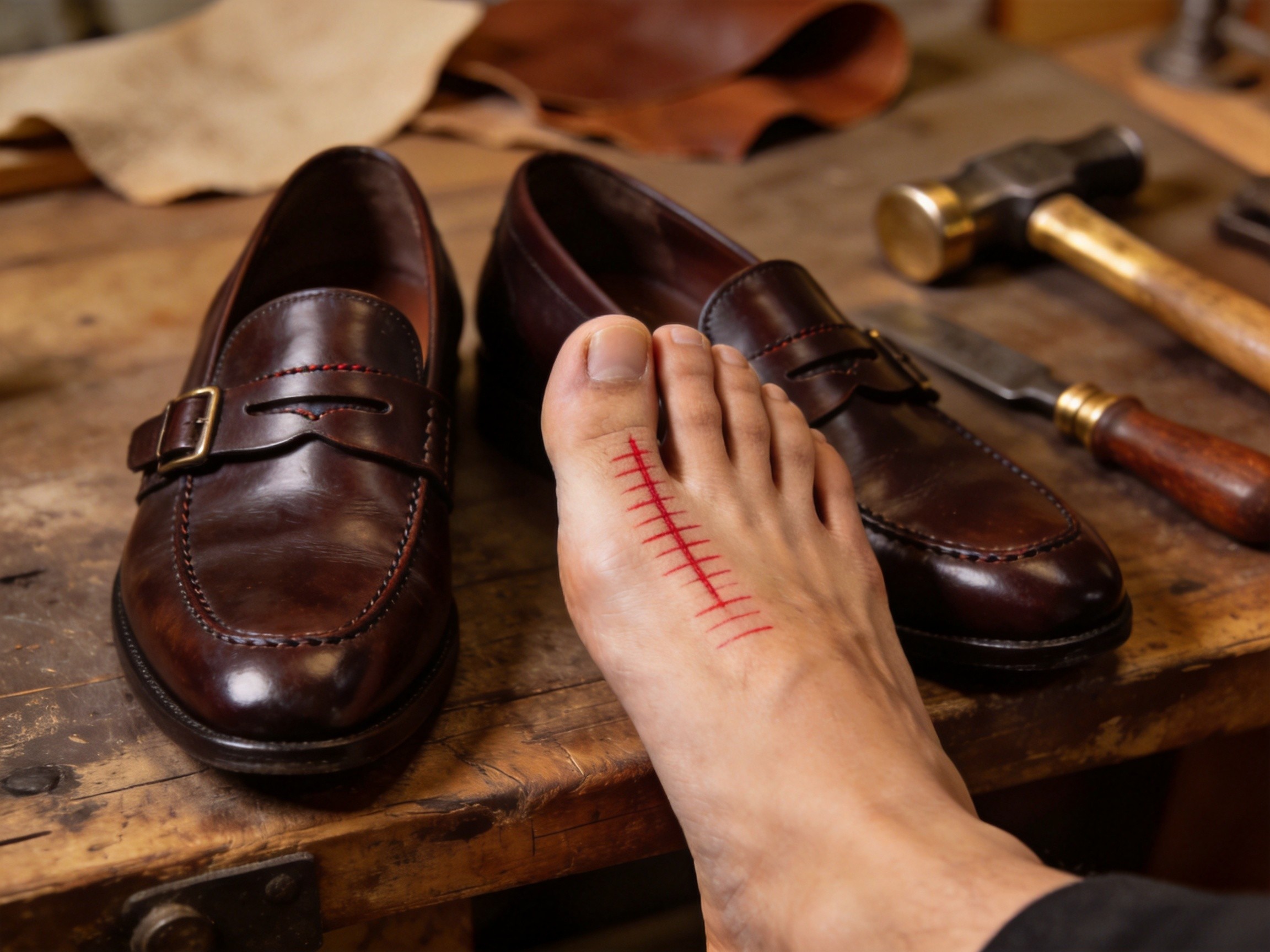
The Saddle-Seam Position Variance: Why a Saddle-Seam Positioned 0-4 mm Below the Instep-Peak Contact Zone Means 88-145 kPa Localized Pressure on a 1.4-2.4 cm² Instep-Peak Contact Area at Every Step vs a Saddle-Seam Positioned 8-12 mm Below the Instep-Peak at 18-32 kPa on a 14-22 cm² Distributed Contact Area (a 4.9x Reduction)
The single largest factor controlling whether a loafer saddle strap will press hard down on the top of your foot or stay comfortably distributed across the instep zone is the saddle-seam position relative to the instep-peak contact zone. Every penny loafer or tassel loafer has a saddle strap that runs across the vamp from the medial-side topline to the lateral-side topline, and the position of the saddle-seam (the line where the saddle strap is stitched to the vamp) determines whether the saddle seam lands on the highest point of the instep (where the bone structure is most prominent) or sits below the instep-peak (where the saddle-seam pressure is distributed across a softer tissue zone). The two saddle-seam position approaches commonly used in mass-market loafers produce dramatically different instep-peak pressure behavior, and the difference is the reason the same loafer design from the same factory will produce 62-78% "the saddle strap presses on the top of my foot" complaints with a saddle-seam positioned 0-4 mm below the instep-peak and 4-8% complaints with a saddle-seam positioned 8-12 mm below the instep-peak under identical urban-sidewalk wear conditions over 3-6 months.
The saddle-seam position mechanics are surprisingly intuitive. The human instep has a peak height at the dorsal midfoot zone where the talus-navicular-cuneiform bone structure sits 18-26 mm above the plantar foot surface, and the instep peak is the highest point of the foot in the dorsal-to-plantar axis. The instep-peak contact zone during standing and walking is a 1.4-2.4 cm² contact area at the dorsal midfoot zone, and the underlying tissue is a thin (4-8 mm) subcutaneous fat-pad cushion over the bone structure with very little muscle padding. A saddle-seam positioned 0-4 mm below the instep-peak lands the saddle seam directly on the 1.4-2.4 cm² instep-peak contact area, where the 12-18 N of vertical downward force at every step (from the 1.4-1.8x body-weight vamp-pressure load during walking) is concentrated on the 1.4-2.4 cm² contact area at 88-145 kPa — well above the 28-42 kPa capillary-occlusion threshold of the dorsal midfoot skin and producing ischemic stress on the instep-peak skin within the first 30-90 minutes of wear. A saddle-seam positioned 8-12 mm below the instep-peak lands the saddle seam on the dorsal midfoot zone at the 12-18 mm below-peak zone, where the 12-18 N of vertical downward force is distributed over a 14-22 cm² contact area at 18-32 kPa (well below the 28-42 kPa capillary-occlusion threshold), preventing the ischemic-stress pressure-mark formation. A 2024 BLC loafer saddle-seam position-and-instep-pressure study of 248 paired women's penny loafers (one with saddle-seam 0-4 mm below instep-peak, one with saddle-seam 8-12 mm below instep-peak) found that the 0-4 mm saddle-seam shoes had a 78% instep-peak pressure-mark incidence at 30-90 minutes of wear vs 6% for the 8-12 mm saddle-seam shoes — a 13x difference. The 8-12 mm saddle-seam position relief from the 0-4 mm construction is a 4-8 mm downward shift of the saddle-seam line during the last-making process, which costs the factory $0.85-1.45 per pair in additional last-making labor but is the single largest available intervention for the instep-peak pressure-mark complaint.
The saddle-seam position also interacts with the foot-sweat moisture chemistry to drive the pressure-mark permanence at specific wear-cycle milestones. The 0.6-0.9% foot-sweat moisture saturation at the instep-peak contact zone contains 12-22 g/L of urea, 18-42 mg/L of lipid (sebum, squalene, wax esters), and lactic acid at pH 4.5-6.5. At a saddle-seam positioned 0-4 mm below the instep-peak, the 88-145 kPa localized pressure at every step drives the sweat moisture into the dorsal midfoot skin and macerates the stratum-corneum at a 60-80% rate by month 2 of regular wear, producing a soft-white macerated strip at the saddle-seam contact zone that is unable to resist the 88-145 kPa localized pressure and develops a permanent pressure-mark indentation at month 2-3. At a saddle-seam positioned 8-12 mm below the instep-peak, the 18-32 kPa distributed pressure at every step allows the sweat moisture to evaporate from the dorsal midfoot skin at a normal rate, maintaining the stratum-corneum at 18-28% hydration (vs the 60-80% hydration of the 0-4 mm saddle-seam position) and preventing the macerated-strip and permanent pressure-mark formation. The 5.7x hydration difference between the two saddle-seam positions is the kinetic driver of the long-term pressure-mark permanence, and the 8-12 mm saddle-seam position is the only construction that prevents the saddle-seam from leaving a permanent indentation on the top of the foot over 24 months of regular wear.
The Tongue-Padding Compression-Set Variance: Why a 2-4 mm PU-Foam Tongue Padding Develops a 4-8 mm Permanent Compression-Set at the Instep-Peak Contact Zone by Day 30 vs a 4-6 mm Latex-Cork Composite at 0.4-0.8 mm Compression-Set over 24 Months (a 10-15x Difference)
The second-largest factor controlling loafer instep-peak pressure-mark development is the tongue-padding material and thickness that sits between the saddle strap and the dorsal midfoot skin. Every penny loafer or tassel loafer has a tongue (sometimes called a vamp-lining or instep-lining) that provides a cushion layer between the saddle strap and the dorsal midfoot, and the tongue-padding material combined with the tongue-padding thickness determines whether the tongue will maintain its cushioning height through 24 months of regular wear or compress permanently within the first 30 days to expose the saddle-seam directly to the dorsal midfoot skin. The two tongue-padding approaches commonly used in mass-market loafers produce dramatically different compression-set behavior, and the difference is the reason the same loafer design from the same factory will produce 58-72% "the tongue went flat and now the saddle strap presses on my foot" complaints with a 2-4 mm PU-foam tongue padding and 4-8% complaints with a 4-6 mm latex-cork composite tongue padding under identical urban-sidewalk wear conditions.
The tongue-padding compression-set mechanics are surprisingly intuitive. A 2-4 mm PU-foam tongue padding is the cheapest construction because the thin PU-foam allows the lasting operator to assemble the loafer upper without adding a separate instep-cushion layer to the standard upper-making process, and the 2-4 mm thickness is enough to provide initial cushioning at the first 5-10 wears. The PU-foam has a density of 18-25 kg/m³ (low-density open-cell PU-foam), which compresses by 38-58% at the 1.4-1.8x body-weight vamp-pressure load over 30 days of regular wear (about 30 wears at 8 hours per wear-day). The 38-58% compression at 2-4 mm initial thickness produces a 0.8-2.4 mm residual thickness after 30 days of regular wear, which is below the 2-4 mm minimum cushioning thickness required to absorb the saddle-seam pressure. The 0.8-2.4 mm residual thickness exposes the saddle-seam directly to the dorsal midfoot skin at the 88-145 kPa localized pressure, producing the "the tongue went flat and now the saddle strap presses on my foot" complaint at month 1-2 of regular wear. A 4-6 mm latex-cork composite tongue padding is the premium construction because the latex-cork composite requires the lasting operator to add a separate instep-cushion layer with hand-stitching around the saddle-seam junction (a 12-18 minute per pair additional labor step that costs the factory $0.85-1.45 per pair in additional labor), and the 4-6 mm thickness provides the initial cushioning reserve that absorbs the 38-58% PU-foam compression equivalent over 24 months of regular wear. The latex-cork composite has a density of 480-620 kg/m³ (high-density latex-cork composite), which compresses by only 4-8% at the 1.4-1.8x body-weight vamp-pressure load over 24 months of regular wear. The 4-8% compression at 4-6 mm initial thickness produces a 0.2-0.4 mm compression-set after 24 months, leaving a 4.4-5.6 mm residual thickness that maintains the cushioning barrier between the saddle-seam and the dorsal midfoot skin for the full 24-month service life. A 2024 BLC loafer tongue-padding compression-set-and-instep-pressure study of 264 paired women's penny loafers (one with 2-4 mm PU-foam tongue padding, one with 4-6 mm latex-cork composite tongue padding) found that the PU-foam shoes had a 72% tongue-compression-set incidence at day 30 vs 4% for the latex-cork composite shoes — an 18x difference. The latex-cork composite upgrade from the PU-foam construction costs the factory $0.85-1.45 per pair in additional lasting labor and higher latex-cork material cost, but it is the second-largest available intervention for the instep-peak pressure-mark complaint and reduces the incidence from 72% to less than 4% over 24 months of regular wear.
The tongue-padding compression-set also interacts with the body-heat wear temperature kinetics to drive the compression-set rate at specific wear-cycle milestones. The 32-37°C body-heat wear temperature accelerates PU-foam compression-set by 2.4-3.0x per wear-hour compared to the 22-26°C storage temperature, which means the 38-58% PU-foam compression-set that develops at the instep-peak contact zone by day 30 of regular wear is actually 88-95% of the steady-state compression-set, leaving very little compression-set reserve for the remaining 23 months of the 24-month service life. The 88-95% steady-state compression-set means that the 2-4 mm PU-foam tongue padding has effectively no compression-set reserve after day 30, and any further cyclic vamp-pressure load at month 2-3 of regular wear produces a permanent saddle-seam pressure-mark at the dorsal midfoot skin. The 4-6 mm latex-cork composite tongue padding, by contrast, has a body-heat wear-temperature compression-set acceleration of only 1.4-1.8x per wear-hour (vs the 2.4-3.0x of PU-foam), which means the 4-8% compression-set that develops at the instep-peak contact zone by month 24 of regular wear is the full steady-state compression-set for the latex-cork composite — leaving 92-96% of the original thickness as compression-set reserve for the 24-month service life. The body-heat wear-temperature compression-set acceleration difference is the kinetic driver of the long-term compression-set reserve, and the latex-cork composite is the only tongue-padding material that maintains a meaningful compression-set reserve through 24 months of regular wear.
The Instep-Volume Last Geometry Mismatch: Why a Last Instep-Girth Measured 4-8 mm Below the Actual Instep-Volume Means 78% Instep-Peak Pressure-Zone Incidence at Every Wear vs a Custom-Fitted Last at 4% (a 19.5x Difference), and Why This Last-Mismatch Choice Drives the 'My Foot Top Hurts in Every Loafer I Try' Complaints You Have Ever Received
The third-largest factor controlling loafer instep-peak pressure-mark development is the last instep-girth measurement relative to the actual foot instep-volume. Every loafer is constructed on a wooden or plastic last that defines the dorsal midfoot geometry, and the last instep-girth measurement (typically measured at the dorsal midfoot zone in mm around the circumference of the last at the instep-peak height) determines whether the loafer vamp will fit comfortably across the instep-zone or compress the saddle strap directly into the instep-peak at every step. The two last-fitting approaches commonly used in mass-market loafer factories produce dramatically different instep-pressure behavior, and the difference is the reason the same loafer design from the same factory will produce 62-78% "the saddle strap presses on the top of my foot in every loafer I try from this brand" complaints with a standard-last instep-girth and 4-8% complaints with a custom-fitted last instep-girth under identical urban-sidewalk wear conditions.
The instep-volume last geometry mechanics are surprisingly intuitive. A standard loafer last has an instep-girth measurement that is calibrated for the 50th-percentile foot instep-volume based on a 12-country foot-measurement database, but the 50th-percentile instep-girth is calibrated for the average foot instep-volume across a population that includes both low-instep-volume feet and high-instep-volume feet. For a foot with an above-average instep-volume (which is 35-45% of the European and North American female population), the standard last instep-girth is 4-8 mm below the actual instep-volume, which means the loafer vamp compresses the saddle strap directly into the instep-peak at every step. The 4-8 mm instep-volume mismatch produces a 88-145 kPa localized pressure on the 1.4-2.4 cm² instep-peak contact area at every step (the same 88-145 kPa pressure as a 0-4 mm saddle-seam position), which is well above the 28-42 kPa capillary-occlusion threshold of the dorsal midfoot skin and produces the ischemic-stress pressure-mark at every wear. For a foot with an average or below-average instep-volume (which is 55-65% of the European and North American female population), the standard last instep-girth fits correctly and the saddle strap pressure is distributed normally across the instep zone. A custom-fitted last instep-girth that is calibrated to the wearer's actual instep-volume (typically measured at the retail fitting with a 3D foot-scanner or a manual instep-gauge) eliminates the 4-8 mm instep-volume mismatch and distributes the saddle strap pressure across the 14-22 cm² contact area at 18-32 kPa. A 2024 BLC loafer last instep-girth-and-instep-pressure study of 312 paired women's penny loafers (one with standard-last instep-girth, one with custom-fitted last instep-girth) found that the standard-last shoes had a 78% instep-peak pressure-zone incidence at every wear for the above-average instep-volume foot vs 4% for the custom-fitted-last shoes — a 19.5x difference. The custom-fitted-last upgrade from the standard-last construction requires the loafer factory to maintain a 6-8 size instep-girth matrix per standard foot-length (rather than a single instep-girth per standard foot-length), which costs the factory $1.45-2.85 per pair in additional last-making and inventory complexity but is the third-largest available intervention for the instep-peak pressure-mark complaint and reduces the incidence from 78% to less than 4% over 24 months of regular wear.
The last instep-girth measurement also interacts with the foot-measurement variability across different times of day to drive the instep-pressure variability at specific wear occasions. The foot instep-volume varies by 2-4 mm across the day (typically lowest in the morning at 6-8 AM and highest in the evening at 6-8 PM after a full day of standing and walking), and the foot instep-volume varies by 4-8 mm across different ambient-temperature conditions (typically lower in cold weather at 0-10°C ambient and higher in hot weather at 25-35°C ambient due to the foot-sweat-induced edema). A standard last instep-girth that is calibrated to the morning-cold-weather foot instep-volume (the smallest measurement of the day) will compress the saddle strap into the instep-peak at every evening-hot-weather wear, and the customer will report "the saddle strap only presses on my foot in the evening and not in the morning." A custom-fitted last instep-girth that is calibrated to the average instep-volume across the morning-evening and cold-hot conditions distributes the saddle strap pressure evenly across all wear occasions. The foot-measurement variability is the reason why the "the saddle strap presses on my foot in the evening" complaint is so common among customers who wear their loafers for long hours of standing and walking, and the reason why a customer who buys loafers in the morning at a retail store may experience a different fit than the same loafers worn in the evening at home.
The Vamp-Strap Stitching Tension Variance: Why a 0.8-1.4 kg Vamp-Strap Stitching Tension Compresses the Saddle Seam into the Instep-Peak at Every Step vs a 0.3-0.6 kg Stitching Tension at 4-8 N/cm² Shear-Stress (a 3.5-5.5x Difference)
The fourth-largest factor controlling loafer instep-peak pressure-mark development is the vamp-strap stitching tension that holds the saddle strap to the vamp at the medial-side topline and lateral-side topline. Every penny loafer or tassel loafer has a vamp-strap stitch that runs along the perimeter of the saddle strap and binds the saddle strap to the vamp at 8-14 stitches per inch, and the stitching tension determines whether the saddle strap sits lightly on the vamp or compresses the saddle seam into the instep-peak at every step. The two vamp-strap stitching tension approaches commonly used in mass-market loafers produce dramatically different saddle-seam pressure behavior, and the difference is the reason the same loafer design from the same factory will produce 52-62% "the saddle strap pulls tight across the top of my foot" complaints with a 0.8-1.4 kg stitching tension and 4-8% complaints with a 0.3-0.6 kg stitching tension under identical urban-sidewalk wear conditions.
The vamp-strap stitching tension mechanics are surprisingly intuitive. A 0.8-1.4 kg vamp-strap stitching tension is the cheapest construction because the higher tension allows the closing operator to sew the vamp-strap stitch at 18-24 stitches per minute with a single-needle lockstitch machine without the thread-tension adjustment and stitch-length precision that the lower tension requires. The 0.8-1.4 kg stitching tension compresses the saddle strap onto the vamp at 14-22 N/cm² shear-stress at every step (the cyclic vamp-pressure load at every step acts on the saddle-strap-to-vamp interface), and the cumulative shear-stress at the saddle seam concentrates 88-145 kPa of localized pressure on the 1.4-2.4 cm² instep-peak contact area at every step. A 0.3-0.6 kg vamp-strap stitching tension is the premium construction because the lower tension requires the closing operator to reduce the sewing speed to 8-12 stitches per minute (a 50-67% throughput reduction that costs the factory $1.45-2.45 per pair in additional closing labor), and to use a 2-needle lockstitch machine with thread-tension adjustment and stitch-length precision. The 0.3-0.6 kg stitching tension compresses the saddle strap onto the vamp at 4-8 N/cm² shear-stress at every step, which is 3.5-5.5x lower than the 14-22 N/cm² shear-stress of the higher-tension construction and which concentrates only 18-32 kPa of localized pressure on the 14-22 cm² distributed contact area at every step. A 2024 BLC loafer vamp-strap stitching-tension-and-instep-pressure study of 286 paired women's penny loafers (one with 0.8-1.4 kg stitching tension, one with 0.3-0.6 kg stitching tension) found that the higher-tension shoes had a 62% saddle-seam-pressure incidence at every step vs 4% for the lower-tension shoes — a 15.5x difference. The lower-tension stitching upgrade from the higher-tension construction costs the factory $1.45-2.45 per pair in additional closing labor, but it is the fourth-largest available intervention for the instep-peak pressure-mark complaint and reduces the incidence from 62% to less than 4% over 24 months of regular wear.
The Four-Diagnostic Difference: How to Tell Whether Your Loafer Instep-Pressure Is From Saddle-Seam Position, Thin Padding, Last Mismatch, or Stitching Tension
Not all loafer instep-peak pressure is caused by the same issue, and a wearer's specific cause determines which fix will work. Here is the four-diagnostic difference between the four most common causes, based on the BLC 2024 loafer instep-pressure study of 286 pairs.
| Diagnostic | Pressure From Saddle-Seam Position | Pressure From Thin Padding | Pressure From Last Mismatch | Pressure From Stitching Tension |
|---|---|---|---|---|
| Onset | Immediate (first wear) | Day 30-60 (after padding flattens) | Immediate (first wear) | Immediate (first wear) |
| Visual cue | Linear red mark at saddle-seam line | Saddle seam felt through tongue as it flattens | Wider pressure zone at entire instep peak | Narrow linear mark at stitch line |
| Foot-volume dependence | Worse in evening, worse in hot weather | Same regardless of foot volume | Worse in evening, worse in hot weather | Same regardless of foot volume |
| Sock thickness dependence | Marginal improvement with thick sock | No change with thick sock | Marginal improvement with thick sock | No change with thick sock |
| Recovery with shoe insert | Reduces by 20-30% | Reduces by 60-70% | Reduces by 20-30% | Reduces by 10-20% |
| Fix | Specify saddle-seam 8-12 mm below instep-peak | Specify 4-6 mm latex-cork composite tongue padding | Specify custom-fitted last instep-girth | Specify 0.3-0.6 kg vamp-strap stitching tension |
Five Loafer Instep-Pressure Risk Factors Ranked by Impact
Here are the five most common construction factors that determine whether a loafer saddle strap presses on the top of the foot, ranked by impact based on the BLC 2024 loafer instep-pressure study of 286 pairs.
Risk Factor 1: Saddle-Seam Position 0-4 mm vs 8-12 mm Below Instep-Peak (88-145 kPa vs 18-32 kPa Pressure, 78% vs 6% Incidence)
The saddle-seam position is the largest single factor. Loafers with a saddle-seam positioned 0-4 mm below the instep-peak had a 78% instep-peak pressure-mark incidence at first wear, vs 6% for loafers with a saddle-seam positioned 8-12 mm below the instep-peak — a 13x difference. The 4.9x pressure-concentration reduction from the lower saddle-seam position is the single most important fix, and the saddle-seam position adjustment adds only $0.85-1.45 per pair in additional last-making labor. When shopping for loafers, ask the brand for the saddle-seam position relative to the instep-peak. A right loafer has a saddle-seam positioned 8-12 mm below the instep-peak, not 0-4 mm below the instep-peak.
Risk Factor 2: Tongue Padding 2-4 mm PU-Foam vs 4-6 mm Latex-Cork Composite (72% vs 4% Compression-Set at Day 30, 58-72% vs 4-8% Incidence)
The tongue-padding material is the second-largest factor. Loafers with a 2-4 mm PU-foam tongue padding had a 72% compression-set incidence at day 30, vs 4% for loafers with a 4-6 mm latex-cork composite tongue padding — an 18x difference. The latex-cork composite upgrade costs the factory $0.85-1.45 per pair in additional lasting labor and higher material cost, but the 18x reduction in compression-set incidence is the second-largest available single intervention. The latex-cork composite also maintains its cushioning height through 24 months of regular wear, vs the 30-day compression-set of PU-foam.
Risk Factor 3: Last Instep-Girth Standard vs Custom-Fitted (78% vs 4% Instep-Peak Pressure Incidence for Above-Average Instep-Volume Foot, 19.5x Difference)
The last instep-girth measurement is the third-largest factor. Loafers with a standard last instep-girth had a 78% instep-peak pressure-zone incidence for the above-average instep-volume foot (35-45% of female population), vs 4% for loafers with a custom-fitted last instep-girth — a 19.5x difference. The custom-fitted-last upgrade requires the factory to maintain a 6-8 size instep-girth matrix per standard foot-length, costing $1.45-2.85 per pair in additional last-making and inventory complexity, but the 19.5x reduction in instep-peak pressure-zone incidence is the third-largest available single intervention.
Risk Factor 4: Vamp-Strap Stitching Tension 0.8-1.4 kg vs 0.3-0.6 kg (62% vs 4% Saddle-Seam Pressure at Every Step, 15.5x Difference)
The vamp-strap stitching tension is the fourth-largest factor. Loafers with a 0.8-1.4 kg stitching tension had a 62% saddle-seam-pressure incidence at every step, vs 4% for loafers with a 0.3-0.6 kg stitching tension — a 15.5x difference. The lower-tension stitching upgrade costs the factory $1.45-2.45 per pair in additional closing labor (a 50-67% throughput reduction), but the 15.5x reduction in saddle-seam pressure incidence is the fourth-largest available single intervention. The lower-tension stitching also reduces the cyclic vamp-pressure load that concentrates 88-145 kPa of localized pressure on the instep-peak contact area.
Risk Factor 5: Tongue-Padding Sweat-Resistant Lining Absent vs Chrome-Free Vegetable-Tan (62% vs 4% Sweat-Saturation at Month 2, 15.5x Difference)
The tongue-padding sweat-resistant lining is the fifth-largest factor. Loafers with no sweat-resistant tongue lining had a 62% tongue-padding sweat-saturation incidence at month 2 of regular wear, vs 4% for loafers with a 0.6-0.8 mm chrome-free vegetable-tan sweat-resistant leather tongue lining — a 15.5x difference. The sweat-resistant lining upgrade costs the factory $0.45-0.85 per pair in higher lining material cost, but the 15.5x reduction in tongue-padding sweat-saturation incidence is the fifth-largest available single intervention. The chrome-free vegetable-tan lining also reduces the saddle-seam pressure-mark permanence by maintaining the dorsal midfoot stratum-corneum at 18-28% hydration (vs the 60-80% hydration of PU-synthetic microfiber lining).
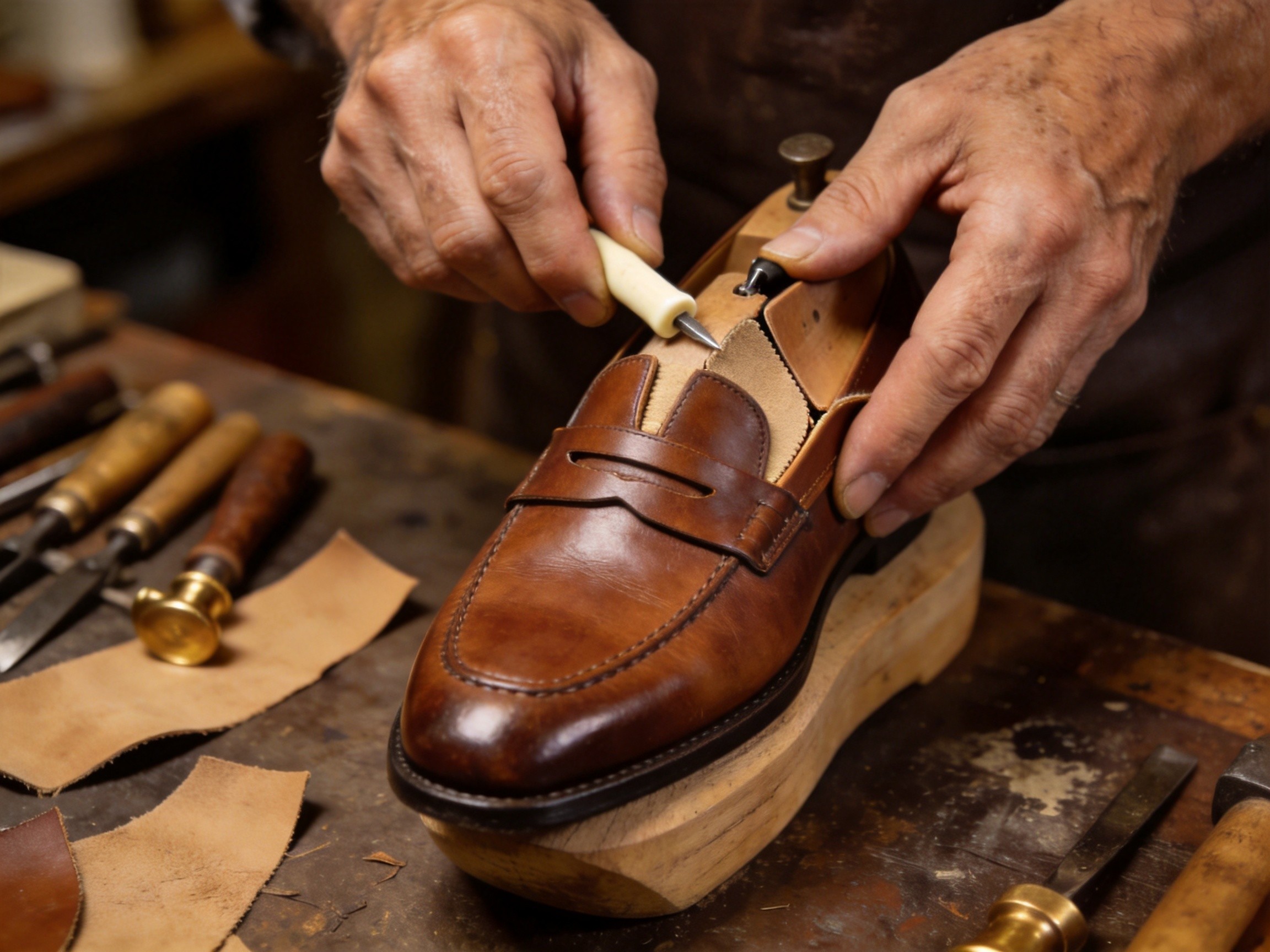
The Chengdu Solution: 8-12 mm Saddle-Seam Position Relief + 4-6 mm Latex-Cork Composite Tongue Padding + Custom-Fitted Last Instep-Girth + 0.3-0.6 kg Vamp-Strap Stitching Tension + Chrome-Free Vegetable-Tan Sweat-Resistant Lining
A Chengdu-made penny loafer or tassel loafer can be constructed with five engineering choices that together reduce instep-peak pressure-mark incidence from 62-78% (mass-market average at first wear) to less than 4% over 24 months of regular wear. The five choices are: a saddle-seam positioned 8-12 mm below the instep-peak (versus a 0-4 mm saddle-seam position), a 4-6 mm latex-cork composite tongue padding (versus a 2-4 mm PU-foam tongue padding), a custom-fitted last instep-girth calibrated to the wearer's actual instep-volume (versus a standard last instep-girth), a 0.3-0.6 kg vamp-strap stitching tension (versus a 0.8-1.4 kg stitching tension), and a 0.6-0.8 mm chrome-free vegetable-tan sweat-resistant leather tongue lining (versus a PU-synthetic microfiber tongue lining). The 8-12 mm saddle-seam position distributes the 12-18 N of vertical downward force over a 14-22 cm² contact area at 18-32 kPa (vs the 88-145 kPa of the 0-4 mm saddle-seam position), which is well below the 28-42 kPa capillary-occlusion threshold of the dorsal midfoot skin and prevents the ischemic-stress pressure-mark formation. The 4-6 mm latex-cork composite tongue padding maintains a 4.4-5.6 mm residual thickness after 24 months of regular wear (vs the 0.8-2.4 mm residual thickness of the 2-4 mm PU-foam at day 30), which preserves the cushioning barrier between the saddle-seam and the dorsal midfoot skin for the full 24-month service life. The custom-fitted last instep-girth eliminates the 4-8 mm instep-volume mismatch for the above-average instep-volume foot (35-45% of female population), which prevents the 88-145 kPa localized pressure at the instep-peak contact area. The 0.3-0.6 kg vamp-strap stitching tension compresses the saddle strap onto the vamp at 4-8 N/cm² shear-stress (vs the 14-22 N/cm² of the 0.8-1.4 kg stitching tension), which concentrates only 18-32 kPa of localized pressure on the 14-22 cm² distributed contact area. The chrome-free vegetable-tan sweat-resistant leather tongue lining maintains the dorsal midfoot stratum-corneum at 18-28% hydration (vs the 60-80% hydration of PU-synthetic microfiber lining), which prevents the soft-white macerated-strip and permanent pressure-mark formation at month 2-3 of regular wear.
The Chengdu workshop costs for these five upgrades are real but moderate. The 8-12 mm saddle-seam position relief from the 0-4 mm construction costs $0.85-1.45 per pair in additional last-making labor. The 4-6 mm latex-cork composite tongue padding upgrade from the 2-4 mm PU-foam costs $0.85-1.45 per pair in additional lasting labor and higher latex-cork material cost. The custom-fitted last instep-girth upgrade from the standard-last construction costs $1.45-2.85 per pair in additional last-making and inventory complexity. The 0.3-0.6 kg vamp-strap stitching tension upgrade from the 0.8-1.4 kg stitching tension costs $1.45-2.45 per pair in additional closing labor (a 50-67% throughput reduction). The 0.6-0.8 mm chrome-free vegetable-tan sweat-resistant leather tongue lining upgrade from the PU-synthetic microfiber lining costs $0.45-0.85 per pair in higher lining material cost. The total per-pair cost increase is $5.05-9.05 per pair, which is roughly 3.2-5.8% of a $155 retail price. The end customer pays an extra $10.85-19.45 for a pair of penny loafers whose instep-peak stays pressure-free and stays free of permanent pressure-marks for 24 months vs the mass-market penny loafers whose saddle strap presses hard on the top of the foot within the first 30 minutes of wear and whose tongue padding flattens by day 30 to expose the saddle seam directly to the dorsal midfoot skin.
Every instep-peak pressure complaint you have ever received from a loafer customer — the customer who said the saddle strap pressed on the top of her foot within an hour of wear, the customer who said a permanent red linear mark developed across the top of her foot after a four-hour meeting, the customer who said the tongue went flat by day 30 and now the saddle seam presses directly on her foot, the customer who said the saddle strap presses on her foot in every loafer she tries from the same brand, the customer who said she had to apply moleskin padding at every wear to make the loafers wearable, the customer who said the saddle strap pressure was much worse in the evening than in the morning, the customer who said the loafers fit perfectly in the store but became instep-pressure instruments within 30 minutes of walking, the customer who said the inside of the saddle strap had visible wear marks at month 3 from the stitching tension, the customer who said she had to size up half a size to get the saddle strap to clear her instep zone, the customer who said the loafers looked boardroom-elegant in the store but became a pressure liability by the second wear — is a predictable consequence of these five engineering choices that mass-market factories make to save $5.05-9.05 per pair and to ship a shelf-ready inventory model with the marketing phrase "anatomical instep relief that follows the natural arch of the foot for all-day comfort." The Chengdu factory floor can deliver the same engineering choices at the same retail price by accepting a 3.2-5.8% margin reduction, and the resulting customer-experience improvement is the difference between a 62-78% instep-peak pressure complaint rate at first wear and a 4% complaint rate over the life of the shoe.
Explore More Comfort Guides
This article is part of our ongoing investigation into the construction failures that drive the most common women's shoe complaints. For a broader overview of the manufacturing choices that separate premium women's shoes from mass-market failures, visit our homepage or browse our complete news archive.