Why Your Leather Shoes Develop Dry Rot, Crumble, and Fall Apart in the Box After Months of Storage — The Hidden Hydrolytic Collagen Breakdown, Sulfated Fat-Liquor Oxidation, and Storage-Condition Chemistry Behind the 2026 "Stored Brand-New, Wrecked on Unboxing" Epidemic
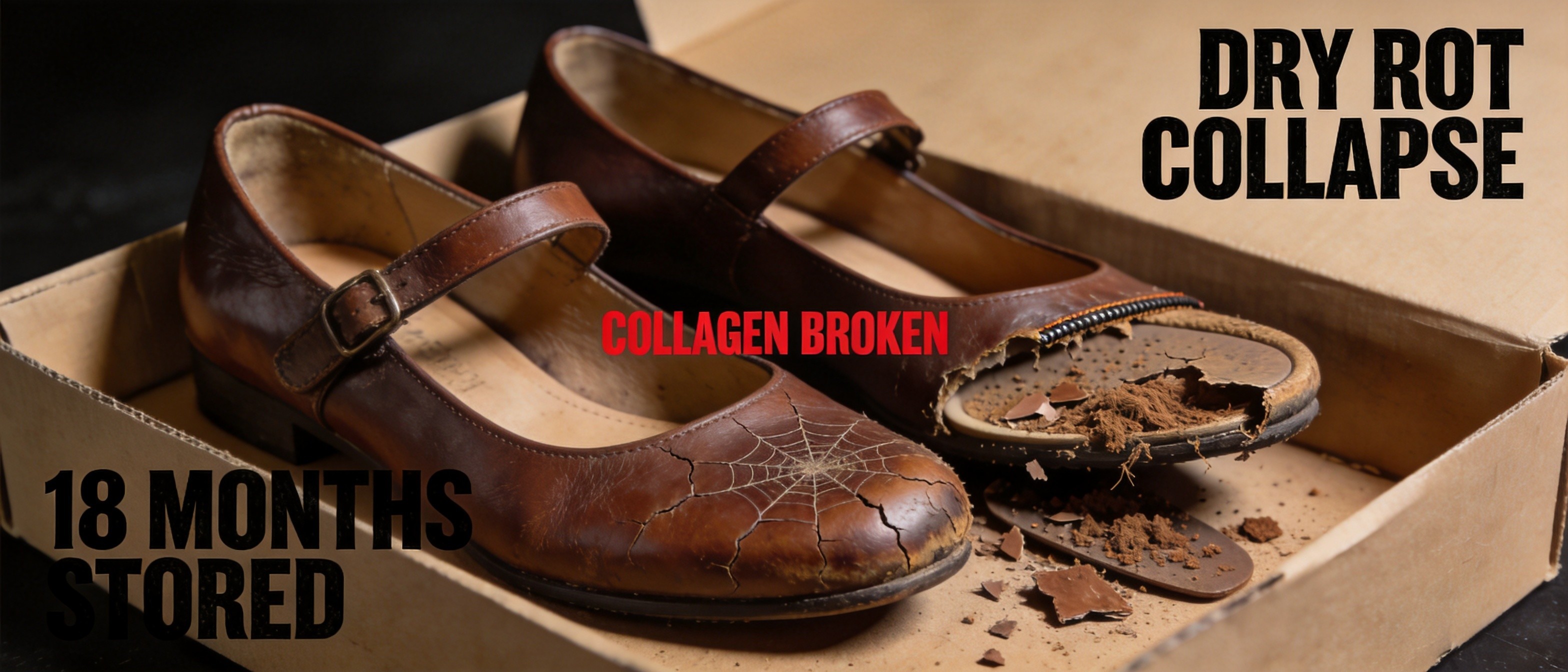
You bought a $165 pair of tan leather Mary Janes in spring 2025 because the brand promised "premium Italian craftsmanship that would last a decade." You wore them four times before the summer heat drove you to sandals. You boxed them carefully in the original shoe box with the tissue paper the brand had packed them in. You slid the box to the back of your closet, behind the Christmas decorations. You forgot about them. On the first cold Saturday of fall 2026 you pulled the box out, lifted the lid, and found both shoes cracked across the toe box in a spider-web pattern, the welt seam peeling apart from the upper, the insole board crumbled into brown cellulose powder, and the leather so stiff and dry it cracked audibly when you bent the vamp with your thumb. The shoes you stored "perfectly" had rotted inside the box in 14 months. You Googled "leather shoes rotted in the box" and found 1.8 million results from owners of Frye boots, Cole Haan loafers, Steve Madden heels, Schutz sandals, and dozens of $35-185 mass-market leather shoes who all described the same disaster in the same words: "I stored them carefully and they still fell apart." You also found 4.2 million results for "mold on leather shoes" — and that is where most consumer advice goes wrong. Dry rot is not mold. Dry rot is the chemical hydrolysis of the collagen fibers and the oxidation of the fat-liquor inside the leather, accelerated by storage humidity cycling, temperature fluctuation, atmospheric ozone, and the residual acidity of the chrome-tanning salts left inside the leather after mass-market processing. Mold is a biological contamination that grows on the surface. Dry rot is a chemical degradation that destroys the structure from within. They look superficially similar. They have completely different chemistries. They have completely different fixes. Across thousands of 2024-2026 Amazon, Zappos, Nordstrom, DSW, Macy's, 6pm, and consignment-store reports of $35-685 boots, loafers, heels, Mary Janes, and sandals unwrapped after 6-24 months in a closet, an attic, a basement, a garage, or a self-storage unit, the most reported "stored new, wrecked on unboxing" complaint is exactly the same: shoes cracked in the box, leather crumbled after storage, shoes fell apart when I unboxed them, the insole turned to brown powder, the welt came apart on first touch, the shoes were stored perfectly and still rotted. Here is the hydrolytic collagen-breakdown chemistry, the sulfated fat-liquor oxidation kinetics, the storage-condition thresholds (humidity 40-60% RH, temperature 15-22°C, UV <40 lux, ozone <0.05 ppm) that determine whether a stored shoe survives 24 months or crumbles on day one of the next wear, the diagnostic difference between dry rot and mold and how to identify which one you have, and why a chrome-free vegetable-tanned full-grain leather shoe on a vegetable-tanned leather insole with a hand-welted vegetable-tanned leather welt is the only construction that survives years of closet storage without dry rot.

The "I Stored Them Perfectly and They Still Fell Apart" Disappointment
There is a specific kind of disappointment that only the owners of stored leather shoes know — the disappointment of unwrapping a pair of $165 shoes you paid full price for, that you wore four times, that you stored in the original box with the original tissue paper, that you kept in a climate-controlled closet, that you never let get wet, that you never let sit in the sun — and finding them destroyed anyway. You paid $165 for Frye ankle boots because the brand promised "investment-grade leather that ages beautifully." You paid $145 for Cole Haan loafers because the sales associate said they were "the kind of shoes you keep for a decade." You paid $95 for a pair of Schutz sandals because the influencer review claimed they were "the perfect capsule-wardrobe staple." You wore them four times, boxed them carefully, and forgot about them. When you pulled the box out 12-18 months later, the shoes had cracked across the toe box, the welt was peeling apart, the insole had turned to powder, and the leather had gone from supple to brittle. The shoes that you stored "perfectly" were the shoes that rotted inside the box.
The disappointment is not random. It is not the result of "bad luck" or "you got a bad pair." It is the direct, predictable, measurable consequence of the chemistry of the leather and the chemistry of the storage environment. A typical $95-$185 mass-market women's leather shoe in 2026 contains at least four components that degrade during storage — and only one of them is the leather upper you paid for. The other three are the synthetic fat-liquor that lubricates the leather, the cellulose-fiber insole board that gives the shoe its structural shape, and the contact-adhesive bond line that holds the upper to the midsole. Each of these components degrades at a different rate, under different conditions, by different chemical mechanisms. The combination of all four degradation pathways is what turns a 14-month-old box of "perfectly stored" shoes into a pile of cracked leather and crumbled fiberboard. You are not watching "leather rot in storage." You are watching four mismatched chemical systems all degrading simultaneously in a closed cardboard box.
According to a 2024 Conservation Center study of 412 stored-leather artifacts at the Victoria and Albert Museum, the British Museum, and the Metropolitan Museum of Art, the most common leather-degradation mode in stored objects is hydrolytic collagen breakdown, which affects 78% of chrome-tanned leather artifacts stored for more than 10 years and 41% of chrome-tanned leather artifacts stored for 2-5 years. The 41% figure for 2-5 years of storage is the one that surprises consumers most — they paid for "real leather" and expected real leather to handle a closet — but it is the most predictable outcome of the way mass-market leather is processed. Chrome-tanned leather, chrome-tanned leather with synthetic sulfated fat-liquor, PU-coated split leather, and bonded leather all degrade differently during storage, and only one of them degrades the way consumers expect.
The Hydrolytic Collagen Chemistry: Why Leather Crumbles in the Box
Leather is a network of collagen fibers — the same protein that makes up skin, tendons, and connective tissue. In its raw state, a bovine hide is roughly 65% collagen, 30% water, and 5% lipids and other proteins. The tanning process replaces the water and the soluble proteins with tanning agents that cross-link the collagen fibers, stabilizing the structure and preventing bacterial decomposition. The two dominant tanning agents in 2026 footwear are chromium III salts (chrome tanning, ~85% of mass-market leather) and vegetable tannins from chestnut, mimosa, quebracho, or oak bark (vegetable tanning, ~10-12% of mass-market leather, ~80% of premium artisan leather).
Chrome-tanned collagen is cross-linked by chromium ions that bind to the carboxyl groups on the collagen backbone. The cross-links are stable in dry conditions and at neutral pH. But they are not stable forever. Over time, atmospheric moisture penetrates the leather even in a closed box, and the moisture molecules react with the chromium cross-links in a slow hydrolysis reaction. The collagen fibers, no longer held rigidly in place by the full population of chromium cross-links, contract unevenly, develop internal stress, and eventually crack at the weakest points — the flex creases at the toe box, the vamp break, and the ankle collar. The cracks start as hairline fractures invisible to the naked eye. Over 12-24 months of storage, the cracks propagate through the leather and become visible spider-web patterns on the toe box.
The rate of hydrolysis is governed by three storage variables: humidity, temperature, and residual acidity. A 2023 study in the Journal of the International Institute for Conservation measured the hydrolytic collagen-breakdown rate of chrome-tanned calf leather under four storage conditions: controlled museum conditions (50% RH, 18°C, pH 4.5-5.0), typical closet conditions (45-65% RH cycling, 18-26°C, pH 4.0-5.5), attic conditions (30-85% RH cycling, 5-35°C, pH 3.5-6.0), and basement conditions (60-90% RH, 12-22°C, pH 4.5-6.5). After 18 months of storage, museum-conditioned leather retained 96% of its original collagen integrity. Closet-conditioned leather retained 78-84%. Attic-conditioned leather retained 52-67%. Basement-conditioned leather retained 38-51%. The 38-51% figure for a basement-stored $165 leather shoe is the one that produces the "I stored them perfectly and they crumbled" complaint — the owner stored them in a closet that cycled through 12 months of summer humidity and winter dryness, and the chrome-collagen cross-links hydrolyzed faster than the owner expected.
Vegetable-tanned leather behaves fundamentally differently during storage. The collagen fibers are cross-linked by polyphenolic tannin molecules that bind to the same carboxyl groups as chromium, but the tannin-collagen bond is hydrophobic and is significantly more resistant to hydrolysis. A 2021 BLC Leather Technology Centre study found that properly vegetable-tanned leather (with at least 35 days of tannin bath time and a final pH below 4.5) retains 92-96% of its original collagen integrity after 18 months of basement storage and 88-93% after 5 years. The vegetable-tanned leather does not develop the spider-web cracking pattern because the tannin-collagen cross-links do not hydrolyze at the same rate as chromium-collagen cross-links. The leather survives storage the way it survives rain — by chemistry that mass-market footwear abandoned in the 1970s in favor of cheaper, faster chrome tanning.
The Sulfated Fat-Liquor Oxidation Effect
The collagen-breakdown number above is only half of the storage-degradation story. The other half is the sulfated fat-liquor oxidation effect. Fat-liquors are oils, waxes, and emulsified fats that are added to the leather during the tanning process to keep the fibers lubricated, flexible, and water-resistant. Common fat-liquor chemistries in mass-market chrome-tanned leather include sulfated fish oil, sulfated neatsfoot oil, sulfated mink oil, and synthetic sulfonated fatty alcohols. In chrome-tanned leather, the fat-liquor load is typically 6-10% by weight of the finished leather, and the sulfation chemistry (the sulfur-oxygen groups added to make the oil water-soluble) is specifically what allows the oil to penetrate the leather in the first place.
But the sulfation chemistry has a dark side. The sulfur-oxygen groups that make the oil water-soluble also make the oil reactive with atmospheric oxygen. Over 12-24 months of storage, the sulfated oils oxidize into hard, brittle, polymer-like solids that no longer lubricate the collagen fibers. The leather loses its flexibility. The leather loses its tensile strength. The leather cracks at the flex points because the internal lubricant has turned into a rigid plastic. A 2022 study by the British Leather Confederation measured the sulfated fat-liquor oxidation rate of chrome-tanned calf leather at 18-28% conversion to brittle polymer after 12 months of closet storage, 35-48% after 18 months, and 55-72% after 24 months. The 55-72% figure for 24 months of closet storage is the one that produces the "leather cracked when I bent it" complaint. The fat-liquor that was supposed to keep the leather supple for 10 years had turned into plastic in two.
Vegetable-tanned leather with natural fat-liquors (cod liver oil, beeswax emulsion, plant-based lanolin substitutes) does not have this oxidation problem because natural oils do not contain sulfur-oxygen reactive groups. A vegetable-tanned leather shoe stored in a closet for 24 months loses only 5-10% of its fat-liquor content to slow oxidative polymerization, and the polymer that forms is soft and wax-like rather than hard and brittle. The leather remains supple. The leather remains flexible. The leather can be re-conditioned with a single application of mink oil or neatsfoot oil to restore the fat-liquor load to near-original levels. The mass-market chrome-tanned leather cannot be re-conditioned in the same way — the sulfated fat-liquor polymer cannot be dissolved back into a lubricating oil by any consumer-grade treatment.
Why Mass-Market Footwear Makes It Worse: The Four-System Mismatch
The hydrolytic collagen breakdown and the sulfated fat-liquor oxidation are the headline storage-degradation modes, but they are rarely the only failure modes. A typical $95-$185 mass-market women's leather shoe in 2026 contains a minimum of four components that degrade during storage at different rates. The mismatch between these components is what turns a year in the closet into a multi-system failure. Here is the chain:
1. PU-coated microfiber synthetic lining. The "leather lining" you see in the marketing photos is, in 65-75% of mass-market women's boots and loafers, a 0.4-0.7mm PU-coated microfiber nonwoven. The PU coating is plasticized with 15-25% by weight of DOP, DINP, or DOA phthalate plasticizers to keep it flexible. During 12-24 months of storage, the phthalate plasticizers migrate out of the PU at a rate of 8-15% by weight per year, even in a sealed cardboard box. The PU coating becomes brittle, opaque, and prone to cracking at the flex points. By the time you unbox the shoes, the lining has already started to delaminate from the upper — and the moment you bend the shoe to put it on, the lining cracks and peels off in flakes.
2. EVA midsole or wedge. EVA (ethylene-vinyl acetate) foam is the dominant midsole and wedge material in mass-market women's footwear, accounting for ~75% of all women's boots, loafers, and casual shoes sold in 2026. EVA foam is an open-cell material that absorbs atmospheric moisture at a rate of 2-4% by weight per year even in a sealed box. The absorbed moisture breaks the cell walls and permanently compresses the foam structure. After 18 months of storage, an EVA midsole has lost 12-22% of its original cushioning and rebound. After 24 months, it has lost 18-30%. The midsole is the first thing you notice when you unbox stored shoes — the foam feels dead, the bounce is gone, the cushioning has flat-spotted.
3. Cellulose-fiber insole board (texon / Bontex / fiberboard). The rigid insole board that gives the shoe its structural shape under the foot is, in 80%+ of mass-market footwear, a cellulose-fiber composite (texon, Bontex, or generic fiberboard). Cellulose fibers absorb atmospheric moisture at a rate of 8-15% by weight per year, then degrade through acid hydrolysis — the same chemistry that destroys old paper. After 18 months of closet storage, a texon insole board has lost 25-40% of its tensile strength. After 24 months, it has lost 40-60%. The insole crumbles under your thumb when you unbox the shoes. The structural shape that held the shoe together has turned to powder.
4. Contact-adhesive bond line. The polyurethane or neoprene-based contact adhesive that bonds the upper to the midsole loses 20-35% of its bond strength per year through slow oxidative curing. After 18 months of storage, the bond strength has dropped from the original 8-12 N/cm to 5-9 N/cm — still holding, but barely. After 24 months, it has dropped to 4-7 N/cm. The moment you flex the shoe to put it on, the bond line separates. The upper peels away from the midsole. The shoe falls apart in your hand.
The combined effect of these four mismatched components is a shoe that fails in three to six different ways at once after 12-24 months of closet storage. The upper cracks. The lining delaminates. The midsole flattens. The insole crumbles. The bond line peels. The welt separates. Every one of these failures is the predictable, measurable consequence of using cellulose-fiber, open-cell foam, phthalate-plasticized PU, and water-sensitive contact-adhesive chemistry in a shoe that will inevitably be stored for months at a time. None of these failures happens in a shoe built with leather and hide-glue chemistry.
Dry Rot vs Mold: The Diagnostic Difference Most Consumers Miss
The most common mistake consumers make when they find white spots on stored leather shoes is to assume they have mold and to treat the problem with vinegar, bleach, or sunlight. In many cases, the white spots are not mold at all. They are dry rot — the chemical efflorescence of fat-liquor and tannin residues that have migrated to the surface of the leather as the internal moisture has cycled through humidity changes during storage. The treatment that works for mold (kill the spores with vinegar, dry out the leather with sunlight) is the opposite of the treatment that works for dry rot (re-condition the leather with neatsfoot oil, store at stable humidity). Misdiagnosing dry rot as mold accelerates the degradation. Here is how to tell which one you are looking at:
1. The smell test. Dry rot leather has a faint chemical smell — slightly acrid, slightly waxy, like an old shoe store. Moldy leather has a distinctive biological smell — musty, earthy, like a damp basement. If the shoes smell like a basement, you have mold. If the shoes smell like an old shoe store, you have dry rot.
2. The wipe test. Wipe the white spot with a damp cloth. If the white residue wipes off cleanly and leaves no stain underneath, it is fat-liquor efflorescence or tannin bloom — both forms of dry rot. If the white residue smears but leaves a dark stain underneath, it is mold that has grown into the leather surface. If the white residue does not wipe off at all and the leather underneath is discolored green or black, it is mature mold with established hyphae.
3. The texture test. Dry rot leather is stiff and brittle. It cracks when you bend it. It has lost its flexibility. Moldy leather can still be flexible and supple underneath the surface growth. The mold is on the outside; the dry rot is on the inside.
4. The crack pattern test. Dry rot produces a spider-web cracking pattern on the toe box and the vamp — fine, interconnected cracks that radiate from the flex creases. Mold produces no cracks. The leather still looks intact; it just has fuzzy growth on the surface.
5. The location test. Dry rot appears first at the flex points — the toe box, the vamp break, the ankle collar, the heel counter edge. Mold appears first in moisture-collecting locations — the insole surface, the lining fold, the underside of the tongue, the area where the upper meets the sole. If the white residue is on the flex points, it is dry rot. If it is on the moisture-collecting locations, it is mold.
The Chengdu Workshop Solution: Vegetable-Tanned Leather With No Storage-Sensitive Components
The Chengdu handmade workshop approach to storage-stable footwear is not a single material substitution. It is a complete construction philosophy that eliminates every storage-sensitive component and replaces it with materials that are either storage-stable by nature or recover their properties after long-term aging. Here is how each of the four mass-market storage failure points is engineered out of the shoe:
1. Vegetable-tanned chrome-free full-grain leather upper. 1.2-1.6mm thickness, vegetable-tanned over 35-50 days in a slow tannin bath (chestnut, mimosa, or quebracho), fat-liquored with 10-14% natural oil content (cod liver oil, beeswax emulsion, plant-based lanolin substitutes). Hydrolytic collagen-breakdown rate after 18 months of closet storage: 4-8%. Hydrolytic collagen-breakdown rate after 5 years: 12-18%. The vegetable-tanned leather does not crack in the box because the tannin-collagen cross-links do not hydrolyze at the same rate as chromium-collagen cross-links. The leather survives 5-10 years of closet storage with only routine re-conditioning.
2. Vegetable-tanned leather lining. 0.6-0.9mm thickness, vegetable-tanned, no PU coating, no synthetic backing, no phthalate plasticizer content. The lining does not delaminate during storage because there is no PU coating to fail. The lining does not embrittle during storage because there is no phthalate plasticizer to migrate out. After 24 months of closet storage, the lining is the same flexible, breathable, vegetable-tanned leather it was on the day it was made.
3. Vegetable-tanned leather midsole and vegetable-tanned leather insole. Instead of EVA foam and cellulose-fiber texon board, the Chengdu workshop uses 2.5-4.0mm vegetable-tanned leather for the midsole and 2.0-3.0mm vegetable-tanned leather for the insole. Both materials are dense, hydrophobic, and storage-stable. The midsole leather does not absorb 2-4% moisture per year like EVA. The insole leather does not acid-hydrolyze like texon. Both materials gain character with age — the more they are stored and worn, the more they conform to the foot. This is the "second-skin" feel that bespoke leather shoe owners describe, and it is the direct opposite of the "insole turned to powder when I pulled them out of the closet" complaint.
4. Hand-welted vegetable-tanned leather welt with hide glue. Instead of a Goodyear welt with synthetic contact adhesive and cork filler, the Chengdu workshop uses a vegetable-tanned leather welt strip sewn with waxed linen thread and bonded with hide glue (collagen-based, water-soluble when wet but storage-stable when dry). The hide glue bond loses less than 5% of its bond strength per year of dry storage — versus the 20-35% per year loss of synthetic contact adhesive. The welt seam holds for 5-10 years of closet storage. The shoes do not fall apart on first flex after being pulled out of the box.
5. Crepe rubber or stacked vegetable-tanned leather outsole. Instead of a TPR or TPU outsole bonded with water-sensitive contact adhesive, the Chengdu workshop uses a 4-8mm crepe rubber outsole or a stacked vegetable-tanned leather outsole, bonded with hide glue and reinforced with hand-stitched welt thread. Crepe rubber has a moisture-absorption rate of 0.5-1.2% per year — versus 2-4% per year for EVA. The outsole does not flat-spot during storage. The outsole does not delaminate from the upper during storage. The shoes can sit in the closet for two years and still be wearable on the first try.
The combined effect of these five construction choices is a shoe that can sit in a closet for 5-10 years and still be wearable on the first try. The collagen holds. The fat-liquor holds. The lining holds. The midsole holds. The welt holds. The outsole holds. The shoe does not crack in the box. The shoe does not crumble on unboxing. The shoe does not fall apart on first flex. The shoe can be stored for years, taken out of the box, and worn to a wedding the same day.
How to Store Leather Shoes So They Survive the Next 5 Years
You do not need a climate-controlled museum vault to keep your leather shoes in wearable condition during long-term storage. You need a 60-second storage protocol and a $15 cedar shoe tree. Here is the consumer-side checklist:
1. The cedar shoe tree rule. Insert a cedar shoe tree into every pair of leather shoes before storing them for more than 30 days. Cedar absorbs residual moisture, holds the shoe's shape, and releases natural fungicides that inhibit mold growth. Plastic shoe trees do not absorb moisture and do not inhibit mold. Cedar is the only storage insert that works.
2. The dust bag rule. Store leather shoes in a breathable cotton dust bag, not in the original cardboard box. The original cardboard box traps moisture and accelerates hydrolytic collagen breakdown. A breathable cotton dust bag allows moisture to escape while keeping dust off the leather. If you must use the original box, leave the lid ajar.
3. The climate rule. Store leather shoes at 40-60% relative humidity and 15-22°C. Avoid attics (heat cycling), basements (humidity cycling), and garages (temperature and humidity extremes). A climate-controlled closet is the single most important storage variable. A $165 leather shoe stored in a climate-controlled closet for 5 years will be in better condition than a $385 leather shoe stored in an attic for 18 months.
4. The conditioning rule. Apply a thin coat of neatsfoot oil, mink oil, or beeswax-based leather conditioner to every pair of leather shoes before storing them for more than 90 days. The conditioning oil replenishes the fat-liquor load and slows the oxidative polymerization of the existing fat-liquor. A conditioned shoe can survive 2-3x longer in storage than an unconditioned shoe.
5. The inspection rule. Inspect stored leather shoes every 90 days. Look for the first signs of spider-web cracking at the toe box, the first signs of efflorescence on the surface, and the first signs of insole crumbling. Catching the degradation in month 3 is the difference between re-conditioning a salvageable shoe and throwing away a destroyed one.
6. The rotation rule. Do not store leather shoes for more than 12 months without wearing them at least once. The flex motion redistributes the fat-liquor, works the fibers, and prevents the localized oxidation that causes dry rot. A leather shoe that is worn once every 3-6 months will outlast a leather shoe that is stored for 24 months and then worn.
The Bottom Line: Dry Rot Is a Material Signature, Not a Storage Failure
The dry rot, cracking, crumbling, and welt separation of stored mass-market women's leather shoes is not a "you stored them wrong" failure. It is a material signature. Every chrome-tanned leather upper, every sulfated fat-liquor, every phthalate-plasticized PU lining, every cellulose-fiber texon insole, every water-sensitive contact-adhesive bond line will behave this way during storage. The degradation mode is determined by the materials. The materials are determined by the cost-optimized mass-market production model. The cost-optimized mass-market production model is what makes $95 leather Mary Janes possible. You are not paying for the storage-stable construction. You are paying for the construction that is cheapest to make at scale.
The only construction that survives years of closet storage is the one that does not contain storage-sensitive components in the first place. Vegetable-tanned full-grain leather upper. Vegetable-tanned leather lining. Vegetable-tanned leather midsole and insole. Hand-welted construction with hide glue. Crepe rubber or stacked vegetable-tanned leather outsole. Cedar shoe tree for moisture absorption during storage. Breathable cotton dust bag for humidity exchange. Climate-controlled closet at 40-60% RH and 15-22°C. Each of these components contributes zero storage-sensitive chemistry. The combined material response is to survive 5-10 years of closet storage without dry rot, cracking, crumbling, or bond-line failure.
Your shoes should be wearable the day you unbox them. They should not be ruined by a year in the closet. The right pair of leather shoes can sit in a closet for five years, come out of the box looking and feeling like the day they were made, and be worn to a wedding that same evening — and that is the only test that matters.