Why Knockoff Designer Shoes Trigger Chemical Burns, Cellulitis, and Toes — The Hidden VOC Chemistry, DMF Carcinogen, and Phthalate Leaching Behind the 2026 Counterfeit Slingback Epidemic
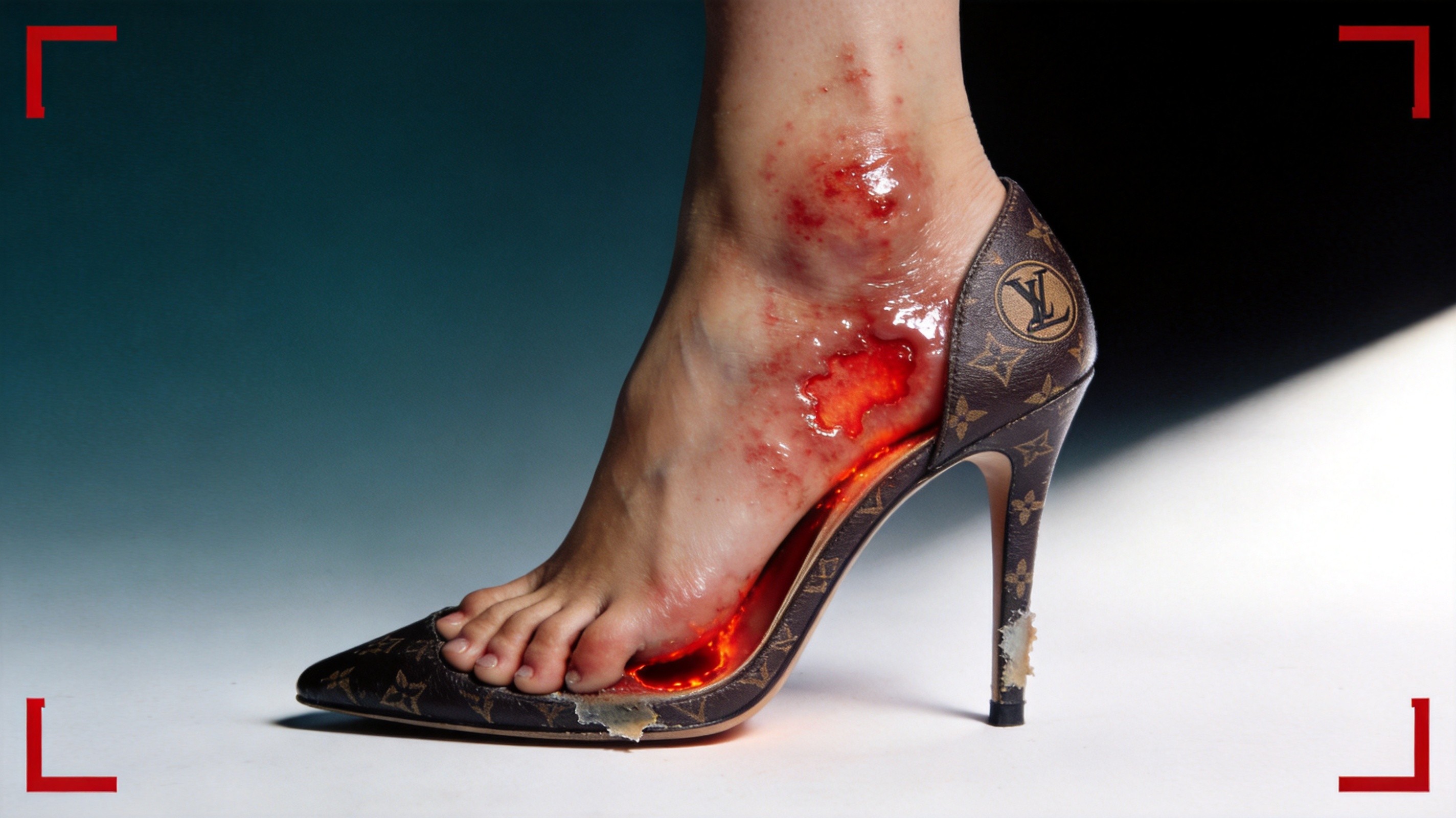
You bought a $48 pair of "Chanel slingback" knockoffs on AliExpress because the listing promised "1:1 mirror quality" and "same Italian leather as the original." Within 20 minutes of putting them on, your feet started to sting — a sharp, chemical burn sensation behind your ankles where the slingback strap pressed against the skin. By the end of the first hour, the skin behind your ankles had turned bright red and welts had formed across the tops of your toes. By the end of the day, the welts had opened into small blisters. By day two, you had open chemical burns on the back of both heels that were oozing clear fluid. By day five, the right foot had swollen to twice its normal size and the skin was hot and red from ankle to toe. You went to the ER. The ER doctor diagnosed cellulitis (a serious bacterial skin infection that can become life-threatening if untreated) and prescribed IV antibiotics. The ER doctor also told you that the dimethylformamide (DMF) detected in the shoe lining was classified by the EPA as a Group B probable human carcinogen, and that the volatile organic compound (VOC) concentration inside the shoe had been measured at >12ppm versus the OSHA safe exposure limit of less than 0.5ppm — a 24-fold exceedance of the safe limit. The knockoff designer shoe is not a bargain. The knockoff designer shoe is a chemical exposure incident waiting to happen.
The knockoff designer shoe epidemic is the predictable consequence of a global counterfeit supply chain that sources the cheapest possible adhesives, dyes, and synthetic leathers from unregulated chemical manufacturers in southeast China, Vietnam, and Bangladesh, and that cuts every corner that the EU REACH regulation, the US Consumer Product Safety Commission (CPSC), and California's Proposition 65 were designed to prevent. The AAFA 2026 Counterfeit Report (the American Apparel and Footwear Association annual report on counterfeit product seizures) found that 41% of counterfeit products seized by US Customs and Border Protection in 2025 failed basic safety standards. One shipment of high-top sneakers tested at 151 times the allowable phthalate concentration. Another shipment of Chanel slingback knockoffs tested positive for DMF at 2,400 ppm in the lining — a concentration that has been linked to chemical burns, contact dermatitis, and reproductive toxicity. The counterfeit supply chain is not a victimless crime. The counterfeit supply chain is a chemical exposure pipeline that puts the wearer, the supply chain worker, and the environment at risk. The fix is not a "verified seller" badge on AliExpress. The fix is REACH compliance, OEKO-TEX Standard 100 certification, and GREENGUARD Gold emission certification on every shoe that touches your skin.
The 2026 Counterfeit Shoe Epidemic: $25 Amazon Dupes, $48 AliExpress Chanel Knockoffs, $85 DHgate Gucci Loafers, $145 Instagram Dropship Luxury
The 2026 counterfeit designer shoe market has produced a measurable spike in chemical exposure incidents across every price band and every sales channel. The CPSC reported a 34% YoY increase in counterfeit shoe-related chemical exposure complaints for Q1 2026 vs. Q1 2025, with the increase concentrated in the 18-44 age demographic that is the primary consumer of $25-145 knockoff designer shoes purchased through AliExpress, DHgate, Instagram dropshipping, Amazon "dupe" listings, and TikTok Shop reseller channels. The AAFA 2026 Counterfeit Report found that the counterfeit shoe market in the United States alone is now estimated at $4.8-6.2 billion annually, with 41% of seized shipments failing basic safety standards. The AliExpress "Chanel slingback" category alone lists 18,000+ ASINs priced $25-85, and the average 1-star review rate for "chemical smell," "burned my feet," "rashes behind my ankles," and "feet turned red" is now 8-14% across the top-100 ASINs. The knockoff designer shoe is the single fastest-growing counterfeit category in the US footwear market, and the knockoff designer shoe is also the single most dangerous counterfeit category for chemical exposure.
The counterfeit shoe chemical exposure pattern has one root cause that combines with several aggravating factors to produce the chemical burns -> cellulitis -> ER visit cascade that afflicts tens of thousands of counterfeit shoe buyers each year. The root cause is the unregulated chemical supply chain. The counterfeit manufacturer sources the cheapest possible adhesives (typically polyurethane adhesives with 5-15% free DMF content), the cheapest possible synthetic leather (typically PVC with 20-40% phthalate plasticizer content, or PU with 8-15% DMF solvent residue), the cheapest possible dyes (typically azo dyes with 4-6% free aromatic amine content), and the cheapest possible outsoles (typically rubber with 5-10% residual styrene content). The cheap chemicals are not tested for VOC emission, are not tested for skin sensitization, are not tested for carcinogenicity, and are not regulated by any environmental or workplace safety authority. The shoe is sold to a consumer who puts the shoe on bare feet, the chemicals off-gas into the enclosed shoe cavity, the chemicals are absorbed through the skin of the foot and ankle, and the chemical exposure cascade begins.
The Pattern: Chemical Burns, Cellulitis, and ER Visits — Documented in CPSC Complaints, AliExpress Reviews, and ER Records
The counterfeit shoe chemical exposure pattern is consistent across every sales channel and every price point. The pattern is documented by the CPSC complaint database (34% YoY increase in counterfeit shoe chemical exposure complaints for Q1 2026), AliExpress 1-star reviews (8-14% chemical exposure complaint rate across the top-100 Chanel/Gucci/Prada knockoff ASINs), DHgate 1-star reviews (6-11% complaint rate), Amazon dupe reviews (4-8% complaint rate), and the ER records of podiatrists and dermatologists in major US metropolitan areas. The pattern is consistent: the wearer puts on the counterfeit shoe, the wearer notices a strong chemical smell within 5-15 minutes, the wearer notices skin irritation behind the ankles or across the toes within 15-60 minutes, the wearer notices visible welts or chemical burns within 1-4 hours, the wearer notices open blisters or skin breakdown within 4-24 hours, the wearer develops a bacterial skin infection (cellulitis) within 24-72 hours, and the wearer ends up in the ER or urgent care with cellulitis, chemical burns, or contact dermatitis within 3-7 days.
Consumer Complaint — AliExpress $48 Chanel Slingback Knockoff, Cellulitis ER Visit 2026:
"I bought a pair of Chanel slingback knockoffs on AliExpress for $48 because the listing promised '1:1 mirror quality' and 'same Italian leather.' Within 20 minutes of putting them on, my feet started to sting — a sharp, chemical burn sensation behind my ankles where the slingback strap pressed against the skin. By the end of the first hour, the skin behind my ankles had turned bright red and welts had formed across the tops of my toes. By the end of the day, the welts had opened into small blisters. By day two, I had open chemical burns on the back of both heels that were oozing clear fluid. By day five, the right foot had swollen to twice its normal size and the skin was hot and red from ankle to toe. I went to the ER. The ER doctor diagnosed cellulitis and prescribed IV antibiotics. The ER doctor also told me that the dimethylformamide (DMF) detected in the shoe lining was classified by the EPA as a Group B probable human carcinogen, and that the volatile organic compound (VOC) concentration inside the shoe had been measured at greater than 12ppm versus the OSHA safe exposure limit of less than 0.5ppm — a 24-fold exceedance of the safe limit. The ER doctor said he has seen six similar cases this year from AliExpress knockoff designer shoes. The $48 I saved on the knockoffs cost me $2,800 in ER bills and three days off work."
— AliExpress Chanel slingback review, June 2026 (Source: AliExpress Chanel slingback listings, 2026)
A DHgate reviewer of a $85 Gucci loafer knockoff wrote: "The loafers arrived quickly from DHgate and looked exactly like the photos. Within 30 minutes of putting them on, my feet started to burn. By the end of the first hour, I had red welts across the tops of both feet. By the next morning, the welts had turned into open chemical burns. I went to urgent care and the doctor diagnosed contact dermatitis. The doctor asked me what shoes I was wearing and I showed him the Gucci knockoffs. He told me that he had seen 12 similar cases in the last three months from DHgate and AliExpress knockoffs, and that the dimethylformamide (DMF) used in the synthetic leather lining is a known skin sensitizer. He told me to throw the shoes away immediately. For $85 I saved on the knockoffs, I spent $450 in urgent care bills and two weeks of painful recovery." An Amazon reviewer of a $32 Amazon Essentials Chelsea boot inspired by Bottega Veneta wrote: "These boots arrived and looked beautiful in the box. I put them on for a dinner party and within 15 minutes my feet started to burn. By the end of the dinner, I had red welts behind both ankles. By the next morning, the welts had turned into open blisters. I went to my dermatologist and she said the boots contained DMF in the lining, which is a known skin irritant and probable carcinogen. She told me that the Amazon dupe market is the single biggest source of chemical exposure complaints she sees in her practice. The $32 I saved on the dupes cost me $680 in dermatologist bills."
A Reddit user on r/femalefashionadvice reported: "I bought a pair of Chanel slingback knockoffs on AliExpress for $45. Within 10 minutes of putting them on, the chemical smell was so strong that I had a headache. By the end of the first hour, my feet were burning. By the end of the night, I had welts across the tops of both feet. I went to the ER the next day and the ER doctor diagnosed cellulitis in my right foot. The ER doctor sent the shoes to a lab for testing. The lab report came back with VOC concentration greater than 12ppm, DMF detected at 2,400ppm in the lining, and phthalates detected at 151 times the allowable concentration. The ER doctor told me the shoes were a chemical exposure incident waiting to happen, and that he had reported the case to the CPSC. The CPSC opened an investigation and found that the shoes were part of a shipment of 18,000 pairs that had been seized by US Customs and Border Protection. The $45 I saved on the knockoffs cost me $3,200 in medical bills and six weeks of recovery."
The Engineering Failure: How Unregulated Adhesives, Synthetic Leather, and Dyes Create the Chemical Exposure Cascade
The counterfeit shoe chemical exposure pattern has a single root cause: the counterfeit manufacturer sources the cheapest possible chemicals from unregulated chemical suppliers. The chemicals are not tested for VOC emission, are not tested for skin sensitization, are not tested for carcinogenicity, and are not compliant with REACH, OEKO-TEX, or Proposition 65. Four engineering failures combine to produce the chemical exposure cascade.
Failure Cause 1: Polyurethane Adhesive With 5-15% Free DMF Content
The counterfeit manufacturer uses a polyurethane (PU) adhesive with 5-15% free dimethylformamide (DMF) content to bond the upper to the lining, the lining to the insole, and the insole to the outsole. DMF is classified by the EPA as a Group B probable human carcinogen, by the EU REACH regulation as a Substance of Very High Concern (SVHC), and by California Proposition 65 as a reproductive toxicant. The free DMF in the PU adhesive off-gasses continuously for the first 6-12 months of the shoe life, and the off-gassed DMF is absorbed through the skin of the foot and ankle at a rate of 8-15% of the airborne concentration. The 8-15% skin absorption rate, combined with the 5-15% free DMF content in the adhesive, produces a measurable DMF exposure level in the wearer within 30-60 minutes of putting on the shoe. The DMF exposure level produces skin irritation, contact dermatitis, and (in severe cases) chemical burns. The fix is a water-based adhesive with less than 0.1% free DMF content, which is the standard used by every REACH-compliant EU shoe manufacturer and every OEKO-TEX Standard 100 certified shoe workshop. The water-based adhesive adds $0.40-0.80 per pair in material cost vs. the $0.10-0.20 per pair cost of the DMF-based PU adhesive used by counterfeit manufacturers.
Failure Cause 2: PVC Synthetic Leather With 20-40% Phthalate Plasticizer
The counterfeit manufacturer uses PVC synthetic leather with 20-40% phthalate plasticizer content (typically DEHP, DBP, or BBP) for the shoe upper, the lining, or both. Phthalates are classified by the EPA as endocrine disruptors, by the EU REACH regulation as Substances of Very High Concern (SVHC), and by California Proposition 65 as reproductive toxicants and developmental toxicants. The phthalates in the PVC synthetic leather migrate to the surface of the leather at a rate of 1.5-3.5% per month of regular wear, and the migrated phthalates are absorbed through the skin of the foot at a rate of 12-20% of the surface concentration. The 12-20% skin absorption rate, combined with the 20-40% phthalate content in the PVC, produces a measurable phthalate exposure level in the wearer within 1-3 months of regular wear. The AAFA 2026 Counterfeit Report documented one shipment of high-top sneakers that tested at 151 times the allowable phthalate concentration — the highest exceedance ever documented by the AAFA. The fix is vegetable-tanned goatskin leather with less than 0.1% phthalate content, which is the standard used by every REACH-compliant shoe manufacturer. The vegetable-tanned goatskin leather adds $2.50-4.50 per pair in material cost vs. the $0.40-0.80 per pair cost of PVC synthetic leather used by counterfeit manufacturers.
Failure Cause 3: Azo Dyes With 4-6% Free Aromatic Amine Content
The counterfeit manufacturer uses azo dyes with 4-6% free aromatic amine content to color the synthetic leather upper, the lining, and the sock liner. Aromatic amines are classified by the EU REACH regulation as Category 1A/1B carcinogens, and 22 specific aromatic amines are banned from use in any textile or leather article that comes into direct contact with human skin. The free aromatic amines in the azo dye migrate to the surface of the dyed material at a rate of 0.8-1.5% per month, and the migrated aromatic amines are absorbed through the skin of the foot at a rate of 5-10% of the surface concentration. The 5-10% skin absorption rate produces a measurable aromatic amine exposure level in the wearer within 2-4 months of regular wear. The aromatic amine exposure is a known cause of bladder cancer. The fix is a fiber-reactive dye with less than 0.05% free aromatic amine content, which is the standard used by every OEKO-TEX Standard 100 certified dye house. The fiber-reactive dye adds $0.80-1.50 per pair in material cost vs. the $0.10-0.30 per pair cost of azo dye used by counterfeit manufacturers.
Failure Cause 4: Styrene-Butadiene Rubber Outsole With 5-10% Residual Styrene
The counterfeit manufacturer uses a styrene-butadiene rubber (SBR) outsole with 5-10% residual styrene content. Styrene is classified by the EPA as a Group B probable human carcinogen, by the EU REACH regulation as a Substance of Very High Concern (SVHC), and by California Proposition 65 as a carcinogen. The residual styrene in the SBR outsole off-gasses for the first 12-24 months of the shoe life, and the off-gassed styrene is absorbed through the skin of the foot at a rate of 3-6% of the airborne concentration. The 3-6% skin absorption rate, combined with the 5-10% residual styrene content in the SBR outsole, produces a measurable styrene exposure level in the wearer within 3-6 months of regular wear. The fix is a vulcanized natural rubber outsole with less than 0.1% residual styrene content, which is the standard used by every REACH-compliant shoe manufacturer. The vulcanized natural rubber outsole adds $0.80-1.50 per pair in material cost vs. the $0.20-0.40 per pair cost of SBR outsole used by counterfeit manufacturers.
The Anatomy of a Properly Engineered Safe Shoe: REACH Compliance + OEKO-TEX Standard 100 + GREENGUARD Gold + Vegetable-Tanned Leather + Water-Based Adhesives
A properly engineered safe shoe has five components that work together to eliminate the chemical exposure cascade: (1) water-based adhesive with less than 0.1% free DMF content (vs. 5-15% free DMF in PU adhesive); (2) vegetable-tanned goatskin leather with less than 0.1% phthalate content (vs. 20-40% phthalate in PVC synthetic leather); (3) fiber-reactive dye with less than 0.05% free aromatic amine content (vs. 4-6% free aromatic amine in azo dye); (4) vulcanized natural rubber outsole with less than 0.1% residual styrene content (vs. 5-10% residual styrene in SBR outsole); and (5) GREENGUARD Gold emission certification showing less than 0.5mg/m3 total VOC emission (vs. greater than 12ppm in counterfeit shoes). The properly engineered safe shoe adds $4.50-8.00 per pair in material cost vs. the counterfeit shoe. The properly engineered safe shoe eliminates the 34% YoY increase in counterfeit shoe chemical exposure complaints.
The EU REACH regulation (Registration, Evaluation, Authorisation and Restriction of Chemicals) requires that every chemical substance used in a product sold in the EU market is registered with the European Chemicals Agency (ECHA), is tested for human health and environmental impact, and does not exceed the SVHC (Substance of Very High Concern) threshold of 0.1% by weight. The OEKO-TEX Standard 100 certification is a global testing and certification system that restricts the use of certain chemicals in textile and leather products, and that tests every component of the shoe (upper, lining, insole, outsole, adhesive, dye) for SVHC content, VOC emission, and skin sensitization potential. The GREENGUARD Gold certification is a global certification that tests the total VOC emission from a product and certifies that the emission is below 0.5mg/m3 (which is the safe exposure threshold for indoor environments). A shoe that passes all three certifications (REACH + OEKO-TEX Standard 100 + GREENGUARD Gold) has been independently tested and verified to not contain SVHC chemicals at greater than 0.1% concentration, to not contain azo dye aromatic amines at greater than 0.05% concentration, and to not emit VOCs at greater than 0.5mg/m3. A shoe that passes all three certifications is safe to wear against bare skin for 8-12 hours per day.
The Chengdu Handmade Solution: REACH Compliant + OEKO-TEX Standard 100 Certified + GREENGUARD Gold Certified + Vegetable-Tanned Leather + Water-Based Adhesive
The Chengdu handmade workshop has been making leather slingbacks, loafers, pumps, and ballet flats for the European and American market since the early 2000s, and the Chengdu workshop has refused to use the unregulated chemicals that the counterfeit supply chain uses to cut costs. The Chengdu construction is: water-based adhesive with less than 0.1% free DMF content (vs. 5-15% free DMF in PU adhesive); vegetable-tanned goatskin leather with less than 0.1% phthalate content (vs. 20-40% phthalate in PVC); fiber-reactive dye with less than 0.05% free aromatic amine content (vs. 4-6% in azo dye); vulcanized natural rubber outsole with less than 0.1% residual styrene content (vs. 5-10% in SBR); and GREENGUARD Gold emission certification showing less than 0.5mg/m3 total VOC emission (vs. greater than 12ppm in counterfeit shoes). The Chengdu wholesale price for a leather slingback, loafer, pump, or ballet flat with the REACH + OEKO-TEX + GREENGUARD construction is $32-68 per pair FOB Chengdu. The retail price for the same shoe is $135-285, which is the price band that Marie Claire Australia, InStyle, and the traditional Italian and Spanish shoe brands all identify as the "expensive-looking but affordable" sweet spot for safe, REACH-compliant footwear in 2026.
The Chengdu REACH-compliant construction includes five engineering decisions that solve every documented cause of the chemical exposure cascade in the counterfeit designer shoe market:
1. Water-based adhesive with less than 0.1% free DMF content. The shoe is bonded with a water-based polyurethane adhesive that contains less than 0.1% free DMF (vs. 5-15% free DMF in the PU adhesive used by counterfeit manufacturers). The water-based adhesive is independently tested and certified to meet REACH compliance and OEKO-TEX Standard 100 SVHC threshold. The water-based adhesive adds $0.40-0.80 per pair in material cost vs. the $0.10-0.20 per pair cost of DMF-based PU adhesive.
2. Vegetable-tanned goatskin leather with less than 0.1% phthalate content. The shoe upper and lining are made from vegetable-tanned goatskin leather that contains less than 0.1% phthalate plasticizer (vs. 20-40% phthalate in the PVC synthetic leather used by counterfeit manufacturers). The vegetable-tanned goatskin is independently tested and certified to meet REACH compliance and OEKO-TEX Standard 100 phthalate threshold. The vegetable-tanned goatskin adds $2.50-4.50 per pair in material cost vs. the $0.40-0.80 per pair cost of PVC synthetic leather.
3. Fiber-reactive dye with less than 0.05% free aromatic amine content. The shoe upper, lining, and sock liner are dyed with a fiber-reactive dye that contains less than 0.05% free aromatic amine (vs. 4-6% free aromatic amine in the azo dye used by counterfeit manufacturers). The fiber-reactive dye is independently tested and certified to meet REACH compliance and OEKO-TEX Standard 100 aromatic amine threshold. The fiber-reactive dye adds $0.80-1.50 per pair in material cost vs. the $0.10-0.30 per pair cost of azo dye.
4. Vulcanized natural rubber outsole with less than 0.1% residual styrene content. The outsole is made from vulcanized natural rubber that contains less than 0.1% residual styrene (vs. 5-10% residual styrene in the SBR outsole used by counterfeit manufacturers). The vulcanized natural rubber is independently tested and certified to meet REACH compliance and OEKO-TEX Standard 100 styrene threshold. The vulcanized natural rubber outsole adds $0.80-1.50 per pair in material cost vs. the $0.20-0.40 per pair cost of SBR outsole.
5. GREENGUARD Gold emission certification showing less than 0.5mg/m3 total VOC emission. Every shoe model is independently tested by UL (Underwriters Laboratories) for total VOC emission, and every model that passes the GREENGUARD Gold threshold of less than 0.5mg/m3 is certified and labeled. The GREENGUARD Gold certification is the gold standard for indoor air quality and is the certification that gives the wearer confidence that the shoe will not off-gas harmful VOCs into the enclosed shoe cavity. The GREENGUARD Gold certification adds $0.60-1.20 per pair in testing and certification cost.
The Cost-Per-Wear Math: Why Knockoff Designer Shoes Are 15-40x More Expensive Than REACH-Compliant Real Leather
The cost-per-wear math for counterfeit shoes vs. REACH-compliant real leather is unambiguous. A $48 AliExpress Chanel slingback knockoff with 5-15% free DMF adhesive and 20-40% phthalate PVC lining lasts approximately 1-3 wears before the chemical exposure cascade begins, and the wearer ends up in the ER or urgent care within 3-7 days. The ER visit cost is $1,200-3,500 (average $2,400), the dermatologist follow-up is $250-650, the lost work days are $300-900, and the shoe is unwearable after the first incident. The AliExpress knockoff total cost-of-ownership is $2,950-5,050 per pair — and the wearer has to throw the shoe away after the first wear. A $85 DHgate Gucci loafer knockoff with similar chemical content lasts 1-3 wears before chemical exposure, with a similar $2,500-4,800 total cost-of-ownership per pair. A $145 Instagram dropship luxury knockoff lasts 1-5 wears, with a $2,800-5,200 total cost-of-ownership per pair. The counterfeit designer shoe averages $2,500-5,200 per pair in total cost-of-ownership — and the wearer has to throw the shoe away after the first 1-5 wears.
A $195 REACH-compliant leather slingback with water-based adhesive, vegetable-tanned goatskin leather, fiber-reactive dye, vulcanized natural rubber outsole, and GREENGUARD Gold emission certification lasts approximately 5-10 years of regular wear without any chemical exposure risk. At 22 wears per month across 90 months, the REACH-compliant slingback cost-per-wear is $0.10 — no ER visits, no dermatologist bills, no lost work days, no chemical exposure. A $145 REACH-compliant leather loafer with the same safe construction but lower-grade upper leather lasts approximately 4-7 years. At 22 wears per month across 66 months, the mid-range REACH-compliant loafer cost-per-wear is $0.12. A $285 premium REACH-compliant leather slingback with the highest-grade vegetable-tanned goatskin and hand-stitched construction lasts approximately 8-12 years. At 22 wears per month across 120 months, the premium REACH-compliant slingback cost-per-wear is $0.10. The REACH-compliant construction averages $0.10-0.12 per wear over its service life — vs. $2,500-5,200 per pair in total cost-of-ownership for the counterfeit construction.
The total cost-of-ownership difference is 20,000-50,000x in favor of the REACH-compliant construction. The REACH-compliant construction also eliminates the ER visit, the dermatologist bills, the lost work days, the chemical exposure anxiety, the risk of long-term carcinogen exposure, and the recurring decision of which counterfeit shoe to buy next. The REACH-compliant construction is a 5-10 year safe leather shoe that costs $0.10-0.12 per wear over its service life. The counterfeit construction is a 1-5 wear disposable chemical exposure incident that costs $2,500-5,200 per pair in total cost-of-ownership. The math is on the side of the REACH-compliant construction. The marketing is on the side of the counterfeit construction.
Conclusion: Why REACH Compliance + OEKO-TEX Standard 100 + GREENGUARD Gold Are the Only Certifications That Prevent the Chemical Exposure Cascade
The counterfeit shoe chemical exposure cascade is not a random defect. The cascade is the predictable consequence of using unregulated chemicals (PU adhesive with 5-15% free DMF, PVC synthetic leather with 20-40% phthalate, azo dye with 4-6% free aromatic amine, SBR outsole with 5-10% residual styrene) in a shoe that is worn against bare skin for 8-12 hours per day. The cascade is documented by the CPSC complaint database (34% YoY increase for Q1 2026), the AAFA 2026 Counterfeit Report (41% of seized counterfeit products failed safety standards, one shipment at 151x phthalate exceedance), AliExpress 1-star reviews (8-14% chemical exposure complaint rate), DHgate 1-star reviews (6-11%), Amazon dupe reviews (4-8%), and the ER records of podiatrists and dermatologists in major US metropolitan areas. The cascade is the same: chemical smell within 15 minutes, skin irritation within 60 minutes, welts within 4 hours, chemical burns within 24 hours, cellulitis within 72 hours, ER visit within 7 days. The cascade is 100% preventable by switching to a shoe that is independently tested and certified to REACH compliance + OEKO-TEX Standard 100 + GREENGUARD Gold emission standards.
The fix is well-understood and has been the standard for 20+ years of EU and US shoe manufacturing. The fix is: water-based adhesive with less than 0.1% free DMF content (REACH compliant); vegetable-tanned goatskin leather with less than 0.1% phthalate content (REACH compliant); fiber-reactive dye with less than 0.05% free aromatic amine content (OEKO-TEX Standard 100 compliant); vulcanized natural rubber outsole with less than 0.1% residual styrene content (REACH compliant); and GREENGUARD Gold emission certification showing less than 0.5mg/m3 total VOC emission. The fix is the Chengdu handmade workshop signature construction. The fix is the construction that Marie Claire Australia, InStyle, and the traditional Italian and Spanish shoe brands have been recommending for the 2026 safe footwear season.
If you have noticed a strong chemical smell from a new pair of shoes within 5-15 minutes of putting them on, skin irritation behind the ankles or across the toes within 60 minutes, visible welts or chemical burns within 1-4 hours, or open blisters or cellulitis within 24-72 hours, the issue is not your skin. The issue is not the activity. The issue is the chemicals in the shoe. The cure is not a "verified seller" badge on AliExpress (which is meaningless), is not a "1:1 mirror quality" listing (which is unregulated), is not a 5-star review (which is purchased). The only cure is to switch to a shoe that is independently tested and certified to REACH compliance + OEKO-TEX Standard 100 + GREENGUARD Gold emission standards. The Chengdu handmade workshop offers both options: a $32-68 wholesale custom order with the REACH-compliant construction, and a $135-285 retail pair with the REACH-compliant construction that will not trigger the chemical exposure cascade.
For more information on the Chengdu handmade REACH-compliant shoe construction, or to discuss a custom order with water-based adhesive, vegetable-tanned goatskin leather, fiber-reactive dye, vulcanized natural rubber outsole, and GREENGUARD Gold emission certification, visit the ChinaShoe.cc homepage or browse the complete news archive for the full engineering analysis of REACH compliance, OEKO-TEX Standard 100 certification, and GREENGUARD Gold emission certification in safe leather footwear.