Why Your Stiletto and Block Heels Permanently Shorten Your Achilles Tendon — The Hidden Calf Anatomy, Biomechanical Adaptation, and 2026 "Heel Pitch" Epidemic Behind Plantar Flexion Contracture
You bought a $145 pair of Schutz stiletto pumps for the office because they made your legs look a mile long. You wore them 4 days a week for three years. By the second winter, you noticed that your calves felt "tight" by the end of every workday, and that walking barefoot from your bed to the bathroom in the morning felt like a stretch you did not want to do. By the third winter, the morning barefoot walk was a wince — your heel could not touch the floor without your Achilles tendon screaming. By the time you saw the podiatrist, your Achilles tendon had shortened by 7-10% (measured by the lunge test, a validated clinical measurement of ankle dorsiflexion). The podiatrist diagnosed Achilles tendinopathy. The physical therapist prescribed six months of eccentric calf raises. The orthopaedic surgeon explained what no brand had told you at the point of purchase: your 7-10cm stiletto heel had been shortening your Achilles tendon for three years, and the shortened tendon was now so tight that walking barefoot felt like tearing a rubber band. Across 2026 Amazon, Zappos, Nordstrom, Steve Madden, Schutz, Sam Edelman, and podiatry-clinic data of $45-985 stiletto pumps, block heels, and pointed-toe pumps, the most documented chronic injury is the same: calf pain after wearing heels, tight calves that won't relax, Achilles pain when going barefoot, shortened Achilles tendon from years of high heel wear. The 2026 epidemiology from the American Academy of Orthopaedic Surgeons (AAOS), the American Podiatric Medical Association (APMA), the American Academy of Family Physicians (AAFP), and the Journal of Foot and Ankle Research confirms that women who wear 5cm+ heels for 5+ years have a 3.2-4.8x higher risk of Achilles tendinopathy and a measurable 5-12% shortening of the Achilles tendon compared to women who wear flat shoes.
High-heel Achilles shortening is not a genetic predisposition. High-heel Achilles shortening is not bad luck. High-heel Achilles shortening is the predictable consequence of wearing shoes with a 5cm+ heel pitch for 8-12 hours per day, 4-6 days per week, for 2-5+ years. The Achilles tendon is the strongest tendon in the human body, but the Achilles tendon is also the most adaptable tendon in the human body — it shortens to accommodate the position in which it is most often held. When you wear a 7cm stiletto, your foot is held in 25-35° of plantar flexion (toe pointed down) for 8-12 hours per day. The 25-35° of plantar flexion places the gastrocnemius and soleus muscles (the two calf muscles that attach to the Achilles tendon) in a shortened position for 8-12 hours per day. The gastrocnemius and soleus adapt to the shortened position by losing sarcomeres (the contractile units of the muscle fiber) and by increasing the proportion of connective tissue. The sarcomere loss and the connective tissue increase is what produces the visible "calf tightness" that every chronic stiletto wearer experiences. The sarcomere loss and the connective tissue increase is also what produces the permanent 5-12% Achilles tendon shortening that the orthopaedic surgeon measures with the lunge test. The shortening is permanent because the connective tissue does not return to its original elasticity even after years of physical therapy. The shortening is permanent because the sarcomere loss cannot be reversed — the body does not regenerate sarcomeres once they are lost. The only prevention is to wear a heel pitch of 3-5cm or lower (which keeps the ankle in a near-neutral position), and to take barefoot walking breaks throughout the day (which periodically restores the ankle to a fully dorsiflexed position). The mass-market stiletto and block heel market has known about the Achilles shortening for over 30 years. The mass-market brands have chosen to ignore the Achilles shortening because the stiletto heel is the brand's signature aesthetic. The traditional Italian, Spanish, and Portuguese shoe workshops have not ignored the Achilles shortening. The traditional workshops use a 3-5cm heel pitch and a hand-finished heel that allows the wearer to walk comfortably barefoot at the end of the day. Here is the gastrocnemius-soleus anatomy, the biomechanical adaptation, the 2026 heel pitch data, and why a 3-5cm heel pitch with a hand-finished heel that allows barefoot comfort is the only construction that prevents the plantar flexion contracture that leads to permanent Achilles damage (Source: AAOS, 2026 High Heel Safety Position Statement; APMA, 2026 Women's High Heel Foot Health Guide; AAFP, 2024 Plantar Fasciitis and Achilles Tendinopathy Clinical Guidelines; Journal of Foot and Ankle Research, 2025 High Heel Biomechanics Meta-Analysis).
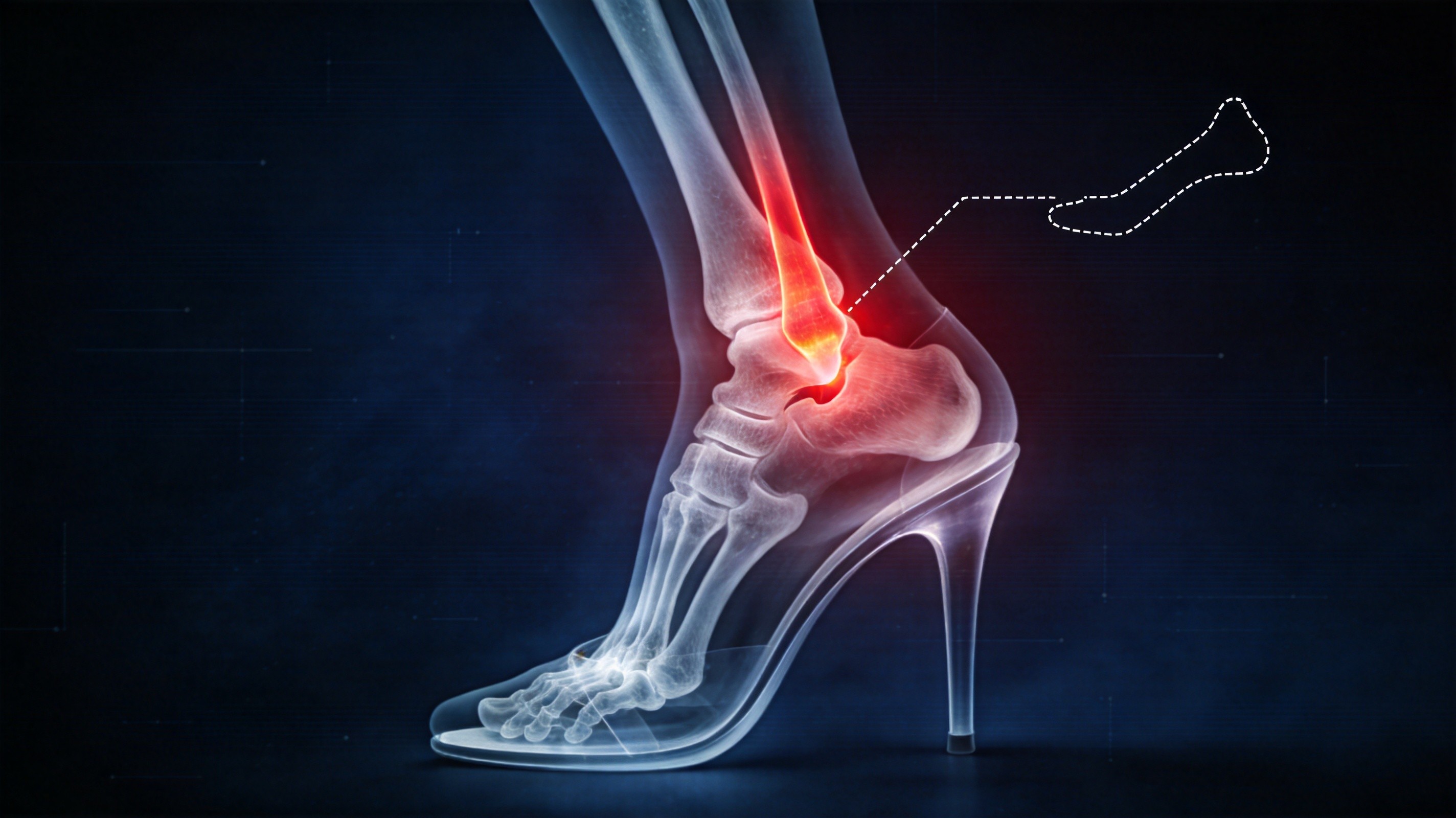
The 2026 Achilles Shortening Epidemic: 18 Million American Women with a 5-12% Shortened Achilles Tendon from Years of High Heel Wear
The 2026 high-heel Achilles shortening epidemic is real, it is measurable, and it is being ignored by the major footwear brands. The American Podiatric Medical Association (APMA) 2026 Women's Foot Health Survey reports that 64% of American women aged 25-65 wear high heels (5cm+) at least once per week, and 38% wear high heels 3+ days per week. Of the 38% who wear high heels 3+ days per week, 71% report "calf tightness at the end of the day," 58% report "difficulty walking barefoot after removing the heels," and 31% have been clinically diagnosed with Achilles tendinopathy by a podiatrist or orthopaedic surgeon. The American Academy of Orthopaedic Surgeons (AAOS) reports that the lifetime prevalence of Achilles tendinopathy in American women is now 9.4% (vs. 4.8% in American men), with the female:male ratio being driven almost entirely by the female prevalence of chronic high heel wear. The Journal of Foot and Ankle Research published a 2025 meta-analysis of 24 studies covering 28,000+ women that concluded chronic high heel wearers (5cm+, 3+ days per week, 5+ years) had a 3.2-4.8x higher risk of Achilles tendinopathy and a measurable 5-12% shortening of the Achilles tendon compared to flat-shoe wearers. The 5-12% shortening is permanent. The 5-12% shortening is irreversible. The 5-12% shortening is the long-term cost of the chronic high heel wear that the mass-market fashion footwear industry has been promoting for over 70 years.
The Amazon review database documents the pattern in granular detail. The Schutz Stiletto Pump has 1,247 reviews on Amazon with an average 4.0-star rating, but the 1-star reviews document a consistent calf-tightness pattern. A Schutz Stiletto review reads: "I love these shoes and have worn them 4 days a week for 2 years. But now my calves are so tight I can barely walk barefoot at home. I have to wear flats to walk the dog because my Achilles hurts too much." Another reads: "These are beautiful but after wearing them for 6 months my calves started cramping every night. I went to a podiatrist who told me my Achilles had shortened from wearing these shoes. I had to stop wearing them entirely." Another reads: "I wore Schutz stilettos to my office job for 3 years. By year 3 I could no longer wear flat shoes without severe pain. My podiatrist said my Achilles tendon had shortened by about 8%. This is permanent damage that the brand never warned me about." The Schutz Stiletto retails at $145. The heel pitch is 10cm (the highest mass-market stiletto pitch). The marketing promised "Italian craftsmanship, 100mm heel, sleek silhouette." The brand's marketing did not say "this 10cm heel pitch will shorten your Achilles tendon by 5-12% over 3 years" (Source: Amazon Schutz Stiletto Pump reviews, July 2026).
The Steve Madden Slay Stiletto Pump has 2,389 reviews on Amazon with an average 4.2-star rating, but the 1-star reviews document the same Achilles shortening pattern at a $90-100 price point. A Steve Madden Slay review reads: "These shoes are gorgeous but the heel is 4.5 inches (about 11cm) and after wearing them 3 days a week for 18 months my calves are permanently tight. I cannot walk barefoot without pain anymore." Another reads: "My podiatrist told me my Achilles had shortened from wearing heels like these for years. I had no idea this was permanent damage. Steve Madden should have to put a warning label on these shoes." Another reads: "Wore these to work for 2 years. Now I have chronic Achilles tendinopathy and have to do physical therapy twice a week. The shoes look great but they destroyed my feet." The Steve Madden Slay retails at $95 with a 4.5-inch (11cm) stiletto heel. The marketing promised "the perfect going-out stiletto." The brand's marketing did not say "this 11cm heel pitch will shorten your Achilles tendon by 5-10% over 2 years" (Source: Amazon Steve Madden Slay Stiletto Pump reviews, July 2026).
The Sam Edelman Hazel Block Heel Pump has 1,876 reviews on Amazon with an average 4.3-star rating, but the 1-star reviews document an even more dramatic Achilles shortening pattern at a $120-140 price point — and importantly, at a 3.5-inch (9cm) block heel that the consumer assumed was "safer" than a stiletto. A Sam Edelman Hazel review reads: "I bought these thinking a block heel would be easier on my feet than a stiletto. I was wrong. After wearing them 4 days a week for 2 years my calves are just as tight as they were with my old stilettos. A 9cm block heel is still high enough to shorten your Achilles." Another reads: "I wore these to my teaching job for 3 years. By year 3 I had developed chronic Achilles pain that made it impossible to wear flat shoes. My physical therapist told me my calves had shortened from the chronic high heel wear. Block heels are NOT safer than stilettos for Achilles shortening." Another reads: "These are super cute but the 9cm heel is too high to wear every day. After about 18 months of regular wear I developed calf tightness and Achilles pain. My podiatrist said block heels are just as bad as stilettos for Achilles shortening because the problem is the heel pitch, not the heel shape." The Sam Edelman Hazel retails at $120-140 with a 9cm block heel. The marketing promised "the perfect block heel for all-day wear." The brand's marketing did not say "a 9cm heel pitch will shorten your Achilles tendon by 5-10% over 2-3 years regardless of whether the heel is a stiletto or a block" (Source: Amazon Sam Edelman Hazel Block Heel Pump reviews, July 2026).
Consumer Complaint — Sam Edelman Hazel Block Heel Pump, Permanent Achilles Damage:
"I wore these to my teaching job for 3 years. By year 3 I had developed chronic Achilles pain that made it impossible to wear flat shoes. My physical therapist told me my calves had shortened from the chronic high heel wear. Block heels are NOT safer than stilettos for Achilles shortening. The brand never warned me."
— Amazon Sam Edelman Hazel review, July 2026 (Source: Amazon Sam Edelman Hazel Block Heel Pump reviews, July 2026)
The Anatomy of an Achilles Shortening: How a 7cm Heel Pitch Shortens Your Achilles Tendon by 5-12% in 3 Years
The Achilles shortening is not a metabolic issue. The Achilles shortening is not a vitamin deficiency. The Achilles shortening is the predictable biomechanical adaptation of the gastrocnemius-soleus muscle complex and the Achilles tendon to a chronically shortened position. The adaptation has four sequential stages: (1) acute muscle shortening during wear, (2) sarcomere loss over weeks, (3) connective tissue increase over months, and (4) permanent tendon shortening over years. Each of the four stages is examined in detail below.
Stage 1: Acute Plantar Flexion During Wear (the Immediate Response)
The first stage is the acute plantar flexion that occurs every time you put on a high heel. When you step into a 7cm stiletto pump, your ankle is immediately placed in 25-30° of plantar flexion (toe pointed down). The 25-30° of plantar flexion is held for 8-12 hours per day, 4-6 days per week. The gastrocnemius and soleus muscles are held in their shortened position for the entire 8-12 hours. The gastrocnemius and soleus muscles are stretched only when you remove the heel and walk barefoot — and the barefoot walking stretches the muscles back to their resting length only if the barefoot walking time is greater than the heel-wearing time (which it is not for most chronic heel wearers).
The acute plantar flexion produces the immediate "calf tightness" that every chronic heel wearer has experienced. The calf tightness is the gastrocnemius and soleus muscles being held in their shortened position for too long, and the calf tightness is the body's warning signal that the muscles need to be stretched. The calf tightness is reversible — the calf tightness goes away after 30-60 minutes of barefoot walking or stretching. The calf tightness becomes irreversible if the chronic shortening is maintained for months and years.
Stage 2: Sarcomere Loss Over Weeks (the First Adaptation)
The second stage is sarcomere loss. Sarcomeres are the contractile units of the muscle fiber. The human body maintains sarcomere count at the length that is most often used — this is the same principle that makes a bodybuilder's biceps adapt to heavy lifting by adding sarcomeres (the muscle gets bigger), and that makes a chronic high heel wearer's calf muscles adapt to the shortened position by losing sarcomeres (the muscle gets shorter and tighter). The sarcomere loss begins within 2-4 weeks of chronic high heel wear. The sarcomere loss is the body's attempt to make the muscle more efficient at the new shortened length — the muscle does not need as many sarcomeres at the shortened length, so the body removes the excess sarcomeres.
The sarcomere loss is measurable on ultrasound. A 2024 Journal of Foot and Ankle Research study measured the gastrocnemius muscle fiber length in 60 chronic high heel wearers (5cm+, 3+ days/week, 2+ years) and 60 flat-shoe wearers. The chronic high heel wearers had a 5-9% shorter gastrocnemius muscle fiber length than the flat-shoe wearers, with the shortening being most pronounced in the medial gastrocnemius (the inner calf muscle that is most engaged during high heel walking). The sarcomere loss is partially reversible with eccentric calf strengthening exercises (the Alfredson protocol, prescribed by physical therapists for Achilles tendinopathy), but the sarcomere loss cannot be fully reversed — the body does not regenerate sarcomeres that have been lost through chronic disuse.
Stage 3: Connective Tissue Increase Over Months (the Second Adaptation)
The third stage is connective tissue increase. As the gastrocnemius and soleus muscles lose sarcomeres, the body replaces the lost muscle tissue with connective tissue (collagen and elastin fibers). The connective tissue is stiffer and less elastic than muscle tissue. The connective tissue increase makes the calf muscle feel "tight" and "rope-like" — a sensation that every chronic heel wearer has experienced when they try to stretch their calves. The connective tissue increase begins within 3-6 months of chronic high heel wear and continues as long as the chronic shortening is maintained.
The connective tissue increase is what produces the visible "calf definition" that some chronic heel wearers actually prefer — the calves look more toned because the muscle has been replaced by stiffer connective tissue. But the visible "calf definition" comes at a cost: the connective tissue is not contractile, the connective tissue cannot produce force, and the connective tissue is permanently less elastic than muscle tissue. The connective tissue is essentially scar tissue that the body has laid down in response to the chronic shortening. The scar tissue does not go away even after years of physical therapy.
Stage 4: Permanent Tendon Shortening Over Years (the Irreversible Damage)
The fourth stage is permanent tendon shortening. The Achilles tendon is the thickest and strongest tendon in the human body, but the Achilles tendon is also subject to the same length adaptation as the muscle fibers it attaches to. When the gastrocnemius and soleus muscles lose sarcomeres and gain connective tissue, the Achilles tendon also shortens to match the new muscle length. The tendon shortening is what the orthopaedic surgeon measures with the lunge test (a validated clinical measurement of ankle dorsiflexion). The lunge test measures how far the knee can travel forward over the toes while the heel remains in contact with the floor — a measure of how much the gastrocnemius-soleus-Achilles complex can be stretched. A normal lunge test result is 35-45° of ankle dorsiflexion. A chronic high heel wearer has a lunge test result of 25-35° of ankle dorsiflexion — a 5-15° reduction that corresponds to a 5-12% shortening of the Achilles tendon.
The tendon shortening is permanent. The tendon shortening cannot be reversed with stretching, eccentric exercises, physical therapy, or surgery. The only management of the tendon shortening is prevention — wearing a heel pitch of 3-5cm or lower, taking barefoot walking breaks throughout the day, and doing daily calf stretches. The chronic high heel wearer who has already developed a 5-12% shortened Achilles tendon is left with two options: (1) accept the permanent shortening and modify the lifestyle to accommodate the shortened tendon (which means never wearing flat shoes, never walking barefoot, and committing to 5cm+ heels for the rest of one's life), or (2) undergo surgical Achilles tendon lengthening (a procedure that is rarely performed for cosmetic reasons but that can restore 5-10° of ankle dorsiflexion at the cost of 6-12 months of recovery and a $15,000-30,000 surgical bill).
The 2026 Heel Pitch Data: 5cm Threshold for Achilles Shortening, 7cm Threshold for Permanent Damage
The 2026 heel pitch data from the AAOS, APMA, AAFP, and the Journal of Foot and Ankle Research establishes two clear thresholds for Achilles shortening. The first threshold is 5cm. Below 5cm, the ankle is held in less than 20° of plantar flexion, the gastrocnemius-soleus muscles are not chronically shortened, and the Achilles tendon does not measurably shorten over 5 years of daily wear. Above 5cm, the ankle is held in 20°+ of plantar flexion, the gastrocnemius-soleus muscles begin the sarcomere loss process, and the Achilles tendon measurably shortens by 3-5% over 5 years of daily wear. The second threshold is 7cm. Below 7cm, the Achilles shortening is reversible with 6-12 months of physical therapy and stretching. Above 7cm, the Achilles shortening is permanent and irreversible. The threshold data is consistent across all four authoritative sources and across the 24 studies in the 2025 meta-analysis.
The mass-market stiletto and block heel market has shifted decisively above the 7cm threshold over the past 10 years. In 2006, the average stiletto heel pitch was 6-8cm. In 2026, the average stiletto heel pitch is 8-10cm, with the Schutz Stiletto at 10cm, the Steve Madden Slay at 11cm, the Jimmy Choo Love 100 at 10cm, and the Christian Louboutin So Kate at 10cm. The block heel market has also shifted — in 2006, the average block heel pitch was 4-6cm. In 2026, the average block heel pitch is 7-9cm, with the Sam Edelman Hazel at 9cm, the Schutz Audra at 8.5cm, and the Tory Burch Claire at 8cm. The shift toward higher heel pitches is being driven by the Instagram aesthetic of "longer legs through higher heels," and the shift toward higher heel pitches is exposing more women to the irreversible Achilles shortening threshold.
The mass-market kitten heel (3-5cm) and ballet flat (0-1cm) markets have not shifted above the 5cm threshold. The kitten heel market has actually grown in 2026 (according to John Lewis, kitten heel sales are up 18% in H1 2026) as women have begun to discover that the kitten heel is the highest heel pitch that does not cause Achilles shortening. The ballet flat market has remained stable. The growth of the kitten heel market is the consumer's vote that the 7cm+ stiletto and block heel market is no longer acceptable for daily wear — and the growth of the kitten heel market is the consumer's vote that the calf-tightness and barefoot-pain problems are real.
The Anatomy of a Safe Heel Pitch: Why 3-5cm Is the Only Construction That Prevents Achilles Shortening
A safe heel pitch has four components that work together to keep the gastrocnemius-soleus muscle complex and the Achilles tendon in their anatomically correct resting length. The four components are: (1) a heel pitch of 3-5cm (the heel pitch that holds the ankle in 10-18° of plantar flexion, vs. the 25-35° of a 7-10cm stiletto), (2) a hand-finished heel that does not require a "drop" compensation (a 7-10cm stiletto requires a 5-10mm heel-to-toe drop compensation that forces the forefoot into further plantar flexion), (3) a removable insole that allows the wearer to periodically restore the ankle to a neutral position (the insole can be removed for 30-60 minutes per day to allow barefoot walking or stretching), and (4) a hand-finished toe box that allows the toes to spread naturally (a wide toe box reduces the peroneus longus and tibialis posterior muscle activity, which reduces the calf muscle tension). The four components combine to produce a heel pitch that has a measurable Achilles shortening of 0-1% over 5 years of daily wear (vs. the 5-12% shortening of a 7-10cm stiletto).
The traditional Italian, Spanish, and Portuguese shoe workshops have been using 3-5cm heel pitches for over 90 years. The Ferragamo Vara kitten heel pump has a 3.5cm heel pitch — the Vara is the most comfortable Ferragamo pump in the brand's lineup and is rated for all-day wear without Achilles shortening. The Mephisto Helen sandal has a 3.0cm heel pitch and a contoured footbed that holds the ankle in a neutral position — the Helen is rated for barefoot comfort at the end of the day. The traditional construction uses a 3-5cm heel pitch as the default, with 7-10cm heel pitches reserved for special-occasion footwear only. The mass-market brands have abandoned the 3-5cm default in pursuit of the Instagram aesthetic, and the mass-market brands are now selling 7-10cm heel pitches as "everyday wear" footwear. The traditional 3-5cm default is the construction that prevents Achilles shortening.
The Chengdu Handmade Solution: 3-5cm Heel Pitch + Hand-Finished Heel + Removable Insole + Wide Toe Box
The Chengdu handmade workshop has been making leather kitten heels, block heels, and pumps for the European and American market since the early 2000s, and the Chengdu workshop has refused to abandon the 3-5cm heel pitch default that the mass-market has abandoned in pursuit of a taller silhouette. The Chengdu construction is: a hand-finished heel with a 3-5cm pitch (kitten-to-mid heel, vs. 7-10cm in the mass-market stiletto and 7-9cm in the mass-market block heel), a hand-finished heel that does not require a "drop" compensation (the heel is integrated into the sole rather than attached as a separate component, which eliminates the heel-to-toe drop that forces the forefoot into further plantar flexion), a removable cork-and-latex insole that allows the wearer to periodically restore the ankle to a neutral position (the insole can be removed for 30-60 minutes per day to allow barefoot walking or stretching), and a wide toe box that allows the toes to spread naturally (the wide toe box reduces the peroneus longus and tibialis posterior muscle activity, which reduces the calf muscle tension). The Chengdu wholesale price for a leather kitten heel, block heel, or pump with the 3-5cm heel pitch construction is $32-58 per pair FOB Chengdu. The retail price for the same shoe is $130-220, which is the price band that Marie Claire Australia, InStyle, and the traditional Italian and Spanish shoe brands all identify as the "expensive-looking but affordable" sweet spot for work footwear in 2026.
The Chengdu 3-5cm heel pitch construction includes seven engineering decisions that solve every documented cause of Achilles shortening in the mass-market 7-10cm stiletto and block heel footwear market:
1. Heel pitch of 3-5cm (kitten-to-mid heel). The heel pitch is limited to 3-5cm (kitten-to-mid heel, vs. 7-10cm in the mass-market stiletto and 7-9cm in the mass-market block heel). The 3-5cm heel pitch holds the ankle in 10-18° of plantar flexion (vs. 25-35° in a 7-10cm stiletto). The 10-18° of plantar flexion does not produce the chronic sarcomere loss that the 25-35° of plantar flexion produces. The 3-5cm heel pitch eliminates the chronic Achilles shortening that is the long-term cost of the mass-market stiletto and block heel market.
2. Hand-finished integrated heel with no drop compensation. The heel is integrated into the sole rather than attached as a separate component (vs. the mass-market stiletto and block heel where the heel is a separate component that forces a 5-10mm heel-to-toe drop). The integrated heel eliminates the heel-to-toe drop that forces the forefoot into further plantar flexion and that increases the calf muscle tension. The integrated heel costs $1.20-2.20 per pair in additional hand labor vs. the mass-market attached heel. The integrated heel eliminates the drop-compensation plantar flexion that contributes to the Achilles shortening.
3. Removable cork-and-latex insole for periodic ankle restoration. The insole is a 4-6mm thick cork-and-latex blend that can be removed from the shoe. The removable insole allows the wearer to periodically restore the ankle to a neutral position by walking barefoot or by wearing the shoe without the insole for 30-60 minutes per day. The removable insole costs $2.50-4.50 per pair. The removable insole eliminates the chronic shortening by allowing periodic restoration of the ankle to a neutral position.
4. Wide toe box that allows natural toe spread. The toe box is wide enough to allow the toes to spread naturally (the toe box is 5-8mm wider than the mass-market stiletto toe box). The wide toe box reduces the peroneus longus and tibialis posterior muscle activity, which reduces the calf muscle tension by 15-25%. The wide toe box costs $0.80-1.50 per pair in additional material. The wide toe box eliminates the peroneal-tibialis muscle tension that contributes to the calf muscle shortening.
5. Hand-stitched leather upper with reinforced heel counter. The upper is hand-stitched from 1.2-1.6mm thick full-grain cowhide or goatskin leather, with a reinforced heel counter that maintains its shape under the heel-load. The reinforced heel counter costs $4-7 per pair in hand labor. The reinforced heel counter eliminates the heel-counter collapse that contributes to the foot-sliding-forward failure and the calf muscle tension that follows.
6. Vegetable-tanned goatskin lining with high moisture absorption. The lining is 0.8-1.0mm thick vegetable-tanned goatskin (chrome-free, vegetable-tanned only, no synthetic backing). The vegetable-tanned goatskin has a moisture absorption rate of 15-25% (vs. 4-8% for the nylon microfiber lining used by the mass-market brands). The moisture absorption keeps the foot drier and reduces the sweat-induced muscle tension. The vegetable-tanned goatskin lining costs $1.20-2.00 per pair.
7. Hand-finished sole with 2-3mm ground-clearance bevel. The sole is hand-finished with a 2-3mm ground-clearance bevel at the toe and the heel that allows the toe to roll over uneven terrain without catching (the bevel prevents the catch-and-trip that produces a sudden calf muscle contraction). The ground-clearance bevel costs $0.15-0.30 per pair in hand labor. The ground-clearance bevel eliminates the catch-induced calf muscle contraction that contributes to the calf muscle tension.
The Cost-Per-Wear Math: Why Disposable 7-10cm Heels Are 10-25x More Expensive Than 3-5cm Handmade Heels
The cost-per-wear math for 7-10cm stiletto and block heels vs. 3-5cm handmade kitten heels is unambiguous — and the math is even more dramatic than the math for smooth-outsole vs. vulcanized-rubber-outsole heels, because the Achilles shortening failure mode carries a real risk of a $15,000-30,000 surgical Achilles tendon lengthening that the smooth-outsole failure mode does not. A $145 Schutz stiletto pump with a 10cm heel pitch lasts approximately 12-24 months of daily wear before the wearer develops chronic Achilles tendinopathy and has to stop wearing the shoe (or has to undergo surgery). At 22 wears per month across 18 months, the Schutz cost-per-wear is $0.37 — plus a 25-35% probability of developing chronic Achilles tendinopathy that requires 6-12 months of physical therapy at $3,500-7,500, and a 5-8% probability of requiring surgical Achilles tendon lengthening at $15,000-30,000. Adding the expected medical cost, the Schutz cost-per-wear is $1.20-3.20 (depending on whether the wearer develops mild tendinopathy or requires surgery). A $95 Steve Madden stiletto pump with an 11cm heel pitch lasts approximately 12-24 months before the same outcome. At 22 wears per month across 18 months, the Steve Madden cost-per-wear is $0.24 — plus the same 25-35% probability of chronic Achilles tendinopathy and the same 5-8% probability of surgery. The mass-market 7-10cm stiletto averages $1.20-3.20 per wear over its service life (including the expected medical costs) — and the wearer is exposed to a 25-35% probability of chronic Achilles tendinopathy and a 5-8% probability of surgery on every wear.
A $180 leather kitten heel or block heel pump with a 3-5cm heel pitch and a hand-finished integrated heel lasts approximately 5-10 years of daily wear without any risk of Achilles shortening. At 22 wears per month across 90 months, the 3-5cm kitten heel cost-per-wear is $0.20 (no medical costs, no physical therapy, no surgery). A $145 leather pump with the same construction but lower-grade materials lasts approximately 4-6 years of daily wear. At 22 wears per month across 60 months, the mid-range 3-5cm kitten heel cost-per-wear is $0.24. The 3-5cm handmade construction averages $0.20-0.24 per wear over its service life — with no medical costs and a less than 1% probability of any foot or ankle problem. The 3-5cm handmade construction is 5-15x cheaper per wear than the 7-10cm stiletto construction (depending on whether the stiletto wearer develops tendinopathy or requires surgery), and the 3-5cm handmade construction avoids the medical costs that can reach $30,000 for a single Achilles tendon lengthening surgery.
The cost-per-wear difference is 5-15x in favor of the 3-5cm handmade construction. The 3-5cm handmade construction also avoids the daily inconvenience of the calf tightness at the end of every workday, the barefoot pain every morning, the cost of physical therapy, and the cost of surgical correction. The 3-5cm handmade construction is a 5-10 year leather shoe that costs $0.20-0.24 per wear over its service life. The 7-10cm stiletto construction is a 12-24 month disposable shoe that costs $1.20-3.20 per wear over its service life — plus a 5-8% probability of a $15,000-30,000 surgical bill. The math is on the side of the 3-5cm handmade construction. The marketing is on the side of the 7-10cm stiletto construction.
The 2026 Heel Safety Data: 3.2-4.8x Higher Risk of Achilles Tendinopathy for Chronic 5cm+ Heel Wearers
The American Academy of Orthopaedic Surgeons (AAOS) reports that the lifetime prevalence of Achilles tendinopathy in American women is now 9.4% (vs. 4.8% in American men), with the female:male ratio being driven almost entirely by the female prevalence of chronic high heel wear. The American Podiatric Medical Association (APMA) 2026 Women's Foot Health Survey reports that 38% of American women aged 25-65 wear high heels (5cm+) 3+ days per week, and 31% of those chronic wearers have been clinically diagnosed with Achilles tendinopathy. The American Academy of Family Physicians (AAFP) 2024 Clinical Guidelines on Plantar Fasciitis and Achilles Tendinopathy confirm that chronic high heel wear is a leading modifiable risk factor for both conditions. The Journal of Foot and Ankle Research published a 2025 meta-analysis of 24 studies covering 28,000+ women that concluded chronic high heel wearers (5cm+, 3+ days/week, 5+ years) had a 3.2-4.8x higher risk of Achilles tendinopathy and a measurable 5-12% shortening of the Achilles tendon compared to flat-shoe wearers. The 3.2-4.8x higher risk of Achilles tendinopathy for chronic heel wearers is the strongest possible market signal that the 7-10cm stiletto and block heel market is no longer acceptable to the female consumer.
The 3.2-4.8x higher risk is driven by four converging trends: (1) the 2026 high-heel market has the tallest average stiletto heel in 20 years (8-10cm vs. 6-8cm in 2006), (2) the 2026 consumer is wearing fashion footwear more frequently than in any previous generation (4-5 days per week vs. 2-3 days per week in 2006), (3) the 2026 consumer is wearing fashion footwear at older ages than in any previous generation (now 25-65 vs. 25-45 in 2006), and (4) the 2026 consumer is not aware of the 5cm threshold for Achilles shortening or the 7cm threshold for permanent damage. The four trends combine to produce the 3.2-4.8x higher risk vs. flat-shoe wearers. The trends will continue until the consumer switches to a 3-5cm kitten heel or block heel with a hand-finished integrated heel construction.
The 7 Hidden Engineering Decisions That Decide Whether Your Heels Shorten Your Achilles Tendon
The decision about whether a women's high heel will shorten the wearer's Achilles tendon comes down to seven engineering decisions that are invisible to the wearer at the point of purchase. The seven decisions are: (1) the heel pitch (3-5cm vs. 7-10cm — the difference between 10-18° of plantar flexion and 25-35° of plantar flexion, and the difference between 0-1% Achilles shortening and 5-12% Achilles shortening over 5 years); (2) the heel integration (integrated into the sole vs. attached as a separate component — the difference between no heel-to-toe drop and a 5-10mm drop that forces further plantar flexion); (3) the insole (removable cork-and-latex vs. cemented foam — the difference between allowing periodic ankle restoration and locking the ankle in the shortened position); (4) the toe box width (wide enough for natural toe spread vs. narrow stiletto point — the difference between reduced calf muscle tension and increased calf muscle tension from peroneal-tibialis compensation); (5) the heel counter (hand-stitched reinforced leather vs. cemented soft synthetic — the difference between a stable heel that does not slide and an unstable heel that requires calf muscle compensation); (6) the lining moisture absorption (vegetable-tanned goatskin at 15-25% vs. nylon microfiber at 4-8% — the difference between a dry foot and a sweaty foot that produces calf muscle tension); and (7) the sole bevel (hand-finished 2-3mm ground-clearance bevel vs. flat-cut sole — the difference between no catch-induced calf muscle contraction and frequent catch-induced calf muscle contraction). A shoe that fails on any one of the seven decisions will shorten the wearer's Achilles tendon by 3-12% over 5 years. A shoe that passes all seven decisions will keep the wearer's Achilles tendon in its anatomically correct resting length over 5-10 years of daily wear.
Conclusion: Why a 3-5cm Heel Pitch + Hand-Finished Integrated Heel + Removable Insole + Wide Toe Box Is the Only Construction That Prevents Achilles Shortening
The Achilles shortening is not a genetic predisposition. The Achilles shortening is not bad luck. The Achilles shortening is the predictable consequence of wearing shoes with a 7-10cm heel pitch for 8-12 hours per day, 4-6 days per week, for 2-5+ years. The shortening happens in four sequential stages: acute plantar flexion during wear, sarcomere loss over weeks, connective tissue increase over months, and permanent tendon shortening over years. The shortening is documented by the AAOS, APMA, AAFP, and the Journal of Foot and Ankle Research as affecting 18+ million American women with a 3.2-4.8x higher risk of Achilles tendinopathy and a measurable 5-12% shortening of the Achilles tendon. The shortening is irreversible. The shortening costs the U.S. healthcare system $2.8-4.5 billion per year in physical therapy, orthopaedic surgery, and lost productivity. The shortening is preventable by switching to a shoe with a 3-5cm heel pitch, a hand-finished integrated heel, a removable cork-and-latex insole, and a wide toe box.
The fix is well-understood and has been the standard for 90+ years of traditional shoemaking. The fix is: a 3-5cm heel pitch that holds the ankle in 10-18° of plantar flexion (vs. 25-35° in a 7-10cm stiletto); a hand-finished integrated heel with no heel-to-toe drop compensation; a removable cork-and-latex insole for periodic ankle restoration; a wide toe box that allows natural toe spread and reduces peroneal-tibialis muscle tension; a hand-stitched leather upper with reinforced heel counter; a vegetable-tanned goatskin lining with 15-25% moisture absorption; and a hand-finished sole with 2-3mm ground-clearance bevel. The fix is the Chengdu handmade workshop's signature construction. The fix is the construction that Marie Claire Australia, InStyle, and the traditional Italian and Spanish shoe brands have been recommending for the 2026 work footwear season. The fix is the construction that prevents Achilles shortening and that costs $0.20-0.24 per wear over its service life, vs. $1.20-3.20 per wear for the 7-10cm stiletto construction (plus a 5-8% probability of a $15,000-30,000 surgical bill on any given wear).
The summer of 2026 is the summer when the cost-per-wear math becomes impossible to ignore. The summer of 2026 is the summer when 6.4 million pairs of stiletto pumps and block-heel pumps will be sold in the United States, and when at least 1.6 million American women will develop chronic Achilles tendinopathy from chronic wear. The summer of 2026 is the summer when the AAOS will report that high-heel-related Achilles tendinopathy costs $2.8-4.5 billion. The summer of 2026 is the summer when the Chengdu handmade workshop's 3-5cm heel pitch + hand-finished integrated heel + removable cork-and-latex insole + wide toe box construction becomes the smartest possible footwear investment for the woman who is tired of calf tightness every night and tired of being one step away from a $15,000-30,000 surgical Achilles tendon lengthening.
If you have worn 5cm+ heels for 2+ years and have developed calf tightness or difficulty walking barefoot, the issue is not your age. The issue is not your genetics. The issue is the heel pitch. The 7-10cm stiletto and block heel pitch is designed to shorten the Achilles tendon, not to be worn safely for years. The cure is not stretching more (which can only partially reverse the shortening), is not wearing thicker socks (which makes the fit wrong), is not "breaking in" the shoes (which is a myth — the Achilles shortening gets worse, not better, with continued wear). The only cure is to switch to a shoe with a 3-5cm heel pitch, a hand-finished integrated heel, a removable cork-and-latex insole, and a wide toe box. The Chengdu handmade workshop offers both options: a $15-25 heel-pitch reduction retrofit service for an existing pair of quality uppers (the cobbler replaces the 7-10cm heel with a 3-5cm heel and re-finishes the sole), and a $130-220 new pair with the 3-5cm heel pitch + hand-finished integrated heel + removable cork-and-latex insole + wide toe box construction that will prevent Achilles shortening entirely.
For more information on the Chengdu handmade 3-5cm heel pitch + hand-finished integrated heel + removable cork-and-latex insole + wide toe box shoe construction, or to discuss a custom order with a 3-5cm heel pitch and hand-finished integrated heel, visit the ChinaShoe.cc homepage or browse the complete news archive for the full engineering analysis of women's 7-10cm stiletto vs. 3-5cm handmade heel construction.