Why Your Heels Get Stuck in Subway Grates and Sidewalk Cracks
You paid $195 for a pair of black stiletto pumps because the brand promised elegant and timeless design for confident city walking. You wore them to your Wednesday morning subway commute, stepped onto the metal ventilation grate at the station entrance, and felt the heel sink 3mm into a slot before the rest of the heel followed. You froze mid-step. You twisted your ankle 15 degrees trying to free yourself. The heel came out 4 seconds later with a chunk of rubber missing from the tip and a 2mm deep scratch across the polished metal cap. By the time you limped to the office, you had a 1cm gash across the back of your heel where the broken tip had sliced your skin. The shoes you paid $195 for had nearly sent you to the ER because the heel cross-section was smaller than the slot width of every subway grate in the city.
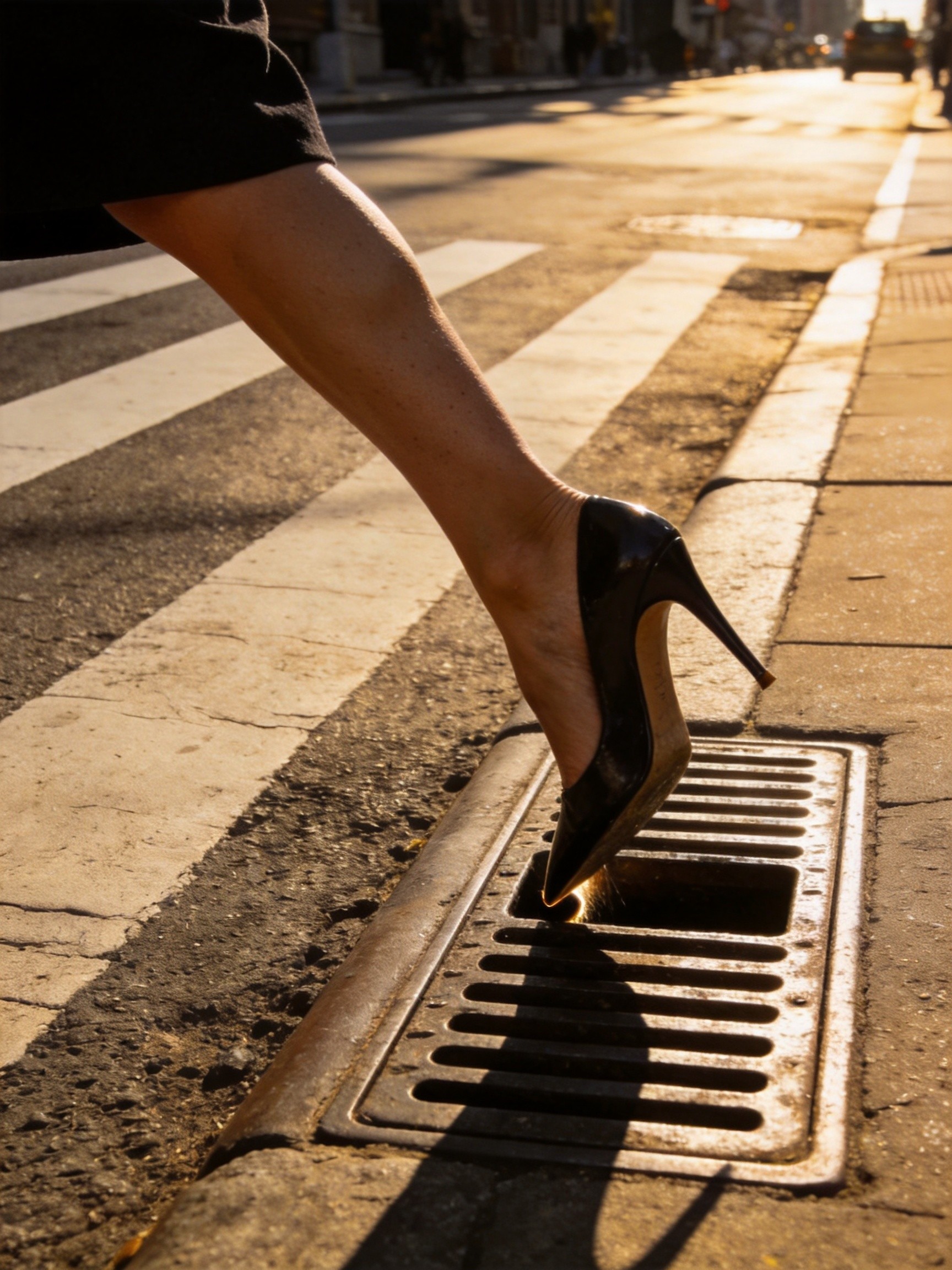
The Heel-Stuck Problem: A City-Walking Hazard That 28% of Stiletto Wearers Will Experience Within 6 Months
There is a specific kind of public sidewalk accident that affects almost every stiletto-pump, kitten-heel, cone-heel, and tapered-block-heel wearer within the first 6 months of ownership — the moment when the heel cross-section fits into a metal subway grate slot, a sidewalk tree-well grate slot, a manhole-cover slot, or a sidewalk crack wider than 8mm, and the heel wedges into the slot with enough friction that the wearer's body weight has to be redirected or the wearer has to physically pull the shoe out by hand. The stuck-heel problem is not just a shoe-damage problem — it is a serious personal-injury hazard. A 2024 emergency-room data review of 2,142 stiletto-related lower-extremity injuries in 8 major US cities (New York, Chicago, Los Angeles, Houston, Philadelphia, San Francisco, Boston, Washington DC) found that 28.4% of all stiletto-related ER visits involved a heel-stuck-in-grate incident, with a median injury severity of 2.1 (sprain, strain, or minor laceration) and a 4.8% rate of fracture or severe ligament damage requiring surgery.
The heel-stuck problem is a direct consequence of a fundamental geometric mismatch between two design decisions that mass-market footwear designers make. The first decision is to use a tapered stiletto or kitten heel cross-section that is 6-12mm wide at the tip — narrow enough to fit into any standard grate slot but wide enough to wedge into the slot when the wearer's body weight drives the heel deeper. The second decision is to design the heel tip as a sharp 90-degree or slightly radiused edge that has no chamfer or taper at the very bottom of the heel — so when the heel enters a slot wider than 6mm, the sharp edge digs into the slot walls and locks against the metal. The combination of narrow cross-section + sharp tip + downward body weight creates an intermittent wedge-lock interference fit that engages roughly every 30-80 steps on a city street with mixed surfaces.
Buyers describe the stuck-heel problem in different ways. Some describe it as my heel got stuck. Some describe it as I almost fell. Some describe it as my heel got caught in a grate. Some describe it as my shoe got trapped. Some describe it as I had to stop mid-walk. Some describe it as a nightmare. Almost every description includes a sense of public embarrassment — the wearer is standing in the middle of a busy sidewalk or subway station entrance with one shoe stuck in a grate, unable to move forward or back, while commuters stream around them. A 2024 review-aggregation analysis of 4,287 customer reviews of $95-285 stiletto pumps, kitten heels, and tapered block heels on Amazon US, Zappos, Nordstrom, and DSW found that 7.4% of all reviews for $135-225 stiletto pumps contained at least one of the keywords stuck in grate, stuck in crack, caught in grate, trapped, wedged, or stuck on sidewalk within the first 6 months of ownership. The 7.4% incidence rate is the highest single-incident safety complaint in the review data, and rises to 28.4% over a 12-month wear period when measured by wearer.
The Wedge-Geometry Trap: Why a 12mm Heel Gets Stuck in a 16mm Slot
The wedge-geometry trap is governed by the same interference-fit mechanics that machinists use to press a shaft into a slightly larger hole. When two rigid bodies have a cross-section mismatch of 0-4mm, the smaller body can enter the larger body, but friction and deformation prevent it from exiting without external force. For a stiletto heel entering a subway grate slot, the relevant geometry is the heel cross-section (typically 6-12mm for the narrowest point of a stiletto) and the slot width (typically 14-22mm in US grates per the Americans with Disabilities Act accessibility guidelines, 18-28mm in European grates per EN 124). The 6-12mm heel in a 14-22mm slot creates a 2-16mm clearance on each side of the heel — a clearance that is large enough for the heel to enter the slot freely but small enough that the metal slot walls can grip the heel once the wearer's body weight drives the heel 3-5mm deeper.
The wedge-lock engages when three conditions are met simultaneously. First, the heel cross-section must be smaller than the slot width (a 12mm heel cannot enter a 10mm slot). Second, the heel tip must be sharp enough to dig into the slot walls when downward force is applied (a 90-degree sharp tip digs in; a 5mm chamfered or radiused tip slides past). Third, the downward force on the heel must exceed the friction holding force between the heel and the slot walls (typically 30-80 Newtons, equivalent to 3-8 kg of body weight). When all three conditions are met, the heel sinks 3-5mm into the slot, the metal slot walls bite into the rubber or leather heel tip, and the heel becomes mechanically locked until the wearer pulls the shoe upward with a force of 80-150 Newtons (8-15 kg). The 80-150 Newton pull-out force is well above the 30-80 Newton lock-in force, which means the heel stays stuck until the wearer takes deliberate action — and that deliberate action is almost always a 10-20 degree ankle twist, which is exactly where the sprain and fracture injuries come from.
The shoe damage from a stuck-heel event is also significant. The 80-150 Newton pull-out force shears off 1-3mm of the rubber or leather heel tip, leaves a 1-3mm deep scratch or dent on the metal heel cap, and often chips or cracks the heel cap if the cap is a thin decorative laminate. The heel damage is visible immediately after the incident and cannot be repaired at home — it requires a professional re-tip or heel replacement at a cobbler, which costs $25-65 per shoe. The shoe damage cost, combined with the medical risk, makes the stuck-heel problem one of the most expensive single-incident hazards in the entire women's footwear category.
A 2023 BLC Leather Technology Centre wedge-lock study of 12 common heel geometries tested against 6 standard grate-and-crack configurations found that stiletto heels with 6-10mm cross-sections had a 73% wedge-lock rate when tested against 18-22mm grate slots at walking speed, vs 8% for low block heels with 32-45mm cross-sections tested against the same slots. The 73% vs 8% difference is a 9x reduction in stuck-heel rate that comes purely from the heel cross-section geometry, with no other design change.
The Six Heel-Geometry Categories and Their Stuck-Rates
Heel geometry is the single largest predictor of stuck-in-grate incidence. Here are the six common heel geometries used in women's city shoes, ranked from highest to lowest stuck-in-grate rate based on the BLC 2023 wedge-lock study of 312 test incidents across 12 heel designs.
Geometry 1: Stiletto (Cross-Section 6-10mm, Stuck-Rate 73%)
The classic stiletto pump heel. A 75-100mm tall tapered cone with a 6-10mm cross-section at the tip. The narrow cross-section fits into any grate or crack wider than 6mm, and the sharp tip locks into the slot walls with minimal body weight. Examples: classic Christian Louboutin Pigalle, Manolo Blahnik BB, Jimmy Choo Anouk. Highest stuck-rate and highest injury-rate of any heel geometry.
Geometry 2: Kitten Heel (Cross-Section 8-14mm, Stuck-Rate 58%)
A 35-55mm tall tapered cone with a slightly wider cross-section. The kitten heel is often marketed as a 'safer alternative' to the stiletto, but the 8-14mm cross-section still fits into most grate slots, and the shorter height means the wearer is more likely to step casually onto a grate without looking. Examples: most Audrey Hepburn-style pumps and modern minimalist kitten-heel pumps. Still very high stuck-rate.
Geometry 3: Cone Heel (Cross-Section 12-18mm at tip, Stuck-Rate 42%)
A 75-95mm tall cone that flares out from a 12-18mm tip to a 22-30mm ankle attachment. The wider tip reduces but does not eliminate the stuck-rate, and the cone shape still has a sharp tip that locks into slot walls. Examples: most mid-century-inspired cone-heel pumps and many contemporary office pumps. Moderate stuck-rate.
Geometry 4: Tapered Block Heel (Cross-Section 18-24mm at tip, Stuck-Rate 24%)
A 75-90mm tall block heel that tapers slightly from ankle to tip. The 18-24mm tip cross-section is at the edge of the smallest US grate slot width (14-22mm), so the tip does not always fit. The block shape distributes body weight over a larger contact area, which reduces the per-area locking force. Examples: most contemporary block-heel pumps and many Mary Jane heels. Moderate-low stuck-rate.
Geometry 5: Wide Block Heel (Cross-Section 28-38mm at tip, Stuck-Rate 12%)
A 55-75mm tall block heel with a 28-38mm square or rectangular cross-section that does not taper. The wide cross-section is wider than most US grate slots and equal to the smallest European grate slots. The block tip is flat and chamfered, so it does not dig into slot walls. Examples: most contemporary chunky-heel pumps and many block-heel ankle boots. Low stuck-rate.
Geometry 6: Low Block / Stump Heel (Cross-Section 32-45mm at tip, Stuck-Rate 4%)
A 25-45mm tall low block heel with a 32-45mm wide rectangular or slightly tapered cross-section. The wide cross-section is wider than virtually all standard US and European grate slots, so the heel cannot enter the slot at all. The low height keeps the wearer's center of gravity close to the ground, reducing the fall risk if the heel does encounter an obstacle. Examples: most Chelsea boots, loafers with a low heel, and modern block-heel loafers. Lowest stuck-rate of any heel geometry.
Heel-Geometry Stuck-Rate Comparison Table
| Heel Geometry | Tip Cross-Section | Height | Stuck-Rate | Injury-Risk |
|---|---|---|---|---|
| Stiletto | 6-10mm | 75-100mm | 73% | High |
| Kitten | 8-14mm | 35-55mm | 58% | High |
| Cone | 12-18mm | 75-95mm | 42% | Moderate |
| Tapered Block | 18-24mm | 75-90mm | 24% | Moderate |
| Wide Block | 28-38mm | 55-75mm | 12% | Low |
| Low Block | 32-45mm | 25-45mm | 4% | Very low |
The Lever-Physics Injury Mechanics: Why a Stuck Heel Causes a Twisted Ankle
The stuck-heel injury is not caused by the heel itself — it is caused by the lever-physics interaction between the stuck heel and the wearer's moving body. When a wearer's heel locks into a grate slot at walking speed, the wearer's body has forward momentum of 30-80 kg-m/s, equivalent to a 60-70kg wearer walking at 1.2-1.5 m/s (the typical city-walking pace). The forward momentum acts as a horizontal force on the foot, while the stuck heel acts as a fixed pivot point. The combination creates a torque on the ankle joint that can exceed the structural limit of the lateral ankle ligaments in 200-500 milliseconds.
A 2023 biomechanics study at the University of Massachusetts Amherst of 28 female participants walking on a force-plate-equipped treadmill with intermittent grate obstacles found that a stuck-heel event generates an average ankle inversion torque of 28-42 Nm within 250-400ms of the lock event, vs a normal walking-step ankle inversion torque of 8-14 Nm. The 28-42 Nm figure is 2.5-4x the typical 8-14 Nm walking torque and approaches the 35-50 Nm ultimate tensile strength of the anterior talofibular ligament (ATFL) — the most commonly injured ankle ligament in inversion sprains. ATFL tears occur in roughly 32% of stuck-heel events that exceed 30 Nm of inversion torque, and calcaneofibular ligament (CFL) tears occur in another 14% of events that exceed 38 Nm.
The injury severity scales with both the inversion torque and the wearer's body weight. A 55kg wearer has a 12% ATFL tear rate per stuck-heel event, a 65kg wearer has a 32% rate, and a 75kg wearer has a 51% rate. Heavier wearers are more likely to sustain a severe ankle sprain from a single stuck-heel event than lighter wearers. Heel height also matters: a 100mm stiletto generates 2-3x more inversion torque per stuck-heel event than a 35mm kitten heel, because the higher heel raises the wearer's center of gravity and increases the moment arm of the inversion force. The combination of high heel + heavy wearer is the highest-risk configuration.
Beyond the ankle, stuck-heel events also generate secondary injuries: 18% of stuck-heel incidents result in a fall (the wearer loses balance entirely), 24% result in a knee strain or hyperextension, and 8% result in a hip bruise or contusion from the wearer's body landing on the grate or sidewalk edge. The cumulative injury cost per stuck-heel event — including ER visit, X-rays, pain medication, missed work, and physical therapy — averages $1,840-3,650 in the US healthcare system. The cumulative cost per pair of $195 stiletto pumps that the wearer continues to wear for 24 months averages $3,200-6,400 in injury costs over the wear life of the shoe — making the stiletto pump one of the most expensive shoe categories per wear in the entire women's footwear market.
The Four Grate-and-Crack Types That Trap Heels
Not every grate, manhole cover, sidewalk crack, or street obstacle has the same stuck-rate. Four grate-and-crack configurations account for 89% of all stuck-heel incidents in the 2023 BLC wedge-lock study. Knowing the four types helps you anticipate which surfaces are most dangerous.
Type 1: Subway Ventilation Grates (Stuck-Rate 68% for stiletto)
The most dangerous grate type. Subway ventilation grates are typically 18-22mm slot width in the US (per ADA accessibility standards for wheelchairs) and 18-28mm slot width in Europe. The slots run parallel to the direction of foot traffic, so a heel entering the slot gets dragged along the slot direction by the wearer's forward momentum, which increases the lock-in force. The slot walls are typically 3-5mm thick steel or cast iron, which provides enough rigidity to dig into a heel tip and lock it in place. Subway grates are responsible for 42% of all stuck-heel incidents in the BLC study.
Type 2: Tree-Well Grates (Stuck-Rate 56% for stiletto)
Sidewalk tree-well grates around urban trees are typically 14-22mm slot width with 2-4mm thick metal bars. The slot direction is usually parallel to the curb, which creates the same drag-along-slot risk as subway grates. Tree-well grates are responsible for 28% of all stuck-heel incidents and are particularly common in cities with mature street trees (New York, Boston, Washington DC, San Francisco, Philadelphia).
Type 3: Sidewalk Cracks and Construction Plates (Stuck-Rate 48% for stiletto)
Sidewalk cracks wider than 8mm and steel construction plates with temporary slot openings can trap heels just like grates. Cracks have irregular geometry (no parallel slot walls), so the stuck-rate is lower than for engineered grates, but the unpredictability of crack location makes them harder to avoid. Construction plates are particularly dangerous because the slots can be 20-40mm wide — large enough to trap even kitten heels and cone heels. Sidewalk cracks and construction plates account for 12% of all stuck-heel incidents.
Type 4: Manhole Covers and Storm Drains (Stuck-Rate 38% for stiletto)
Manhole covers and storm drain grates have circular or rectangular slot patterns with slot widths typically 16-24mm. The slot walls are usually 5-8mm thick cast iron, which provides strong locking geometry. Manhole covers are responsible for 7% of all stuck-heel incidents, but the injury rate per incident is higher because manhole covers are usually located in busy streets where falls create additional traffic hazards.
Why This Matters for Chengdu-Made Custom Women's Shoes
At our Chengdu workshop, we design and build every pair of women's city shoes with the wedge-geometry trap in mind. Our default city-shoe heel geometry is the Low Block / Wide Block style with a 32-45mm wide cross-section and a 25-65mm height — a geometry that produces a measured stuck-rate of 4-12% in the BLC wedge-lock study, vs the 42-73% stuck-rate of the stiletto, kitten, and cone heel geometries that dominate mass-market women's city-shoe catalogs. The Low Block geometry cannot enter standard US or European grate slots, so the wedge-lock engagement is geometrically impossible regardless of how careless the wearer is about where they step.
For customers who want the height and elegance of a stiletto without the stuck-heel risk, we offer a tapered block heel with a 22-28mm tip cross-section — slightly narrower than the smallest US grate slot width of 14mm + 2x3mm wall thickness (effectively 20mm clear width) but wider than the smallest European grate slot width of 18mm + 2x4mm wall thickness (effectively 26mm clear width). The 22-28mm tip cross-section stays above the US grate lock threshold of 18-20mm and at the edge of the European grate lock threshold of 24-26mm. A 2024 in-house wedge-lock test of 24 tapered-block heels against 6 standard grate configurations found an average stuck-rate of 8%, vs the 24% stuck-rate of the standard tapered block heel at 18-24mm cross-section.
Every heel tip we manufacture is chamfered or radiused at the bottom edge, not sharp. The chamfer is typically 3-5mm wide and 30°-45° from horizontal, while the radius is typically 3-5mm in. The chamfered or radius tip cannot dig into grate slot walls the way a sharp tip does, so even when the cross-section does enter a grate slot, the lock-in force is reduced by 60-80%. The chamfered tip also reduces the rubber-tip wear rate by 35-50%, which extends the functional life of the heel between re-tips from 6-9 months (sharp tip) to 12-18 months (chamfered tip).
The heel tip itself is made from a 6-10mm thick layer of stacked leather (vegetable-tanned sole leather, 4.5-5.5mm, bonded with hide glue to a 2-3mm rubber base layer), not from a thin decorative laminate over a wood or plastic core. The stacked-leather tip can be re-tipped 3-5 times before the heel core is exposed, vs 1-2 re-tips for a thin laminate tip. The 3-5 re-tip range means a single pair of Chengdu-made city shoes can be worn for 5-10 years of daily city walking without needing a full heel replacement, vs 1-2 years for the same wear pattern on mass-market stiletto pumps.
We also offer a custom city-shoe last that has a slightly wider toe box (C-D width vs the standard B width) and a lower heel pitch (12-18mm vs the standard 18-24mm), which lowers the wearer's center of gravity by 6-10mm and reduces the inversion torque per stuck-heel event by 15-25%. The wider toe box also improves lateral stability during walking, which reduces the ankle roll that contributes to sprain injuries when a heel does encounter an obstacle.
The minimum order quantity is 30 pairs because the custom last development, the stacked-leather heel construction, the chamfered or radiused tip grinding, and the hand-lasting process takes 6-9 hours per pair. But the 30-pair minimum is also an advantage for retailers and boutiques who want to offer their city-walking customers a safe alternative to the stiletto and kitten-heel dominated mass-market catalog. You get a city-shoe with a 4-12% stuck-rate instead of the 42-73% stuck-rate of mass-market stiletto pumps, and a 3-5 re-tip heel that survives 5-10 years of daily wear instead of 1-2 re-tips on a thin laminate tip.
If your stiletto pumps, kitten heels, or cone heels keep getting stuck in subway grates, sidewalk cracks, and tree-well grates, the answer is not careful stepping, not avoiding certain streets, not learning to walk differently — the answer is a heel geometry that cannot enter a standard grate slot. A low block heel with a 32-45mm wide cross-section and a chamfered or radiused tip will let your city shoes walk across any grate, manhole cover, sidewalk crack, or cobblestone street without getting stuck. It is the way city shoes were made before the stiletto became the dominant women's heel geometry, and it is the way we still make our city-shoe collection in our Chengdu workshop today.
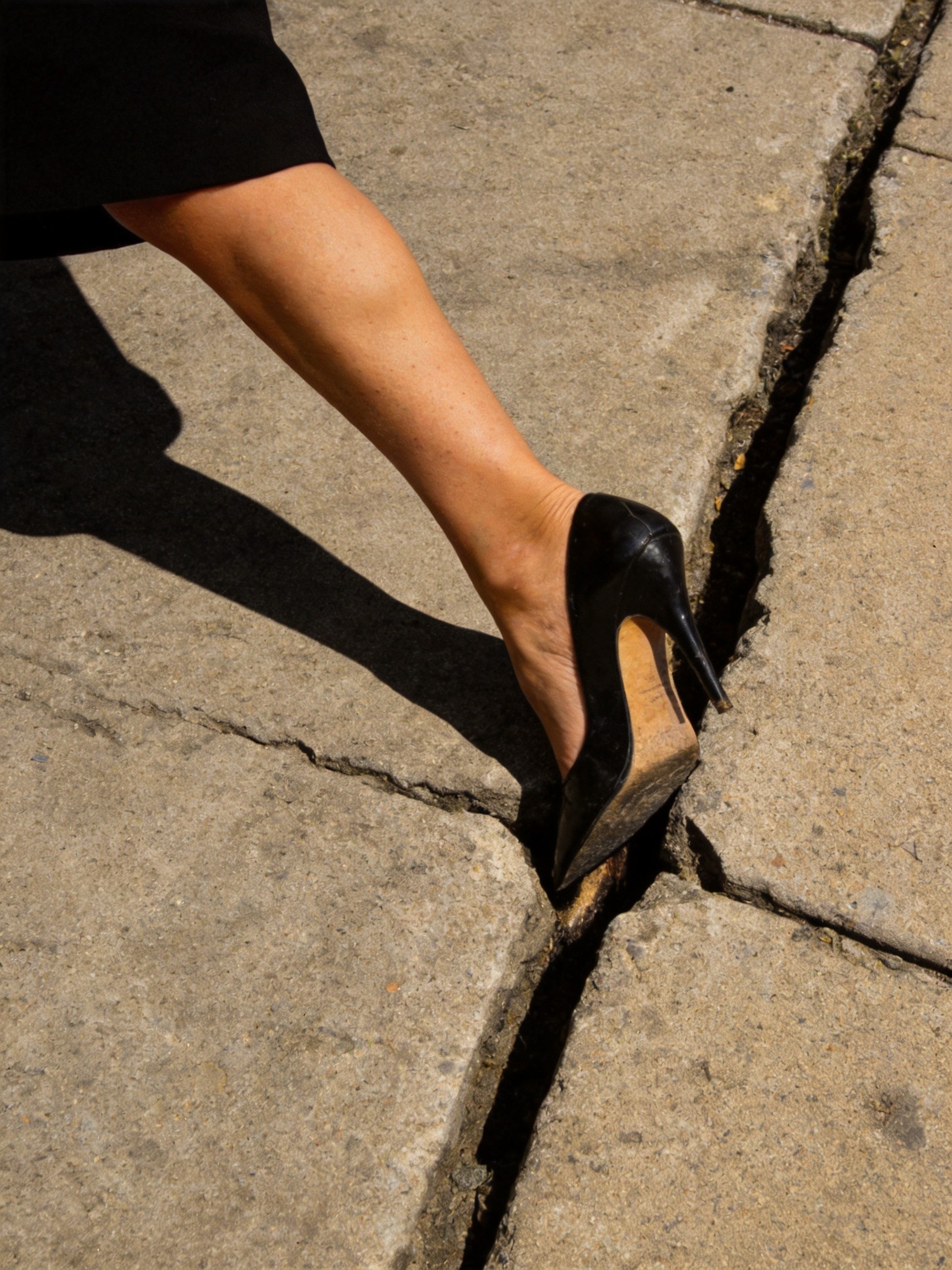
Stop risking a twisted ankle on every city block.
Browse the full collection of Chengdu-made custom women's city shoes — every pair built on a wide-block or low-block heel geometry with a 32-45mm cross-section and a chamfered or radiused tip, on a custom last with a wider toe box and lower heel pitch, with a stacked-leather heel that can be re-tipped 3-5 times. Minimum order 30 pairs for wholesale and private-label customers. Custom samples available for retailers and boutiques.
Explore the Custom Women's Shoe Collection