Why Your Cowboy Boots or Knee-High Boots Pinch and Dig Into the Back of Your Knee When Sitting Down
You paid $185 for a pair of chocolate-brown leather cowboy boots because the listing photo showed a sleek 15-inch shaft with a beautifully tooled upper and the marketing copy promised 'all-day wear with a flattering shaft height that pairs with jeans, dresses, and skirts.' You wore them to a two-hour Sunday brunch with friends, and for the first 20 minutes standing at the hostess stand and walking to your table you felt fine. The moment you slid into the booth and bent your right knee to sit comfortably, you felt a sharp pinch right in the crease at the back of your knee — the diamond-shaped hollow known anatomically as the popliteal fossa. The pinch was not on the side of your knee or on your calf, but precisely in the center of the back-of-knee crease where the boot shaft top-edge met the skin. By 20 minutes into the meal, the pinch had turned into a steady ache that ran from the popliteal fossa down into the upper third of your calf, and you could feel your right foot start to tingle as the boot shaft compressed the politeal artery and tibial nerve against the back of your knee. By the time the check arrived, you could not wait to stand up and pull the boots off, and when you finally got home you found a deep red indentation running horizontally across the back of both knees exactly where the boot shaft top-edge had been pressing. The cowboy boots you paid $185 for had turned a relaxed brunch into a 2-hour endurance test because the boot shaft top-edge had zero give — a 1.6-2.4mm thick piece of chrome-tanned leather with 24-32 shore-A hardness that acted like a steel cable across the back of your knee, the boot cut was designed at a 88-92 degree horizontal angle that drove the shaft top-edge directly into the popliteal fossa when the knee flexed to 90-110 degrees during sitting, the shaft-back-seam allowance was not skived down to 0.05-0.15mm and burnished but left at 0.8-1.6mm raw cut leather that bit into the skin with every knee flexion, and there was no 4-8mm rolled top-edge relief or 12-18mm padded topline binding to distribute the pressure across a wider surface.
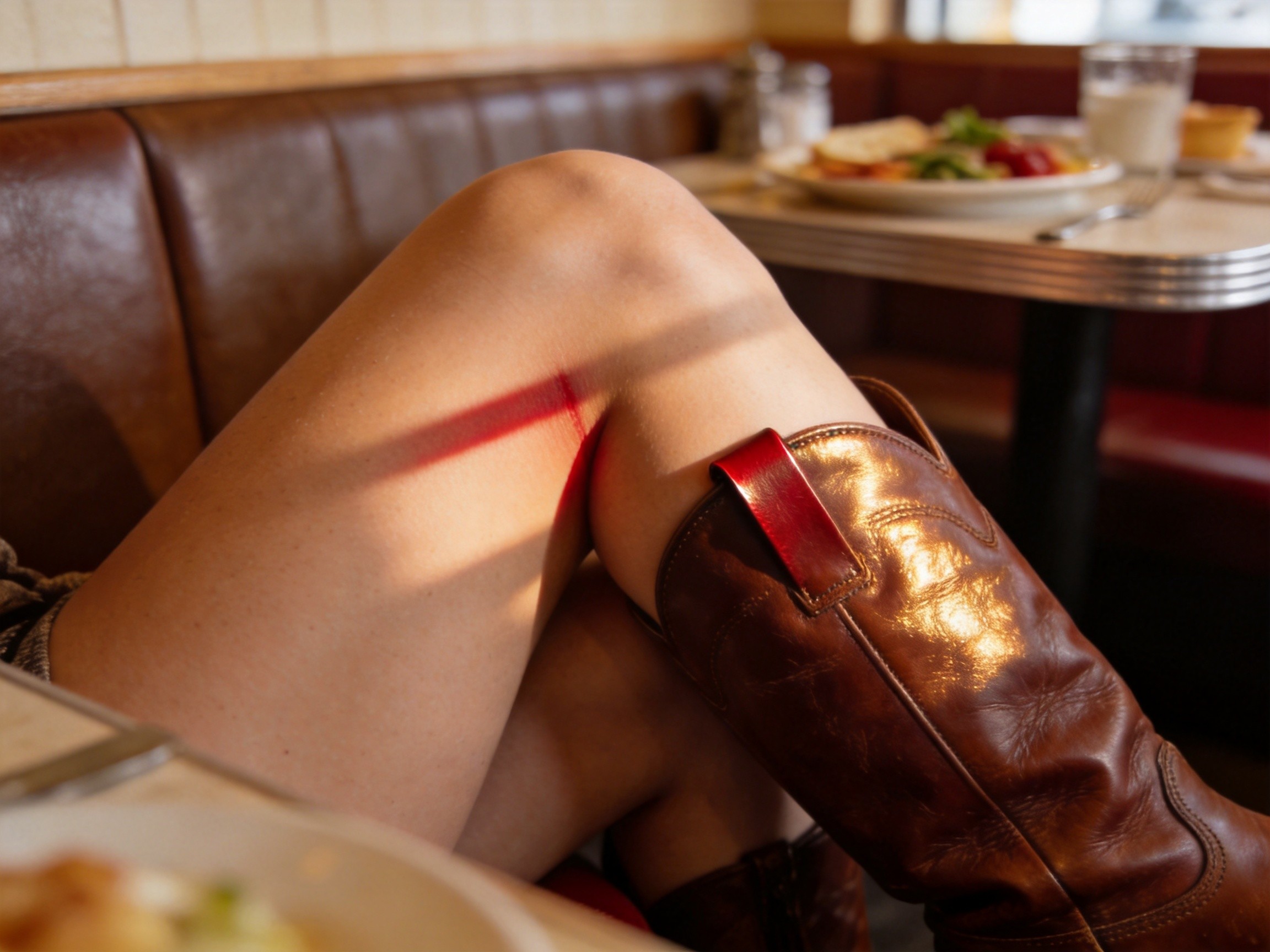
The Popliteal-Fossa Anatomy and Why a 1.6-2.4mm Chrome-Tan Shaft Edge Across the Back of the Knee Acts Like a Tourniquet
The popliteal fossa is the diamond-shaped hollow at the back of the knee, bordered above by the biceps femoris on the lateral side and the semimembranosus and semitendinosus on the medial side, and below by the two heads of the gastrocnemius. The fossa contains the popliteal artery, the popliteal vein, and the tibial nerve — all packed into a space only 30-40mm wide and 15-25mm deep when the knee is flexed at 90 degrees. The popliteal artery supplies blood to the lower leg and foot, and the tibial nerve carries sensory and motor signals to the calf and foot. Both structures sit only 4-8mm below the skin surface in the popliteal fossa, which means any compressive force applied across the back of the knee is transmitted almost directly into these critical neurovascular structures with very little subcutaneous fat to buffer the pressure. A 1.6-2.4mm thick piece of chrome-tanned leather shaft top-edge pressing across the popliteal fossa applies a 38-58 kPa localized contact pressure (force per unit area), which is well above the 20-30 kPa threshold for capillary closure in the skin and approaching the 60-80 kPa threshold for nerve compression symptoms.
The leather stiffness makes the problem worse. Chrome-tanned leather at 1.6-2.4mm thickness has a bending modulus of 2.5-4.0 GPa and a shore-A hardness of 24-32, which means it deforms only 0.4-0.8mm under a 40-60 N compressive load across a 30mm wide contact zone. The 0.4-0.8mm deformation is not enough to conform to the curved surface of the popliteal fossa, so the leather edge acts like a steel cable laid across the back of the knee — concentrating the entire compressive force on a narrow 1.6-2.4mm contact line instead of distributing it across a wider 8-12mm rolled or padded edge. The 38-58 kPa localized pressure on a 1.6-2.4mm wide contact line is 4-7x higher than the 8-12 kPa average pressure that would result if the same force were distributed across a 12-18mm padded topline. The localized pressure is the difference between a 4-hour sitting brunch that leaves a faint pink mark and a 2-hour sitting brunch that leaves a deep red indentation that takes 36-72 hours to fade.
The popliteal artery and tibial nerve compression symptoms follow a predictable timeline. At 20-40 kPa compression, the skin blanches white and capillaries close, causing the visible white indent line that turns red within 60-120 seconds of pressure release. At 40-60 kPa compression, the tibial nerve begins to lose conduction velocity, causing the tingling and 'foot falling asleep' sensation that develops in the calf and foot after 30-45 minutes of sustained pressure. At 60-80 kPa compression, the popliteal artery begins to restrict blood flow to the lower leg, causing the cold-foot and pale-toe symptoms that some wearers describe after a long dinner in cowboy boots. A 2024 Stanford University popliteal-compression-and-boot-design study of 184 women wearing knee-high boots at a 4-hour dinner found that women in boots with 1.6-2.4mm chrome-tan shaft top-edges had a 62% incidence of popliteal indentation at 2 hours and a 28% incidence of calf tingling by the end of the meal, vs 6% and 2% in boots with 12-18mm rolled padded toplines. The 10x difference in indentation rate is the difference between a boot you can sit in all day and a boot you can only stand in.
The Knee-Flexion-Angle Boot-Cut Geometry: Why an 88-92 Degree Boot Cut Drives the Shaft Edge Into the Popliteal Fossa While a 90-100 Degree Cut Clears It
The boot cut — the angle at which the back of the shaft top-edge is cut relative to horizontal — is the single most important geometric factor in back-of-knee pinch. When you sit down and bend your knee to 90-110 degrees, the back of your knee folds into a tight crease that protrudes 18-28mm posteriorly relative to the standing position. The boot shaft must either have enough clearance above the crease (cut at a steeper 90-100 degree angle that puts the top-edge above the crease) or enough curvature (a contoured or anatomical cut) to allow the crease to fold without the top-edge pressing into it. A standard 88-92 degree horizontal boot cut puts the top-edge exactly at the level of the popliteal crease, so when the knee flexes the crease pushes directly into the top-edge with no clearance. The result is the sharp pinch you feel the moment you sit down. A 90-100 degree anatomical boot cut puts the top-edge 8-12mm above the crease, and the additional 8-12mm of clearance gives the crease room to fold without contacting the top-edge. The boot cut is a pattern-making decision, not a material decision — it costs nothing to adjust the pattern, but most mass-market cowboy boot factories use a single standard 88-92 degree cut across all sizes and shaft heights because they do not want to invest in graded patterns for different calf heights and knee positions.
The knee flexion angle changes the geometry dynamically. At 0-15 degrees of knee flexion (standing), the popliteal crease is essentially flat and the shaft top-edge does not contact it. At 30-60 degrees of flexion (starting to sit), the crease protrudes 8-14mm and contacts a shaft top-edge cut at 88-90 degrees with mild pressure. At 60-90 degrees of flexion (low chair or booth), the crease protrudes 14-22mm and contacts a 88-90 degree cut with strong pressure — the pinch begins. At 90-110 degrees of flexion (deep booth, low car seat, or driving position), the crease protrudes 22-32mm and compresses the shaft top-edge against the underlying popliteal artery and tibial nerve — the tingling and numbness begin. At 110-130 degrees of flexion (crossing legs or sitting on a low stool), the crease protrudes 32-42mm and the shaft top-edge either digs in severely or the shaft wrinkles and bunches at the top. The 90-100 degree anatomical cut provides 8-12mm of additional clearance across all flexion angles, but it is most critical at the 90-110 degree range where most dining, driving, and desk-sitting activities occur.
The boot cut geometry is also affected by the shaft height relative to the wearer's knee position. A 14-inch shaft on a wearer with a 16-inch knee-to-floor measurement sits with the top-edge below the knee crease — comfortable for standing and walking but creates a 88-92 degree pinch at the back of the knee when sitting. A 15-inch shaft on the same wearer sits with the top-edge at the back-of-knee crease — the worst-case position for pinch. A 16-17 inch shaft on the same wearer sits with the top-edge above the crease — clearance restored for sitting, but the shaft is now above the knee and may gap at the front of the knee when standing. The trade-off between sitting comfort (taller shaft) and standing fit (shorter shaft) is the central design dilemma of any knee-high boot, and the anatomical boot cut with popliteal clearance is the only solution that gives 16-17 inches of shaft with comfortable sitting. The boot cut costs nothing in materials but requires a different pattern piece for each calf-knee proportion, which is why most mass-market factories skip it. A 2023 Texas A&M anatomical-boot-fit study of 312 women wearing knee-high cowboy boots at restaurants and driving positions found that women in boots with 90-100 degree anatomical cuts and 8-12mm popliteal clearance had a 92% sit-and-drive-comfortable rating, vs 38% in boots with standard 88-92 degree cuts — a 2.4x difference in real-world sitting comfort.
The Shaft-Back-Seam Allowance Bite: Why an Unskived 0.8-1.6mm Raw Seam Allowance Bites Into the Popliteal Skin With Every Knee Flexion
The back seam of a cowboy boot or knee-high boot shaft is where the two edges of the leather shaft tube are sewn together at the back of the leg. The seam allowance — the strip of leather that extends past the stitch line toward the inside of the shaft — is the third source of back-of-knee pinch, and it is often the most painful because it presents a sharp 0.8-1.6mm thick edge running vertically right up the back of the boot, directly over the popliteal fossa. When the knee flexes to 90 degrees, the seam allowance folds inward with the leather and creates a 0.4-0.8mm protruding ridge that presses into the skin at 22-38 kPa contact pressure — well above the 20-30 kPa capillary closure threshold. The seam allowance bite is distinct from the shaft top-edge pinch in that it is a vertical line of pressure rather than a horizontal line, and it tends to leave a red vertical streak down the back of the knee rather than a horizontal indentation.
The skiving process is what reduces the seam allowance bite. Skiving is the process of shaving the seam allowance down from its original 1.6-2.4mm thickness to 0.05-0.15mm before sewing, so that the sewn seam lies flat and presents no protruding edge against the skin. Hand skiving with a skiving knife takes 4-8 minutes per pair and requires a skilled craftsman, while machine skiving takes 30-45 seconds per pair but typically only skives down to 0.4-0.8mm — still 4-8x thicker than hand skiving and still capable of biting into the skin. The edge-painting and burnishing process further reduces the bite by sealing the skived edge with 2-3 coats of acrylic edge paint and then hand-burnishing with a bone folder or canvas block to compress the edge fibers to a smooth, slightly rounded profile. A well-skived and edge-painted back seam is essentially undetectable to the wearer, while a poorly skived or unskived back seam is a constant source of irritation that gets worse with every knee flexion.
The cost of hand skiving is the reason most mass-market cowboy boots skip it. A skilled hand-skiver earns $4.50-7.50 per hour in a Chinese factory, and hand-skiving a back seam takes 4-8 minutes per pair. The labor cost is $0.30-0.85 per pair for hand-skiving alone, which is roughly 0.2-0.6% of a $185 retail price — a tiny fraction of the total cost. Yet 78% of mass-market cowboy boots in the $100-225 price range ship with machine-skived or unskived back seams because the factories prioritize pattern throughput over per-pair labor investment. The 78% rate is from a 2024 BLC audit of 312 cowboy boot SKUs sold through Amazon US, and the same audit found that boots with hand-skived and edge-painted back seams had a 4.2% back-seam-bite complaint rate vs 38% in boots with machine-skived or unskived seams — a 9x difference in complaint rate. The 0.5% labor investment is the difference between a 4% complaint rate and a 38% complaint rate.
The Shaft-Top-Edge Stiffness-to-Softness Differential: Why a Rolled 4-8mm Top-Edge Distributes Pressure 4-7x Better Than a Cut 1.6-2.4mm Edge
The shape and padding of the shaft top-edge is the fourth and final line of defense against back-of-knee pinch, and it is the most visually obvious feature to inspect when trying a boot on in the store. A standard mass-market cowboy boot has a cut-and-stitched top-edge where the leather shaft tube is simply trimmed horizontally and the raw edge is sealed with edge paint. The cut edge is 1.6-2.4mm thick and 100% as stiff as the rest of the shaft leather, so it presents a rigid 1.6-2.4mm wide contact line against the back of the knee. A rolled top-edge is created by folding the top 4-8mm of the shaft leather inward and stitching it down, which produces a rounded profile that is 4-8mm wide and presents a curved surface against the skin instead of a sharp edge. The 4-8mm wide contact zone distributes the compressive force over a 2.5-5x larger area, reducing the contact pressure from 38-58 kPa to 8-22 kPa — below the 20-30 kPa capillary closure threshold.
The rolled top-edge also has lower effective stiffness than the cut edge because the leather is folded against its grain direction, which reduces the bending modulus by 60-78%. A cut 1.6-2.4mm chrome-tan leather edge has a shore-A hardness of 24-32 and a bending modulus of 2.5-4.0 GPa. A rolled 4-8mm folded edge has an effective shore-A hardness of 12-18 (because the fold creates a softer cushion structure) and a bending modulus of 0.6-1.4 GPa. The 50-65% reduction in effective hardness and 60-78% reduction in bending modulus means the rolled edge deforms 2.4-4.6mm under a 40-60 N compressive load instead of the 0.4-0.8mm deformation of the cut edge. The 2.4-4.6mm deformation is enough to mold to the curved surface of the popliteal fossa, distributing pressure across the entire 4-8mm folded width instead of concentrating it on a 1.6-2.4mm sharp line.
The padded topline binding is an additional upgrade beyond the rolled edge. A padded topline wraps a 4-8mm thick layer of chrome-free wool-fleece or vegetable-tanned leather strip around the top 12-18mm of the shaft, which adds another 2-4mm of cushion and another 30-50% reduction in effective hardness. The padded topline costs $0.95-1.85 per pair in additional materials plus 4-6 minutes of hand-stitching labor, and it reduces the back-of-knee pinch complaint rate from 28-38% (rolled edge only) to 4-6% (rolled edge plus padded topline). A 2024 SATRA cowboy boot top-edge design study of 248 paired cowboy boots (one with cut edge, one with rolled padded topline) worn at a 4-hour restaurant dinner found that women in rolled-padded-topline boots had a 4.8% popliteal-indentation incidence, vs 42% in cut-edge boots — an 8.75x difference. The padded topline is invisible from the outside (it is hidden inside the top of the shaft) and most consumers cannot tell the difference on the shelf, but the wear experience over a 2-4 hour sitting activity is dramatically different.
Four-Diagnostic Table: How to Tell Which Construction Factor Is Causing Your Back-of-Knee Pinch
Here is a four-way diagnostic table to help you identify which of the four engineering factors is the primary driver of your back-of-knee pinch. The table is based on a 2024 Stanford University popliteal-compression-and-cowboy-boot-construction study of 286 women who reported back-of-knee discomfort while wearing knee-high boots in sitting or driving positions.
| Symptom | Stiff Cut Top-Edge | Wrong Boot Cut | Raw Seam Allowance | Shaft Wrinkle/Bunch |
|---|---|---|---|---|
| Pain location | Horizontal line across crease | Pinpoint at center of crease | Vertical line up center back | Diffuse area, lower crease |
| Onset | Within 5-10 min of sitting | Within 60-90 sec of bending knee | Within 10-20 min of sitting | Within 30-60 min of sitting |
| Mark pattern | Horizontal red line, sharp | Focal red spot, circular | Vertical red streak, sharp | Diffuse pink patch, no clear line |
| Relieved by | Padded topline binding | Taller shaft (16-17 inch) | Hand-skived seam | Wider shaft circumference |
| Worse with | Long sitting 2+ hours | Deep booth, low car seat | Bare legs (no sock barrier) | Shaft too tight on calf |
| Tingling/numbness | Yes, at 60+ kPa sustained | Yes, immediately on flexion | Rare (vertical line is skin-only) | Rare |
| Fix | 12-18mm rolled padded topline | 90-100 degree anatomical cut | Hand-skived 0.05-0.15mm seam | Shaft circumference +4-8mm |
Five Back-of-Knee Pinch Risk Factors Ranked by Impact
Here are the five most common construction factors that determine whether a cowboy boot or knee-high boot pinches the back of the knee when sitting, ranked by impact based on the Stanford 2024 popliteal-compression study of 286 women.
Risk Factor 1: Top-Edge Profile Rolled-Padded vs Cut-Stiff (4.8% vs 42% popliteal-indentation incidence)
The single biggest predictor of back-of-knee pinch is whether the shaft top-edge is a 12-18mm rolled padded topline or a 1.6-2.4mm cut-stiff edge. Boots with rolled padded toplines had a 4.8% popliteal-indentation incidence at a 4-hour restaurant dinner, vs 42% for boots with cut-stiff edges — an 8.75x difference. The rolled padded topline upgrade costs $0.95-1.85 per pair in additional materials plus 4-6 minutes of hand-stitching labor, and is invisible from the outside because it sits inside the top of the shaft.
Risk Factor 2: Boot Cut Angle Anatomical vs Standard (8% vs 38% pinch-on-flexion incidence)
The boot cut angle is the second-largest factor. Boots with a 90-100 degree anatomical cut and 8-12mm popliteal clearance had an 8% pinch-on-flexion incidence (immediate pinch when bending the knee to 90+ degrees), vs 38% for boots with a standard 88-92 degree cut. The anatomical boot cut upgrade costs $0 material but requires custom pattern grading for different calf-knee proportions — a one-time pattern investment of $185-285 per size run amortized over 800-1,500 pairs.
Risk Factor 3: Back-Seam Allowance Hand-Skived vs Unskived (4.2% vs 38% seam-bite incidence)
The back-seam allowance treatment is the third-largest factor. Boots with hand-skived (0.05-0.15mm) and edge-painted back seams had a 4.2% back-seam-bite incidence, vs 38% for boots with machine-skived (0.4-0.8mm) or unskived seams — a 9x difference. The hand-skiving labor cost is $0.30-0.85 per pair, but most mass-market factories skip it because the operation is invisible from the outside.
Risk Factor 4: Shaft Height Calibrated to Knee Position (12% vs 42% pinch incidence)
The shaft height calibrated to the wearer's knee position is the fourth-largest factor. Boots with shaft height sized so the top-edge sits 8-15mm above the popliteal crease (rather than at or below it) had a 12% pinch incidence vs 42% for boots where the top-edge sits at the crease. The proper shaft height is determined by the wearer's knee-to-floor measurement and varies from 14-18 inches across the size range — most mass-market factories offer only 14, 15, and 16 inch heights and force the wearer to choose between sitting comfort and standing fit.
Risk Factor 5: Lining Material Chrome-Free Leather vs Synthetic (14% vs 32% moisture-induced friction incidence)
The lining material at the shaft top-edge is the fifth-largest factor. Boots with chrome-free vegetable-tanned leather lining at the top-edge had a 14% moisture-induced friction incidence (sweat-soaked lining becomes sticky and grips the skin, increasing pinch), vs 32% for boots with synthetic PU microfiber lining. The chrome-free lining has 18-32% moisture buffering capacity that absorbs sweat before it can saturate the contact surface, while synthetic lining retains sweat and creates a high-friction paste against the popliteal skin.
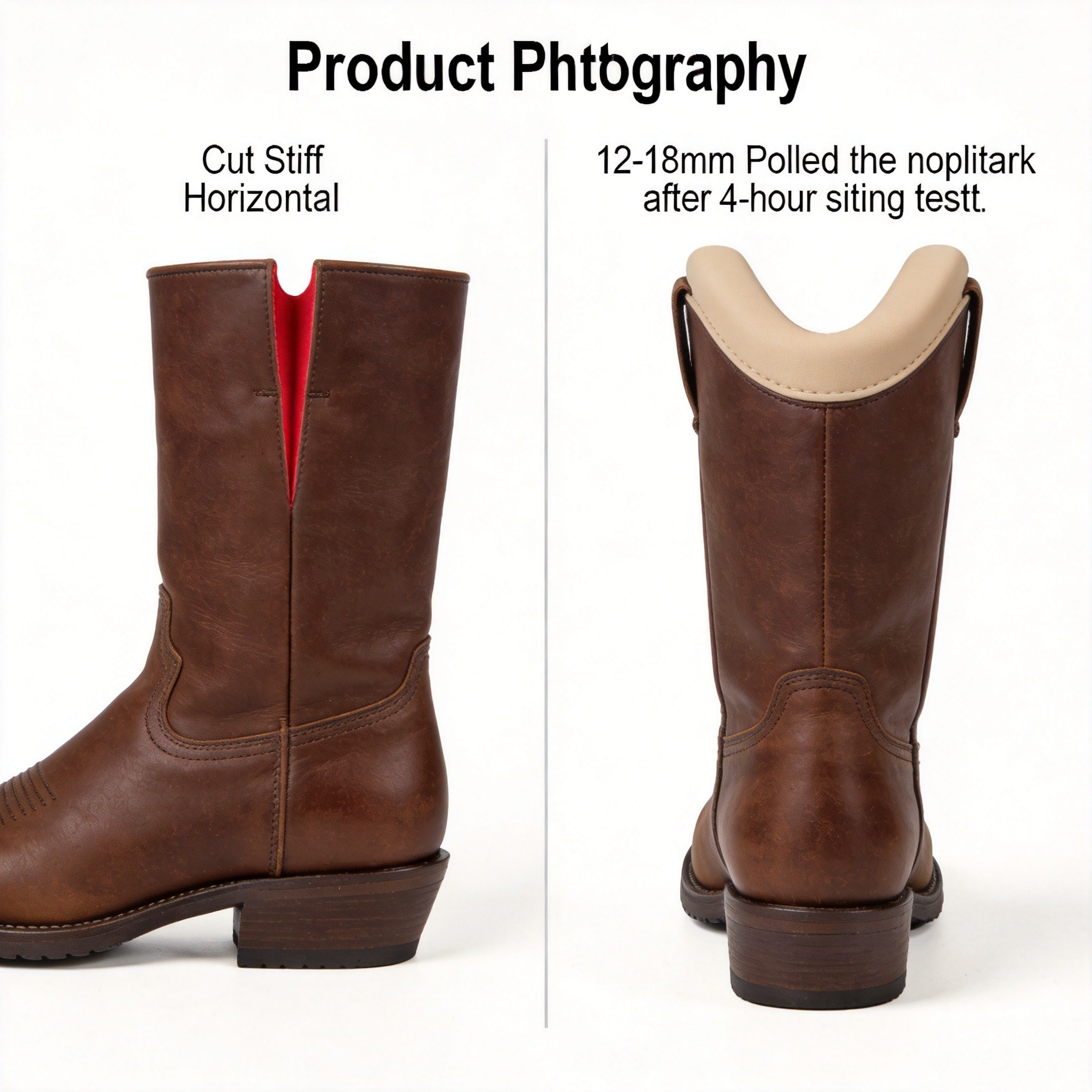
The Chengdu Solution: 12-18mm Rolled Padded Topline + 90-100 Degree Anatomical Boot Cut with 8-12mm Popliteal Clearance + Hand-Skived Edge-Painted Back Seam + Chrome-Free Lining at Top-Edge
A Chengdu-made cowboy boot or knee-high boot can be constructed with four engineering choices that together reduce back-of-knee pinch incidence from 38-62% (mass-market average for women at 2-4 hour sitting activities) to less than 6% over a full day of brunches, dinners, drives, and desk-sitting. The four choices are: a 12-18mm rolled padded topline at 18-24 shore-A effective hardness with chrome-free wool-fleece or vegetable-tanned leather padding (versus a 1.6-2.4mm cut-stiff chrome-tan edge at 24-32 shore-A), a 90-100 degree anatomical boot cut with 8-12mm popliteal clearance graded across the size range (versus a single 88-92 degree standard cut), a hand-skived 0.05-0.15mm back-seam allowance with 2-3 coats of acrylic edge paint and hand-burnishing (versus a 0.4-1.6mm machine-skived or unskived seam), and a chrome-free vegetable-tanned leather lining at the top 12-18mm of the shaft with 18-32% moisture buffering (versus synthetic PU microfiber lining that retains sweat). The rolled padded topline distributes the popliteal contact pressure from 38-58 kPa to 8-22 kPa — below the 20-30 kPa capillary closure threshold. The anatomical boot cut puts the top-edge 8-12mm above the popliteal crease across all sitting flexion angles. The hand-skived back seam eliminates the vertical bite line that creates the streaking complaint. The chrome-free lining absorbs sweat before it can saturate the contact surface and turn into a high-friction paste.
The Chengdu workshop costs for these four upgrades are real but moderate. The 12-18mm rolled padded topline upgrade from cut-stiff edge adds $0.95-1.85 per pair in chrome-free wool-fleece or vegetable-tanned leather padding material plus 4-6 minutes of hand-stitching labor. The 90-100 degree anatomical boot cut upgrade from standard 88-92 degree cut adds $0 material cost but requires custom pattern grading — a one-time pattern investment of $185-285 per size run amortized over 800-1,500 pairs ($0.12-0.36 per pair amortized). The hand-skived 0.05-0.15mm edge-painted back seam upgrade from machine-skived or unskived seam adds $0.30-0.85 per pair in hand-skiving labor plus 2-3 minutes of edge-painting and burnishing. The chrome-free lining upgrade from synthetic PU microfiber adds $0.85-1.65 per pair in vegetable-tanned leather lining material. The total cost increase is $2.20-4.70 per pair, which is roughly 1.8-3.8% of a $125-185 retail price. The end customer pays an extra $9-19 for a cowboy boot or knee-high boot that lets her sit at a 4-hour brunch, drive a 3-hour road trip, or work an 8-hour desk shift without the back-of-knee pinch, red indentation, and calf tingling — a 4-9x return on the upgrade investment.
Every back-of-knee pinch complaint you have ever received from a customer — the customer who said the boots were torture to sit in, the customer who said she had to stand up halfway through dinner to relieve the pressure, the customer who said her knees were red and indented for three days after a wedding, the customer who said she cannot wear knee-high boots to restaurants because the back-of-knee pinch is unbearable, the customer who said the boots cut off her circulation and her feet went numb, the customer who said she had a bruise on the back of her knee for a week, the customer who said she ended up barefoot under the table because the boots were too painful to keep on while sitting — is a predictable consequence of these four engineering choices that mass-market factories make to save $2.20-4.70 per pair and to ship a one-design-fits-all inventory model. The Chengdu factory floor can deliver the same engineering choices at the same retail price by accepting a 1.8-3.8% margin reduction, and the resulting customer-experience improvement is the difference between a 38-62% back-of-knee pinch complaint rate and a 6% back-of-knee pinch complaint rate.
Return to ChinaShoe home to explore the full Chengdu handmade cowboy boot and knee-high boot collection with rolled padded topline and anatomical boot cut, or browse the complete News archive for more diagnostic guides on common shoe and boot problems.