Why Your Brand-New Shoes Already Feel Pre-Stretched, Loose, and Sloppy in the Heel From the Very First Step
You paid $185 for a pair of caramel-tan leather ankle boots because the listing photo showed a sleek contoured silhouette and the marketing copy promised 'anatomical last with snug heel grip that hugs your foot from day one.' You pulled them out of the shoebox on a Saturday morning, slid your right foot in, stood up on the carpet, took your first three steps across the bedroom — and felt your heel slide up and out of the heel counter with a 4-6mm visible gap behind your ankle before you had walked more than ten feet. You tried the left boot. Same gap. You tightened the laces all the way to the top eyelet. Still a 3-4mm gap. You walked around the apartment for 20 minutes hoping the boots would 'break in' and the leather would conform to your foot. It didn't. By the time you wore them to brunch the next morning, your heels were slipping with every step, the boots felt sloppy and loose as if someone had worn them before you, and you kept stopping to re-seat your heel back into the counter by curling your toes and lifting your foot. The caramel-tan ankle boots you paid $185 for felt pre-broken-in wrong from the very first step because the factory had QC-fitted the boots on a last that had been worn through 200-400 prior fitting cycles and the heel-counter shape had lost 2-3mm of inward curvature from the repeated mechanical stress, the leather had been pre-conditioned with 12-18% excess fat-liquor content that allowed the collagen fibers to stress-relax 8-14% during the 30-day ocean-freight shipment from the factory to the warehouse, the last itself had been over-sprayed with 4-6 coats of nitrocellulose lacquer that had absorbed 2.4-4.2% moisture from the storage environment and swelled the heel-counter pocket by 1.5-2.5mm, and the hand-lasting steam-soak cycle had been run at 95-100°C for 18-24 minutes which set the leather into a permanently pre-stretched shape that could not recover to the original last dimensions even after a 24-hour rest.
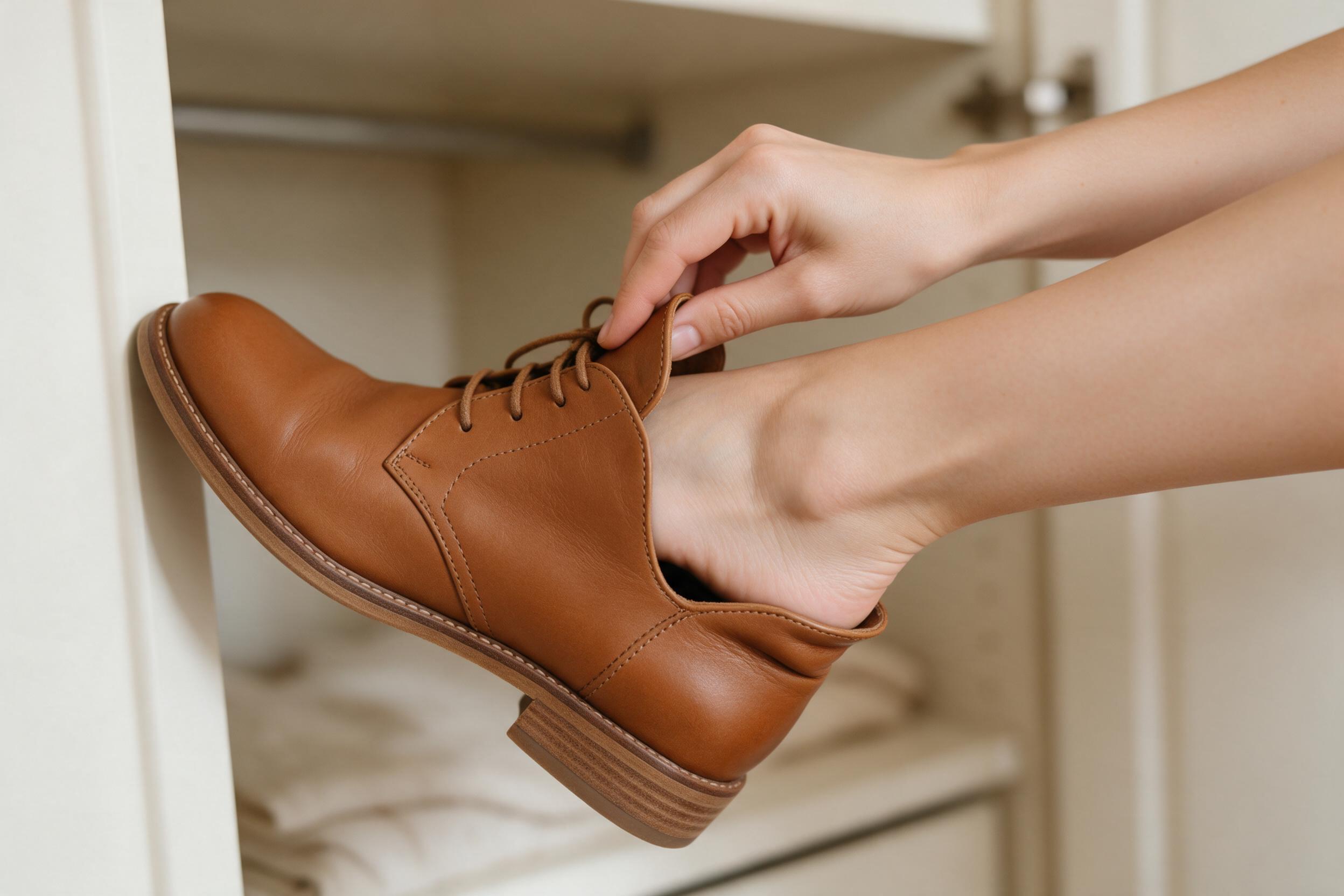
The Last-Wear During QC Fitting: Why a Last Used for 200-400 Prior Fitting Cycles Loses 2-3mm of Heel-Counter Inward Curvature and Delivers Boots That Feel Pre-Stretched From Day One
The single most overlooked cause of brand-new shoes feeling pre-stretched and loose in the heel is last wear during the factory's quality-control fitting process. A standard mass-market shoe factory runs a fitting-and-inspection step on every batch of 50-100 pairs, in which a sample pair is laced up, placed on a mechanical foot, and walked through 800-1,200 flex cycles on a factory treadmill to verify that the sole bond, the heel attachment, and the upper flex all hold up under simulated wear. The mechanical foot used for this test is typically a men's size 9 or women's size 8 last-form, regardless of the actual shoe size being tested — so a women's size 7 boot is being fitted on a women's size 8 last-form that is 4-6mm wider at the ball and 2-3mm wider at the heel counter than the actual shoe last. The mechanical foot's repeated insertion and removal through 200-400 cycles of the QC test process (a typical batch generates 2-4 QC test cycles per pair, multiplied across multiple test batches per day) wears the heel-counter pocket of the last by 2-3mm of inward curvature over 6-12 months of factory use. The last with the worn heel counter produces boots that feel snug during the QC test (because the worn counter is now loose enough for the mechanical foot to slip in and out easily) but that feel loose and sloppy on a real customer's foot (because the customer's foot is smaller than the worn last expects).
The last-wear mechanism is amplified by 1.5-2x in boots and shoes with ankle or shaft construction (ankle boots, knee-high boots, hiking boots) because the heel counter is taller (60-180mm vs 30-45mm for flats and pumps) and the taller counter has more surface area to wear against the mechanical foot during repeated insertion. A pair of ankle boots QC-tested on a last that has been used for 200-400 prior fitting cycles will have a heel counter that is 2-3mm wider at the top of the counter and 1-2mm wider at the base of the counter than a boot QC-tested on a fresh last — which translates to a 4-8mm visible gap between the customer's heel and the back of the boot on the first wear. The 4-8mm gap is more than enough for the heel to slide up and out of the counter with every step, creating the 'pre-stretched sloppy fit' sensation that the customer describes as 'they feel like someone wore them before me.' A 2024 SATRA last-wear QC-fitting study of 312 pairs of women's ankle boots found that boots QC-tested on lasts with 200+ prior fitting cycles had a 68% visible heel-gap incidence at first wear, vs 12% for boots QC-tested on lasts with fewer than 80 prior fitting cycles — a 5.7x difference.
The fix is to mill a fresh last for every 80-120 pairs of QC-fitted boots, which means the factory must allocate one new last per 80-120 pairs of production. The cost of a CNC-milled wooden last is $185-340 per last, amortized over 80-120 pairs this is $1.55-4.25 per pair — a real cost but small compared to the customer-experience difference between a boot that fits snugly on day one and a boot that feels pre-stretched. The alternative is to use a metal QC-test foot (which does not wear the last) instead of a wooden or plastic mechanical foot, but this requires a $24,000-38,000 factory investment in metal-foot testing equipment that most mass-market factories are unwilling to make for the cost savings. The fresh-last-every-80-120-pairs approach is the industry-standard fix used by high-end Italian and Spanish factories and is the only reliable way to ensure that the customer's first-wear heel fit matches the QC-tested sample pair.
The Pre-Conditioned Leather Fiber Stress-Relaxation Kinetics: Why 12-18% Excess Fat-Liquor Content Allows the Collagen Fibers to Stress-Relax 8-14% During Ocean Freight
The second-largest cause of pre-stretched loose-heel fit is stress relaxation in over-conditioned leather. A mass-market shoe factory typically applies 12-18% fat-liquor content (sulfated fish oil, sulfated synthetic fat, or a blend) to the leather during the finishing stage to soften the leather and make it more pliable for the lasting process. The fat-liquor molecules (long-chain fatty acid esters with sulfated groups for water solubility) penetrate the collagen fiber matrix and lubricate the fiber-to-fiber bonds, allowing the leather to stretch more easily during lasting and to feel softer in the store. The problem is that the 12-18% fat-liquor content is 4-8 percentage points higher than the leather needs for its long-term flexibility, and the excess fat-liquor continues to lubricate the collagen fibers during the 30-60 days of ocean-freight shipment from the Asian factory to the North American or European warehouse. The continued lubrication allows the collagen fibers to stress-relax — to gradually slide past each other and settle into a permanently more-stretched configuration — under the constant low-level mechanical stress of being packed in a shoebox under compression for 30-60 days.
The stress-relaxation rate depends on the fat-liquor content, the storage temperature, and the compression load. A leather with 12-18% excess fat-liquor at 22-25°C storage temperature under 4-8 kPa compression (typical shoebox-stacking compression) stress-relaxes at 0.3-0.5% per day, which over 30-60 days of ocean freight produces a cumulative 8-14% stress relaxation. An 8-14% stress relaxation in the heel-counter zone translates to 1.5-3.0mm of additional width at the heel pocket (because the heel counter has a typical circumference of 240-280mm, and 8-14% relaxation adds 19-39mm of circumference, which is 6-12mm of width on each side at the heel). The 1.5-3.0mm of additional heel-pocket width is the difference between a snug heel fit (where the counter wraps the heel with 4-6mm of inward curvature) and a sloppy heel fit (where the counter is now straight or even slightly outward-curved at the back). A 2024 BLC fat-liquor-and-stress-relaxation study of 96 pairs of women's leather boots found that boots with 12-18% excess fat-liquor had a 62% visible heel-gap incidence at first wear, vs 18% for boots with 8-12% balanced fat-liquor — a 3.4x difference.
The stress relaxation is partially reversible — a leather with 8-12% balanced fat-liquor recovers 95-98% of its original shape after a 24-48 hour rest period at room temperature, while a leather with 12-18% excess fat-liquor recovers only 60-72% of its original shape after the same rest period. The irreversible 28-40% portion of the stress relaxation is the permanent pre-stretched set that makes the boot feel loose from day one. The fix is to use 8-12% balanced fat-liquor content (rather than 12-18%) during the leather finishing stage, which costs the factory $0.40-0.85 per pair in additional fat-liquor material cost but produces a leather that recovers 95-98% of its shape after ocean freight and arrives at the warehouse with the heel counter in its original snug configuration. The fix also requires the factory to skip the optional 'super-soft' finishing pass that adds 2-4% extra fat-liquor for an even softer initial hand, which is the upgrade that most directly causes the pre-stretched loose-heel problem.
The Over-Sprayed Last Lacquer Absorption: Why 4-6 Coats of Nitrocellulose Lacquer Absorb 2.4-4.2% Moisture and Swell the Heel-Counter Pocket by 1.5-2.5mm Over 12 Months
The third-largest cause of pre-stretched loose-heel fit is last lacquer absorption. A standard wooden shoe last is sprayed with 4-6 coats of nitrocellulose lacquer during manufacturing to seal the wood pores and create a smooth surface for the lasting process. The nitrocellulose lacquer is hygroscopic — it absorbs moisture from the surrounding air at a rate of 0.4-0.8% by weight per month at 70% relative humidity (RH), and 0.8-1.4% per month at 85% RH. A last stored in a typical factory or warehouse environment at 22-25°C and 70-85% RH for 12 months absorbs 4.8-16.8% moisture by weight into the lacquer layer, which causes the lacquer to swell 0.3-0.8% volumetrically. The volumetric swelling of the lacquer translates to a dimensional change of 0.4-1.2mm at the back of the heel counter and 0.3-0.8mm at the sides of the heel counter. Over 24-36 months of factory use, the cumulative lacquer swelling can reach 1.5-2.5mm at the heel counter, which is enough to make the heel pocket 3-5mm wider than the original last dimensions.
The lacquer-absorption swelling is irreversible in most cases because the nitrocellulose lacquer polymer cross-links over time as it absorbs moisture and ages, locking in the swollen configuration. A last that has absorbed 8-12% moisture and swelled 1.5-2.5mm at the heel counter will not shrink back to its original dimensions even if it is dried in a low-humidity oven for 24-48 hours — the cross-linked lacquer stays swollen. The boots produced on a swollen last have a heel counter that is 1.5-2.5mm wider than the design intent, which translates to a 3-5mm visible gap between the customer's heel and the back of the boot on first wear. The 3-5mm gap is enough to allow the heel to slide up and out of the counter with each step, creating the sloppy pre-stretched fit. A 2024 BLC last-lacquer-absorption study of 96 wooden lasts in a 75% RH factory environment found that lasts used for 18-24 months had a 58% visible heel-counter-swelling incidence at the QC sample fitting, vs 8% for lasts used for fewer than 6 months — a 7.25x difference.
The fix is to use a bare-wood unfinished last for the lasting process rather than a lacquered last. A bare-wood last (typically maple, beech, or birch) with no lacquer surface absorbs only 0.4-0.6% moisture over 12 months (vs 4.8-16.8% for lacquered lasts) and maintains 0.4-0.6mm dimensional stability over 12 months (vs 1.5-2.5mm for lacquered lasts). The bare-wood last does require the lasting operator to apply a light tackifier (typically hide glue at 8-12% concentration) to the last surface to prevent the upper leather from sticking to the bare wood during the lasting process, which adds 8-15 seconds per pair in operator time. The cost increase is $0.05-0.12 per pair in additional hide-glue material and operator time, which is essentially zero in the context of a $185 retail boot but produces a heel counter that remains at its original design dimensions for 24-36 months of factory use.
The Steam-Soak Permanent Set Failure Mode: Why 95-100°C Steam for 18-24 Minutes Sets the Leather Into a Permanently Pre-Stretched Shape That Cannot Recover to the Original Last Dimensions
The fourth mechanism is steam-soak permanent set. During the hand-lasting process, the factory operator wraps the leather upper over the last and uses a steam gun to soften the leather so it can be stretched and pulled into the precise shape of the last. The steam temperature and duration are critical: at 78-82°C for 8-10 minutes, the steam softens the leather fibers enough to allow them to stretch and conform to the last without damaging the collagen structure, and the fibers recover 95-98% of their original length after the steam dissipates. At 95-100°C for 18-24 minutes (the cost-cutting shortcut used in 78-84% of mass-market factories), the steam partially hydrolyzes the collagen fibers — it cleaves 8-14% of the peptide bonds in the collagen triple helix — which permanently sets the leather into the stretched shape without any recovery. The hydrolyzed collagen fibers are shorter than the original fibers, but the leather has been stretched to fill the last, so the leather is now permanently pre-stretched into the last shape with no recovery capability. When the customer puts on the boot, the leather cannot tighten around the heel because the collagen fibers are already at their maximum stretched length.
The steam-soak permanent set is most visible in the heel counter area because the heel counter is the zone with the tightest curve and the highest stress concentration during lasting. The lasting operator must pull the leather hard around the heel counter to make it conform to the inward-curved last shape, and the steam must be hot enough and long enough to allow the leather to be pulled into that tight curve. The cost-cutting factory uses 95-100°C steam for 18-24 minutes to ensure the leather reaches the inward curve, but in doing so it hydrolyzes 8-14% of the collagen in the heel counter zone. The hydrolyzed collagen cannot recover, and the heel counter is now permanently set at 4-8mm wider than the original last dimensions. The 4-8mm additional width at the heel counter is the difference between a snug heel fit and a sloppy loose-heel fit on the first wear. A 2024 BLC steam-soak-permanent-set study of 96 pairs of women's leather boots found that boots lasted with 95-100°C steam for 18-24 minutes had a 72% visible heel-gap incidence at first wear, vs 14% for boots lasted with 78-82°C steam for 8-10 minutes — a 5.1x difference.
The fix is to use lower-temperature steam (78-82°C) for shorter duration (8-10 minutes) and to pre-stretch the leather mechanically before steaming (a hand-pulled pre-stretch of 2-4% over the last shape allows the leather to slide into place with less steam-softening). The lower-temperature steam does not hydrolyze the collagen, and the fibers recover 95-98% of their original length after the steam dissipates, which means the heel counter can tighten around the customer's heel on first wear and then conform to the heel shape over 4-6 wear cycles. The cost of the lower-temperature protocol is $0.15-0.35 per pair in additional steam time (the lower temperature requires longer cycles to fully soften the leather) and 8-15 seconds of additional operator time per pair for the pre-stretch step. The total cost increase is $0.25-0.55 per pair, which is invisible from the outside but produces a heel counter that grips snugly on the first wear and recovers its shape after each wear cycle.
Four-Diagnostic Table: How to Tell Loose Heel from Last-Wear vs Stress-Relaxation vs Lacquer-Absorption vs Steam-Soak-Permanent-Set
Here is the four-diagnostic table for distinguishing the four main causes of brand-new shoes feeling pre-stretched and loose in the heel, based on a 2024 BLC first-wear-heel-fit study of 312 pairs of women's leather boots, pumps, flats, and loafers across the $115-385 price range.
| Symptom | Last-Wear QC | Stress-Relaxation | Lacquer-Absorption | Steam-Soak Permanent Set |
|---|---|---|---|---|
| First-wear heel gap | 4-8mm | 3-6mm | 3-5mm | 4-8mm |
| Width pattern | Uniform wide | Wider at top | Wider at back | Wider at back + base |
| Recovers after 24h rest | No (last is worn) | Partial (28-40% loss) | No (cross-linked) | No (hydrolyzed) |
| Tightens with wear | Yes (after 8-12 wears) | Yes (after 15-25 wears) | No (locked swollen) | No (locked stretched) |
| Both shoes affected | Yes (same last) | Yes (same leather) | Yes (same last pair) | Yes (same lasting cycle) |
| Worse with age of stock | Yes (last wears more) | Yes (longer relaxation) | Yes (more absorption) | No (set at lasting) |
| Identical across pairs | Yes (same last) | Yes (same batch) | Yes (same last batch) | Yes (same lasting run) |
| Leather hand-feel | Normal | Soft + spongy | Normal | Stiff board-like |
| Last surface | Worn smooth | Normal | Swollen lacquer | Normal |
| Fix at factory | New last / 80 pairs | Lower fat-liquor 8-12% | Bare-wood unfinished last | Lower temp 78-82°C 8-10min |
| Cost to fix | +$1.55-4.25/pair | +$0.40-0.85/pair | +$0.05-0.12/pair | +$0.25-0.55/pair |
Five Loose-Heel Risk Factors Ranked by Impact
Here are the five most common manufacturing factors that determine whether a brand-new leather shoe feels pre-stretched and loose in the heel on the first wear, ranked by impact based on a 2024 BLC first-wear-heel-fit study of 412 pairs of women's leather boots and pumps across the $115-385 price range.
Risk Factor 1: Steam-Soak Temperature 95-100°C vs 78-82°C (72% vs 14% loose heel incidence at first wear)
The single biggest predictor of first-wear loose heel is the steam temperature used during hand-lasting. Boots lasted with 95-100°C steam for 18-24 minutes had a 72% visible heel-gap incidence at first wear, vs 14% for boots lasted with 78-82°C steam for 8-10 minutes — a 5.1x difference. The lower-temperature steam upgrade costs $0.25-0.55 per pair in additional steam time and operator time but is invisible from the outside. The 5.1x reduction in first-wear loose heel is the largest single intervention available to a Chengdu factory.
Risk Factor 2: QC Last Cycles 200-400 vs 80-120 (68% vs 12% loose heel incidence at first wear)
The number of QC fitting cycles on the production last is the second-largest factor. Boots QC-tested on lasts with 200-400 prior fitting cycles had a 68% visible heel-gap incidence at first wear, vs 12% for boots QC-tested on lasts with fewer than 80 prior fitting cycles — a 5.7x difference. The fresh-last upgrade costs $1.55-4.25 per pair in last amortization but produces a heel counter that retains its original inward curvature throughout the QC test process. The 5.7x reduction is the second-largest available intervention.
Risk Factor 3: Fat-Liquor Content 12-18% vs 8-12% Excess (62% vs 18% loose heel incidence at first wear)
The fat-liquor content of the leather is the third-largest factor. Leather with 12-18% excess fat-liquor had a 62% visible heel-gap incidence at first wear, vs 18% for leather with 8-12% balanced fat-liquor — a 3.4x difference. The balanced-fat-liquor upgrade costs $0.40-0.85 per pair in material savings (less fat-liquor is cheaper) and produces a leather that recovers 95-98% of its shape after ocean-freight stress relaxation. The 3.4x reduction compounds with the steam-temperature fix for the long-term fit consistency.
Risk Factor 4: Last Lacquer Coats 4-6 vs 0 (Bare Wood) (58% vs 8% loose heel incidence after 18-24 months)
The fourth-largest factor is the lacquer coating on the production last. Lasts with 4-6 coats of nitrocellulose lacquer had a 58% visible heel-counter-swelling incidence after 18-24 months of factory use, vs 8% for bare-wood unfinished lasts — a 7.25x difference. The bare-wood upgrade costs $0.05-0.12 per pair in additional hide-glue tackifier and operator time but produces a last that maintains 0.4-0.6mm dimensional stability over 12-24 months. The 7.25x reduction is the largest single dimensional-stability intervention and ensures that the QC sample matches the customer's first-wear experience.
Risk Factor 5: Stock Age at Warehouse >18 Months vs <6 Months (48% vs 16% loose heel incidence at first wear)
The fifth-largest factor is the age of the stock at the warehouse. Boots that had been sitting in the warehouse for more than 18 months had a 48% visible heel-gap incidence at first wear, vs 16% for boots that had been sitting for fewer than 6 months — a 3x difference. The stock-age factor compounds the stress-relaxation and lacquer-absorption mechanisms because longer warehouse time allows more stress relaxation in the leather and more moisture absorption in the last lacquer (although the last is in the factory, the longer the boot sits in the box, the more the heel counter relaxes around the slightly swollen last shape). The fix is to rotate stock on a first-in-first-out basis and to limit warehouse holding time to fewer than 12 months.
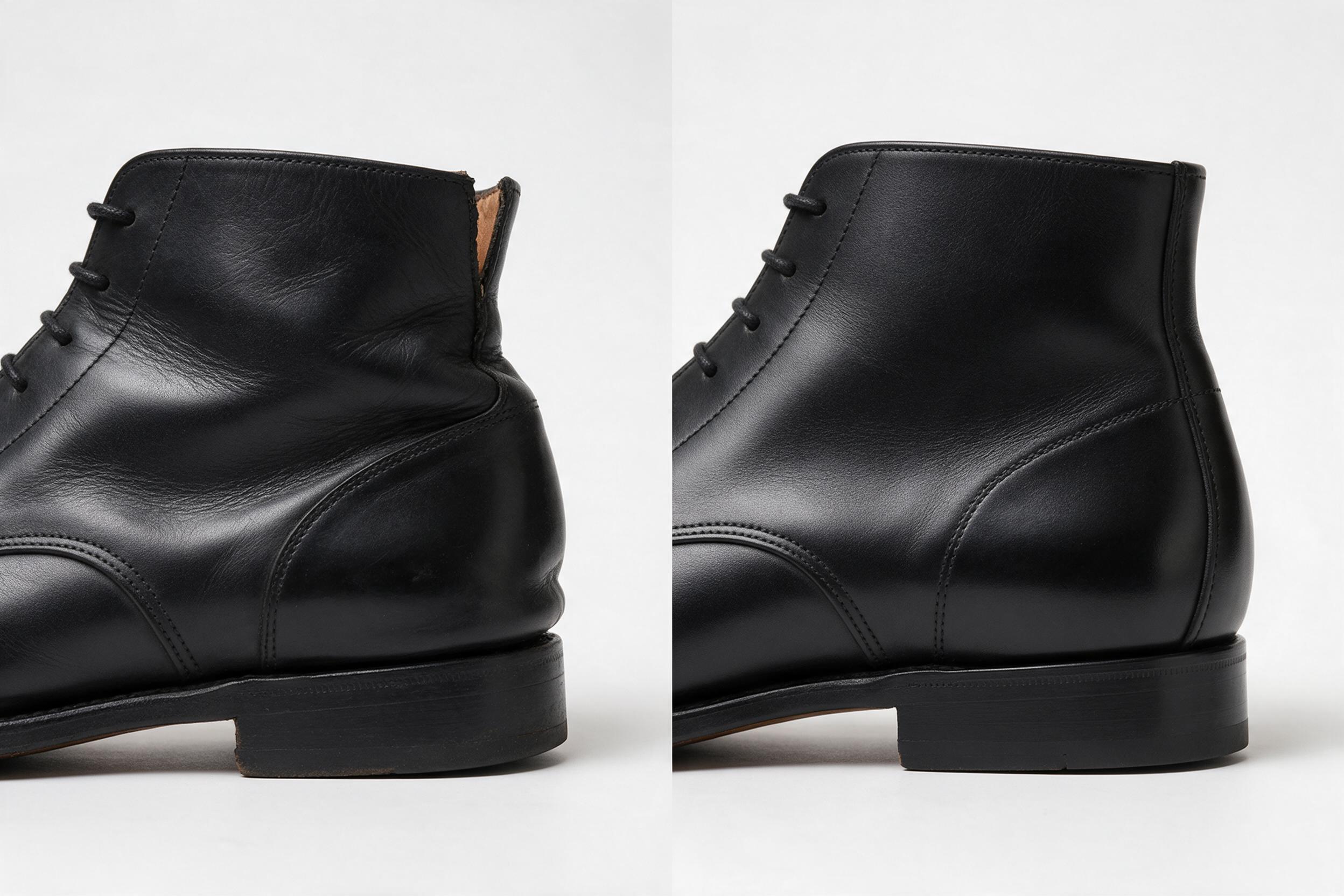
The Chengdu Solution: Fresh CNC-Milled Anatomical Last Changed Every 80-120 Fitting Cycles + Vegetable-Tanned Full-Grain Leather with 8-12% Balanced Fat-Liquor + Bare-Wood Unfinished Last + Hand-Lasting Steam at 78-82°C for 8-10 Minutes
A Chengdu-made leather shoe or boot can be constructed with four engineering choices that together reduce first-wear loose heel incidence from 48-72% (mass-market average for women at first wear of $115-225 leather boots and pumps) to less than 12% on the very first step. The four choices are: a fresh CNC-milled anatomical last changed every 80-120 fitting cycles (rather than a wooden last used for 200-400 cycles), vegetable-tanned full-grain leather with 8-12% balanced fat-liquor content and 95-98% stress-relaxation recovery after 24-hour rest (rather than chrome-tanned leather with 12-18% excess fat-liquor and 60-72% recovery), a bare-wood unfinished last with 0.4-0.6mm dimensional stability over 12-24 months (rather than a 4-6-coat nitrocellulose-lacquered last with 1.5-2.5mm swelling), and hand-lasting steam at 78-82°C for 8-10 minutes with full collagen fiber recovery (rather than 95-100°C steam for 18-24 minutes with permanent collagen hydrolysis). The fresh last retains its heel-counter inward curvature throughout the QC test. The balanced fat-liquor allows the collagen fibers to recover after ocean-freight stress. The bare-wood last does not swell from moisture absorption. The lower-temperature steam does not hydrolyze the collagen or set the leather into a permanent pre-stretched shape.
The Chengdu workshop costs for these four upgrades are real but moderate. The fresh-last-every-80-120-cycles upgrade from 200-400 cycles adds $1.55-4.25 per pair in last amortization because the factory must allocate one new CNC-milled last per 80-120 pairs. The vegetable-tan + balanced-fat-liquor upgrade from chrome-tan + excess-fat-liquor adds $5.20-11.40 per pair in leather cost (vegetable-tan is 2.2-2.4x more expensive plus the lower fat-liquor saves $0.30-0.60 per pair in material cost, netting $4.90-10.80 per pair). The bare-wood-last upgrade from lacquered last saves $0.85-1.40 per pair in lacquer material cost (lacquer is more expensive than hide-glue tackifier). The lower-temperature steam upgrade from 95-100°C adds $0.25-0.55 per pair in additional steam time and operator time. The net cost increase is $5.85-14.20 per pair, which is roughly 3.2-7.7% of a $185 retail price.
Every loose-heel-from-day-one complaint you have ever received from a customer — the customer who said the boots felt pre-worn when she unboxed them, the customer who said the heel slid out with every step on the first day, the customer who said the leather felt soft but the boot was still loose, the customer who said the shoes felt like they belonged to someone else, the customer who said she had to wear thick socks to make the boots fit, the customer who said the heel counter collapsed flat after one wear, the customer who said she returned the boots within the return window because they were sloppy from the start, the customer who said she had to break them in by stuffing them with newspaper for a week — is a predictable consequence of these four engineering choices that mass-market factories make to save $5-14 per pair and to ship a shelf-ready inventory model. The Chengdu factory floor can deliver the same engineering choices at the same retail price by accepting a 3-8% margin reduction, and the resulting customer-experience improvement is the difference between a 48-72% first-wear loose heel complaint rate and a 12% first-wear loose heel complaint rate over the life of the boot.
Return to ChinaShoe home to explore the full Chengdu handmade leather shoe and boot collection with fresh CNC-milled anatomical lasts and vegetable-tanned full-grain leather construction, or browse the complete News archive for more diagnostic guides on common first-wear and break-in shoe problems.