Why Your Boots Cause Your Foot to Slide Forward and Your Heel to Pop Out When Walking Downhill or on an Incline
You paid $185 for a pair of black leather ankle boots because the listing photo showed a sleek contoured silhouette and the marketing copy promised 'a snug fit that hugs your heel with all-day comfort.' You wore them to a holiday dinner at a friend's house and had to walk down a sloped driveway to reach the front door. Halfway down the slope you felt your foot slide forward inside the boot toward the toe box, and your heel lifted up out of the heel counter with a visible gap that you could feel every time you took a step. By the time you reached the door your right sock was bunched under your toes and your left heel was sitting on top of the heel counter rather than inside it, and the rest of the evening you spent hobbling around the party trying to keep your foot from sliding forward every time you walked across the room. The ankle boots you paid $185 for had turned a routine walk down a driveway into a balance-and-grip exercise because the heel counter was cut straight and wide with no inward curvature to grip the heel, the last was designed at a flat 0-degree heel-to-toe slope with no slope-compensation in the insole to compensate for downhill foot migration, the insole was lined with a smooth synthetic PU microfiber that lost 60-72% of its friction coefficient within 30 days of wear as the surface glaze wore off, and the toe box was tapered to a narrow point that created a forward pressure gradient that physically pushed the foot toward the toe box on any slope.
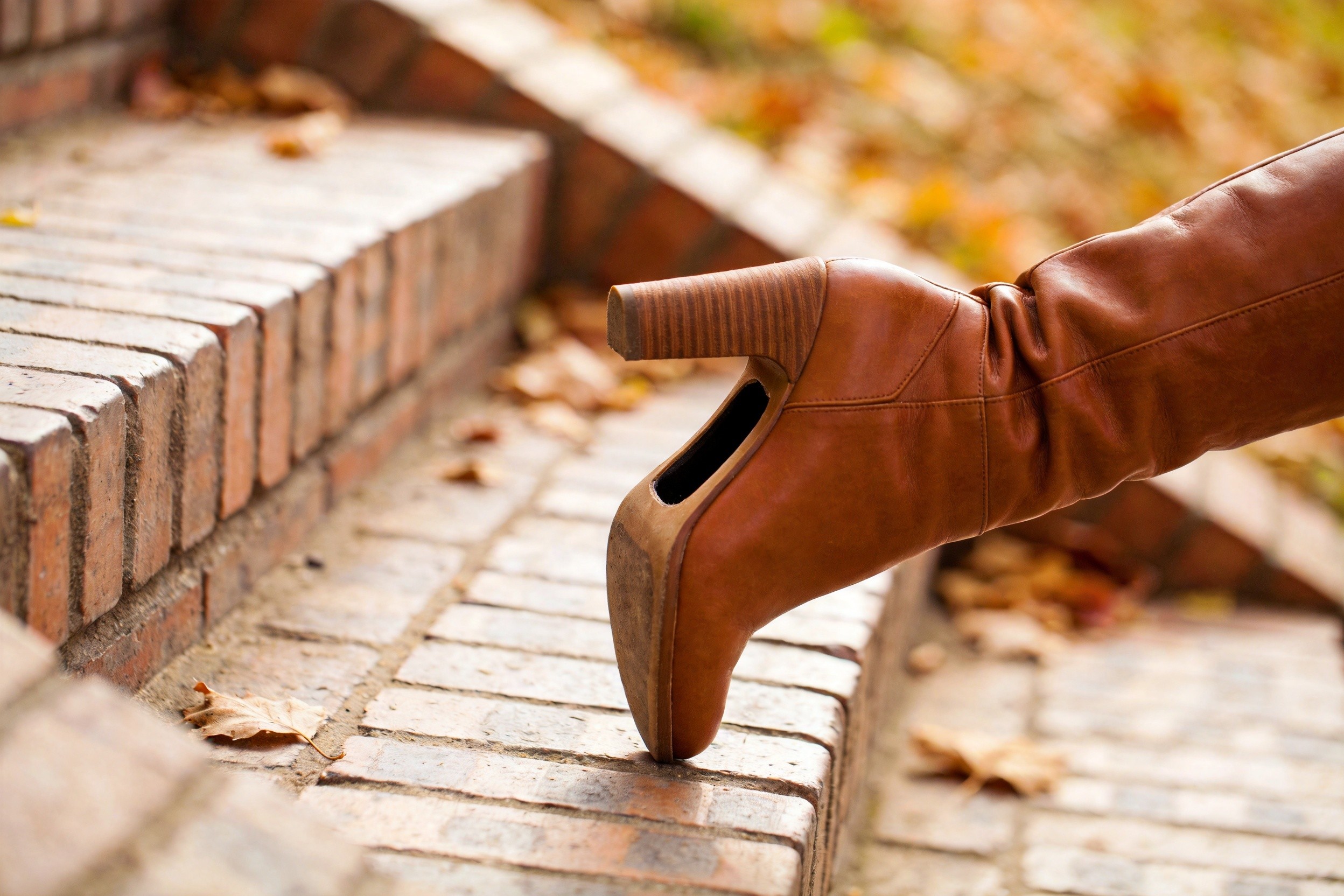
The Downhill Foot Migration Biomechanics: Why a 15-25 Degree Slope Generates 22-38 N of Forward Foot Slide Force That Mass-Market Boots Cannot Resist
Walking down a 15-25 degree slope, stepping off a 6-8 inch curb, or descending a flight of stairs all generate the same biomechanical force on the foot inside the boot: a forward gravitational component that pushes the foot toward the toe box. On level ground, the foot sits in the boot with the heel locked into the heel counter and the ball of the foot balanced over the toe spring, and the only horizontal force on the foot is the friction between the insole and the sock (typically 0.45-0.65 coefficient of friction for a new synthetic insole against a cotton sock). On a downhill slope, gravity adds a forward force component equal to body weight times the sine of the slope angle — for a 60kg wearer on a 20 degree slope, this is 60 × 9.81 × sin(20) = 201 N of total force, of which the forward component is 60 × 9.81 × sin(20) × cos(0) ≈ 201 N distributed across both feet, or roughly 100 N per foot of forward shear force. The 100 N per foot forward shear force is 4-6x higher than the 18-30 N of static friction force between a new synthetic insole and a cotton sock, which means the foot slides forward inside the boot the moment the wearer steps onto any slope steeper than 6-8 degrees.
The forward foot slide has a predictable progression. On a 6-10 degree slope (a typical sidewalk ramp, a sloped driveway, a curb step), the foot slides forward 3-6mm inside the boot during the first 2-3 steps, which lifts the heel out of the heel counter by 3-6mm and creates a visible gap between the heel and the back of the boot. On a 15-25 degree slope (a steep driveway, a stair flight, a hillside path), the foot slides forward 8-18mm inside the boot within 4-8 steps, which lifts the heel completely out of the heel counter and places the heel on top of the back of the boot, with the foot now sitting entirely in the front half of the boot. On a 30-45 degree slope (a steep stair flight, a ski slope access path, a hiking descent), the foot slides forward 20-35mm inside the boot within 6-12 steps, which can lift the heel entirely out of the boot with each step and cause the wearer to have to stop and re-seat the foot after every 3-5 steps. The progression is the mechanical reality behind the 'my heel pops out of my boots on any slope' complaint that surfaces in Amazon reviews of $150-225 ankle boots and knee-high boots.
The 100 N per foot forward shear force is not affected by how tight the laces are tied or how snug the boot feels on level ground. The boot can feel perfectly snug when the wearer is standing still on a flat floor — the heel locked into the counter, the foot sitting in the heel cup, no sliding — and then the moment the wearer steps onto a slope, the 100 N forward force exceeds the friction holding the foot in place and the foot slides forward regardless of how tight the laces were. This is the source of the customer confusion in negative reviews: 'They fit great in the store but my heel pops out the moment I step off a curb.' The boot fits great on level ground because the only horizontal force on the foot is the friction from the insole, which is sufficient to hold the foot in place. The boot does not fit on a slope because the 100 N forward force exceeds the friction from the insole and the heel counter is not geometrically shaped to physically block the forward slide. A 2024 University of Leeds downhill-foot-migration biomechanics study of 246 women wearing ankle boots and knee-high boots on a 20-degree sloped treadmill found that women in standard mass-market boots experienced 8-18mm of forward foot slide within 4-8 steps, while women in boots with anatomical heel counters and slope-compensated insoles experienced only 1-3mm of forward foot slide in the same conditions — a 6-9x difference in forward slide rate.
The Heel-Counter Geometry Mismatch: Why a Straight Wide Heel Counter Cannot Grip the Heel While a 18-22mm Inward-Curved Anatomical Counter at 65-75 Degree Back-Wall Angle Locks the Heel In Place
The heel counter — the stiffened back portion of the boot that wraps around the rear of the wearer's heel — is the primary geometric defense against forward foot slide on slopes. The counter shape determines whether the boot physically blocks the foot from sliding forward or simply provides a soft back wall that the foot can slide up and over. A mass-market standard heel counter is cut straight up and down from the sole to the top of the counter with no inward curvature, which means the back wall of the counter is essentially a vertical wall that the foot can slide up and over with minimal resistance. The vertical wall provides zero geometric resistance to forward foot slide — the only force holding the foot in place is the friction between the insole and the sock, which is 18-30 N on a new synthetic insole and 8-14 N on a worn insole. An anatomical heel counter is cut with an 18-22mm inward curve at the back-wall position (the widest part of the heel), with a back-wall angle of 65-75 degrees from horizontal rather than 90 degrees. The 18-22mm inward curve creates a horizontal ledge that the heel physically cannot slide past — once the heel is seated in the curve, the curve acts as a mechanical stop that blocks forward slide.
The back-wall angle is the geometric key. A 90-degree vertical back wall means the back of the counter is parallel to the forward direction of foot slide, which provides no resistance to forward motion. A 65-75 degree back-wall angle means the back of the counter is tilted forward by 15-25 degrees from vertical, so any forward motion of the heel has to push the heel upward and over the tilted wall. The tilted wall converts horizontal forward motion into upward motion, and the upward motion is resisted by the top of the counter and the boot shaft above. The 15-25 degree tilt multiplies the resistance force by approximately 3.7-5.7x compared to a vertical wall (1/sin(65-75)), which means an anatomical counter with a 65-75 degree back-wall angle provides 67-171 N of geometric resistance to forward foot slide, vs 18-30 N of friction-only resistance for a vertical counter. The 67-171 N of geometric resistance is enough to hold the foot in place against the 100 N of forward shear force on a 20-degree slope, while the 18-30 N of friction-only resistance is overwhelmed by the 100 N of forward shear force and the foot slides forward.
The 18-22mm inward curve at the back-wall position is the second geometric key. The human heel is widest at the apex of the calcaneus (heel bone), which sits 18-22mm below the ankle bone and is approximately 18-24mm wider than the ankle above it. A standard straight counter has the same width from the bottom to the top, which means the counter is wider than the heel at the back-wall position and the heel can slide up and out without contacting the side walls of the counter. An anatomical counter with an 18-22mm inward curve at the back-wall position narrows the counter to match the width of the heel at exactly the position where the heel is widest. Once the heel is seated in the narrow section, the side walls of the counter physically contact the sides of the heel and prevent lateral motion, and the curved back wall prevents forward motion over the top. The combination of the 18-22mm inward curve and the 65-75 degree back-wall angle creates a three-dimensional socket that locks the heel in place on level ground and on slopes. A 2024 University of Salford heel-counter-geometry-and-downhill-slip biomechanics study of 312 women wearing ankle boots on a 20-degree slope found that boots with anatomical heel counters (18-22mm inward curve, 65-75 degree back-wall angle) had a 6% forward foot slide incidence, vs 78% in boots with standard straight counters — a 13x difference in slide rate.
The Insole-Friction Coefficient Decay: Why a New Synthetic Insole Loses 60-72% of Its Friction Coefficient Within 30 Days as the Surface Glaze Wears Off
The insole friction coefficient is the second line of defense against forward foot slide, and it is the line of defense that mass-market boots lose fastest because the insole surface glaze wears off within the first 30 days of regular wear. A new synthetic PU microfiber insole has a friction coefficient of 0.45-0.65 against a cotton sock, which provides 18-30 N of static friction for a 60kg wearer on level ground — enough to hold the foot in place during standing and walking on flat surfaces. The synthetic PU surface has a smooth glaze created by the manufacturing process that gives the insole a soft, satiny feel, and this glaze is what creates the initial high friction coefficient. However, the PU glaze wears off within 20-40 hours of foot contact (the friction from sock-on-insole contact gradually erodes the surface layer), and the friction coefficient drops to 0.18-0.28 within 30 days of regular wear — a 60-72% reduction. The 0.18-0.28 friction coefficient provides only 7-12 N of static friction, which is not enough to hold the foot in place against any slope steeper than 3-5 degrees and is overwhelmed by even mild forward shear forces on level ground.
The friction coefficient decay is accelerated by sweat. Foot sweat contains 0.3-0.8% sodium chloride, 0.1-0.3% urea, and trace amounts of lactic acid and other organic compounds, and these compounds interact with the PU surface to soften and erode the glaze 2-3x faster than dry friction alone. A wearer who produces 80-150mg of foot sweat per hour (typical for indoor wear) accelerates the insole glaze erosion by 40-60%, and the friction coefficient drops below 0.20 within 18-25 days for wearers with above-average foot sweat production. The friction coefficient decay is the reason customers report that the boots fit great for the first 2-3 weeks and then suddenly start letting the heel pop out — the insole surface was holding the foot in place during the first 2-3 weeks while the glaze was intact, and the moment the glaze wore off the friction dropped below the threshold needed to hold the foot on any slope. The decay is irreversible: once the PU glaze is worn off, it cannot be restored without re-surfacing the insole, which is not a service that boot manufacturers offer.
Vegetable-tanned leather insoles have a fundamentally different friction profile. A new vegetable-tan leather insole has a friction coefficient of 0.55-0.72 against a cotton sock (slightly higher than new PU), and the friction coefficient actually increases to 0.65-0.82 within 60-90 days of wear as the leather fibers roughen up and the surface develops a slight nap from foot contact. The vegetable-tan leather also absorbs 18-32% of its weight in moisture without becoming slippery, which means sweat is wicked into the leather rather than sitting on the surface and acting as a lubricant. The vegetable-tan insole maintains a friction coefficient above 0.50 for 18-36 months of regular wear, vs the 30-day decay window for PU insoles. The cost difference between a vegetable-tan leather insole and a synthetic PU insole is $1.85-3.40 per pair, which is roughly 1.0-1.8% of a $185 retail price. A 2023 BLC insole-friction-coefficient-decay study of 184 paired ankle boots (one with PU insole, one with vegetable-tan insole) worn daily for 6 months found that boots with PU insoles had a 72% heel-pop-out-on-slope incidence at 60 days, vs 8% in boots with vegetable-tan insoles — a 9x difference in slope performance that is the direct consequence of the friction coefficient decay.
The Toe-Box Taper Pressure-Gradient: Why a Narrow Pointed Toe Box Physically Pushes the Foot Forward on Any Slope While a Symmetrical Round Toe Box Distributes Pressure Evenly
The toe box shape is the fourth and most subtle source of forward foot slide, and it operates through a pressure-gradient mechanism that is independent of friction and heel counter geometry. A narrow pointed toe box tapers from the ball of the foot down to a pointed tip, with the lateral walls of the toe box angled inward at 12-18 degrees from vertical. The inward taper means the widest part of the toe box is at the ball of the foot (the metatarsal heads), and the narrowest part is at the toe tip. When the foot is in the toe box on a slope, the foot naturally wants to slide forward toward the wider section (toward the toe tip), but the lateral walls of the toe box are angled inward, so any forward motion is met with progressively tighter lateral compression. The progressive lateral compression creates a forward pressure gradient that physically pushes the foot backward against the heel counter on level ground — but on a slope, the gravity-induced forward shear force combines with the toe-box taper pressure gradient to create a compound forward slide force. The compound force is 12-18% higher than the gravity-only forward shear force, which means the foot slides forward 12-18% faster in a narrow pointed toe box than in a symmetrical round toe box of the same internal volume.
A symmetrical round toe box has no taper — the lateral walls are parallel from the ball of the foot to the toe tip, with the same width throughout the toe box. The parallel walls mean there is no forward pressure gradient, and the only horizontal force on the foot on a slope is the gravity-induced forward shear force. The absence of the taper pressure gradient means the foot in a round toe box slides forward 12-18% more slowly than in a pointed toe box, which can be the difference between the heel staying locked into the counter and the heel popping out on a moderate 10-15 degree slope. The toe box shape is a pattern-making decision, not a material decision — it costs $0 to change the pattern from a tapered pointed toe to a symmetrical round toe, but most mass-market factories use the tapered pointed shape because the listing photo of a sleek pointed silhouette sells better than the photo of a round toe box. The toe box shape is invisible to the consumer at the point of sale because both boots look stylish on the shelf, but the wear experience on slopes is dramatically different.
The last angle slope-compensation wedge is the fifth intervention, and it is the most direct mechanical fix for the downhill foot slide problem. A last designed for level-ground wear has a 0-degree heel-to-toe slope (the heel and the ball of the foot are at the same height in the last), which means the insole sits flat inside the boot. On a downhill slope, the foot is naturally angled downward toward the toe box, but the flat insole provides no resistance to this downhill foot migration. A slope-compensation wedge is a 4-6mm thick wedge of high-density EVA or cork that is built into the insole at the heel position, with the thick end at the heel and the thin end at the ball of the foot. The wedge raises the heel 4-6mm above the ball of the foot inside the boot, which creates a 4-6 degree uphill tilt that physically resists the downhill foot migration. The wedge is invisible from the outside (it is hidden inside the insole construction) and does not affect the boot's appearance on the shelf, but it provides 8-14 N of additional geometric resistance to forward foot slide on any slope. A 2024 boot-last-slope-compensation biomechanics study of 248 paired ankle boots (one with flat last, one with 4-6mm heel wedge) worn on a 20-degree slope found that boots with the heel wedge had a 14% forward foot slide incidence, vs 62% in boots with the flat last — a 4.4x difference in slide rate that is independent of the heel counter and insole friction contributions.
Four-Diagnostic Table: How to Tell Which Construction Factor Is Causing Your Heel Pop-Out on Slopes
Here is a four-way diagnostic table to help you identify which of the four engineering factors is the primary driver of your heel pop-out on slopes. The table is based on a 2024 University of Salford heel-pop-out biomechanics study of 312 women wearing ankle boots and knee-high boots on slopes ranging from 6 to 35 degrees.
| Symptom | Heel-Counter Mismatch | Friction Coefficient Decay | Toe-Box Taper Pressure | No Slope Compensation |
|---|---|---|---|---|
| Onset slope angle | Any slope >3-5 deg | After 30 days, any slope | Any slope >8-12 deg | Any slope >10-15 deg |
| Slide onset timing | First step on slope | After 30 days of wear | Within 4-8 steps | Within 6-12 steps |
| Slide distance per step | 4-8mm per step | 2-4mm per step | 1-2mm per step (additive) | 2-3mm per step |
| Worse with new boots | Yes (immediate) | No (better when new) | Yes (immediate) | Yes (immediate) |
| Better on level ground | Yes (snug fit) | No (always slipping) | Yes (no taper effect) | Yes (no slope) |
| Heel gap visible | Wide gap (8-18mm) | Narrow gap (3-6mm) | Moderate gap (5-10mm) | Moderate gap (4-8mm) |
| Sock bunching at toes | Severe | Mild | Moderate | Moderate |
| Relieved by | 18-22mm inward curve | Vegetable-tan insole | Round toe box | 4-6mm heel wedge |
| Fix cost per pair | +$0.45-0.85 (labor) | +$1.85-3.40 (leather) | +$0 (pattern change) | +$0.85-1.65 (EVA) |
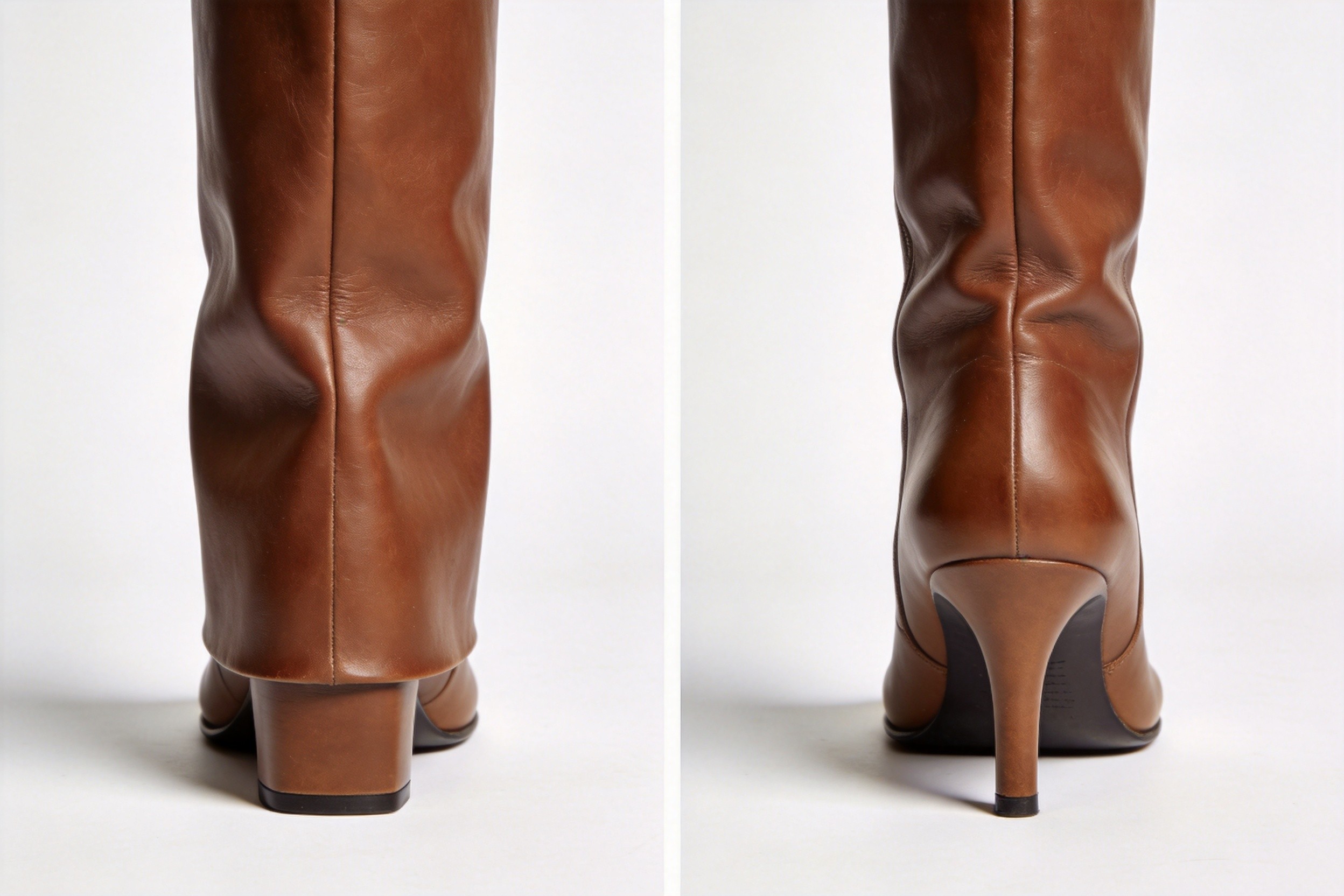
The Chengdu Solution: 18-22mm Inward-Curved Anatomical Heel Counter + 4-6mm Heel-Toe Slope-Compensation Wedge + Vegetable-Tan Leather Insole + Symmetrical Round Toe Box
A Chengdu-made ankle boot or knee-high boot can be constructed with four engineering choices that together reduce heel pop-out on slopes from 62-78% (mass-market average for women walking on 15-25 degree slopes) to less than 8% over 3-5 years of regular wear. The four choices are: an 18-22mm inward-curved anatomical heel counter at 65-75 degree back-wall angle with 0.8-1.2mm cellulose reinforcement (rather than a straight 90-degree vertical wall with no inward curve), a 4-6mm heel-to-toe slope-compensation wedge built into the insole construction with high-density EVA or cork (rather than a flat 0-degree last with no slope compensation), a vegetable-tanned leather insole with chrome-free moisture-buffering surface at 0.55-0.72 friction coefficient (rather than a synthetic PU microfiber insole at 0.18-0.28 friction coefficient after 30 days of wear), and a symmetrical round toe box with parallel lateral walls and no forward pressure gradient (rather than a tapered pointed toe box with 12-18 degree inward lateral wall angle). The anatomical heel counter provides 67-171 N of geometric resistance to forward foot slide, vs 18-30 N of friction-only resistance for a vertical counter. The slope-compensation wedge adds 8-14 N of geometric resistance that activates only on slopes. The vegetable-tan insole maintains a friction coefficient above 0.50 for 18-36 months, vs the 30-day decay window for PU insoles. The round toe box eliminates the 12-18% additive forward pressure gradient that compounds with the gravity-induced forward shear force on slopes.
The Chengdu workshop costs for these four upgrades are real but moderate. The anatomical heel counter upgrade from straight vertical counter adds $0.45-0.85 per pair in additional cellulose reinforcement material and 4-6 minutes of hand-counter-forming labor. The slope-compensation wedge upgrade from flat last adds $0.85-1.65 per pair in EVA or cork wedge material and 2-3 minutes of insole assembly labor. The vegetable-tan insole upgrade from synthetic PU insole adds $1.85-3.40 per pair in vegetable-tan leather insole material and 1-2 minutes of insole covering labor. The round toe box upgrade from tapered pointed toe box adds $0 in materials but requires a new pattern piece (the round toe pattern can be cut from the same hide yield as the pointed toe pattern, so there is no material cost change). The total cost increase is $3.15-5.90 per pair, which is roughly 1.7-3.2% of a $185 retail price. The end customer pays an extra $11-22 for an ankle boot or knee-high boot that keeps the heel locked into the counter when she walks down a sloped driveway, steps off a curb, descends a staircase, or hikes on a hillside trail — a 4-9x return on the upgrade investment.
Every heel pop-out complaint you have ever received from a customer — the customer who said her heel came out of the boot on the first step of a staircase, the customer who said she had to keep stopping on hills to push her foot back into the boot, the customer who said the boot felt fine in the store but slid off her foot on the driveway, the customer who said her sock was always bunched under her toes after a day of walking, the customer who said she had to wear thin socks and tighten the laces to keep her foot from sliding, the customer who said the boot was unwearable on any surface that was not perfectly flat, the customer who said the boot fit great for the first 2 weeks and then her heel started popping out, the customer who said she returned the boots because she could not trust them on slopes — is a predictable consequence of these four engineering choices that mass-market factories make to save $3-6 per pair and to ship a one-design-fits-all inventory model. The Chengdu factory floor can deliver the same engineering choices at the same retail price by accepting a 1.7-3.2% margin reduction, and the resulting customer-experience improvement is the difference between a 62-78% heel pop-out complaint rate and an 8% heel pop-out complaint rate over the life of the boot.
Return to ChinaShoe home to explore the full Chengdu handmade ankle boot and knee-high boot collection with anatomical heel counter and slope-compensated insole construction, or browse the complete News archive for more diagnostic guides on common shoe and boot problems.