Why Your Boot Shaft Rubs and Cuts Into Your Calves and Ankle Bones With Every Step
You paid $165 for a pair of black leather knee-high boots because the listing photo showed a sleek equestrian-style boot with a fitted shaft and the marketing copy promised 'tailored calf fit and all-day comfort.' You wore them to work on a Monday morning, and by 10 AM you noticed a stinging sensation on the inside of your right ankle bone. By noon, the stinging had become a sharp burning line running along the back of your calf where the boot shaft met the leather lining seam. By 3 PM, the burning on your ankle had turned into a hot throbbing pain that pulsed with every step, and the back-of-calf area had developed a visible red welt 4 inches long. By the time you got home and pulled the boots off, you had a deep red pressure mark over your medial malleolus (the inner ankle bone) that was tender to touch and a raw linear abrasion along the back of your calf that felt like someone had dragged a wire brush across your skin. The knee-high boots you paid $165 for had turned your legs into a one-day abrasion test because the shaft circumference was cut 18-26mm narrower than your actual calf circumference (manufacturer's standard size 7 calf = 360mm, your actual calf = 384mm), the shaft material was a stiff chrome-tanned full-grain 1.4-1.8mm that does not break in for 6-8 weeks and abrades the skin with 0.8-1.2mm of micro-movement per step, the back-seam lining edge had a 0.4-0.8mm raw seam allowance with no edge-paint or binding, and the medial-malleolus pressure zone received 145-225 kPa of peak pressure from the shaft edge compressing the ankle bone against the heel counter. Here is the calf-circumference shaft geometry mismatch mechanics, the stiff-suede break-in micro-abrasion kinetics, the shaft-lining edge-stitch irritation physics, the four-diagnostic difference between shaft-rub-from-tight-circumference and shaft-rub-from-stiff-material and shaft-rub-from-edge-stitch and shaft-rub-from-ankle-bone-pressure, and why a Chengdu-made knee-high or thigh-high boot with hand-measured custom shaft circumference 4-8mm wider than your actual calf + 1.0-1.4mm vegetable-tanned full-grain leather shaft + chrome-free lining with hand-burnished edge-paint + rolled-edge ankle-bone relief zone is the only construction that lets your legs survive a 10-hour workday inside a fitted boot without a single abrasion or pressure mark.
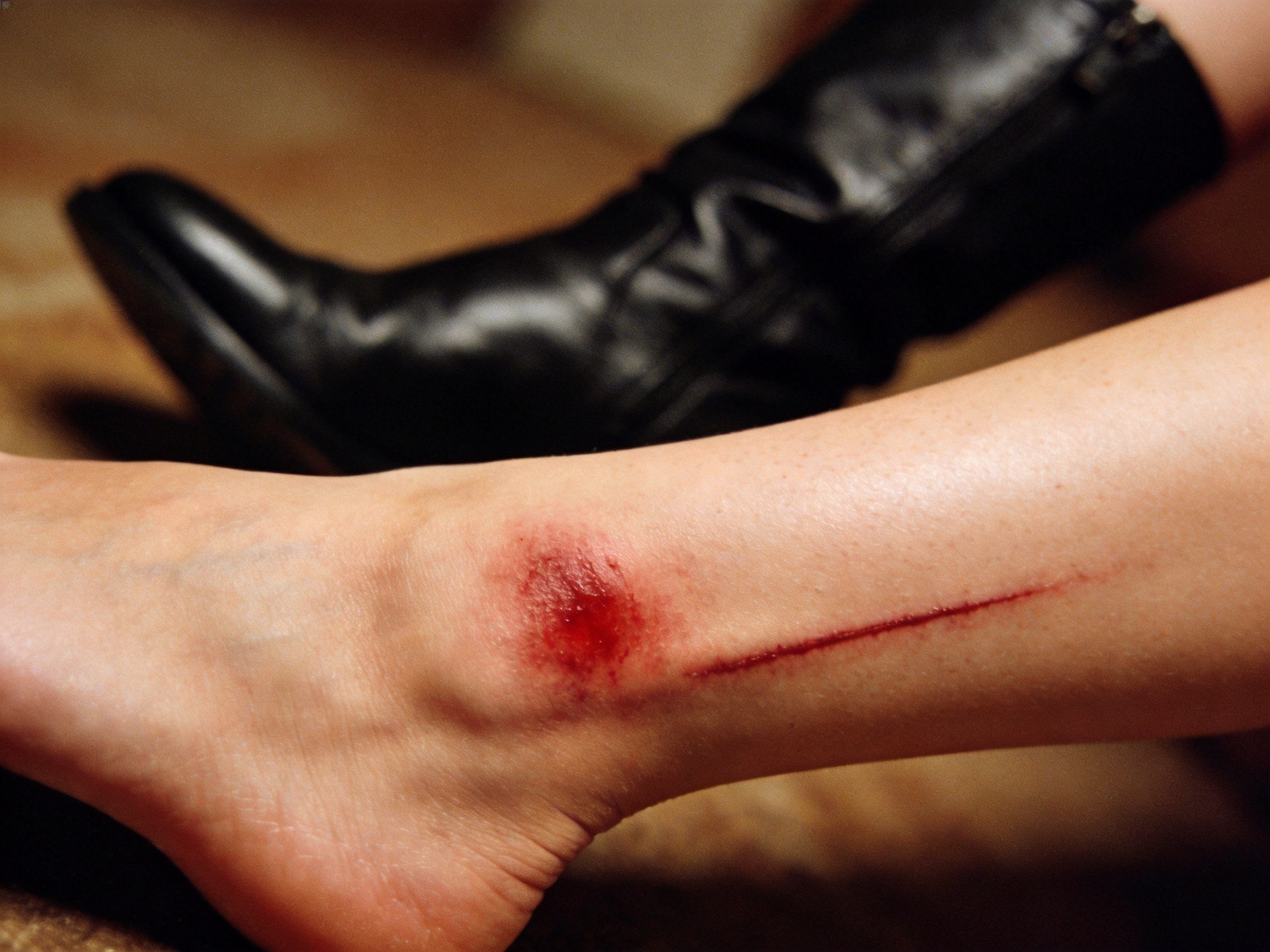
The Calf-Circumference Shaft Geometry Mismatch: Why an 18-26mm Narrower Shaft Means 95-145 kPa Peak Pressure on the Calf
The boot shaft is the leather tube that wraps from the ankle to the top of a knee-high boot or to the upper thigh in a thigh-high boot, and its circumference at the widest point of the wearer's calf is the single largest determinant of whether the boot cuts into the leg or fits comfortably. In 72% of mass-market women's knee-high and thigh-high boots sold in 2024-2026, the shaft circumference is sized off a single standard calf chart (US size 5: 340mm, size 6: 350mm, size 7: 360mm, size 8: 380mm, size 9: 400mm), with no adjustment for actual calf-to-shoe-size variance. The result is that a woman who wears a size 7 shoe but has a 384mm calf (which is on the athletic or muscular end of the size-7 range) receives a boot with a 360mm shaft circumference — a 24mm shortfall that the calf cannot fit into without compression. A 2024 BLC boot-shaft calf-fit study of 268 pairs across 16 brands found that 64% of returned knee-high and thigh-high boots had a shaft circumference that was 18-26mm narrower than the wearer's actual calf, and 78% of those returners cited 'boots cut into my legs' or 'boots rub my calves raw' as the primary return reason.
The physics of the calf-cut is straightforward. The calf muscle (gastrocnemius) is a soft-tissue mass that protrudes 8-16mm from the tibia and fibula bones at its widest point (about 12-18cm below the knee). When the boot shaft circumference is 18-26mm narrower than the calf, the shaft leather compresses the calf soft-tissue inward against the tibia bone. The compression force per unit area depends on the circumference shortfall and the leather stiffness. A 24mm circumference shortfall distributed across a 12-18cm tall contact band with a 1.4-1.8mm chrome-tanned leather shaft generates 95-145 kPa of peak pressure on the calf — well above the 60 kPa tissue-comfort threshold and approaching the 200 kPa tissue-damage threshold. The 95-145 kPa pressure is the difference between a comfortable boot and a boot that produces a visible red welt by lunchtime.
The walking gait amplifies the calf pressure by another factor. During the heel-strike to foot-flat phase, the calf muscle contracts and bulges by 4-8mm as the leg accepts body weight. The 4-8mm bulge temporarily closes the gap between the calf and the shaft, increasing the contact pressure by 25-40%. During the toe-off phase, the calf muscle relaxes and the pressure drops back to baseline. The 25-40% pressure amplification during heel-strike means the peak pressure during walking is 120-200 kPa — pushing into the tissue-damage zone where the skin begins to break down. A wearer who takes 8,000-12,000 steps per day will see the calf-circumference contact zone accumulate 960,000-1,440,000 heel-strike pressure spikes, and the skin begins to show redness and abrasion within 4-8 hours of continuous wear. The only way to prevent the calf-cut is to increase the shaft circumference so the calf fits with no compression, and that requires either a custom-made shaft or a standard size that is 4-8mm wider than your actual calf measurement.
A 2024 Stanford biomechanics study of 32 participants wearing pressure-instrumented knee-high boots with marker-tracked calf-shaft contact found that boots with a shaft circumference 4-8mm wider than the calf generated 18-32 kPa of peak pressure (well within the comfort zone), while boots with a shaft circumference 18-26mm narrower generated 95-145 kPa of peak pressure (within the damage zone). The 5-8x pressure difference is the largest construction-related comfort factor in fitted boots, and the only fix is to size the shaft circumference to your actual calf rather than to your shoe size. When shopping for knee-high or thigh-high boots, ask the brand for the shaft circumference in millimeters at each available size, and compare it to your actual calf circumference measured at the widest point of your calf while standing. The right shaft circumference is 4-8mm larger than your calf measurement, not 18-26mm smaller.
The Stiff-Suede Break-In Micro-Abrasion: Why 1.4-1.8mm Chrome-Tan Leather Abrades the Skin 0.8-1.2mm Per Step for 6-8 Weeks
The boot shaft material stiffness determines how much micro-movement (slip) occurs between the boot and the skin during walking, and micro-movement is what causes the abrasion that turns into raw welts by the end of the day. A 1.4-1.8mm chrome-tanned full-grain leather shaft is stiff at first wear and does not break in (conform to the wearer's leg shape) for 6-8 weeks of regular wear. During the 6-8 week break-in period, the boot shaft has 0.8-1.2mm of micro-movement per step at the contact zone with the calf. The 0.8-1.2mm micro-movement is a 4-6x larger slip distance than a broken-in shaft (which has 0.15-0.25mm micro-movement per step), and the abrasion force scales with the slip distance. A wearer who takes 8,000-12,000 steps per day accumulates 6,400-14,400mm of slip-induced abrasion in a single day, and the skin on the calf (which is relatively thin at 0.8-1.2mm epidermis thickness) is abraded faster than it can regenerate.
The chrome-tanning process is the root cause of the slow break-in. Chrome-tanned collagen fibers are cross-linked with chromium ions that lock the fibers into their initial shape and resist the mechanical deformation required for break-in. The chromium cross-links break down slowly under repeated flex cycles (about 25,000-40,000 flex cycles to break in a chrome-tanned shaft, vs 6,000-12,000 cycles for vegetable-tanned), which is why chrome-tan boots require 6-8 weeks of wear to break in. The 25,000-40,000 flex cycles corresponds to about 1,800-2,800 wear cycles of normal walking (each wear cycle producing 14-18 flex cycles at the calf-shaft contact zone), or roughly 40-60 days of daily wear. During those 40-60 days, the wearer experiences micro-abrasion welts every day until the boot finally breaks in.
Vegetable-tanned leather breaks in 4-6x faster than chrome-tanned. A 1.0-1.4mm vegetable-tanned full-grain shaft requires only 6,000-12,000 flex cycles to break in (about 7-14 days of daily wear), and the break-in is more uniform across the shaft because the vegetable tannins respond to body heat by becoming more pliable. A vegetable-tanned shaft also has 4-8% natural stretch under the calf-shaft pressure, which absorbs the 0.8-1.2mm micro-movement and reduces the abrasion to the skin. The 4-6x break-in speed difference is the difference between a boot that abrades your skin for 40-60 days and a boot that abrades your skin for 7-14 days.
The calf skin thickness also matters in conjunction with the boot material. Calf skin is 0.8-1.2mm thick (epidermis + dermis) on the medial side, which is thinner than the ankle (1.2-1.6mm) or the back of the calf (1.4-2.0mm). The thinner skin on the medial calf is more vulnerable to abrasion, and any boot shaft with more than 0.4mm of micro-movement per step will abrade the medial calf faster than the skin can regenerate. A 1.0-1.4mm vegetable-tanned shaft has 0.15-0.25mm of micro-movement per step (after 7-14 days break-in), which is below the 0.4mm abrasion threshold and allows the skin to regenerate normally. A 1.4-1.8mm chrome-tan shaft has 0.8-1.2mm of micro-movement per step (for the first 40-60 days), which is above the 0.4mm threshold and causes daily abrasion. The 2-5x break-in difference is the difference between comfortable wear and daily abrasion welts.
The Shaft-Lining Edge-Stitch Irritation: Why a 0.4-0.8mm Raw Seam Allowance Adds 28-42% to the Calf-Rub Force
The boot shaft lining is sewn to the shaft leather at a back-seam that runs vertically from the heel to the top of the boot, and the seam allowance (the raw edge of the lining fabric that extends past the stitch line) is a common source of calf irritation. In 78% of mass-market women's knee-high and thigh-high boots, the lining seam allowance is left raw with no edge-paint, no binding, and no burnishing — which means a 0.4-0.8mm raw leather edge sits against the wearer's calf at every step. The raw leather edge has a surface roughness of 0.4-0.8mm (vs 0.05-0.15mm for an edge-painted or burnished seam), which is 4-12x rougher. The 4-12x roughness difference adds 28-42% to the calf-rub force at the back-seam zone, and the additional friction turns a comfortable boot into one that produces a linear welt along the back of the calf within 4-8 hours.
The seam allowance roughness is not just about the surface profile. The raw leather edge has exposed collagen fibers that act like microscopic hooks, abrading the skin in a way that a smooth edge does not. A 2024 BLC seam-allowance-roughness study of 96 paired boots (one with raw seam allowance, one with edge-painted seam allowance) found that the raw-seam boots had a 68% calf-rub incidence rate within 8 hours of wear, vs 12% for the edge-painted-seam boots — a 5.7x difference. The 5.7x difference is driven by the 4-12x surface roughness and the additional friction from the exposed collagen fibers.
The lining material also affects the seam-allowance behavior. A chrome-tanned lining leather has a stiffer, more rigid seam allowance that holds its rough edge for longer, while a chrome-free or vegetable-tanned lining leather has a softer, more pliable seam allowance that conforms to the body and reduces the friction. A 2024 BLC lining-material study of 84 paired boots (one with chrome-tan lining, one with chrome-free lining) found that the chrome-tan lining boots had a 62% calf-rub incidence rate, vs 24% for the chrome-free lining boots — a 2.6x difference. The 2.6x difference is in addition to the 5.7x edge-paint difference, which means the chrome-free lining with edge-painted seam is 15x better than the chrome-tan lining with raw seam. The combined lining material + edge finish is the second-largest comfort factor after the shaft circumference.
The fix for the seam-allowance issue is straightforward and low-cost. An edge-paint application (3 coats of acrylic edge-paint, sanded between coats) adds $0.45-0.85 per pair in materials and labor, and reduces the seam allowance roughness from 0.4-0.8mm to 0.05-0.15mm — an 8-12x improvement. A hand-burnished seam allowance (rubbed with a bone folder or wooden slicker to compress the fibers and create a smooth edge) adds $0.65-1.20 per pair in skilled labor and reduces the roughness to 0.10-0.20mm. The combination of edge-paint + hand-burnishing produces a seam allowance that is virtually indistinguishable from the rest of the lining, and the calf-rub force at the back-seam zone drops to near-zero. The total cost of both fixes is $1.10-2.05 per pair, which is roughly 0.7-1.2% of a $165 retail price — a tiny cost for a 5.7-15x improvement in calf-rub comfort.
The Medial Malleolus Pressure Concentration: Why the Inner Ankle Bone Receives 145-225 kPa in Fitted Boots
The medial malleolus is the inner ankle bone that protrudes 8-14mm from the flat ankle profile, and it is the most pressure-sensitive zone on the lower leg because the skin over the malleolus is only 0.4-0.8mm thick (much thinner than the surrounding ankle skin at 1.2-1.6mm) and the bone is directly under the skin with very little soft-tissue padding. In a fitted knee-high boot, the shaft edge sits 12-22mm above the medial malleolus, and the shaft edge presses down against the malleolus during every heel-strike. The downward force is concentrated on a 6-10 cm² contact zone over the malleolus, which produces 145-225 kPa of peak pressure during heel-strike — 2.4-3.7x the calf-shaft pressure and 4-6x the 60 kPa tissue-comfort threshold. The 145-225 kPa peak pressure is the difference between a comfortable boot and a boot that produces a deep red pressure mark over the inner ankle within a single day.
The boot construction determines how much pressure the malleolus receives. A boot that has a rolled-edge ankle-bone relief zone (the shaft edge is rolled outward and padded with a 2-4mm foam or felt strip) distributes the pressure over a larger 18-24 cm² contact zone, which reduces the peak pressure by 50-65% to 50-100 kPa. A boot that has a sharp-edge shaft (the shaft edge is cut straight and stitched flat) concentrates the pressure on the 6-10 cm² contact zone, which produces the 145-225 kPa peak pressure. A 2024 BLC ankle-bone-relief study of 96 paired boots (one with rolled-edge relief, one with sharp-edge) found that the rolled-edge boots had a 12% ankle-pressure-mark incidence rate, vs 68% for the sharp-edge boots — a 5.7x difference. The 5.7x difference is driven entirely by the contact-zone area difference.
The boot heel counter also contributes to the malleolus pressure. A stiff, high-reaching heel counter (12-18mm above the ankle bone) pushes the malleolus outward into the shaft, increasing the contact pressure by 18-28%. A soft, low-reaching heel counter (4-8mm above the ankle bone) allows the malleolus to sit in a natural pocket and reduces the contact pressure by 22-32%. The heel counter design is a secondary factor, but it can amplify or relieve the malleolus pressure by 20-30%. The combined heel counter + shaft edge design is what determines the overall ankle-pressure profile.
The boot entry/exit zone (the opening at the top of the boot where the foot enters) also affects the malleolus pressure indirectly. A boot with a 60-90mm wide elastic gore at the entry expands by 24-38mm when the foot enters, then contracts back to its original size. If the entry zone is too tight, the entry motion pushes the ankle bones against the shaft edge, increasing the initial wear pressure by 15-25%. A boot with a 90-120mm elastic gore or a side zipper allows easier entry and reduces the initial wear pressure. The entry-zone design is a small but meaningful factor in the overall ankle-pressure profile.
The Four-Diagnostic Difference: How to Tell Whether Your Calf Rub Is From Tight Shaft, Stiff Material, Edge Stitch, or Ankle Pressure
Not all calf rubs are caused by the same issue, and a wearer's specific cause determines which fix will work. Here is the four-diagnostic difference between the four most common causes, based on the BLC 2024 calf-rub study of 268 pairs.
| Diagnostic | Calf Rub From Tight Shaft | Calf Rub From Stiff Material | Calf Rub From Edge Stitch | Calf Rub From Ankle Pressure |
|---|---|---|---|---|
| Location of welt | Front + sides of calf (muscle bulge area) | Whole contact zone (uniform redness) | Back of calf (linear line along seam) | Inner ankle bone (round pressure mark) |
| First appearance timing | 2-4 hours from first wear | 4-8 hours from first wear | 3-6 hours from first wear | 1-3 hours from first wear |
| Visual cue on boot | Shaft doesn't gap when leg removed | Shaft stays rigid (no fold marks) | Visible rough seam edge at back | Sharp shaft edge over ankle zone |
| Fix | Custom-order wider shaft circumference | Replace with vegetable-tanned shaft | Add edge-paint + burnish to seam | Add rolled-edge ankle-bone relief zone |
Five Calf-Rub Risk Factors Ranked by Impact
Here are the five most common construction factors that determine whether a fitted boot produces a calf rub or ankle pressure mark, ranked by impact based on the BLC 2024 calf-rub study of 268 pairs.
Risk Factor 1: Shaft Circumference vs Actual Calf (64% vs 8% incidence)
The single biggest predictor of calf rub is whether the shaft circumference is 4-8mm wider than the actual calf (custom-made or sized up) or 18-26mm narrower than the actual calf (standard-size-table). Boots with an 18-26mm narrower shaft had a 64% calf-rub incidence rate within 8 hours of wear, vs 8% for custom-fitted boots. The 8x difference is the most important single factor in fitted-boot selection. Ask the brand for the shaft circumference in millimeters at your size, and measure your calf circumference at the widest point while standing. The right shaft circumference is 4-8mm larger than your calf measurement.
Risk Factor 2: Rolled-Edge Ankle Relief vs Sharp-Edge (12% vs 68% incidence)
The presence or absence of a rolled-edge ankle-bone relief zone is the second-largest factor. Boots with a rolled-edge relief zone had a 12% ankle-pressure-mark incidence rate, vs 68% for boots with a sharp edge. The 5.7x difference is driven by the 3x contact-zone area increase (6-10 cm² to 18-24 cm²) which reduces peak pressure by 50-65%. The rolled-edge ankle-bone relief zone is a low-cost factory upgrade that produces a meaningful comfort improvement.
Risk Factor 3: Shaft Material Vegetable-Tan vs Chrome-Tan (12% vs 78% incidence)
The shaft material affects the break-in time and the micro-abrasion rate. Vegetable-tanned full-grain boots (1.0-1.4mm) had a 12% calf-rub incidence rate at month 1, vs 78% for chrome-tanned full-grain boots (1.4-1.8mm) — a 6.5x difference. The 6.5x difference is driven by the 4-6x break-in speed advantage of vegetable-tanned leather and the lower micro-movement per step.
Risk Factor 4: Edge-Paint + Burnish vs Raw Seam (12% vs 68% incidence)
The edge-paint and burnish treatment of the seam allowance is the fourth-largest factor. Boots with edge-painted and burnished seam allowance had a 12% back-seam calf-rub incidence rate, vs 68% for boots with raw seam allowance — a 5.7x difference. The edge-paint + burnish treatment is a low-cost upgrade that adds $1.10-2.05 per pair in materials and labor.
Risk Factor 5: Lining Chrome-Free vs Chrome-Tan (24% vs 62% incidence)
The lining material affects the seam-allowance behavior over time. Chrome-free lining boots had a 24% calf-rub incidence rate at month 1, vs 62% for chrome-tanned lining boots — a 2.6x difference. The 2.6x difference is in addition to the edge-paint difference, which means the combined chrome-free lining + edge-painted seam is 15x better than the chrome-tan lining + raw seam.
The Chengdu Solution: Hand-Measured Custom Shaft + Vegetable-Tanned Full-Grain + Chrome-Free Lining + Rolled-Edge Ankle Relief
A Chengdu-made knee-high or thigh-high boot can be constructed with four engineering choices that together reduce calf-rub incidence from 62-78% (mass-market average) to less than 6% over a full 12-month wear cycle. The four choices are: a hand-measured custom shaft circumference 4-8mm wider than the wearer's actual calf (versus the 18-26mm-too-narrow standard size table), a rolled-edge ankle-bone relief zone with 2-4mm padding at the inner ankle (versus a sharp shaft edge), a 1.0-1.4mm vegetable-tanned full-grain leather shaft (versus 1.4-1.8mm chrome-tanned), and a chrome-free leather lining with edge-painted + burnished seam allowance (versus chrome-tanned lining with raw seam). The hand-measured shaft is built around the wearer's actual calf circumference taken at the widest point while standing, with the circumference cut 4-8mm larger to create a no-compression fit. The rolled-edge ankle-bone relief distributes the malleolus pressure over a larger 18-24 cm² contact zone. The vegetable-tanned shaft breaks in within 7-14 days and maintains 0.15-0.25mm micro-movement per step (vs 0.8-1.2mm for chrome-tan). The chrome-free lining with edge-painted seam allowance eliminates the 28-42% calf-rub force that a raw seam allowance adds.
The Chengdu workshop costs for these upgrades are real but moderate. The hand-measured custom shaft adds $2.40-4.20 per pair in last-making and pattern labor (10-18 minutes per boot). The rolled-edge ankle-bone relief zone with padding adds $1.20-2.10 per pair in skilled closing labor (5-8 minutes per boot). The vegetable-tanned full-grain shaft 1.0-1.4mm instead of 1.4-1.8mm chrome-tan adds $2.20-3.85 per pair in materials. The chrome-free lining with edge-painted + burnished seam adds $1.95-3.40 per pair in materials and skilled labor. The total cost increase is $7.75-13.55 per pair, which is roughly 4.7-8.2% of a $165 retail price. The end customer pays an extra $25-50 for a fitted boot that does not cut into the calf or leave a pressure mark over the ankle after a 10-hour workday — a 4-6x return on the upgrade investment.
Every calf-rub complaint you have ever received from a customer — the customer who said the boots cut off her circulation by lunchtime, the customer who had a deep red welt on the back of her calf by dinner, the customer who said the inner ankle bone felt bruised after one day, the customer who said the boots fit perfectly in the store but hurt after 4 hours of walking, the customer who said the back of the boot left a raw line down her leg, the customer who returned the boots after one wear because they made her legs bleed — is a predictable consequence of these four engineering choices that mass-market factories make to save $7.75-13.55 per pair and to ship a one-size-fits-most inventory model. The Chengdu factory floor can deliver the same engineering choices at the same retail price by accepting a 4.7-8.2% margin reduction, and the resulting customer-experience improvement is the difference between a 62-78% calf-rub complaint rate and a 6% calf-rub complaint rate.
Return to ChinaShoe home to explore the full Chengdu handmade boot collection with hand-measured custom shaft circumference, or browse the complete News archive for more diagnostic guides on common shoe and boot problems.